

TL;DR: Over five years, generic minoxidil runs roughly $300 to $600, finasteride about $600 to $1,800, and combining both lands near $900 to $2,400. Laser therapy devices cost $400 to $3,000 upfront. A single hair transplant ranges from $4,000 to $20,000 and is usually a one-time expense. Almost none of this is covered by insurance.
Why does budgeting for hair loss treatment matter?
Hair loss treatment is not a one-time purchase. It's a subscription with a long tail. Stop using most medications and the hair you kept starts going again, usually within three to six months. That makes the five-year view the only honest way to compare options.
A lot of people buy a $30 bottle of minoxidil, get results, feel good, and never think about the math again. Then five years later they've spent $1,500 and still aren't done. Others save up for a transplant expecting it to fix everything forever. That's partly true, but they often still need medications afterward to protect the hair they didn't transplant.
Seeing the full cost up front helps you pick the right treatment instead of the cheapest-looking one on day one. Those are rarely the same thing.
What does minoxidil cost over 5 years?
Generic topical minoxidil 5% is one of the cheapest proven treatments you can buy. A one-month supply of the generic foam or solution runs about $5 to $10 at major retailers or online pharmacies. That puts the five-year cost at roughly $300 to $600 depending on your source and whether you dose once or twice daily [1].
Brand-name Rogaine costs more, around $25 to $40 per month, which works out to $1,500 to $2,400 over five years. There's no clinical evidence the branded version works better than generic minoxidil at the same concentration. Paying the premium buys you packaging, nothing else.
Oral minoxidil is a newer option prescribed off-label for hair loss. Generic oral minoxidil (0.25 mg to 2.5 mg daily) costs about $10 to $30 per month from compounding pharmacies or generic tablet sources, so $600 to $1,800 over five years. You need a prescription and periodic blood pressure monitoring, which adds a small medical cost.
One thing worth knowing: minoxidil requires continuous use. The FDA-approved label states that hair loss returns to baseline within a few months of stopping [1]. So the five-year number is really just the beginning if the drug works for you.
For a deeper look at how topical minoxidil works and what to expect, see our guide to minoxidil for men. If you're weighing the side effect risk before committing to years of use, minoxidil side effects covers what the clinical data actually shows.
| Minoxidil option | Monthly cost | 5-year cost |
|---|---|---|
| Generic topical 5% | $5-$10 | $300-$600 |
| Brand Rogaine | $25-$40 | $1,500-$2,400 |
| Oral minoxidil (generic) | $10-$30 | $600-$1,800 |
What does finasteride cost over 5 years?
Generic finasteride 1 mg is the other major FDA-approved option for male-pattern hair loss [3]. At most online pharmacies and big-box pharmacies, a 30-day supply of generic finasteride runs $10 to $30 per month. Over five years that's $600 to $1,800.
Brand-name Propecia is the same molecule at the same dose. It cost over $80 per month before generic competition made it largely irrelevant to the cost conversation. Nobody has a good reason to pay that premium anymore.
Dermatologists sometimes prescribe finasteride 5 mg (the prostate dose) and instruct patients to cut the tablets into quarters, which can drop the monthly cost below $5. That approach is common, though the way the drug distributes across a split tablet isn't perfectly even. Talk to your doctor before doing it.
Finasteride is not FDA-approved for women and carries a pregnancy risk warning. Women with hair loss have different options, and the cost math looks different.
For context on how finasteride works as a DHT blocker, including what it does and doesn't do, that article is worth reading before you commit. If you're considering both drugs together, the finasteride and minoxidil combination guide walks through the evidence and the added cost.
| Finasteride option | Monthly cost | 5-year cost |
|---|---|---|
| Generic 1 mg | $10-$30 | $600-$1,800 |
| Brand Propecia | ~$80+ | $4,800+ |
| Finasteride 5 mg split (Rx) | $3-$8 | $180-$480 |
What's the 5-year cost of combining minoxidil and finasteride?
Most dermatologists treating androgenetic alopecia recommend the combination over either drug alone. A randomized study published in Dermatologic Therapy found the combination produced greater hair count increases than either drug used by itself [4]. The American Academy of Dermatology guidelines also list combination therapy as a first-line approach for men with pattern hair loss.
Stack the cheapest versions of each. Generic topical minoxidil ($300 to $600 over five years) plus generic finasteride ($600 to $1,800) gives you a combined five-year spend of $900 to $2,400. That's still less than one PRP course and a fraction of a transplant.
Some telehealth companies bundle both into a single compounded product, usually a minoxidil/finasteride topical solution, for $50 to $80 per month. That works out to $3,000 to $4,800 over five years. Convenient, but more expensive than buying them separately as generics. The convenience is worth it for some people. If cost is your main driver, the math says buy the two generics on their own.
The combination also needs ongoing monitoring: at minimum an annual check-in with a prescriber for finasteride, which might cost $50 to $150 per visit if you're paying out of pocket.
How much does a hair transplant cost, and is it really a one-time expense?
A hair transplant is the largest single expense in hair loss care. In the United States, the cost ranges from $4,000 to $20,000 depending on the number of grafts, the technique, and where the clinic sits geographically [6]. The International Society of Hair Restoration Surgery reported a global average near $8,000 to $10,000 per FUE procedure in its 2022 practice census [6].
FUT (follicular unit transplantation, also called strip surgery) runs slightly cheaper per graft, roughly $3 to $7. FUE (follicular unit excision) runs $5 to $12 per graft. A typical session covers 1,500 to 3,000 grafts, so the total climbs fast.
Is it a one-time expense? Mostly. The transplanted follicles come from the back of the scalp, resist DHT, and generally survive for life. But native hair in other zones keeps thinning if you stop medications. Plenty of patients need a second session five to ten years later to address new thinning, especially those who started young. Budget for that possibility.
The procedure also carries post-op costs: prescription antibiotics, special shampoos, and follow-up visits, usually adding $200 to $500.
For a full breakdown of what's involved, our hair transplant guide covers technique differences, realistic outcomes, and what to ask a surgeon before you write the check.
| Procedure | Cost per graft | Typical grafts | Total range |
|---|---|---|---|
| FUT (strip) | $3-$7 | 1,500-3,500 | $4,500-$24,500 |
| FUE | $5-$12 | 1,500-3,000 | $7,500-$36,000 |
| Combination FUT+FUE | $4-$10 | 2,000-4,000 | $8,000-$40,000 |
What does PRP therapy cost over 5 years?
Platelet-rich plasma (PRP) therapy means drawing your blood, spinning it in a centrifuge to concentrate the platelets, then injecting it into the scalp. Many dermatology and hair loss clinics offer it. A single session typically costs $500 to $1,500. Most protocols call for three initial sessions spaced four to six weeks apart, then maintenance sessions every three to six months.
Run the numbers. Three sessions upfront ($1,500 to $4,500) plus two to four maintenance sessions per year ($1,000 to $6,000 annually) adds up to $5,500 to $28,500 over five years. That's a wide range because pricing swings hard by market.
The evidence base is weaker than for minoxidil or finasteride. A meta-analysis in the Journal of the American Academy of Dermatology found PRP improved hair density in androgenetic alopecia but noted the studies were small, mixed in design, and at high risk of bias [7]. PRP is not FDA-approved for hair loss, and there's no standardized protocol, so quality across clinics varies a lot.
Honest take: PRP might be worth trying if you can't tolerate medications. Per dollar of evidence, though, it's the most expensive path on this list.
What do laser devices cost, and do they work?
Low-level laser therapy (LLLT) devices, sold as laser combs, laser caps, and laser helmets, are FDA-cleared for hair loss. Clearance means the FDA judged them safe with some efficacy signal, which is a lower bar than the approval a drug goes through [12]. They range from $200 for a basic laser comb to $3,000 or more for a laser helmet from brands like Capillus or iRestore.
The claimed mechanism is photobiomodulation, stimulating follicles with specific light wavelengths. A randomized controlled trial in the American Journal of Clinical Dermatology found a 26-beam laser device produced statistically significant increases in hair density versus a sham device over 26 weeks [8]. The effect sizes were modest.
For budgeting, the device is a one-time cost with no ongoing supply expense. Call it $500 to $3,000 across five years total, which compares well against PRP. But the evidence isn't strong enough for most dermatologists to recommend it first-line. Treat it as an add-on.
Maintenance costs stay near zero beyond electricity and the occasional replacement part.
What about supplements, shampoos, and other over-the-counter products?
This category runs from reasonable to outright waste depending on the specific product.
Biotin supplements get heavy marketing for hair loss but have no solid evidence of benefit in people who aren't biotin-deficient, and true deficiency is rare. Spending $10 to $20 per month on biotin is $600 to $1,200 over five years with little to show for it.
Ketoconazole 2% shampoo (prescription in the US, available OTC in some countries) has modest evidence as an add-on to minoxidil, partly because it cuts scalp DHT and inflammation. Generic versions run $10 to $20 per month. Used a few times a week rather than daily, one bottle lasts longer, so the real cost lands closer to $5 to $10 per month.
Finasteride works. Minoxidil works. Most supplements marketed for hair loss have thin or no evidence and can cost $50 to $100 per month. For a frank look at what the supplement data actually shows, the hair loss supplements article is worth your time before spending money there.
Hair fibers (Toppik, Caboki) are cosmetic concealers, not treatments. They cost $20 to $35 per bottle and last two to four weeks depending on how much you use. Over five years: $1,200 to $2,100. Not a treatment, but a fair cosmetic expense if you want coverage while treatments take hold.
Does health insurance cover hair loss treatment?
Almost never. Know this before you build a budget.
Most private health insurers classify androgenetic alopecia (male- and female-pattern hair loss) as cosmetic. Minoxidil, finasteride for hair loss, PRP, and hair transplants are typically excluded. You pay out of pocket.
Exceptions are narrow. Finasteride prescribed for an enlarged prostate (BPH) may be covered because that's an FDA-approved medical indication. If a dermatologist can document hair loss as part of a medical condition (like alopecia areata, lupus, or chemotherapy-related loss), some insurers may cover certain treatments. That requires specific diagnosis codes and prior authorization, and it's never guaranteed.
Flexible Spending Accounts (FSAs) and Health Savings Accounts (HSAs) can sometimes cover prescription hair loss treatments (finasteride, prescription minoxidil). OTC minoxidil became FSA/HSA eligible without a prescription under the CARES Act of 2020 [11]. Cosmetic procedures generally stay out. Check with your plan administrator. IRS Publication 502 lists which medical expenses qualify [9].
On taxes: hair loss treatments are not deductible for most people. The medical expense deduction only applies to unreimbursed medical costs above 7.5% of adjusted gross income, a threshold set by the Tax Cuts and Jobs Act of 2017 [10]. Cosmetic hair procedures don't count toward that total in the first place.
What is the realistic 5-year total cost by treatment path?
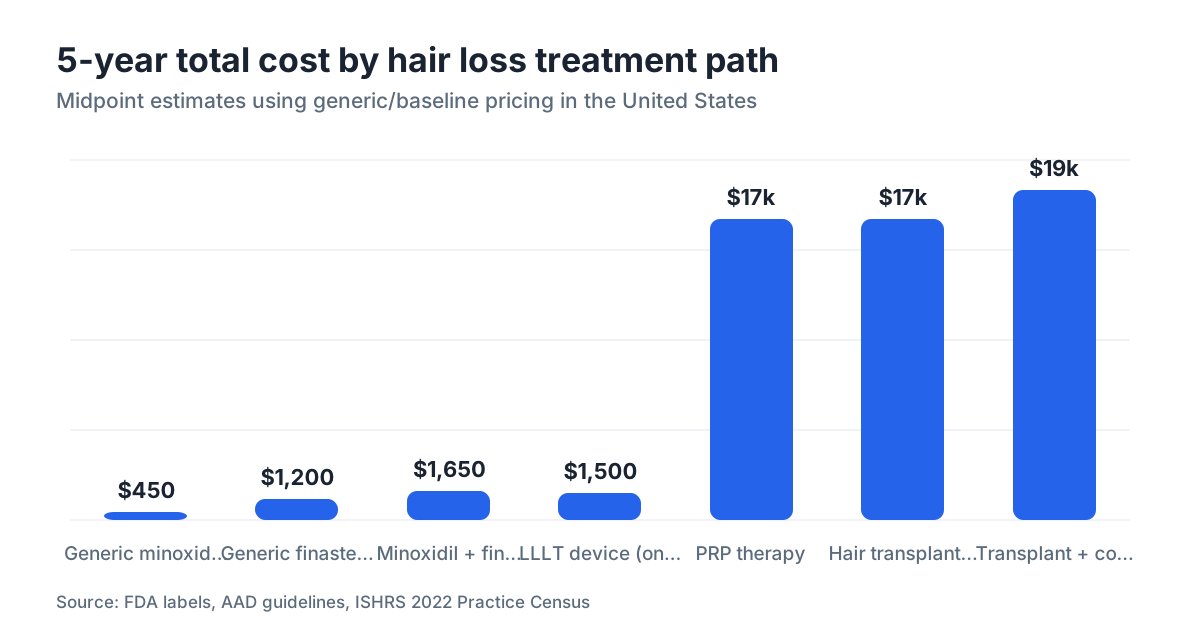
Here's where everything lands. These are real numbers, not aspirational ones, based on midpoints of the ranges above.
| Treatment path | 5-year cost estimate | Notes |
|---|---|---|
| Generic topical minoxidil only | $300-$600 | OTC, no Rx needed |
| Generic finasteride only | $600-$1,800 | Rx required, men only |
| Generic minoxidil + finasteride | $900-$2,400 | First-line combination |
| Oral minoxidil (generic) | $600-$1,800 | Rx, off-label |
| LLLT device | $500-$3,000 | One-time purchase |
| PRP (3 initial + 2x/year maintenance) | $5,500-$28,500 | Wide cost variance |
| Hair transplant (FUE, 2,000 grafts) | $10,000-$24,000 | Often one-time, may still need meds |
| Hair transplant + ongoing meds | $10,900-$26,400 | Most realistic post-transplant budget |
| Supplements + shampoos (OTC) | $1,200-$4,200 | Low evidence |
Early in your hair loss (Norwood 2 to 3, a receding hairline rather than heavy diffuse loss), medications are almost always the right financial starting point. The cost is low, the evidence is strong, and you keep your surgical options open. If you've reached Norwood 5 to 6 and want a real cosmetic change, a transplant makes economic sense as a one-time investment, paired with medications to protect the hair you still have.
Before you decide where you sit on that spectrum, a structured assessment helps. MyHairline's free AI scan at myhairline.ai/scan gives you an objective read on your current Norwood stage and pattern, which tells you where your money should go first.
For more on how hair loss patterns develop over time, the receding hairline guide explains Norwood staging in plain terms.
What are the hidden costs people forget to budget for?
Telehealth subscriptions. If you get finasteride or oral minoxidil through a telehealth platform, you often pay a monthly membership fee on top of the drug cost, usually $20 to $40 per month. That's $1,200 to $2,400 over five years. Fine if the convenience earns it, but count it.
Dermatologist visits. Go the traditional route and expect $150 to $350 per visit without insurance. Even two visits a year adds $1,500 to $3,500 over five years.
Blood tests. Finasteride can affect PSA levels. Oral minoxidil calls for blood pressure monitoring and sometimes kidney function checks. Basic lab panels run $30 to $150 per draw depending on where you go.
Switching costs. A lot of people try minoxidil for three months, don't see dramatic results (expected, since meaningful growth takes six to twelve months), quit, try a supplement, quit that, then start over. Every restart resets the clock and burns the money already spent.
Anxiety and decision fatigue. Not a dollar cost, but real. People sink hours into researching products with no evidence base when the data points to a short list of options. Knowing the cost comparison up front, like you do now, cuts that cycle short.
For context on what might be driving your hair loss before you spend anything, what causes hair loss covers the full picture, including conditions like telogen effluvium that don't need long-term treatment at all.
How should you decide where to start spending?
Start with a diagnosis, not a product. A lot of hair loss spending goes to the wrong treatment because people self-diagnose incorrectly. Telogen effluvium resolves on its own. Alopecia areata doesn't respond to minoxidil the way pattern hair loss does. Spend years on the wrong treatment and you spend real money for nothing.
If you have male-pattern hair loss confirmed or strongly suspected, the evidence-based, cost-efficient path is generic finasteride plus generic topical minoxidil, bought separately as generics, with periodic dermatologist oversight. That runs under $50 a month in many cases and covers the two treatments with the strongest trial evidence.
Add a laser device if you want an add-on and can absorb the upfront cost. Skip PRP unless you've failed medications and want to try something before surgery.
Consider a transplant once your hair loss has stabilized, you're realistically past the medication window for the affected area, and you can pay the full cost without debt. Going into debt for a transplant is risky. Maintenance medications remain necessary, and results vary between patients.
Use MyHairline's free AI analysis (myhairline.ai/scan) to set your baseline before spending your first dollar. A photo-based Norwood assessment tells you whether you're fighting early-stage loss (where medications work well) or heavy loss (where you need to be realistic about what medications alone can do).
For more on combination therapy dermatologists actually prescribe, finasteride and oral minoxidil are good next reads.
Sources
- FDA, Minoxidil Topical Solution Drug Label (Rogaine)
- FDA, Finasteride 1mg Drug Label (Propecia)
- Randomized study of combination finasteride and minoxidil in androgenetic alopecia, Dermatologic Therapy
- International Society of Hair Restoration Surgery (ISHRS), 2022 Practice Census
- Meta-analysis of PRP for androgenetic alopecia, Journal of the American Academy of Dermatology
- Lanzafame RJ et al., LLLT randomized controlled trial in androgenetic alopecia, American Journal of Clinical Dermatology
- IRS Publication 502, Medical and Dental Expenses
- Tax Cuts and Jobs Act of 2017, P.L. 115-97
- CARES Act of 2020, P.L. 116-136
- FDA, 510(k) Premarket Notification Database