
TL;DR: The right hairline shape depends on your face shape, age, donor density, and how much hair you might still lose. Surgeons work from five templates: straight, rounded, M-shaped, widow's peak, and irregular. No single shape fits everyone. A transplanted hairline is permanent, so this one decision matters more than almost anything else in the procedure.
Why does hairline shape matter so much in a transplant?
The hairline design decides whether a transplant looks like hair or looks like surgery. Graft survival, technique, the surgeon's skill with the punch tool, all of that matters. But none of it saves you if the hairline sits in the wrong spot or has the wrong shape for your face.
Here's the problem. Once grafts take root and grow, undoing the design is very hard. You can't pull transplanted hairs back out the way you put them in. Laser hair removal can destroy grafts, but it's expensive, imprecise, and leaves the scalp looking patchy. So the design conversation before surgery isn't a formality. It's the whole ballgame.
Studies on patient satisfaction after transplants keep landing on the same finding: hairline design drives whether people are happy or full of regret [1]. A 2020 review in the Journal of Cutaneous and Aesthetic Surgery found that hairline irregularity, unnatural appearance, and wrong positioning were the most common complaints in revision cases [1]. Get it right the first time and you save money, months, and a lot of grief.
What are the main hairline shapes surgeons use?
Five shapes come up in surgical planning, and each has a specific job.
Straight hairline. A mostly flat line across the forehead with little recession at the corners. It looks natural on a small number of men and is more common in women. On most men, a dead-straight hairline reads as fake, because real adult hairlines almost never run flat. Good restoration surgeons talk men over 30 out of this.
Rounded hairline. A soft arc curving gently from temple to temple. This suits oval and long faces because the arc shortens how long the face looks. It reads young without looking designed.
M-shaped or mature hairline. Gentle recession at the temporal corners, producing a soft M silhouette. It's the most natural-looking option for most adult men, and here's the twist: nearly every man's hairline matures into some version of this by his mid-twenties, even with no hair loss at all [2]. Trying to rebuild the flat hairline of a 16-year-old on a 40-year-old man looks off, even when the surgery is flawless.
Widow's peak. A downward central point on the forehead. This is a genetic trait, not a design choice you pick off a menu. If you had a natural widow's peak before losing hair, rebuilding it makes sense. If you never had one, drawing one in looks strange and creates maintenance headaches, because the graft density has to taper fast around the point.
Irregular or feathered hairline. Less a shape than a technique layered onto any of the above. Natural hairlines aren't smooth curves. They have micro-irregularities: single-hair grafts scattered slightly ahead of the main line, small asymmetries, sentinel hairs. A feathered hairline uses single-follicle grafts at the very front edge placed in a slightly random pattern to copy that. Almost every good surgeon builds some irregularity into whatever primary shape they use [3].
Which hairline shape fits which face shape?
Face shape is the variable people obsess over, and for good reason. The hairline is the top frame of the face. Change the frame and the whole face reads differently.
| Face Shape | Key Characteristics | Recommended Hairline Style |
|---|---|---|
| Oval | Balanced proportions, forehead slightly wider than jaw | Rounded or gentle M-shape; most shapes work |
| Round | Wide cheeks, short forehead, soft jawline | Slight M-shape or central peak to add vertical length |
| Square | Strong jaw, broad forehead, similar width throughout | Rounded or softly curved to offset angular jaw |
| Rectangle / Oblong | Long face, high forehead, narrow cheeks | Straight-ish or rounded to reduce vertical length |
| Heart / Triangle | Wide forehead, narrow jaw | Rounded with softened temples; avoid strong widow's peak |
| Diamond | Narrow forehead and jaw, wide cheekbones | Slightly wider rounded line to broaden the forehead |
These are starting points, not laws. A surgeon who only asks your face shape and then reaches for a template isn't planning carefully. Real design also reads your existing hairline remnants, your natural growth direction, where your temporal points sit, and how much donor hair you have to spend [4].
Oval faces have the most room to move. Almost any shape looks proportionate on a balanced oval, which is why surgeons treat oval as the reference standard for facial proportion.
Round faces want the illusion of length. A soft central peak, or a slightly lower central point with higher temples, pulls the eye upward. Skip the flat straight hairline on a round face; it only advertises the width.
Square faces carry strong angles. A rounded hairline softens the silhouette. Pile on a hard M-shape or sharp temporal recession and the forehead starts to look boxy.
Rectangular faces already run long. A rounded design that sits a touch lower shortens the read. Don't recreate deep temporal recession on an oblong face; it just adds more length.
Heart-shaped faces have a wide forehead tapering to a pointed chin. The move is to soften the forehead width, not spotlight it. A rounded, centrally softer hairline works. Leave the temples alone.
Where should the hairline actually sit on the forehead?
Position and shape are two separate calls that have to work together. Nail the shape and botch the height, and it still looks wrong.
The classic rule puts the hairline about 7 to 8 centimeters above the glabella (the brow ridge between your eyebrows) for men, and roughly 5.5 to 6.5 centimeters for women [4]. But those are averages pulled from facial proportion studies, not targets to hit on everyone. A man with a naturally tall forehead who gets dropped to the textbook number ends up looking obviously placed.
A better anchor is anatomy you already have. Raise your eyebrows and a horizontal crease appears across your forehead. The hairline usually sits at or just above that crease. Many surgeons use it precisely because it's yours, not a population average.
Age is a heavy factor in height. Set a hairline very low on a 50-year-old and it looks frozen at 25 while the rest of the face has moved on. Most experienced surgeons add a few millimeters of height per decade past 35. That's judgment, not arithmetic, and it's one of the places surgeon experience shows most.
Height also has to answer to your future hair loss. Say you're 28 at a Norwood 2 and the surgeon plants the hairline at the Norwood 1 position. If loss keeps going and the native hair behind the transplant falls out, you're left with a lonely strip of grafts up front and a bald band behind it. That is one of the most common ways younger patients end up wrecked [1]. It's also why many surgeons ask patients to consider a DHT blocker like finasteride to stabilize loss before or alongside surgery.
How does age affect the right hairline design?
Age is the variable people underweight the most, especially men in their 20s chasing the hairline they had at 18.
A low, straight, full hairline looks fine on a 20-year-old, because he might actually own one. Put the same hairline on a 45-year-old and it reads as a hairpiece, even with perfect surgery. The reason is the rest of the face. Skin loses elasticity, the brow drops a little, the temples hollow out. Those changes make a youthful hairline placement look out of place.
This is where the mature hairline matters. Most men develop some natural temporal recession between ages 17 and 25 that isn't disease. It's just the adult version of the same hairline [2]. The American Academy of Dermatology draws a line between normal hairline maturation and androgenetic alopecia, and designing around that difference matters [5].
For men under 30, many surgeons won't transplant unless loss has clearly stabilized or the patient commits to medical therapy to slow future loss. That's not fussiness. Donor hair is a fixed supply. Burn a big chunk of it rebuilding a 25-year-old's hairline, then watch him lose more native hair behind it over ten years, and he can end up worse off overall. A modest, age-appropriate design keeps donor grafts in reserve for what's coming.
How does donor hair density limit hairline choices?
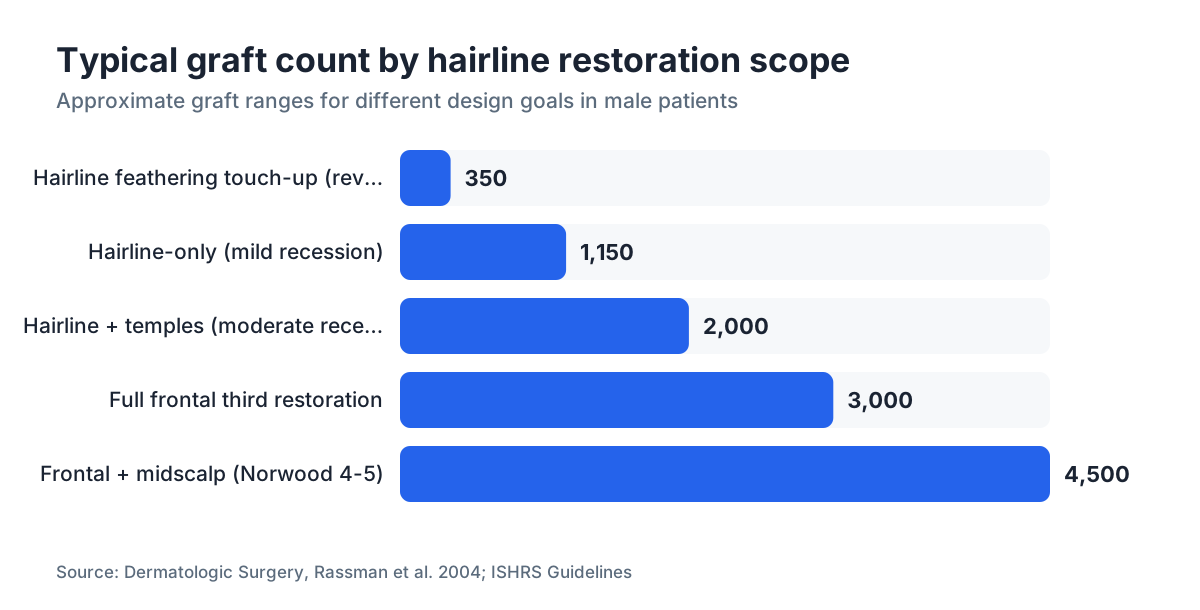
Every hairline design has a graft price tag. The lower and denser you want it, the more grafts it burns. Most patients have a fixed donor supply, usually somewhere between 4,000 and 8,000 extractable follicular units from the scalp, depending on hair caliber, density, and the size of the safe donor zone [6].
A clean hairline for a man with mild recession might run 800 to 1,500 grafts. A full hairline rebuild from Norwood 5 or 6 can easily eat 3,000 to 5,000 grafts for the frontal third alone. Add midscalp and crown coverage and the grafts have to be rationed. Shape and overall plan can't be separated.
Hair caliber matters too. Coarse, dark hair has more visual weight per graft than fine, light hair. Coarse hair means a fuller-looking hairline with fewer grafts. Very fine hair needs higher density for the same look, which drains the supply faster.
Donor density also drifts with ongoing loss. If a patient hasn't stabilized with medication, the donor zone itself can thin over time, shrinking what's available for future work. That's a strong practical reason to pair a transplant with finasteride or minoxidil for men to slow the bleed.
With a limited donor supply, a surgeon might steer you toward a slightly higher or narrower hairline than your ideal to protect grafts. Understand that trade before you sit in the chair. A natural conservative hairline beats an aggressive one that leaves your crown bare.
What's the difference between a hairline for men and one for women?
Men's and women's hairlines differ in several real ways, and the design has to answer all of them.
Start with position. Women's hairlines sit lower, averaging 5.5 to 6.5 centimeters above the brow versus 7 to 8 centimeters in men [4]. Women also tend to have a rounder, continuous hairline without the strong temporal recession that's normal in men.
The loss pattern differs too. Women with androgenetic alopecia usually thin diffusely across the top of the scalp rather than receding at the front like men. The Ludwig scale gets used for women, not Norwood [7]. Hairline transplants in women often address a naturally high forehead (forehead reduction) rather than recession from loss.
Shape expectations differ as well. For women, the goal in most cases is a slightly rounded, low, continuous line. Temporal recession looks wrong and is almost never rebuilt. Feathering at the front edge is even more important for women, because the hair framing the face gets studied more closely.
Women weighing a transplant should also rule out telogen effluvium and other non-androgenetic causes first. Transplanting into an active diffuse-loss condition can wreck graft survival.
How do surgeons actually plan and mark the hairline before surgery?
The pre-surgical marking session is where the design principles hit the scalp. Here's what a careful process looks like.
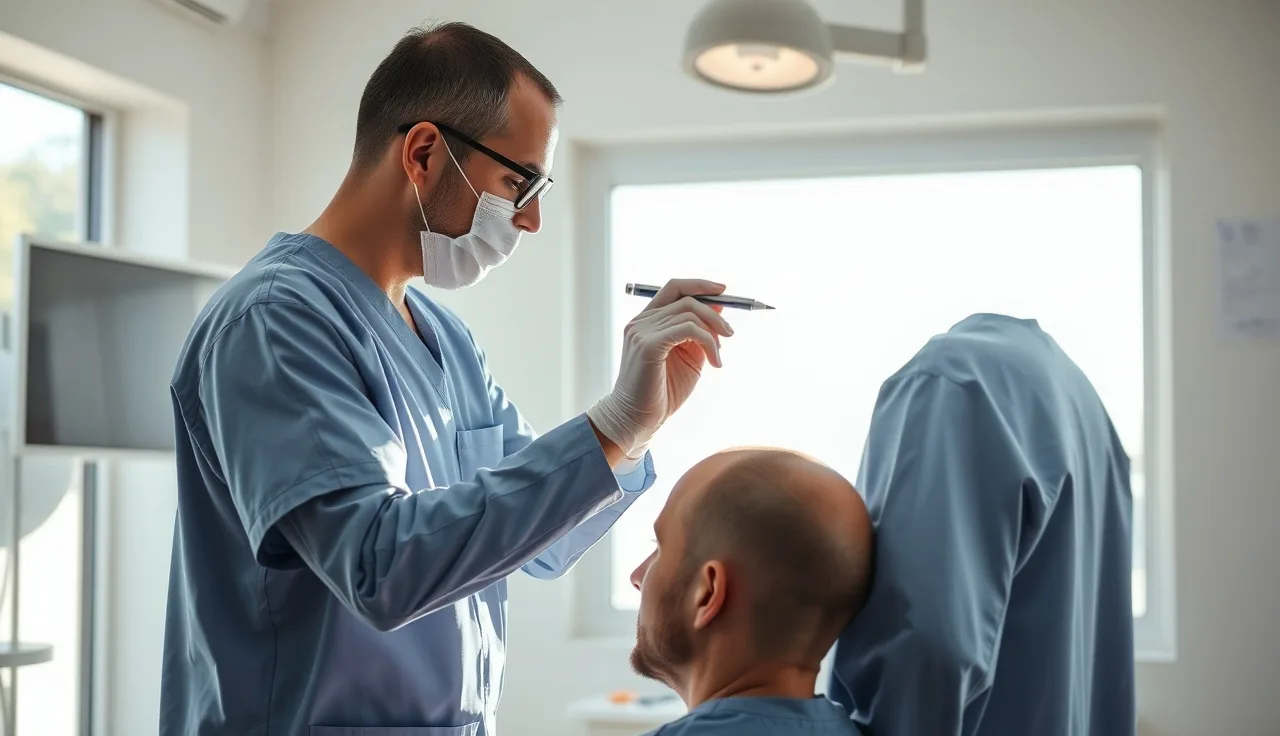
The surgeon works with the patient upright, not lying down, because gravity changes how the face reads. They assess face shape, forehead height, existing hair, and the temporal points. A careful surgeon draws the proposed hairline with a surgical marker and hands the patient a mirror before anything gets committed.
Good surgeons shoot photos from several angles. Some run digital imaging software to simulate the result, though those simulations are approximations and honest surgeons won't sell them as guarantees.
The temporal points, the small downward projections of hair at the outer corners, get placed on purpose. They frame the face and change how wide or narrow the forehead looks. A common mistake is ignoring them entirely and restoring only the central hairline, which leaves the face unframed.
Micro-irregularity gets planned here too. The surgeon marks where single-hair grafts go at the very front edge and where two- and three-hair units fill in behind. The density gradient from front to back copies how natural hairlines work: sparse at the leading edge, denser 1 to 2 centimeters back [3].
Want to check your own recession pattern before you sit down with a surgeon? The free AI scan at MyHairline gives you a baseline read on your current hairline position and pattern, so you walk into the design conversation better prepared.
Asymmetry belongs in the plan on purpose. Natural hairlines aren't perfectly symmetrical. A mathematically symmetrical hairline can look drawn on. A few millimeters of left-right variation is intentional and makes the whole thing read as real.
What questions should you ask your surgeon about hairline design?
Most patients spend their questions on technique (FUE vs. FUT), recovery, and cost. Fair enough, those matter. But the design conversation deserves the same airtime. Here's what to ask.
"What hairline shape are you recommending, and why?" You want a specific answer that names your face shape, age, and donor supply, not a template.
"Where exactly will the central point sit, and how did you measure it?" Ask them to mark it and walk you through the measurement.
"What does my donor supply limit me to, and how does that shape the design?" A surgeon who answers in graft numbers instead of vague reassurance is thinking clearly.
"What happens to this hairline if I keep losing hair behind it?" This question reveals whether the surgeon is planning for your future or just your present.
"Can I see photos of patients with a similar face shape and loss pattern at 12 months post-op?" Twelve months, not six. Graft survival and final appearance aren't settled until around a year [8].
"Will you use single-hair grafts at the hairline edge?" The answer should be yes. Anything else gives you a plug-like front edge.
Ask about temporal points specifically. Most surgeons won't raise it unless you do, and a hairline without considered temporal design looks half finished.
If a surgeon bristles at these questions or hands you canned answers, that tells you what you need to know.
Can a badly designed hairline be fixed?
Sometimes, yes. But it's harder, pricier, and less satisfying than getting it right the first time.
The most fixable problem is a hairline that's too straight or too hard at the edge. If the original used multi-hair grafts at the very front, a surgeon can place single-hair grafts ahead of them to soften the transition. That takes relatively few grafts, maybe 200 to 500, and it's a legitimate, effective revision [1].
A hairline placed too low is a different beast. You can't easily pull the transplanted hairs out. Laser hair removal works but can cause hypopigmentation and uneven texture, and it needs multiple sessions. Electrolysis removes individual grafts but crawls. Some clinics offer graft excision, but results are hit or miss.
A wrong-shaped hairline (say, too straight for a square face) can sometimes be reshaped by adding grafts to the edges, but that spends donor supply you might have wanted elsewhere.
The honest takeaway: revisions exist, but they're expensive and imperfect. The starting design is where your time and care actually pay off.
If you're weighing a transplant and worried about future loss, read up on the receding hairline stage you're at now and whether finasteride and minoxidil could slow things down before you commit to surgery.
How much do different hairline designs cost to graft?
Cost follows graft count, and graft count follows how ambitious the design is.
In the United States, follicular unit extraction (FUE) grafts typically run $3 to $10 per graft at established clinics [9]. A hairline-only restoration of 800 to 1,500 grafts lands around $4,000 to $15,000. A full frontal rebuild of 2,500 to 4,000 grafts runs $10,000 to $40,000 at the top of per-graft pricing, though most patients sit in the middle.
Medical tourism spots (Turkey, India, Thailand) offer much lower per-graft prices, sometimes $1 to $2 per graft all-in. But the design conversation and follow-up care often get less attention at high-volume clinics, and design quality is hard to judge from overseas.
Insurance doesn't cover transplants. The procedure counts as cosmetic [10].
The design work itself, meaning the consultation and planning session, is usually folded into the surgical fee. Some clinics charge a separate design fee for the pre-surgical consult, typically $150 to $500, often credited toward the procedure. If a clinic doesn't charge for a detailed design consult, ask how much time the surgeon personally spends on the design versus handing it to a technician. At high-volume clinics, the surgeon may spend a few minutes on the mark and then step away. That's a real risk.
What role does hair texture and color play in hairline design?
Two patients with the same face shape and the same graft count can walk out with very different hairlines, purely on hair characteristics.
Contrast is the biggest lever. Dark, coarse hair against pale skin creates high contrast, so every graft shows. Feathering at the edge is critical for high-contrast patients, because any plugginess or clumsy density gradient jumps out. Light or gray hair against fair skin is low contrast, and the hairline can look natural even with a less refined technique.
Curly or wavy hair covers more scalp per graft than straight hair. A curly-haired patient can often reach a full-looking hairline with fewer grafts, which opens up the design. Fine straight hair, common in Asian patients, needs very precise single-hair placement because the scalp shows through easily [3].
Color also sets where you can put the density gradient. With low-contrast hair, you can go sparser at the edge and still look natural. With high-contrast dark hair, you need a more abrupt density transition to dodge a painted-on look.
Ethnic background shapes expectations too. The normal range of hairline shapes and positions varies across populations, and a surgeon who's mostly operated on one demographic may not be your best pick. Ask straight out whether they have experience with patients who share your hair texture and color.
Sources
- Journal of Cutaneous and Aesthetic Surgery, 2020, 'Complications in Hair Transplant Surgery'
- International Society of Hair Restoration Surgery (ISHRS), Hairline Design Guidelines
- Dermatologic Surgery, Rassman et al., 'Follicular Unit Transplantation in 2004'
- Aesthetic Surgery Journal, 'Hairline Design in Hair Transplantation: Basic Principles'
- American Academy of Dermatology, Hair Loss Overview
- International Society of Hair Restoration Surgery (ISHRS), Donor Supply and Follicular Unit Guidelines
- Journal of the American Academy of Dermatology, Ludwig Classification of Female Androgenetic Alopecia
- Dermatologic Clinics, 'Hair Transplantation: Surgical Considerations'
- American Society of Plastic Surgeons, Plastic Surgery Statistics Report
- U.S. Centers for Medicare & Medicaid Services, Cosmetic Surgery Coverage