

TL;DR: At Norwood 4, the hairline and midscalp are almost always the better surgical priority. The crown is a low-density illusion that eats grafts fast and looks odd if loss keeps moving. Most surgeons put 1,500 to 2,500 grafts into the frontal zone first and leave the crown for a second session or long-term medication.
What does Norwood 4 actually mean for your hair loss?
Norwood 4 is the stage where you have two separate bald zones with a bridge of hair between them. The temples have receded and joined across the front, and a distinct patch has opened up on the crown. That bridge is the whole game. It decides how a surgeon spends your grafts.
The Norwood-Hamilton scale, published in its modern form in 1975 and still the most used classification in restoration surgery, places Norwood 4 exactly there: frontal recession plus a separate vertex patch, split by a strip of thinner hair [1]. You have not merged into one continuous bald field yet. That is Norwood 5 and up.
Here is the catch. The bridge often looks fine to the naked eye while the hairs inside it are already miniaturized and on their way out. Your donor supply today has to cover whatever your genetic endpoint turns out to be, more than what you see in the mirror this morning.
Men hit Norwood 4 at wildly different ages. Some are there at 24. Others take until their mid-40s. A 26-year-old Norwood 4 carries a very different risk profile than a 46-year-old Norwood 4, because the younger man has far more loss ahead of him and far fewer good options if he burns through his donor grafts now.
Why do most surgeons say hairline first at Norwood 4?
Because the hairline is what people see, and fixing it gives the highest visual return per graft. Nobody stares at the back of your head in a conversation. They look at your face, and the frontal hairline frames it.
The frontal hairline and midscalp use roughly 1,500 to 2,500 follicular unit grafts in one quality session, depending on the bald area and the density you want [10]. Done well, that zone holds up even if the crown stays thin. From most social angles, a bare crown simply goes unnoticed.
The reverse looks wrong. A filled crown above a bald or badly receded front does not match any natural pattern. Surgeons call it the monk's cap: a ring of hair around an empty front, which reads worse than an untouched Norwood 4.
There is a density problem too. The crown is a spiral, a vortex where follicles radiate out from a center point. Light hits it from every angle, so it needs more grafts per square centimeter to look full. A 2020 review in the Journal of Cutaneous and Aesthetic Surgery reported that crown restoration typically demands 40 to 60 grafts per cm² for visual fullness, against 35 to 45 grafts per cm² for the frontal zone [2]. More grafts, less payoff. That is the crown in one line.
How many grafts does a Norwood 4 transplant typically need?
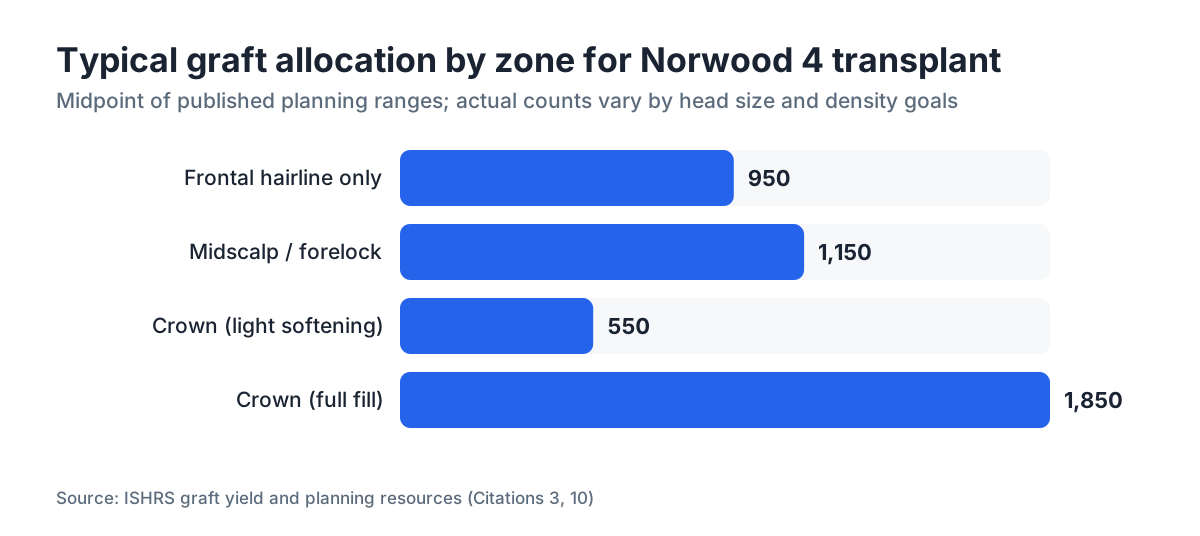
Counts vary by head size, target density, and technique, but published planning guides give solid benchmarks [2][3].
| Zone | Typical graft range | Notes |
|---|---|---|
| Frontal hairline (1-2 cm band) | 700-1,200 | Creates the frame; highest visual impact |
| Midscalp / forelock | 800-1,500 | Fills the central corridor between hairline and crown |
| Crown (full fill) | 1,200-2,500+ | Needs more grafts per cm²; light swallows density |
| Crown (cosmetic softening only) | 400-700 | Reduces contrast without committing full supply |
A typical Norwood 4 has lifetime donor capacity somewhere between 5,000 and 8,000 grafts, though this swings widely with scalp laxity, hair caliber, and follicular density in the safe donor zone [3]. Spending 2,000-plus grafts on the crown in a first session is a real commitment. Progress to Norwood 5 or 6 later and you may not have enough left to cover the bigger bald area.
That is why most experienced surgeons will not target the crown first in a Norwood 4 patient under 35 to 40 without a detailed talk about donor limits and a real medical plan, finasteride or minoxidil or both, to slow further loss [7].
Is there any case where treating the crown first makes sense?
Yes. A few specific situations make crown-first or crown-alongside a reasonable call.
Some Norwood 4 patients have a hairline they are personally fine with but a crown patch that bothers them badly, especially if their work puts the back of the head on display. Performers, teachers, surgeons leaning over a table, anyone whose crown is constantly in frame on video calls. Patient priorities count for something.
Older patients, usually 50 and up, with documented stable loss, good donor density, and a hairline that has not budged in a decade, can sometimes treat the crown. The risk of future progression eating the result is lower.
If the crown loss is small, say under 10 to 12 cm², a conservative 400 to 600 grafts can soften it without mortgaging the donor supply. Some surgeons add this as a supplemental zone during a hairline session when the graft budget allows.
The word that matters is stable. Before any crown work you want at least one to two years of documented stability, ideally with year-over-year photos and ideally with the patient already on finasteride or another DHT blocker so ongoing loss is being handled.
What happens if future loss continues after a crown transplant?
This is the core risk that keeps surgeons cautious about the crown at Norwood 4. Transplanted hairs are permanent because they come from the back and sides where follicles resist DHT. They stay. The native hairs around them do not resist DHT, and they keep falling.
Fill the crown at Norwood 4, then progress to Norwood 5 or 6, and you end up with an island of transplanted density ringed by widening baldness. That looks worse than leaving the crown alone. Fixing it needs more grafts, and by then your donor supply may be running low.
A 2018 paper in Dermatologic Surgery followed patients who got crown grafts before age 30 and found that nearly 40% needed revision surgery within 10 years because surrounding native loss had isolated the transplanted area [4]. The study was small (n=87), so treat the exact percentage with caution, but the direction matches what surgeons see in practice.
Medication is not optional background here. Head into a Norwood 4 transplant without being on finasteride and minoxidil, or without a documented reason you cannot use them, and your surgeon should be walking you through how continuing loss can undo today's result.
How does finasteride or minoxidil change the crown decision?
Both drugs change the math. Finasteride (1 mg oral, FDA-approved for male androgenetic alopecia) blocks 5-alpha reductase, the enzyme that turns testosterone into DHT. In the original registration trials, finasteride 1 mg daily slowed or stopped loss in about 83% of men over two years and produced visible regrowth in roughly 66% [5]. The crown tends to answer finasteride better than the hairline does, probably because vertex follicles are less irreversibly miniaturized early on.
Already on finasteride with a crown that has held or improved over 12 to 24 months? The urgency to transplant it drops hard. You may be managing it with a pill. The hairline still needs surgery because finasteride is weaker up front, but the crown might need no grafts at all.
Minoxidil for men adds a second lever. Topical minoxidil (2% or 5%, FDA-approved) and oral minoxidil (0.625 to 1.25 mg daily, off-label for hair loss) both raise crown density in some people [8][9]. A good minoxidil response in the crown is cosmetic cover you did not have to buy with grafts.
The practical move: get on medication first if it fits you medically, wait 12 to 18 months to read the response, then plan surgery around the zones the drugs are not covering. For most Norwood 4 patients that still means the hairline. The crown often becomes the thing you can wait on.
What should a Norwood 4 surgical plan actually look like?
A well-built Norwood 4 plan usually runs like this.
Session one targets the frontal hairline and midscalp with 1,800 to 2,500 grafts depending on the geometry. The hairline design has to suit your age. A 28-year-old should not get a 16-year-old's hairline, because it will look wrong at 48. Density should layer, finer single-hair units at the front edge and denser multi-hair units behind. This one session changes the most visible part of your scalp.
Session two, planned 12 to 18 months later once things have healed and settled, can extend the midscalp or start conservative crown work if loss has stayed stable and the donor supply allows. The gap also lets you see how much natural crown loss kept going.
Medication runs the whole time. Finasteride if it suits you, to slow DHT-driven loss. Minoxidil on the crown and vertex. Some surgeons add minoxidil to the transplanted zone after surgery to blunt shock loss, though the evidence for that specific use is only moderate.
Want a read on where you stand before you book a consult? The free AI scan at MyHairline gives a Norwood stage estimate and flags which zones are actively thinning, which is useful to bring to your first in-person visit.
Honest qualifier: this is a framework, not a law. A surgeon who sees your scalp, photographs the donor zone, and runs dermoscopy on the bridge hairs will out-advise any article, including this one.
How much does treating each zone cost?
Transplants are priced per graft. In the United States, per-graft pricing runs $3 to $10, with most experienced FUE clinics charging $4 to $7 [6]. Turkey and other medical-tourism spots sell package pricing that can drop the effective per-graft cost to $1 to $2, with its own quality, revision, and travel-complication trade-offs.
Apply realistic graft counts to those prices:
| Zone | Grafts needed | US cost at $5/graft | Budget-country package estimate |
|---|---|---|---|
| Hairline + midscalp (full Norwood 4 front) | 2,000 | ~$10,000 | $2,000-4,000 |
| Crown (full fill) | 1,800 | ~$9,000 | $1,800-3,600 |
| Crown (light cosmetic softening) | 500 | ~$2,500 | $500-1,000 |
| Full hairline + light crown same session | 2,500 | ~$12,500 | $2,500-5,000 |
These are rough ranges. Geography, surgeon experience, clinic overhead, and technique (FUT vs FUE) all move the number. The American Society of Plastic Surgeons reported a national average of about $14,000 for hair transplant procedures in 2022, though that figure blends all Norwood stages and both techniques [6].
What the table says in practice: doing both zones in one session costs less per graft, since setup and anesthesia are fixed, but it commits more of your lifetime donor supply at once. Splitting the sessions keeps your options open.
FUT vs FUE: does technique change the crown vs hairline decision?
Technique matters, but it does not overturn the hairline-first logic.
FUT (follicular unit transplantation) takes a strip of scalp from the back. It usually yields more grafts per session, 3,000 to 4,000 in one sitting is feasible, and it spares the FUE donor field for later. The cost is a linear scar that needs longer hair to hide. For someone planning several sessions, FUT first can be strategic because it leaves the FUE pool intact.
FUE (follicular unit extraction) pulls individual units one at a time. It leaves tiny round scars and no linear line, but each session thins the shaved donor area, and aggressive FUE can shrink future extraction options. People who wear their hair very short usually prefer it.
For crown decisions, FUT's higher yield sometimes makes it more practical to hit both hairline and crown in a single session than FUE would, simply because you have more grafts on the table. That is a technical detail, not a strategic reversal. The rule holds either way: do not overspend on the crown at Norwood 4.
What do real patients typically regret about crown transplants at Norwood 4?
The most common regret in patient communities and in revision-surgery literature is not the surgery. It is the timing. Patients who had crown work at Norwood 4 without adequate medication often watch the surrounding native hair thin over the next five to eight years, leaving a visible contrast between the dense transplanted island and the bare skin around it.
The second pattern is density disappointment. The crown's vortex means light hits it from many angles at once. Even excellent placement can look sparse under direct overhead light because there is no single direction to orient the follicles for maximum coverage. Patients expect the crown to match the hairline and feel let down when it reads thinner at the same graft density. That is physics, not surgeon error.
The third is opportunity cost. Men who spent 2,000 grafts on the crown at 30 and progressed to Norwood 5 by 38 often wish they had those grafts back for the expanded front and midscalp. Grafts do not come back. The donor zone is finite.
None of this makes crown work a mistake. It makes it a decision that needs sharper patient selection and more honest pre-op counseling than hairline work does.
When should you get a hair transplant at Norwood 4 vs wait longer?
Age and stability are the two gates.
Under 30, most experienced surgeons want you on finasteride for one to two years before surgery, to see how your loss answers DHT suppression. Loss that stabilizes on medication is far safer to transplant than loss that is still accelerating. A receding hairline in a 23-year-old Norwood 4 can look very different at 30, depending on genetics and how well he sticks with treatment.
Over 35 to 40 with documented stability (matching photos year to year, no new thinning zones, maybe already a steady responder to medication) and the math shifts. Waiting longer does not necessarily buy you more options, and donor hair quality can slip with age in some people.
Family history counts too. Knowing what causes hair loss in your family, specifically which male relatives went to Norwood 6 or 7 versus stalling at 4 or 5, tells you something real about your likely endpoint. It is not destiny. But a father and two uncles who all hit Norwood 6 by 50 should make a 30-year-old Norwood 4 very careful about spending grafts on the crown.
The free AI analysis at MyHairline can map your current Norwood stage and flag zones of active miniaturization, useful baseline data to hand a surgeon on day one.
Sources
- Norwood OT. Male pattern baldness: classification and incidence. Southern Medical Journal, 1975.
- Journal of Cutaneous and Aesthetic Surgery, review of graft density planning, 2020.
- International Society of Hair Restoration Surgery (ISHRS), Practice Census and Graft Yield Guidelines.
- Dermatologic Surgery, crown graft revision outcomes study, 2018.
- DailyMed (U.S. National Library of Medicine), finasteride 1 mg (Propecia) prescribing information.
- American Society of Plastic Surgeons, 2022 Plastic Surgery Statistics Report.
- American Academy of Dermatology (AAD), Hair Loss resource page.
- DailyMed (U.S. National Library of Medicine), minoxidil 5% topical solution labeling.
- JAMA Dermatology, oral minoxidil for hair loss systematic review, 2021.
- International Society of Hair Restoration Surgery (ISHRS), graft planning resources.