

TL;DR: You lose 30 to 50% of the density in an area before anyone else notices thinning. Track temple angles, crown density, part width, and daily shed counts and you can spot the pattern weeks or months earlier. Early matters because the two proven medical treatments hold living follicles far better than they raise the dead.
Why does catching hair loss early actually matter?
Follicles don't die overnight. They shrink through a process called miniaturization, where each growth cycle spits out a thinner, shorter, lighter strand than the last. By the time someone tells you your hairline moved, the follicles in that zone have usually been miniaturizing for two to five years [1]. That's the window where treatment does the most work.
Finasteride, the only FDA-approved oral drug for male pattern hair loss, is much better at stopping loss than reversing it [2]. Minoxidil, the topical approved for men and women, keeps living follicles in the growth phase. It doesn't resurrect dead ones [3]. So the math is simple: catch the pattern while the follicles are still alive and you have real options. Wait until your Norwood stage is advanced and the conversation shifts to a hair transplant, which works but runs $4,000 to $15,000 or more and involves surgery [4].
Early detection isn't vanity. It's triage.
How much hair do you normally lose per day, and what's too much?
A healthy person sheds 50 to 100 hairs a day as part of the normal telogen (resting) phase of the cycle [5]. That sounds alarming until you remember a full scalp carries roughly 100,000 hairs. Losing 100 is under 0.1%.
The count matters in two ways. First, if you're consistently pulling more than 100 hairs out of the shower drain or off your pillow, start tracking. Second, and this gets missed, thickness matters as much as number. A miniaturizing follicle produces a finer hair every cycle, so thin, wispy shed hairs should worry you more than thick ones at the same count.
Nobody has clean data on the exact shed-count threshold for early androgenetic alopecia. A 2012 review in the Journal of the American Academy of Dermatology by Rudnicka and colleagues found that trichoscopy (dermoscopy of the scalp) picks up miniaturization more reliably than counting ever will [1]. So use counts as a rough trend signal over weeks, not a diagnosis.
Here's a method that works: do a 60-second collection in the shower drain once a week for four straight weeks. Average the count. If it climbs week over week and the hairs look thin, take it seriously.
What are the earliest physical signs of male pattern hair loss?
The first sign is almost never a bald spot. It's a shift in texture or density you notice before anyone else does.
Here's what to look for, roughly in the order it tends to show up:
Temple recession. The hairline at both temples starts pulling back in a slight arc. This is the earliest visible sign in most men with androgenetic alopecia. Compare photos taken in the same lighting three to six months apart. A ruler, or a fixed reference point like the top crease of your ear, makes the comparison honest.
Widening part line. Part your hair and watch the strip of scalp. Over months it gets wider. Most people spot this first in bathroom mirror light because overhead bulbs hit the scalp directly. Shoot it from the same angle every month.
Scalp visibility under bright light. Wet your hair and look at the crown under a bright overhead bulb or your phone flashlight. If scalp shows through when the hair is wet, density has already dropped in that zone.
Texture change at the hairline. Miniaturizing hairs are finer and shorter than the ones they replaced. Run two fingers backward from your hairline. If the first inch feels noticeably softer and thinner than the hair further back, miniaturization has started there.
Scalp showing up in photos. Flash and outdoor sun catch scalp that mirror light hides. Scroll back through your camera roll with fresh eyes.
None of these alone confirms androgenetic alopecia. Two or more, moving in the same direction over months, is a signal worth acting on.
What are the earliest signs of female pattern hair loss?
Women rarely get the classic receding hairline. Female pattern hair loss (androgenetic alopecia in women, sometimes shortened to FPHL) almost always starts as diffuse thinning across the crown and top of the scalp, with the frontal hairline usually left alone [6].
The Ludwig Classification splits it into three stages. Stage I is a widening part in the central scalp. Stage II is more obvious thinning across the top. Stage III is heavy density loss at the crown. Catching it at Stage I is the goal.
The earliest signs in women:
Widening central part. A part that used to read as a thin white line now shows a strip of scalp. Photograph it under the same overhead light every week.
Ponytail diameter shrinks. If you wear a ponytail, the circumference at the hair tie shrinks measurably before thinning is obvious with your hair down. Some women track it with a piece of string.
More scalp when the hair is wet. Same principle as men. Wet hair lies flat and tells the truth about density.
More hairs on the pillow or in the drain. Worth tracking, with one caveat: long hair simply looks like more when it sheds because each strand is more visible.
One thing men usually skip that women can't: women are far more likely to have hair loss from something other than genetics. Iron deficiency, thyroid problems, and telogen effluvium all mimic pattern loss early on. A blood panel to rule those out comes before you assume it's genetic.
How do you map your own Norwood stage at home?
The Norwood-Hamilton scale is the standard map for male pattern baldness, running from Type I (no recession) to Type VII (only a horseshoe fringe left) [7]. Most men who catch their loss early sit somewhere between Type I and Type III.
Here's a self-mapping method that takes ten minutes.
Step 1: Shoot three photos in the same conditions every time. Same time of day, same light (bright overhead is best), hair dry and unstyled. Take one from directly above the crown, one from the front at eye level, and one from each side at roughly 45 degrees.
Step 2: Compare the front and 45-degree shots to the Norwood illustrations. Look hard at the temple recession and the shape of the frontal hairline. Type I has no recession. Type II shows slight temple recession, no more than 2 cm. Type IIa and III show deeper temple recession or slight frontal thinning. Type III Vertex adds crown thinning.
Step 3: Dig up photos from three to six months ago if you have them. Pattern baldness moves, so a direction beats a single frame.
Step 4: Repeat the photo set every six to eight weeks. You're watching for movement, not judging one snapshot.
Self-staging isn't as accurate as a dermatologist or a trichoscopy exam. But it's free, it's fast, and it gives you a documented baseline nobody can argue with.
| Norwood Stage | What it looks like | When to start worrying |
|---|---|---|
| I | No recession, full hairline | Not yet a concern |
| II | Slight temple recession, less than 2 cm | Monitor every 3 months |
| IIa / III | Deeper temple recession or slight frontal thinning | Strong candidate for treatment |
| III Vertex | Crown thinning added | Act now if you haven't |
| IV+ | Clear bald areas at front and/or crown | Treatment still helps remaining follicles |
What tools or tests can confirm early hair loss?
At-home photo tracking is where you start. A few tools go further and tell you more.
Trichoscopy (dermoscopy). A dermatologist uses a handheld dermoscope to magnify the scalp 10x to 70x. It reads hair shaft diameter variability, miniaturized follicles, and early perifollicular pigmentation that shows up before visible loss. Rudnicka and colleagues, writing in the Journal of the American Academy of Dermatology in 2012, described more than 20% thin hairs to normal hairs in a scalp zone as a reliable early marker of androgenetic alopecia [1]. This is the most reliable non-invasive clinical tool for early detection.
Hair pull test. A dermatologist (or you at home, as a rough proxy) grabs 40 to 60 hairs between thumb and forefinger and pulls gently but firmly from root to tip. Normally fewer than 6 come out. More than 6 means active shedding above baseline. This test spots active effluvium better than it maps an androgenetic pattern.
Scalp biopsy. The gold standard for ambiguous cases. A 4mm punch biopsy from the thinning zone counts terminal versus miniaturized follicles and rules out scarring alopecias like lichen planopilaris. Most early androgenetic cases never need it. But if the diagnosis is still murky after trichoscopy and blood work, this settles it.
Blood panel. Not diagnostic for pattern baldness itself, but it rules out causes you can actually treat. A useful baseline: ferritin (iron stores), thyroid-stimulating hormone (TSH), complete blood count, and total and free testosterone with DHEA-S. The American Academy of Dermatology recommends this workup before pinning diffuse hair loss in women on genetics [6].
AI photo analysis tools. Consumer apps and web tools that read scalp photos are getting better, but none are validated to clinical accuracy yet. They're best as a tracking aid and a nudge to see a dermatologist, not a substitute for one. MyHairline's free AI scan at /scan sits here: it can flag asymmetry and suggest a Norwood estimate from photos, but it doesn't replace trichoscopy.
For a man with a clear family history and early temple recession, an in-person dermatology visit with trichoscopy is the fastest route to a confident diagnosis.
What causes early hair loss, and how do you tell patterns apart?
Not every case of early hair loss is androgenetic alopecia, and getting the cause right decides the treatment.
Androgenetic alopecia is driven by dihydrotestosterone (DHT) sensitivity in genetically wired follicles. It follows the Norwood pattern in men and the Ludwig pattern in women. It's gradual, it progresses, and it doesn't bring scalp pain or a sudden onset. That's the pattern this article is about. The biology is in our guide to what causes hair loss.
Telogen effluvium is a diffuse shedding event set off by physical or emotional stress, illness, surgery, crash dieting, or childbirth. It usually starts two to four months after the trigger and clears on its own within six to nine months [8]. The shed hairs are typically full thickness, not miniaturized. It can also unmask hidden androgenetic alopecia by draining reserve density. Our telogen effluvium guide walks through it.
Alopecia areata causes patchy, well-defined circular bald spots, not the slow recession of pattern loss. It's autoimmune.
Scarring alopecias like lichen planopilaris and frontal fibrosing alopecia destroy follicles for good. They often come with scalp redness, scaling, or burning on top of the hair loss. These need a fast dermatology referral because the damage doesn't come back.
The sorting question is short. Is the loss following the Norwood or Ludwig map, creeping along over months or years, with no scalp symptoms? That points to androgenetic alopecia. Does it feel sudden, patchy, or come with scalp inflammation? Get a dermatologist involved quickly.
DHT is the engine behind androgenetic alopecia. Our guide to DHT blockers explains the mechanism and what targets it.
Does family history reliably predict your risk?
Partly. Androgenetic alopecia is polygenic, meaning many genes pitch in, and the inheritance isn't a clean dominant-or-recessive rule.
The old story that baldness comes only from your mother's father is wrong. Research keeps finding that a bald father raises your risk, and a bald father plus a bald maternal grandfather raises it more [9]. A 2017 genome-wide association study in PLOS Genetics by Hagenaars and colleagues identified 287 genetic loci tied to male pattern baldness, which tells you this is nowhere near a single-gene story.
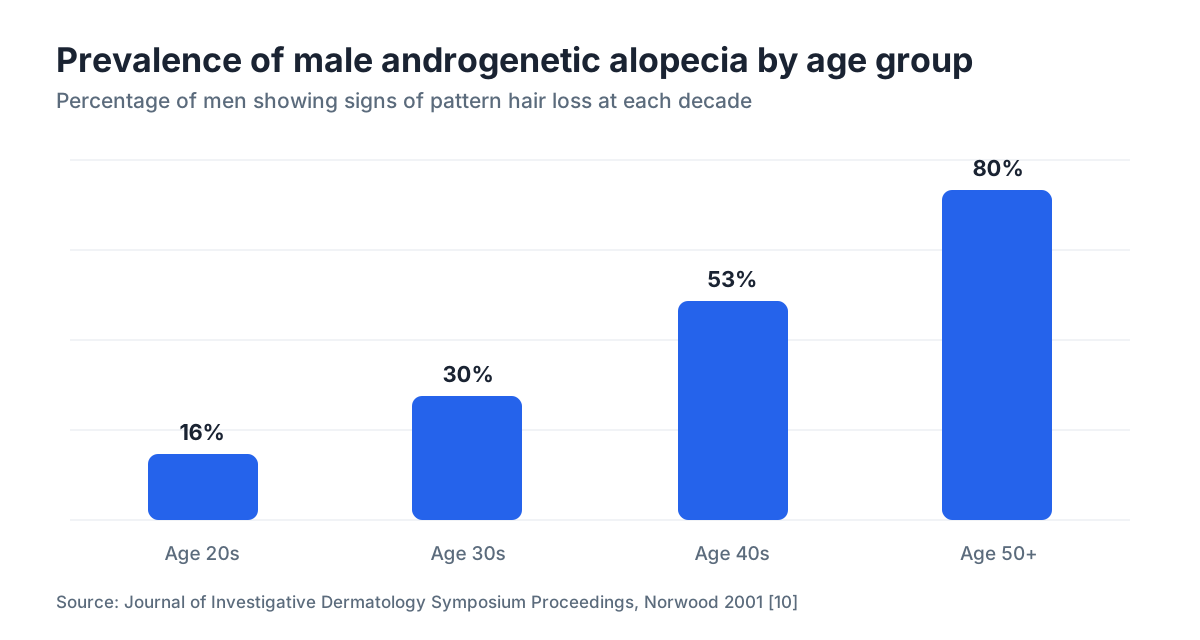
What family history buys you in practice: if your father or brothers have significant pattern loss, your prior probability of developing androgenetic alopecia is well above average. Lifetime prevalence in men reaches roughly 50% by age 50 and 80% by age 80 [10]. If your family history is heavy, start monitoring in your early twenties instead of waiting for something to show.
Family history won't tell you how fast you'll lose it. Some men with a heavy history thin slowly over decades. Others burn through several Norwood stages in a few years. Speed is partly genetic and partly something treatment can change.
What should you do the moment you suspect early hair loss?
The most useful first move is a documented baseline. Take the four-angle photo set from earlier today, in good light, and stash it somewhere you'll actually find in six months. Phones timestamp photos on their own. That timestamp is your evidence.
Second move: book a dermatology appointment if you can get one. A dermatologist can run trichoscopy, order blood work, and hand you an accurate diagnosis in a single visit. If access is thin, a telehealth dermatology service is a fair bridge.
Third, learn what the two proven treatments actually do. Finasteride drops scalp DHT by about 70% and has strong evidence for slowing progression and modestly regrowing hair in early stages [2]. Minoxidil for men stretches the growth phase of follicles you still have, with roughly 40 years of clinical use behind its safety and effect [3]. Running both together adds up, as our guide to finasteride and minoxidil lays out.
Neither is a cure. Both need ongoing use. Started early, though, they give you a real shot at keeping what you have for years or decades.
Fourth, skip the supplements and "hair growth" shampoos until you've read the evidence. Most have no meaningful clinical backing. Our guide to hair loss supplements sorts what's backed by data from what's a waste of money.
MyHairline's free AI scan at /scan can give you a rough read on your pattern and help you frame the conversation with a dermatologist. Treat it as a starting point, not the final word.
Can you slow early hair loss without medication?
To a degree, yes. No non-medical move will stop androgenetic alopecia the way finasteride does, but a few factors change how fast it moves.
Scalp health. Chronic scalp inflammation speeds up miniaturization. Seborrheic dermatitis, a common scalp condition, shows up more often in men with androgenetic alopecia and may make it worse. A zinc pyrithione or ketoconazole shampoo (prescription Nizoral 2%, for example) used twice a week has some evidence for modest benefit, probably through anti-inflammatory and anti-fungal effects [11].
Nutrition. Severe iron deficiency, low ferritin, and protein malnutrition all drag on hair growth. If deficiency is confirmed, getting ferritin above 40 ng/mL is a reasonable target. Crash dieting is a known trigger for telogen effluvium. Eating enough protein (roughly 0.7 to 1 gram per pound of body weight a day) keeps keratin synthesis fed.
Mechanical stress. Tight braids, cornrows, and high ponytails cause traction alopecia, which stacks on top of pattern loss at the hairline. It's a separate problem, but it can speed up how far your hairline appears to recede in vulnerable spots.
Creatine. A single small 2009 study suggested creatine supplementation raises DHT, which sparked worry about it speeding pattern loss. The evidence is weak and never replicated, but if hair loss is already on your mind, it's worth knowing. Our piece on does creatine cause hair loss breaks the study down.
Smoking. Observational data keeps linking cigarette smoking to worse hair loss severity, possibly through reduced scalp blood flow.
None of these come close to finasteride or minoxidil in effect. They're still worth fixing.
How often should you check for changes, and what counts as real progression?
Monthly photo sets are about right for someone who has spotted early signs and wants to watch it. More often than monthly and normal day-to-day variation will make you paranoid. Less often than every two months and you can miss real movement.
Here's how to separate real progression from noise.
Normal variation is styling changes, humidity puffing up your volume, and lighting differences. That's exactly why identical photo conditions matter so much.
Real progression is the same zone showing clearly more scalp across two or three consecutive monthly photos shot in identical conditions. One photo comparison never counts.
A rule that works: if you've got six straight monthly photos and the earliest three look noticeably better than the latest three, that's directional evidence you're losing ground. If the series looks flat, that's reassuring.
On treatment (finasteride, minoxidil, or both), shoot every eight weeks over the first year to see whether the drug is holding the line. Don't expect dramatic regrowth, especially in the first six months. Stabilization is a win. A review in the Journal of the American Academy of Dermatology noted that finasteride trials defined success mainly as stopping progression, not reversing it, across a five-year study period [2].
If progression feels fast, meaning visible change in one to two months, see a dermatologist. Rapid loss sometimes means something other than standard androgenetic alopecia.
Sources
- Journal of the American Academy of Dermatology, Rudnicka et al. 2012, Trichoscopy: a new method for diagnosing hair loss
- U.S. FDA, Propecia (finasteride) prescribing information
- U.S. FDA, Rogaine (minoxidil topical) label and approval history
- American Society of Plastic Surgeons, Hair transplant procedure overview
- American Academy of Dermatology, Hair loss: tips for managing
- American Academy of Dermatology, Diagnosis and care of hair loss in women
- Norwood-Hamilton classification, historical reference cited in Dermatologic Clinics (Olsen 1999)
- StatPearls (NCBI Bookshelf), Telogen Effluvium
- PLOS Genetics, Hagenaars et al. 2017, Genetic prediction of male pattern baldness
- Journal of Investigative Dermatology Symposium Proceedings, Norwood 2001, Male pattern baldness prevalence
- International Journal of Dermatology, Piérard-Franchimont et al. 1998, Ketoconazole shampoo and hair loss