

TL;DR: When your partner notices your hair thinning before you do, it usually means the loss is real and has been going on for a while. The right move is to look calmly, confirm the pattern, understand the likely cause (androgenetic alopecia accounts for roughly 95% of male hair loss), and decide fast, because FDA-approved treatments work best when started early.
Why does your partner notice hair loss before you do?
The bathroom mirror shows you the front. Your partner sees the crown, the back, the way light hits your scalp when you sit at dinner. That difference in vantage point is the whole explanation, and it's completely ordinary.
Androgenetic alopecia, the most common type of hair loss, usually starts at the crown or the temples, not the hairline you inspect every morning [1]. Diffuse thinning across the top of the scalp can reduce density by 25 to 50 percent before most people notice in a front-facing mirror [2]. Your partner has been watching the top of your head for months. You've been looking at your face.
There's a psychological piece too. We adapt to gradual change in ourselves in a way we don't with other people. The same thing that makes you stop hearing the hum of your refrigerator makes you stop registering slow crown thinning. That isn't denial exactly. It's just how human perception works.
So if your partner says something, treat it as data, not an attack.
What should you actually do when your partner tells you they've noticed thinning?
Step one is to look properly. More than a quick glance. Get a hand mirror and a well-lit room, angle it so you can see your crown and the back of your scalp, and take a clear-headed look. Take a photo if you can. A baseline photo today matters more than you'd think, because hair loss is slow and you'll want something to compare against in six months.
Step two is to understand what you're probably seeing. The overwhelming majority of hair loss in men is androgenetic alopecia (male pattern baldness), which is genetic and driven by the hormone DHT [1]. Thinning at the crown, a receding hairline, or both points to that. Women can have a similar genetic pattern, though it tends to show up as diffuse thinning across the part rather than a distinct bald spot [3].
Step three: don't immediately buy whatever supplement ad came up on your feed. The supplement industry around hair loss is largely unregulated and the evidence for most products is thin to nonexistent. The FDA has approved two treatments for androgenetic alopecia: topical minoxidil (and now oral minoxidil in certain contexts) and finasteride [4]. Everything else is conjecture until proven otherwise.
Step four is to see a dermatologist or a doctor who specializes in hair loss. A proper diagnosis matters because not all hair loss is genetic. Telogen effluvium, thyroid dysfunction, nutritional deficiencies, and autoimmune conditions like alopecia areata all cause shedding, and treating them looks nothing like treating androgenetic alopecia. A doctor can run bloodwork and often diagnose the pattern in a single visit.
Step five is to decide quickly. This is not a panic instruction. It's practical. Minoxidil and finasteride both work by slowing loss and partially regrowing thinned hair. They do not resurrect follicles that have been completely dormant for years. The earlier you start, the more you keep.
How serious is hair loss noticed early by a partner, really?
This depends entirely on what's happening and how long it's been going on. A partner noticing thinning doesn't mean you're going bald in six months. Androgenetic alopecia progresses on a spectrum measured by the Norwood scale for men (I through VII) and the Ludwig scale for women [3]. Plenty of people with early-stage loss stay at that stage for years with no treatment. Others progress faster.
What early detection buys you is time. If your partner noticed something at a Norwood II or III (a slightly receding hairline or early crown thinning), you have real options with real evidence behind them. If they're noticing what turns out to be Norwood V or VI, the conversation shifts toward hairline management and possibly a hair transplant down the line.
The condition itself is medically harmless. Hair loss doesn't hurt you. But the research on psychological impact is real: a 2012 study in the Journal of the American Academy of Dermatology found that hair loss is associated with significantly lower self-esteem and higher levels of anxiety and depression compared to control groups, particularly in younger men and in women [5]. Acknowledging that impact, and doing something practical about it, is a legitimate health decision.
Nobody should feel pressured to treat hair loss. Some people decide they don't care, shave their head, and feel great. Both outcomes are fine.
What are the most effective treatments to start early?
The two FDA-approved treatments for androgenetic alopecia are minoxidil and finasteride, and combining them beats either alone [4].
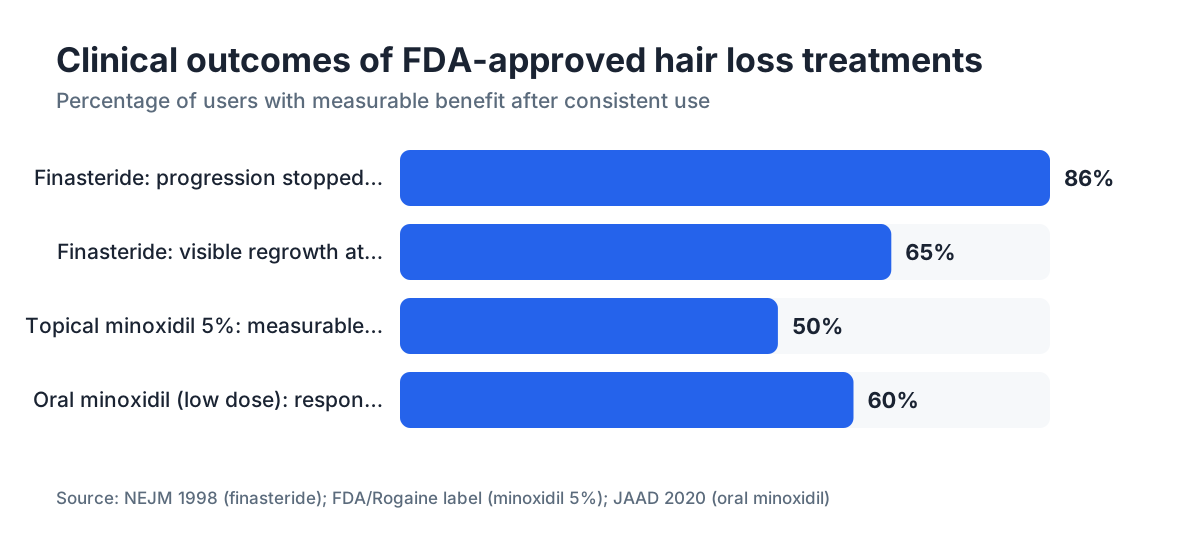
Minoxidil for men comes as a 2% or 5% topical solution or foam applied to the scalp once or twice daily. It's over the counter. The 5% formulation works better for men. It prolongs the growth phase of hair follicles and increases blood flow to the scalp. About 40 to 60 percent of users see measurable regrowth or significantly slowed loss after 12 months of consistent use [4]. You have to keep using it. Stop, and any hair the drug retained reverts within three to six months.
Finasteride is an oral prescription taken once daily. It blocks the enzyme that converts testosterone to DHT, the hormone mostly responsible for follicle miniaturization in androgenetic alopecia [1]. Clinical trials found finasteride stopped progression in roughly 86% of men and produced visible regrowth in about 65% after two years [6]. It's prescription-only in the U.S. and is not approved for women who are or may become pregnant because of teratogenic risk.
Using finasteride and minoxidil together is increasingly treated as the standard of care for early androgenetic alopecia by hair loss specialists, based on studies showing additive benefit. If you're going to treat, the combination gives you the best odds.
Oral minoxidil at low doses (0.625 to 2.5 mg for women, 2.5 to 5 mg for men) is an off-label option gaining real traction. A 2020 review in the Journal of the American Academy of Dermatology found it effective for androgenetic alopecia with a manageable side effect profile at low doses, though unwanted facial hair growth is a genuine concern [7].
For people with more advanced loss who want density back rather than just maintenance, a hair transplant is the surgical route. It doesn't stop the underlying process, which is why many transplant patients stay on finasteride afterward.
Platelet-rich plasma (PRP), low-level laser therapy, and hair loss supplements sit in a different tier: plausible mechanisms, lower-quality evidence, and usually used as add-ons rather than primary treatments. The American Academy of Dermatology doesn't list them as first-line [3].
Know what the side effects of minoxidil look like before you start, especially the initial shedding phase that scares people into quitting too early. That shedding around weeks two to eight is normal and doesn't mean the drug isn't working.
How do you have a good conversation with your partner about this?
Most people who bring up a partner's hair loss are trying to help, not criticize. The framing still matters. If your partner said it bluntly in a moment that felt harsh, that sting is real. You're allowed to acknowledge it stung before you decide what to do with the information.
A few things that generally help:
Ask your partner to be specific about what they're seeing and from what angle. "The back is looking thinner" is more useful than "you're losing your hair." That specificity helps you locate the problem and photograph it.
Tell them what you're planning to do: look at it properly, maybe see a doctor. That's not caving to criticism. It's treating your own body with the same practical attention you'd give a weird mole or a cough that won't quit.
If you're resisting the conversation, ask yourself honestly whether that resistance comes from something worth examining. Some people find the idea of hair loss genuinely distressing in ways tied to identity and aging. That's understandable, and if it's causing real anxiety, a short conversation with a therapist who knows body image work can help more than either ignoring the problem or spiraling about it.
On your partner's side: the most useful thing they can do is bring it up once, clearly, offer support without pressure, then let the person decide. Repeated references or jokes about hair loss are corrosive, even when they're meant to be light.
What if you're not sure the thinning is really there?
Fair question. Lighting is unreliable. Wet hair looks thinner. Certain haircuts expose the scalp more. Before you commit to any treatment or any stress, confirm the finding objectively.
The easiest method: take a photo of your crown in natural daylight, hair dry and unstyled, from directly above. Compare it to any old photos you have of your head from the same angle. Even five-year-old photos can show a meaningful difference in density.
A dermatologist can use dermoscopy, a handheld magnified light device, to measure the percentage of miniaturized follicles and estimate the stage of loss with far better precision than a bathroom mirror. This is the gold standard, and one appointment gives you a baseline.
If you want a starting point before an appointment, tools like the free AI scan at MyHairline can analyze a photo and give you an estimated Norwood stage and areas of concern. That's not a diagnosis, but it can help you figure out whether what you're seeing needs a doctor urgently or can wait a month for a regular appointment.
One number worth knowing: humans lose between 50 and 100 hairs per day on average as part of normal cycling, and that number can spike to 200 to 300 during a temporary shed from stress, illness, or hormonal shifts [2]. A big clump in the shower drain doesn't automatically mean androgenetic alopecia. Context matters.
Is hair loss from stress different from genetic hair loss, and can your partner's concern itself cause shedding?
Yes, and it's worth raising because the timing can get circular. Telogen effluvium is a temporary form of hair loss triggered by physiological or psychological stress, usually showing up two to three months after the stressor. It's diffuse shedding across the whole scalp rather than a pattern, and it almost always resolves within six to nine months once the trigger is gone [8].
Could anxiety about hair loss, set off by your partner's comment, cause additional shedding? In theory, yes, if it's severe enough to count as a real physiological stressor. In practice, most people's stress response to learning about thinning isn't dramatic enough to trigger a full telogen effluvium episode.
The distinction between telogen effluvium and androgenetic alopecia matters for treatment. Androgenetic alopecia has a pattern (crown, temples, frontal hairline). Telogen effluvium is diffuse. Blood tests checking ferritin, TSH, and complete blood count can rule out nutritional and thyroid causes [3]. If your dermatologist suspects telogen effluvium, they may recommend watchful waiting plus addressing the underlying trigger rather than starting finasteride.
Knowing what causes hair loss in your specific case is not optional. It determines whether treatment helps, whether it's temporary, and whether there's an underlying condition that needs attention.
Does the cause of your hair loss change what your partner noticed?
Sometimes. The pattern and location of thinning your partner describes can actually point toward a diagnosis.
A crown spot with a defined edge: suggests androgenetic alopecia.
Diffuse all-over thinning with heavy shedding: suggests telogen effluvium or nutritional deficiency.
A patchy area with complete hair absence in a smooth circle: suggests alopecia areata, an autoimmune condition.
A frontal hairline receding symmetrically, combined with eyebrow and eyelash loss: rarer, but suggests frontal fibrosing alopecia or lichen planopilaris.
Traction at the hairline or breakage at a uniform length: suggests traction alopecia or chemical damage.
If your partner is specific about where and what they're seeing, that description has diagnostic value. Write it down before your dermatology appointment. "They said there's a thin spot about the size of a silver dollar near the back of the crown" is useful. "They said I'm going bald" is not.
If you use creatine and wonder whether it might be contributing, the short answer is the evidence is weak but not zero. One small 2009 study found elevated DHT levels in college rugby players supplementing creatine versus placebo [9]. Whether that translates to clinically meaningful hair loss is unclear, and the major hair loss organizations don't currently list creatine as a confirmed cause. More on that at does creatine cause hair loss.
What does the research say about how early treatment affects long-term outcomes?
Earlier is meaningfully better, and the data on this is fairly clear.
The main finasteride trials showed that men who started at Norwood II or III had significantly better cosmetic outcomes at five years than men who started at Norwood IV or V [6]. That's not surprising: the drug works by slowing DHT-driven follicle miniaturization, and miniaturization that's already complete (the follicle is dead) can't be reversed by a DHT blocker.
Minoxidil shows the same pattern. Better response in areas where follicles still produce fine or vellus hair than in areas that have been completely smooth for years [4].
This is why catching thinning early, even before you noticed it yourself, is genuinely useful. The American Academy of Dermatology advises patients to "see a board-certified dermatologist at the first sign of hair loss" for exactly this reason [3].
Transplants are a different case. They move healthy follicles from a donor zone to a thinned area, so they work regardless of how long an area has been thin. But they cost a lot more (typically $4,000 to $15,000 in the U.S. depending on graft count and clinic) and are generally saved for people with stabilized loss, since transplanting into an area where active loss continues creates patchy results [10].
The window your partner's observation opens is real. The correct response is action, not panic, and not inaction.
What should you tell other people who comment on your hair?
Your partner is one thing. Relatives at a family dinner, coworkers making offhand remarks, acquaintances who think they're being helpful by pointing it out: that's a different situation.
You're under no obligation to discuss your hair loss with anyone. "Yeah, I know" and a subject change is a complete and adequate response. If someone is persistent or unkind, calling it out directly usually works better than deflecting: "I've noticed, thanks. It's not really a topic I want to get into."
For close friends or family who ask with genuine concern and might see you making lifestyle or treatment changes, a brief honest answer lands better than deflection. Something like: "Yeah, it's thinning. I've started topical minoxidil / saw a dermatologist / decided I'm fine with it, and I'm not worried about it anymore." That closes the loop without turning it into a big conversation.
If hair loss is genuinely affecting your self-confidence or your relationships, that's worth naming with a therapist. The psychological impact of hair loss is well documented and underserved [5]. There's no medal for powering through something that's bothering you.
When should you see a doctor urgently versus scheduling a routine appointment?
Most androgenetic alopecia doesn't need urgent care. Schedule a routine dermatology appointment within the next one to two months.
See a doctor sooner (within a week or two) if you notice:
Rapid shedding that fills the shower drain noticeably, especially if it started suddenly in the last few weeks.
Patchy areas of complete hair loss rather than diffuse thinning.
Scalp itching, burning, scaling, or pain along with the hair loss.
Shed hairs with a small white or yellow bulb attached at the root (suggests active follicle disruption rather than end-of-cycle shedding).
Hair loss alongside other symptoms: fatigue, weight change, skin changes, irregular menstrual cycles in women.
Those presentations can signal conditions (alopecia areata, scarring alopecias, thyroid disease, iron deficiency anemia) that benefit from faster diagnosis and completely different treatment.
If you're a woman noticing thinning, the threshold for a prompt visit is lower. Female hair loss has more possible causes, and the treatment options differ enough from men's that self-diagnosis is more likely to steer you wrong. The AAD recommends bloodwork as part of the workup for women with hair loss specifically to rule out hormonal and nutritional causes [3].
If you want a sense of your pattern before the appointment, a tool like MyHairline's free AI scan can give you a preliminary Norwood or Ludwig estimate to bring into the conversation with your doctor.
Sources
- StatPearls, National Library of Medicine: Androgenetic Alopecia
- American Academy of Dermatology Association: Hair loss types and causes
- FDA: Minoxidil Drug Label (Rogaine 5%)
- Journal of the American Academy of Dermatology, 2012: Psychological effects of hair loss
- New England Journal of Medicine, 1998: Finasteride in men with androgenetic alopecia (Kaufman et al.)
- Journal of the American Academy of Dermatology, 2020: Oral minoxidil review
- StatPearls, National Library of Medicine: Telogen Effluvium
- International Society of Hair Restoration Surgery: ISHRS Practice Census