

TL;DR: Most men with androgenetic alopecia can slow loss with finasteride and minoxidil, but neither reverses advanced baldness well. If you've used first-line treatments correctly for 12 months with no response, or you're Norwood 5-7 with diffuse loss, the honest math often favors accepting baldness or exploring transplant over indefinite medication. Your mental health matters as much as your hair count.
Why is this decision so hard to make?
Nobody tells you there's a finish line. You start minoxidil or finasteride, you wait, and then you wait some more. The dermatology literature calls 12 months the minimum trial period before you can judge whether a treatment worked [1]. Most men are reassessing at month three, panicking at month six, and still unsure at month twelve.
The decision to stop treating is hard because both options feel morally weighted. Continuing feels like fighting. Stopping feels like surrender. Neither framing is useful.
Here's a more honest frame: hair loss treatment is a cost-benefit calculation, and the inputs change as your loss progresses. A 28-year-old at Norwood 2 with fast-moving loss has a very different calculation than a 52-year-old at Norwood 5 who's been stable for years. Same question, different answer.
What makes it harder is that treatments work differently for different people, the evidence base is real but imperfect, and the psychological toll of checking your own hair every morning is something the clinical trials never measured.
What does the evidence say about how well hair loss treatments actually work?
First-line drugs work for many people with early to moderate loss and work less reliably as baldness advances. Neither one restores a full head of hair in men who are already substantially bald. Anchor to real numbers before talking about when to quit.
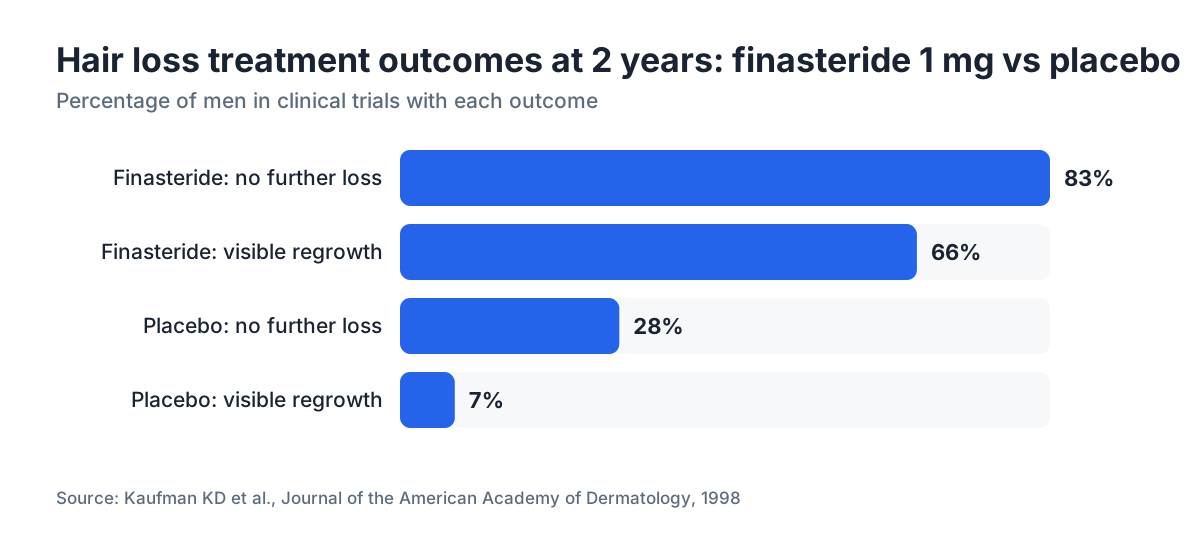
Finasteride 1 mg daily was studied in two large randomized controlled trials published in the Journal of the American Academy of Dermatology in 1998. After two years, 83% of men taking finasteride had no further hair loss, and 66% showed visible regrowth compared to baseline [2]. That sounds good. The catch: the trial enrolled men with mild to moderate loss (Norwood 2-4 vertex), not men with advanced baldness.
Minoxidil for men has a similarly bounded track record. The FDA-approved 5% topical formulation showed statistically significant regrowth versus placebo, but the mean regrowth was modest. A 2002 review in the Journal of the American Academy of Dermatology reported that about 40% of men using 5% topical minoxidil achieved moderate to dense regrowth at 48 weeks, while many others got minimal or no visible change [3].
Used together, finasteride and minoxidil beat either one alone. A 2021 randomized trial in Dermatology and Therapy found the combination produced significantly greater hair count increases than monotherapy at 24 weeks [4].
Knowing all this matters when you're deciding whether to keep going. The drugs hold ground better than they take it back.
| Treatment | Trial Duration | % with no further loss | % with visible regrowth |
|---|---|---|---|
| Finasteride 1 mg | 2 years | 83% | 66% |
| Minoxidil 5% topical | 48 weeks | Not separately reported | ~40% moderate/dense regrowth |
| Finasteride + Minoxidil | 24 weeks | Not separately reported | Significantly greater than monotherapy |
What are the signs that treatment is actually working?
Success is subtler than you'd expect. The most common signal people miss is no further loss. If your crown looked the same at month 6 as it did at month 12, the drug worked. Stabilization is the main goal of finasteride; regrowth is a bonus. Men who expect to look 25 again quit a treatment that's doing exactly its job.
Regrowth, when it happens, usually shows up in the first 6-12 months and peaks around 12-18 months [1]. Baby hairs or increased density in previously thinning areas mean the drug is responding. Shedding that increases in the first 1-3 months of minoxidil use is a normal part of the hair cycle shift, not a failure signal [5].
Practical ways to track progress:
- Take standardized photos every 8-12 weeks. Same angle, same lighting, ideally after washing.
- Count hairs in a consistent zone if you want a rough number.
- Ask a dermatologist to do a baseline and follow-up trichoscopy or hair pull test.
Here's the clean test. If after 12 full months of correct use (daily finasteride, twice-daily or once-daily minoxidil depending on formulation, no missed weeks) you have more loss than when you started, that's a real non-response. At that point the cost-benefit math changes.
At what Norwood stage does treatment stop being worth it?
The honest answer gets uncomfortable here. The trials that established finasteride's efficacy enrolled men at Norwood 2-4, mostly with vertex thinning [2]. No large randomized trial shows meaningful regrowth in men at Norwood 6 or 7.
That doesn't make treatment at advanced stages useless. Finasteride can still slow or stop further loss at later stages, and some men get modest improvement. But you won't regrow a crown that's been gone for a decade. The biology says no: prolonged miniaturization eventually kills the follicle, and dead follicles don't respond to DHT blockers or minoxidil.
A rough framework most dermatologists use in practice:
- Norwood 1-3: Strongest evidence and best realistic upside. Worth a full 12-month trial.
- Norwood 4-5: Treatment can stabilize and sometimes improve, especially vertex thinning. Expectations matter.
- Norwood 6-7: Medication may slow further loss at the margins. Regrowth is unlikely. A hair transplant or acceptance is probably the more honest conversation.
If you're unsure of your stage, a receding hairline assessment from a dermatologist or a tool like the free AI hair scan at MyHairline can give you a starting point before you book an appointment.
The cause matters too. Read what causes hair loss if you're not sure of yours. If your loss is androgenetic (the most common type), the Norwood framework applies. If it's something like telogen effluvium, the calculus is entirely different: that kind is often temporary and resolves without treatment.
When do the side effects tip the scale toward stopping?
If side effects are hurting your quality of life, the drug is no longer net positive regardless of what it's doing for your hair. That's a legitimate reason to stop. Hair loss isn't life-threatening.
Finasteride carries real side effect risk that the FDA label documents: sexual side effects including decreased libido, erectile dysfunction, and ejaculation disorders occurred in roughly 3.8% of men in clinical trials versus 2.1% on placebo [6]. That's a real difference, not a nocebo artifact, though the nocebo effect is also real and documented.
A smaller body of evidence, contested but not dismissed, suggests a subset of men experience persistent sexual or cognitive side effects after stopping finasteride, sometimes called Post-Finasteride Syndrome. The FDA updated the finasteride label in 2012 to include persistent sexual side effects after discontinuation. The actual incidence stays poorly quantified; the science here is genuinely uncertain [6].
For minoxidil side effects, topical formulations are generally well tolerated. Scalp irritation, dryness, and contact dermatitis are the common issues. Oral minoxidil carries more systemic risk including fluid retention and hypertrichosis (unwanted body hair growth), and needs cardiology clearance in some patients.
You don't have to tough it out. Talk to a prescribing physician before stopping finasteride abruptly if you've been on it long-term. Most guidelines suggest a supervised conversation rather than a cold stop.
How does mental health factor into the decision?
This doesn't get discussed enough in medical settings. Hair loss has documented psychological effects. A 2012 study in the Journal of the European Academy of Dermatology and Venereology found that hair loss significantly affected self-esteem, body image, and psychological well-being, with effects comparable in magnitude to those seen in other visible skin conditions [7].
Here's what the hair loss internet almost never says: for some people, the act of monitoring and treating hair loss causes more distress than the hair loss itself would if they just accepted it. Checking your hairline every morning. Analyzing photos. Calculating whether this month looks worse than last. Reading forums at 1 a.m. about DHT blockers. That's a real quality-of-life cost.
A few questions worth sitting with honestly:
- Would you spend this much mental energy on this if you had no access to treatment?
- Is the anxiety primarily about the hair, or about losing control of something?
- If treatment stopped working tomorrow, how long would it take you to be okay?
None of this means you should stop treating. It means the decision isn't purely medical. Research on men who've accepted baldness consistently finds that self-esteem and attractiveness concerns improve over time, not because hair grew back, but because the cognitive load of fighting it was gone. That's not rationalization. It's psychological data.
What does 'accepting baldness' actually look like in practice?
Accepting baldness isn't passive. It's a set of decisions.
Shaving your head is the most effective visual move most balding men don't consider early enough. Social perception research consistently finds that men with shaved heads are rated as more dominant, more confident, and even taller than the same men with thinning hair [8]. A receding hairline reads as hair loss. A shaved head reads as a choice. That distinction does a lot of work.
Beyond the razor, accepting baldness often means:
- Stopping the daily mirror audit
- Choosing haircuts that work with your current hair rather than hiding loss
- Not organizing your life around hat-wearing
- Being honest with yourself and others about where you are
None of this requires you to be happy about it immediately. Acceptance is a process. But it has an endpoint. Treatment monitoring generally doesn't.
If you're somewhere in the middle and want an objective read on where your loss actually stands before making the call, the MyHairline AI scan at MyHairline maps your pattern against the Norwood scale without a clinic visit. It's a free starting point, not a diagnosis.
Is a hair transplant a middle path between treating and accepting?
It can be, for the right candidate. A hair transplant moves permanent follicles (from the back and sides of your scalp, which are DHT-resistant) to thinning areas. The transplanted hair is genuinely permanent; it doesn't respond to DHT the way frontal and vertex hair does [9].
Transplants have real limits:
- You need enough donor hair. Men with advanced diffuse loss (Norwood 6-7) often don't have the donor density to cover the bald area adequately.
- If your native hair keeps falling out after the transplant, you'll end up with islands of transplanted hair surrounded by new loss. Most surgeons recommend continuing finasteride after a transplant to protect native hair.
- Cost ranges from roughly $4,000 to $15,000 in the United States depending on the technique (FUT vs FUE) and graft count. That range is real; pricing varies a lot by city and clinic.
A transplant isn't a substitute for coming to terms with your hair situation. Men who expect it to look identical to their hair at age 20 are often disappointed. Men who treat it as a targeted restoration of specific areas tend to be much happier.
A transplant also doesn't erase the acceptance question. You still have to decide what you're managing for and what ongoing treatment or future procedures you're willing to commit to.
What if my hair loss has a different cause and might reverse?
Not all hair loss is androgenetic. If yours isn't, the whole calculus shifts.
Telogen effluvium is excessive shedding triggered by physical or emotional stress, illness, nutritional deficiency, or hormonal change. It's typically temporary. The hair cycle shifts, you lose more than normal for a stretch, then the follicles return to their growth phase. This can take 3-6 months to peak and another 3-6 months to fully recover [11]. You don't need to treat it aggressively. You mostly need to fix the underlying cause and wait.
Alopecia areata is an autoimmune condition causing patchy loss. It has entirely different treatment protocols, including corticosteroids and JAK inhibitors. The FDA approved baricitinib (Olumiant) for severe alopecia areata in 2022 [10]. Finasteride and minoxidil are not the right tools here.
Nutritional deficiencies, thyroid disease, scalp conditions like seborrheic dermatitis, and certain medications can all cause hair loss that resolves once the underlying issue is addressed. A basic blood panel including ferritin, TSH, and a complete metabolic panel is worth getting before committing to long-term medication, especially if your loss came on suddenly or doesn't follow a typical male pattern.
One word on hair loss supplements: most have very limited evidence behind them. Biotin deficiency causes hair loss, but most people aren't biotin deficient, and supplementing when you're not deficient doesn't help. Iron, zinc, and vitamin D deficiencies are more commonly implicated and more worth testing for.
What questions should you ask a dermatologist before making this call?
A board-certified dermatologist, ideally one who specializes in hair (sometimes called a trichologist, though the credential varies by country), gives you real information no article can substitute.
Specific questions worth asking:
- What's my current Norwood stage and how fast has my pattern progressed?
- Based on my age and pattern, what's a realistic outcome from continuing treatment versus stopping?
- Do you see evidence of miniaturization in areas that still look okay to me?
- Would trichoscopy help us track progress more objectively?
- Am I a realistic hair transplant candidate given my donor density and the extent of my loss?
- If I stop finasteride, how fast can I expect loss to resume?
On that last one: most evidence suggests stopping finasteride leads to resumption of hair loss within 6-12 months, returning to roughly the level you'd have been at without treatment [2]. You don't lose the ground finasteride protected. You lose the benefit going forward.
A DHT blocker like finasteride needs ongoing use to hold its effect. That's not a reason to never use it. It is a reason to think hard about whether you're signing up for an indefinite commitment and whether that commitment fits your life.
How do you actually make the final call?
There's no universal threshold. Here's an honest framework for working through it.
Consider stopping treatment (or not starting) if:
- You've been on correct-dose finasteride and minoxidil for 12 months and your loss has progressed anyway
- You're at Norwood 5-7 with diffuse loss and a dermatologist has assessed your donor supply as inadequate for transplant
- You're getting side effects that affect your quality of life
- The mental load of monitoring and managing your loss costs you more than the hair itself
- The cost of treatment is genuinely straining your finances over many years
Consider continuing or starting treatment if:
- You're early in your loss pattern (Norwood 1-3) and haven't done a real 12-month trial
- You've stabilized on treatment and loss has slowed or stopped
- You're planning a future hair transplant and want to protect native hair in the interim
- Side effects have been minimal and manageable
- Your hair matters a lot to your professional or personal life and you have the resources to continue
Neither list is a checklist. These are inputs to a decision that's ultimately yours, ideally made with a doctor who knows your case. The goal isn't the objectively correct answer. It's the answer that fits your actual life, your actual values, and your actual biology.
Sources
- American Academy of Dermatology, Hair Loss: Diagnosis and Treatment
- Kaufman KD et al., Journal of the American Academy of Dermatology, 1998; finasteride clinical trial results
- Olsen EA, Journal of the American Academy of Dermatology, 2002; minoxidil 5% review
- Hu R et al., Dermatology and Therapy, 2021; finasteride plus minoxidil combination RCT
- FDA, Rogaine (minoxidil) 5% topical solution prescribing information
- FDA, Propecia (finasteride) prescribing information and 2012 label update
- Hunt N, McHale S, Journal of the European Academy of Dermatology and Venereology, 2012; psychological impact of hair loss
- Mannes AE, Social Psychological and Personality Science, 2012; shaved heads and dominance perception
- International Society of Hair Restoration Surgery, Patient Information
- FDA, FDA approves first systemic treatment for alopecia areata, June 2022
- American Academy of Dermatology, Hair Loss: Overview