
TL;DR: Track hairline recession at home by shooting three fixed camera angles under the same lighting, then matching your hairline to the Norwood scale with a few finger-width and ruler measurements. Do it every 90 days. That gives you a before-and-after record any dermatologist can read, and it tells you whether a treatment is working instead of leaving you to guess in the mirror.
Why bother measuring your hairline recession at all?
Most men notice their hairline has moved, then spend months arguing with themselves. Did it recede last year? Is the bathroom mirror lying? That doubt costs you, because hair loss treatments work best early and plenty of guys burn a year debating whether anything is happening before they act.
Measuring beats memory. It gives you data across time instead of a gut feeling. A 2014 study in the Journal of the American Academy of Dermatology found that physician-rated Norwood staging and patient self-staging agree closely when patients use standardized photos and a reference guide, which means a careful home protocol is real information, not busywork [1].
The second reason is treatment. Minoxidil, finasteride, and everything else take months to show anything, and without a baseline photo set you cannot tell a working treatment from a dud. Your eye adapts to your own face far too fast to trust across six months.
What equipment do you actually need?
Nothing expensive. Here is the full list:
- A smartphone with a rear camera (rear-camera photos are sharper than selfies)
- A tripod or a stack of books to hold the phone at a fixed height
- A measuring tape or a ruler
- A well-lit room, ideally with a window facing you (skip overhead lighting if you can)
- A plain, light-colored wall behind you
- A comb
- A notes app or a printed template to log the date and measurements
That is it. Dermatoscopes and UV lamps earn their keep in a clinic, but they add no meaningful accuracy to the home job of tracking hairline position over time. The phone camera is enough.
How do you set up a repeatable photo protocol?
Repeatability is the whole game. A gorgeous photo shot from a different angle than last time tells you nothing. You want to recreate the exact same shot every session.
Camera height. Put the lens at the same height as the crown of your head, not your face. Measure floor to lens and write the number down (say, 62 inches). Use that number every time.
Distance from wall. Stand with your heels against the baseboard. Set the phone on a tripod exactly 36 inches (about 90 cm) away. The distance is arbitrary. What matters is that it never changes.
Three required angles. Three shots per session:
- Front-facing, head level, chin parallel to the floor
- 45-degree angle to the left
- 45-degree angle to the right
A top-down (bird's-eye) shot is optional but handy if you are tracking crown thinning alongside a receding front.
Lighting. Face a window with natural daylight. Overhead lights throw shadows on the scalp and make recession look worse than it is. No window? Use two soft lamps at 45-degree angles from your face, never directly above.
Hair position. Comb your hair back off your face the same way every time. No product. Wet hair only if you always use wet hair. Consistency beats any particular style.
Timer or remote shutter. Use a two-second timer so your arm is down and you are standing naturally when the photo fires. Log the date and session number right after. Never trust the file date alone. Phones get backed up, files get renamed, timestamps drift.
How do you actually measure hairline position with your hands?
Photos are your visual record. Numbers make it precise. Two finger-width measurements are the most practical, because your fingers are always with you and convert to centimeters once you calibrate them.
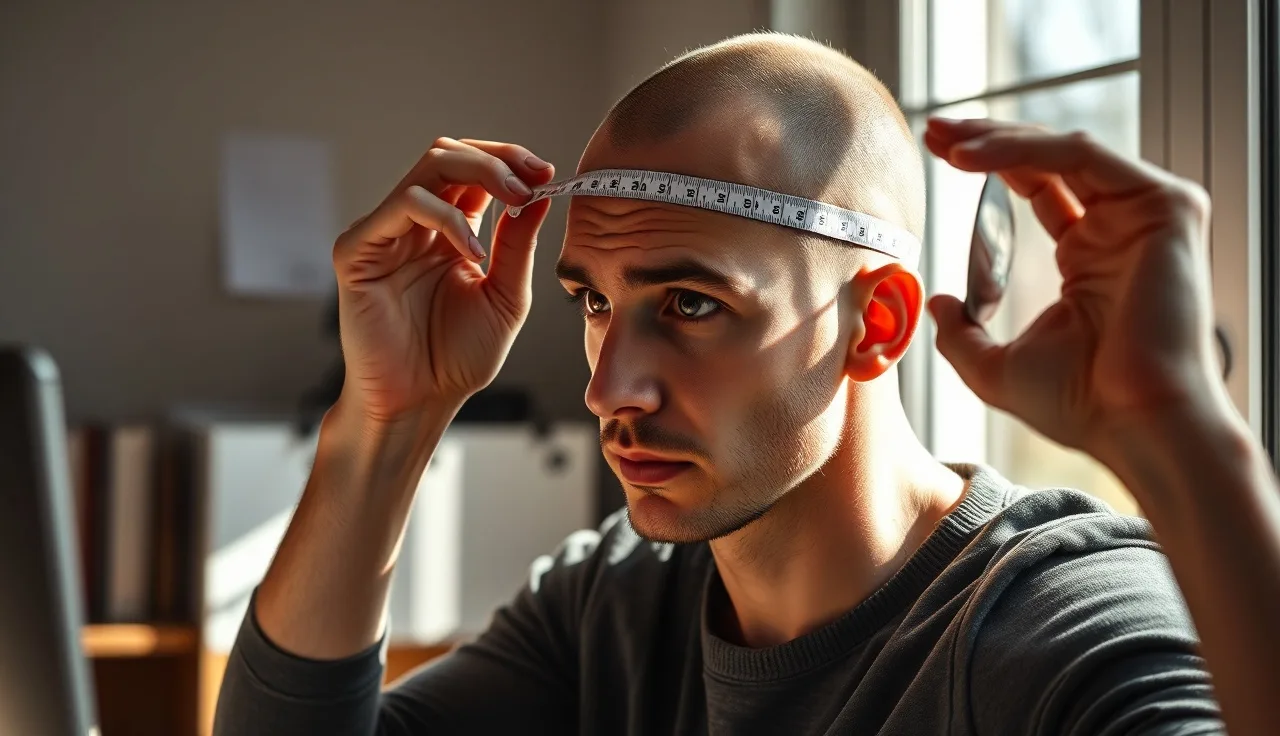
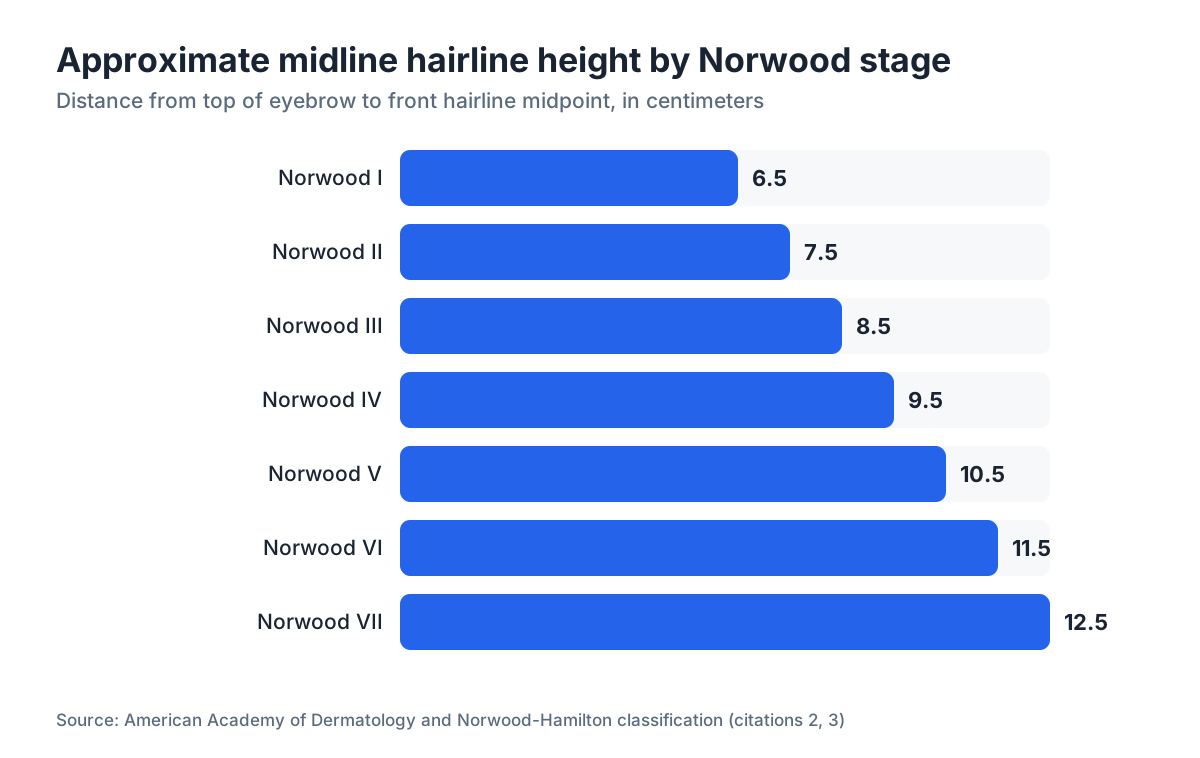
Measurement 1: Midline forehead height. Set the edge of your index finger horizontally at the top of your eyebrow. Stack fingers upward from there. The average male hairline sits roughly 6 to 8 cm above the top of the eyebrow, about three to four finger-widths [2]. Measure yours with a flexible tape and record it. Anything above 8 cm usually reads as recession in men under 30. In older men some natural lift is expected and harder to judge without a baseline.
Measurement 2: Temple recession depth. Temples recede diagonally, not straight back. Use a ruler to measure the horizontal distance from the outermost point of your front hairline to the innermost point of the temple notch on each side. Symmetrical recession under 1 cm is typically Norwood II. Over 2 cm points to Norwood III or beyond [3].
Measurement 3: Hairline curve continuity. This one gives no number but is the most telling visual check. Draw an imaginary arc from temple to temple across your forehead. In Norwood I the arc is smooth and low. From Norwood II up, the temples break that arc into an M-shape or a widow's peak. Photograph the arc in your front shot by holding a piece of white string along where the hairline used to be (use old photos to estimate).
Calibrate your finger width once. Measure across your four fingers. The average adult male reads about 7 to 8 cm across four fingers. That lets you convert finger-stack estimates to centimeters later.
What is the Norwood scale and how do you match your hairline to it?
The Norwood-Hamilton scale is the standard system for classifying male pattern hair loss. It runs from Type I (no visible recession) to Type VII (only a horseshoe fringe left) [3]. Dermatologists have used it since 1975, and it is still the reference clinicians, researchers, and transplant surgeons work from.
Here is a working description of each stage you can hold up against your photos:
| Norwood Stage | What it looks like | Approximate midline hairline height above brow |
|---|---|---|
| I | No recession, mature hairline | 6-7 cm |
| II | Slight temple recession, arc still mostly intact | 7-8 cm |
| IIA | Recession reaches midline, temples not deeply affected | 7-8 cm |
| III | Deep temple recession forming a clear M-shape | 8-9 cm |
| III Vertex | Temple recession plus a thinning crown | 8-9 cm |
| IV | Wider recession and crown thinning, bridge of hair between them | 9-10 cm |
| V | Bridge of hair narrows between front and crown | 10-11 cm |
| VI | Bridge gone, front and crown merge | 11+ cm |
| VII | Only rear and side fringe remains | 12+ cm |
To place yourself, open a Norwood diagram (the American Academy of Dermatology and the National Library of Medicine both carry reference images) and set your front photo beside it [1][4]. Match the shape of the recession, the temples especially, more than the raw hairline height. Stages I through III are generally early-stage and respond best to medical treatment [1].
The Norwood scale was built for men. Women use the Ludwig scale, which sorts diffuse central thinning into three grades rather than a receding front. If your loss looks more like overall thinning than a retreating hairline, read about telogen effluvium and what causes hair loss before you assume Norwood applies to you.
How do you track changes over time and know when something is actually happening?
Take your first full measurement set today. Repeat every 90 days. That interval is not random: the anagen (active growth) phase of scalp hair runs two to six years, and the shedding-and-cycling that drives visible recession plays out over months, not weeks [5].
Each session, log:
- Date
- Midline forehead height in centimeters
- Left and right temple recession depth in centimeters
- Norwood stage estimate (or "between II and III")
- Any change in treatment or lifestyle
A shift of 0.5 cm or more in midline height between sessions, confirmed by side-by-side photos, is meaningful. Random measurement noise (different tape tension, a slight head tilt) usually stays under 0.3 cm if you are careful [2].
Some people use a free phone app that overlays photos for direct comparison. That works well. Just make sure the app does not recompress or crop your shots. You want the originals saved somewhere permanent, cloud backup or a hard-drive folder.
One honest caveat: home measuring cannot catch miniaturization, the thinning of individual hair shafts that comes before visible recession. A dermatologist with a dermatoscope can spot miniaturization years before recession becomes measurable. If hair loss runs in your family, one early dermatology visit is worth the money even when your home numbers look flat.
What common mistakes make home measurements unreliable?
These are the errors that produce garbage data:
Inconsistent lighting. The single biggest source of error. Overhead light shines down through your hair and bares the scalp. Frontal natural light fills it back in. If you have ever thought "I look balder today" or "I look fine today" with no idea why, lighting is almost always the reason. Pick one setup and never deviate.
Selfies instead of tripod shots. Hold the phone at arm's length and tilt it down to see your hairline, and you are shooting from above at a foreshortening angle. That makes hairlines look higher and worse than they are. Always use a tripod or a prop.
Measuring only when anxious. Pull out the ruler only after a bad shedding day and your baseline is skewed toward panic. Measure on a schedule regardless of what the shower drain looked like.
Comparing to old photos with unknown angles. A graduation photo shot from below by a friend at a party is not comparable to your standardized front shot. Old photos are useful for direction (was the hairline lower?) but not for precise numbers.
Checking too often. Weekly measurement amplifies noise and feeds anxiety without adding information. Ninety-day intervals fit most people. On an active treatment, once every 60 days is the shortest useful interval, because minoxidil for men takes at least 16 weeks to show any result [6].
Can you use AI tools or apps to measure recession more precisely?
Yes, and the accuracy is climbing fast. Several tools, including the free AI scan at MyHairline (myhairline.ai/scan), read your uploaded photos, estimate Norwood stage, flag asymmetric recession, and build a baseline you can compare against later. The value is consistency: the algorithm applies the same classification rules every single time, which is exactly what makes tracking reliable.
The limits are real. No phone-camera tool can detect miniaturization (that needs a dermatoscope), and AI hair-loss staging is still a young field without long-term validation studies in peer-reviewed journals as of this writing. Treat these tools as a well-calibrated second opinion on your own photo read, not a diagnosis.
If the AI assessment and your own Norwood estimate disagree by more than one stage, that is your cue to see a board-certified dermatologist, not a reason to trust one over the other.
When do your home measurements mean you should see a doctor?
Home tracking does not replace a clinical exam. See a dermatologist if:
- Your midline height rises by 1 cm or more between any two 90-day sessions
- Temple recession jumps from under 1 cm to over 2 cm in a single quarter
- You advance two Norwood stages in six months (rapid progression is treatable but needs a faster look)
- You see diffuse thinning rather than a receding hairline (this pattern can mean telogen effluvium or another cause)
- You have scalp pain, burning, or scaling (that points toward conditions like scarring alopecia, which differs from androgenetic alopecia and needs a different treatment path entirely)
- You are under 25 and already at Norwood III or above
Bring your photo log to the appointment. A dermatologist who can see six or twelve months of standardized photos reads the rate of progression far better than someone seeing you cold for the first time.
If your numbers put you in the early stages and you want to know your options, read up on finasteride, minoxidil for men, and DHT blockers before the visit. That makes the conversation faster. Your doctor can then help you weigh a medication, a hair transplant, or watchful waiting for your situation.
How do you create a long-term photo archive that does not get lost?
The archive is only as good as your ability to find things in it. Here is a setup that holds up:
- Make a dedicated folder in iCloud, Google Photos, or Dropbox named "Hairline Log".
- After each session, name files with the date in YYYY-MM-DD format (2025-04-15-front.jpg, 2025-04-15-left.jpg, 2025-04-15-right.jpg). That sorts them chronologically on its own.
- Keep a plain text file or spreadsheet in the same folder with your measurements and Norwood estimate per session.
- Back it up to a second location. Phone photos vanish when phones get lost or reset.
After a year you have four sessions of three photos each plus a measurement log, enough for a side-by-side comparison that actually tells you something. After two years, that archive becomes a real history any specialist will value.
Start a treatment like finasteride and minoxidil together? Note the start date in your log. That date is the baseline the whole record is measured against, and without it you cannot judge whether the treatment helped.
What do the numbers actually mean for your treatment decisions?
Here is the practical read once you have a few sessions banked:
| What your log shows | What it likely means | Suggested next step |
|---|---|---|
| Stable measurements, no Norwood change over 12 months | Mature hairline or very slow progression | Keep monitoring, no urgent action |
| 0.5-1 cm increase in midline height over 6 months | Active recession, early to moderate | Discuss medical treatment with a dermatologist |
| Temple recession growing each session | Progressive androgenetic alopecia | Medical evaluation, consider finasteride or minoxidil |
| Norwood stage jumps 2+ stages in a year | Rapid progression | Prompt dermatologist visit |
| Diffuse thinning without a clear M-shape | May not be androgenetic alopecia | Rule out telogen effluvium, thyroid issues, nutritional deficiency |
The FDA-approved medical treatments for androgenetic alopecia are topical minoxidil (approved for men in 1988) and oral finasteride (approved for men in 1997) [6][7]. Neither reverses advanced recession reliably. Both work best started at Norwood II or III. That is the practical reason to measure early: the window for a meaningful treatment response is widest at the start.
Androgenetic alopecia reaches roughly half of men by age 50 and moves through the Norwood stages in a predictable order [8]. For anyone at Norwood V or beyond who wants density back, a hair transplant is usually the realistic route, and home measurements at that point mostly serve to document donor-area stability before surgery.
Sources
- Journal of the American Academy of Dermatology, 2014 - Norwood self-staging validation study
- American Academy of Dermatology - Hair loss overview and measurement guidance
- Hamilton JB, Norwood-Hamilton scale original classification, reproduced by National Library of Medicine
- American Academy of Dermatology - Androgenetic alopecia patient resource
- National Library of Medicine - Hair follicle cycling and anagen phase duration review
- FDA - Minoxidil OTC drug label and approval history
- FDA - Finasteride (Propecia) prescribing information and approval
- National Center for Biotechnology Information, StatPearls - Androgenetic alopecia clinical review
- International Society of Hair Restoration Surgery - Hair transplant patient guidelines