

TL;DR: Temporal recession is the natural rounding of the hairline corners that most men and many women develop in their late teens and twenties. True hairline recession is progressive androgenetic alopecia driven by DHT. The difference matters because one needs no treatment and the other does. A dermoscopy exam plus family history is how doctors tell them apart.
What is temporal recession and is it normal?
Temporal recession is the slight pulling back of the hairline at the temples, creating a softer, more oval or slightly rounded shape compared with the square juvenile hairline most people have as children. It's so common that dermatologists sometimes call it a "mature hairline" rather than recession at all.
Most men develop at least some temple rounding by their mid-twenties. A 2017 review in the Journal of the American Academy of Dermatology noted that the shift from a juvenile to a mature hairline can start in men as young as 17 and is largely finished by age 30. The process is gradual, and on its own it doesn't reliably predict further loss [1].
The key word is "gradual." Normal temporal recession moves slowly, stays symmetric, stops on its own, and never thins the crown or the mid-scalp. It isn't driven by active follicle miniaturization the way androgenetic alopecia is, though it does involve some hairline migration at the temples.
For women, true temporal recession is rare as an isolated finding. When women lose hair at the temples, it's more often traction alopecia, frontal fibrosing alopecia, or telogen effluvium than the male-pattern progression. See our guide on telogen effluvium for more on diffuse shedding patterns in women.
What counts as true hairline recession?
True hairline recession is progressive. It doesn't stop at the temples and hold steady. It keeps advancing, often with thinning of the hair shaft diameter (miniaturization) at the leading edge of the hairline and eventually at the crown.
The clinical standard for classifying male-pattern hair loss is the Norwood-Hamilton scale, which runs from Type I (no recession) to Type VII (only a horseshoe band of hair remaining). Temporal recession that has stabilized and shows no miniaturization is generally considered a mature hairline or at most a Norwood Type I-II. Once recession is measurable, progressive, and shows follicle miniaturization under dermoscopy, dermatologists classify it as androgenetic alopecia, regardless of where the person falls on the scale [2].
True recession is driven by dihydrotestosterone (DHT), the androgen that makes genetically susceptible follicles shrink over successive growth cycles. Follicles at the temples and the crown carry a higher density of androgen receptors than occipital follicles, which is why those areas go first. For more on the mechanism, our article on what causes hair loss covers the biology.
Here's a practical tell. True recession makes individual hairs at the hairline finer and shorter over time. Look closely at the edge of a receding hairline. If the hairs there are visibly thinner or more vellus-like (fine, almost colorless) than the hairs two inches behind them, that's miniaturization, and that's androgenetic alopecia.
How do dermatologists diagnose which one you have?
Diagnosis combines four things: clinical history, physical exam, dermoscopy, and sometimes a scalp biopsy or blood work.
Clinical history. The doctor asks when you first noticed the change, whether it has moved over months or years, whether family members (on either or both sides, contrary to the old myth that only the maternal grandfather matters) have significant hair loss, and whether there are associated symptoms like scalp pain, itch, or systemic illness.
Physical exam. The doctor measures or photographs the hairline and compares it to the Norwood scale. They check symmetry (asymmetric recession is a red flag for other causes) and assess whether the temporal recession stands alone or whether the crown and mid-scalp are also affected.
Dermoscopy. This is the most important tool. A dermoscope (essentially a magnifying glass with polarized light) lets the clinician see hair shaft diameter variation at the scalp level. More than 20% diameter variability across hairs in the affected zone is the accepted diagnostic threshold for androgenetic alopecia miniaturization [3]. Normal temporal recession doesn't produce this pattern. Dermoscopy also shows features like perifollicular discoloration or fibrosis, which can point toward scarring alopecias such as frontal fibrosing alopecia.
Blood work and biopsy. These aren't always needed for classic male androgenetic alopecia, but they matter when the diagnosis is uncertain, particularly in women or when recession is rapid. Labs typically include ferritin, thyroid-stimulating hormone, total and free testosterone, and DHEA-S. A 4mm punch biopsy read by a dermatopathologist can show the ratio of terminal to vellus hairs and confirm the miniaturization pattern at the tissue level [4].
The American Academy of Dermatology's clinical guidelines state that in men presenting with the typical pattern of androgenetic alopecia (bitemporal recession plus or minus vertex thinning) with no other clinical concerns, biopsy is usually unnecessary and a clinical diagnosis is appropriate [4].
Can you tell by looking in the mirror?
Sometimes. A few checks can help you make a reasonable judgment before you see a doctor.
First, take a photo in good lighting and compare it to a photo from two to three years ago. If the shape and density match, you're probably looking at a stable mature hairline. If the hairline has clearly moved or the density has dropped, that suggests progression.
Second, pull a few hairs from the leading edge of the hairline (close to the temple) and a few from the back of the scalp. Hold them against a white background. If the temple hairs are noticeably finer or shorter in their anagen (growth) length, that's a sign of miniaturization.
Third, look at the density one centimeter behind the hairline. Androgenetic alopecia often creates a "see-through" look at the hairline because miniaturized hairs don't provide full coverage. A mature hairline that has simply repositioned doesn't do that. The hair behind it stays fully dense.
No self-diagnosis beats a dermoscopy exam. If you're genuinely uncertain and want a first read before booking a dermatologist appointment, tools like the free AI hair scan at MyHairline can analyze photos for patterns consistent with miniaturization and give you a Norwood estimate to bring to your appointment. It's not a clinical diagnosis, but it tells you whether the concern is worth pursuing.
If the recession is asymmetric, comes with scalp soreness or itching, or has progressed very fast (noticeable change within weeks), see a dermatologist promptly. Those patterns suggest something other than standard androgenetic alopecia.
What does the Norwood scale say about temporal recession specifically?
The Norwood-Hamilton scale is the most widely used classification for male-pattern hair loss, and the early stages are defined almost entirely by temporal recession.
| Norwood Type | Description | Temporal area |
|---|---|---|
| Type I | No recession. Juvenile hairline. | Full coverage |
| Type II | Slight, symmetric recession at temples, less than 1.5 cm from Type I. | Slight rounding |
| Type III | Deep temporal recession. First cosmetically significant stage. | Clearly receded |
| Type III Vertex | Temples like Type III but primary loss is at crown. | Recession present |
| Type IV | More extensive recession, early separation of temple and crown zones. | Significant loss |
| Type V-VII | Progressive until only occipital band remains. | Most or all gone |
The clinical convention is that a mature hairline (normal temporal rounding without progression) sits at Type I or borderline Type I-II. Once a trained clinician sees miniaturization under dermoscopy, even a Type II pattern becomes a true androgenetic alopecia diagnosis rather than a "mature hairline" finding [2].
For women, the Ludwig scale and the more recent FPHL Visual Scale are used instead because female-pattern hair loss rarely follows the bitemporal recession path.
What causes temporal recession to become true recession?
The driver is genetics and androgen sensitivity, not the recession itself. A man can sit at a stable Type II for his entire adult life, or that same Type II can be the leading edge of a Type VII pattern twenty years later. There's no way to know from the starting position alone.
Risk factors that predict progression include a strong family history of extensive baldness (particularly early onset, before 30), high DHT levels or high androgen sensitivity at the follicle level, early onset of any recession (before 20 is more predictive than onset at 28), and rapid initial progression [5].
Things often blamed that don't actually cause true temporal recession: wearing hats, poor diet (unless you're genuinely malnourished), hard water, and most shampoos. Tight hairstyles can cause traction alopecia, which can mimic recession at the temples, but that's a different diagnosis. If you're curious about specific lifestyle factors and hair loss, the does creatine cause hair loss article examines one commonly blamed supplement against the actual evidence.
Stress and nutritional deficiency can cause diffuse shedding (telogen effluvium), which sometimes makes the hairline look thinner for a while, but telogen effluvium doesn't cause the progressive miniaturization pattern of androgenetic alopecia. Rule it out before starting medication.
When should you start treatment and what are the options?
The evidence-based treatments for androgenetic alopecia are minoxidil and finasteride. Both have FDA approval for hair loss. Neither reverses a mature hairline that was never androgenetic alopecia.
Finasteride (1 mg/day orally) inhibits the enzyme 5-alpha reductase, which converts testosterone to DHT, cutting scalp DHT by roughly 60-70% [6]. A 5-year trial published in the Journal of the American Academy of Dermatology found that 90% of men on finasteride maintained or improved hair count versus 75% of placebo patients who lost hair [6]. It works best started early, before significant miniaturization sets in. Our full breakdown of finasteride covers dosing, side effects, and what to expect.
Minoxidil (topical 2% or 5%, or oral at low doses) extends the anagen phase of follicles and may increase follicle size. It doesn't block DHT, so it doesn't address the root cause in androgenetic alopecia, but it can thicken miniaturized hairs and slow visible loss. Combined with finasteride, it works better than either alone [7]. See finasteride and minoxidil for the combination data, and minoxidil for men for topical specifics.
For pure temporal recession that a dermatologist has diagnosed as a mature hairline with no miniaturization, the honest answer is that medications offer minimal benefit. You're not treating a disease, and the treatments carry real side effect profiles. Finasteride carries a small but real risk of sexual side effects in some users, and minoxidil can cause initial shedding and, in the oral form, blood pressure effects. See minoxidil side effects for the full picture.
Hair transplant surgery is an option for men who have stable recession (not actively progressing) and enough donor hair. A surgeon will usually not transplant into an actively receding hairline because the surrounding native hair will keep falling, leaving transplanted hairs as isolated islands. Hair transplant covers candidacy and realistic outcomes.
For those who want to understand DHT blockers beyond finasteride, including newer options like dutasteride and topical formulations, the dht blocker article breaks down the evidence.
What if you're a woman with temporal recession?
Women rarely experience the standard male-pattern bitemporal recession as their primary hair loss presentation. When a woman sees significant temple hair loss, the differential diagnosis is different and broader.
Frontal fibrosing alopecia (FFA) is a scarring alopecia that causes a progressive, band-like recession of the frontal and temporal hairline. It's becoming more common, with incidence rising sharply since the 1990s, though the reason isn't fully understood. FFA recedes the hairline in a particular way: the skin at the hairline margin looks slightly pale or scarred, and there's often loss of eyebrow and eyelash hair too. Early diagnosis matters because FFA can cause permanent scarring [8].
Traction alopecia from tight ponytails, braids, extensions, or weaves preferentially hits the temples and hairline. Unlike androgenetic alopecia, it's preventable and often partly reversible if the traction stops early.
Female androgenetic alopecia does happen, but it usually shows up as a widening central part or diffuse thinning over the crown, not bitemporal recession. Women who do have temporal recession as part of female-pattern hair loss often have elevated androgens from conditions like PCOS.
Any woman with temporal recession should have blood work including androgens and ferritin, and should see a dermatologist for dermoscopy. The stakes of misdiagnosis are higher here because the treatments differ a lot depending on the cause.
How quickly does true hairline recession progress?
There's no single answer, and this is one of the most frustrating things about androgenetic alopecia. Some men go from Type II to Type V in five years. Others stay at Type III for decades.
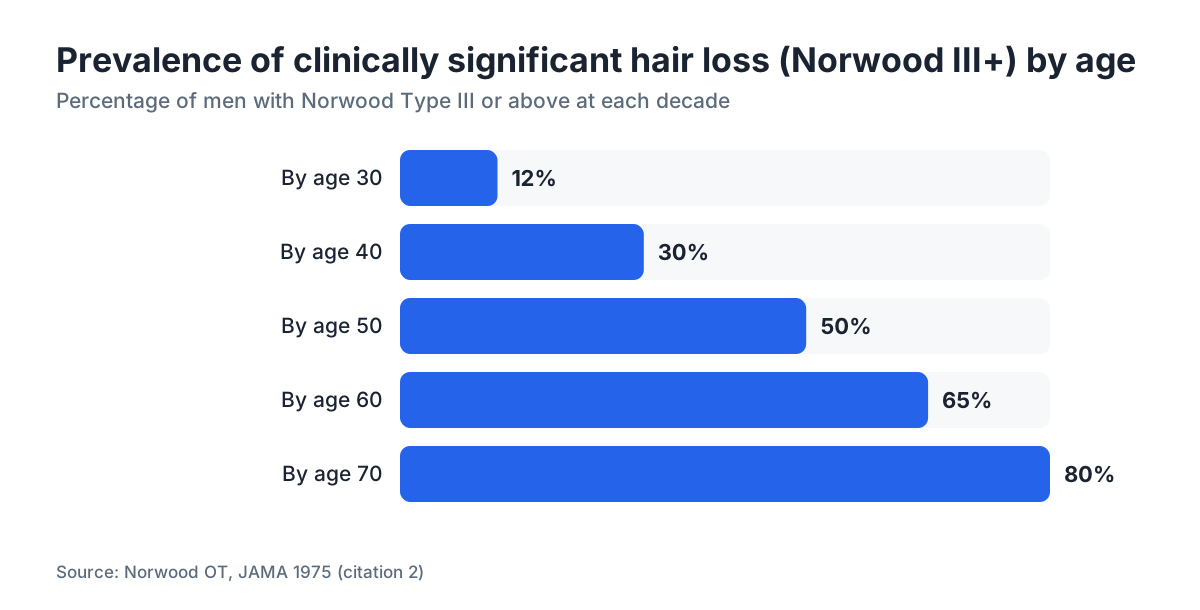
The best prognostic data comes from long-term observational studies. Norwood's 1975 classification study of over 1,000 men found that by age 50, roughly 50% of men have some degree of clinically significant hair loss (Type III or above), and by age 70 that number approaches 80% [2]. That's a population average, not an individual prediction.
Onset age is the most useful predictor. Men who show measurable recession before age 20 are far more likely to reach advanced Norwood stages by their 40s than men whose recession starts at 30. A retrospective review published in Dermatology found that onset before age 20 was associated with a fourfold higher risk of reaching Norwood V or above compared with onset after age 30 [5].
Stable at the same level for three or more years with no new miniaturization on dermoscopy? You may well stay there. Moved a full Norwood stage in less than two years? That trajectory is a reason to take treatment seriously.
Hair loss reviews in JAMA make a consistent point: early intervention in androgenetic alopecia produces better maintenance outcomes than treatment started after significant loss, and recovery of already-lost hair is limited. The practical implication is simple. If you want to preserve what you have, act early rather than wait for the recession to stabilize on its own.
What is the role of photos and tracking in monitoring hairline changes?
Consistent photography is the single most underused tool in hair loss monitoring. Daily changes are imperceptible, and human memory is terrible at recalling exactly how thick or far back the hairline was two years ago.
A useful protocol: take standardized photos every three to six months in the same lighting, the same camera position, and the same hair styling (ideally hair pulled back or cut short). Use three angles: frontal, each side at 45 degrees, and top-down (vertex). The AAD recommends that dermatologists use global photography and standardized hair counts as outcome measures in both clinical practice and trials [4].
Some dermatologists mark a 1cm x 1cm scalp section with a removable marker, count the hairs in that section, and repeat every six months. This "hair count" method isn't practical at home, but the principle holds: what gets measured gets managed.
For AI-assisted tracking at home, the free scan at MyHairline can analyze your photos over time and flag changes that suggest progression, giving you something concrete to bring to a dermatologist rather than just a feeling that things look different.
Tracking answers one question: is this stable or moving? If it's stable, you're probably looking at a mature hairline. If it's moving, you have androgenetic alopecia and the treatment decision becomes real.
Can a mature hairline be improved with a hair transplant?
Technically, yes. A surgeon can transplant follicles into the temple corners to restore a squarer, more juvenile hairline shape. But most reputable surgeons are cautious about it, for several reasons.
First, if the person has any underlying androgenetic alopecia, those transplanted hairs are permanent (they come from DHT-resistant occipital follicles) but the native hairs around them will keep thinning. That creates an odd, patchy look over time. Transplanting into a stable, purely mature hairline with zero androgenetic alopecia and excellent donor hair is more defensible, but proving the hairline is truly stable with no miniaturization takes time and dermoscopy follow-up over more than one appointment.
Second, hairline transplants are a cosmetic procedure with permanent aesthetic consequences. Surgeons vary a lot in their skill at designing natural-looking hairlines with appropriate density gradients and single-hair grafts at the leading edge. Choosing on price alone is a serious mistake.
Third, the donor supply is finite. If a man has a stable mature hairline at 25 but is genetically headed for a Norwood VI pattern by 50, spending donor grafts on the temple corners now wastes a limited resource. Most hair loss specialists recommend deferring transplant decisions until the pattern has been stable for at least two years, and ideally until the person is in their late twenties or older.
For a thorough look at what transplants realistically involve, costs, and how to evaluate surgeons, see our hair transplant guide.
Sources
- Journal of the American Academy of Dermatology, Shapiro & Otberg 2017 review on mature hairline
- Norwood OT, JAMA 1975, classification and prevalence of male-pattern alopecia
- Rudnicka L et al., Journal of the American Academy of Dermatology 2012, dermoscopy in hair and scalp diseases
- American Academy of Dermatology, Clinical Guidelines for Androgenetic Alopecia
- Messenger AG, Dermatology 2000, age of onset and progression in androgenetic alopecia
- Kaufman KD et al., Journal of the American Academy of Dermatology 1998 to 5-year finasteride trial
- Hu R et al., systematic review of combined finasteride and minoxidil for androgenetic alopecia
- Vano-Galvan S et al., British Journal of Dermatology 2014, frontal fibrosing alopecia multicenter study
- FDA Drug Label, Propecia (finasteride 1 mg), NDA 020788
- FDA Drug Label, Rogaine (minoxidil topical solution), approved OTC for hair loss
- Sinclair RD, International Journal of Dermatology 2004, female-pattern hair loss review
- National Institutes of Health MedlinePlus, hair loss overview