

TL;DR: The Norwood scale (officially Hamilton-Norwood) sorts male pattern baldness into seven stages based on hairline position and crown thinning. You can self-assess by comparing your hairline and crown to the stage diagrams. Stages 1-2 are minimal recession; stages 3-4 show clear loss; stages 5-7 mean extensive baldness. Most men with androgenetic alopecia fall between stages 2 and 5 at first diagnosis.
What is the Norwood scale and who created it?
The Norwood scale is the most widely used classification system for male pattern hair loss. Its full name is the Hamilton-Norwood scale because dermatologist James Hamilton built the original in 1951 and Dr. O'Tar Norwood revised and expanded it in 1975. [1] Norwood's version added intermediate stages (the "A" variants) and clarified what counts as a distinct progression step, which is why it became the clinical standard.
The scale runs from Type I (no meaningful recession) to Type VII (only a narrow rim of hair remains along the sides and back). In between, each stage describes a predictable pattern of hairline retreat and crown thinning driven by dihydrotestosterone (DHT) shrinking genetically sensitive follicles. [2]
It was built for classification in clinical research, not as a self-diagnosis tool. Even so, dermatologists and hair transplant surgeons use it daily to decide whether a patient is a candidate for treatment, which drug dose makes sense, and whether a transplant is premature. Learn the stages well enough to place yourself accurately and you walk into any consultation already speaking your doctor's language.
What are the seven Norwood stages and what does each one look like?
Here is a plain-language description of every Norwood stage so you can compare against your own hairline and crown.
Type I. The hairline sits where it did in your late teens or early twenties. No real recession. Many men never leave this stage.
Type II. Slight triangular recession at the temples. The hairline edges back symmetrically, but there is still a full fringe across the front. Most men in their 20s who notice "slight thinning" are here. This is where many people first start paying attention.
Type II A (variant). Recession moves forward across the entire front of the hairline rather than deepening at the temples. Crown remains full. The A variants are defined by this front-to-back pattern rather than the temple-first pattern of standard stages.
Type III. This is the first stage Hamilton and Norwood classified as clinically significant hair loss. The temples are deeply receded, leaving the hairline shaped like a U or V from above. The area behind the temples may show light thinning.
Type III Vertex. Recession at the temples similar to Type III, but thinning at the crown (vertex) is now the dominant feature. This is where men often notice a growing spot on the back of the head.
Type IV. Recession is severe at the temples and the hairline has retreated well behind where it started. The crown bald spot has grown. A band of hair still separates the front hairline from the crown thinning area. That bridge disappears at stage V.
Type V. The bridge of hair between the front and crown has narrowed a lot and, in many men, nearly disappeared. The two bald zones are beginning to merge. Hair loss now covers a large portion of the top of the head.
Type VI. The bridge is gone. The front hairline recession and crown baldness have merged into one continuous bald zone. Only a horseshoe-shaped band of hair remains on the sides and back.
Type VII. The most advanced stage. The horseshoe band is now narrow and may sit low on the head. This is the maximum extent of androgenetic alopecia on the Norwood scale. [1][3]
| Norwood Stage | Hairline recession | Crown thinning | Separated zones? |
|---|---|---|---|
| I | None | None | N/A |
| II | Slight temple recession | None | N/A |
| III | Deep temple recession | None or minimal | Yes |
| III Vertex | Moderate temple recession | Prominent | Yes |
| IV | Severe temple recession | Significant | Yes |
| V | Severe, hairline retreated | Merging | Barely |
| VI | Severe | Extensive | No |
| VII | Maximum | Maximum | No |
How do you self-assess your Norwood stage at home?
Self-assessment is not perfect, but it is good enough to give you a working idea of where you are before you see a doctor. You need three things: good lighting, a second mirror or a camera that can photograph the top of your head, and a photo from two to three years ago if you have one.
Step 1. Look at your hairline from the front. Stand under a bright light (daylight is best) and look straight into a mirror. Note where your hairline crosses your forehead. A rough reference I use: place your forefinger horizontally at the top of your forehead creases. If your hairline sits one to two finger-widths above that line, it has receded. If it sits three or more finger-widths above, recession is significant. The corners matter as much as the center. Deep triangular temple recession with a relatively intact center front is the classic early Norwood pattern.
Step 2. Check the crown. Use a second mirror behind your head and a front mirror at the same time, or take a photo directly above your head with your phone. Look for a circular or oval zone where the hair appears sparse. In good light, scalp showing through the hair is the key signal, more than overall hair density.
Step 3. Map it to the stages. Temple recession but a fully connected hairline and no crown involvement puts you at II or III. If the crown is thinning but a strip of hair still connects the front to the back, you are in the IV to V range. No strip means VI or VII.
Step 4. Compare against old photos. Recession happens slowly, so the gap between today and two years ago is often the clearest evidence of active progression. Stable stage II is a different situation from stage II that became stage III in 18 months.
One honest limitation: self-assessment reliably misreads diffuse thinning (where the hair gets thinner uniformly without clear recession) as a lower stage than it really is. Diffuse thinning can be androgenetic alopecia, or it can be telogen effluvium, which has a completely different cause and treatment path. If your hair seems uniformly thin rather than receding in a pattern, see a dermatologist before assuming Norwood applies to you. [4]
How accurate are Norwood scale self-assessments compared to a dermatologist's?
Self-assessments run low. Two trained clinicians agree on a Norwood stage roughly 73% of the time; a man staring at his own scalp does worse, especially at the borderlines. A 2017 study in the Journal of the American Academy of Dermatology found that inter-rater agreement dropped when raters hit the tricky calls, like II versus III or IV versus V. [3]
Most people never see the crown of their own head, and we adapt to the gradual changes we watch in the mirror every day. The line between a stage IV and a stage V, which drives treatment decisions, often comes down to whether a thin bridge of hair is still there. That is hard to judge from a phone photo.
None of this makes self-assessment useless. It gives you a real starting point. But if you are thinking about committing to finasteride or budgeting for a hair transplant, a formal read from a board-certified dermatologist or hair specialist is worth the single appointment. Many offer it free or at low cost, and androgenetic alopecia (AGA) can sometimes be confirmed with a scalp biopsy or trichoscopy rather than guessed from pattern alone. [4]
What causes the hairline to recede in a Norwood pattern?
The mechanism behind Norwood-pattern hair loss is well established. DHT, the potent metabolite of testosterone produced by the enzyme 5-alpha reductase, binds to androgen receptors in hair follicles on the scalp. Follicles in the frontal scalp and crown are genetically sensitive to DHT; follicles on the sides and back (the "safe zone" used in transplants) resist it. When DHT binds to sensitive follicles, it shortens the anagen (growth) phase and miniaturizes the follicle over successive cycles until it makes only vellus (fine, nearly invisible) hairs. [2]
This is why the Norwood pattern is not random. Temple recession followed by crown thinning tracks the distribution of DHT-sensitive follicles across the scalp. Genetics (multiple genes, more than one from your mother's side) set how sensitive your follicles are and how aggressively they miniaturize.
Age is the big amplifier. The American Academy of Dermatology reports that androgenetic alopecia affects roughly 50% of men by age 50. [5] Some men see heavy recession by their early 20s; others barely move from stage II their whole lives. That spread in progression rate is one reason two men at the same stage need different treatment plans.
For a deeper look at the underlying mechanism, what causes hair loss covers DHT, genetics, and lifestyle factors in full. For how DHT-blocking treatments work, read dht blocker next.
At what Norwood stage should you start treatment?
This is the question that matters most in practice. The honest answer: earlier is better, because treatments slow or stop progression but do not reliably reverse advanced loss.
For finasteride, the FDA-approved oral 5-alpha reductase inhibitor for male pattern baldness, trials showed it worked best in men with mild to moderate loss, roughly Norwood II through IV. The 5-year trial published in the Journal of the American Academy of Dermatology found that 90% of men taking 1 mg finasteride daily maintained or increased hair count versus 75% who lost hair on placebo. [6] That trial mainly enrolled men at Norwood stages II through IV. Men at stage VI or VII have little scalp hair left to preserve, which is why finasteride makes less clinical sense that late.
Minoxidil for men (topical, 2% and 5%) is FDA-cleared for androgenetic alopecia and can start at any stage, but again the payoff is largest when there is still real hair to keep or stimulate. If you want the downsides before starting, minoxidil side effects has the real data on what to expect.
Hair transplant surgery is generally not recommended below stage III or IV because surgeons need to know the final extent of loss before moving permanent donor hair. Transplant at stage II and you often need a second procedure years later. Most surgeons prefer to operate on patients who have been stable (no meaningful new recession) for at least one to two years, and who are already on medical therapy to slow ongoing loss.
For men combining both, finasteride and minoxidil together show additive effects in clinical data, and the pair is now the most common starting point for men at stages II through IV.
Want a free baseline before booking anything? MyHairline's AI scan at /scan can place your Norwood stage from a photo and flag whether your pattern matches typical androgenetic alopecia or something else worth checking.
How fast does the Norwood scale progress?
Progression rate varies enormously between men. The longest-running data come from Norwood's own work and later epidemiological studies. On average, genetically predisposed men move roughly one Norwood stage per decade, but that average hides a wide spread. Some men jump from stage II to stage IV in three to four years in their 20s; others sit at stage III for 20 years.
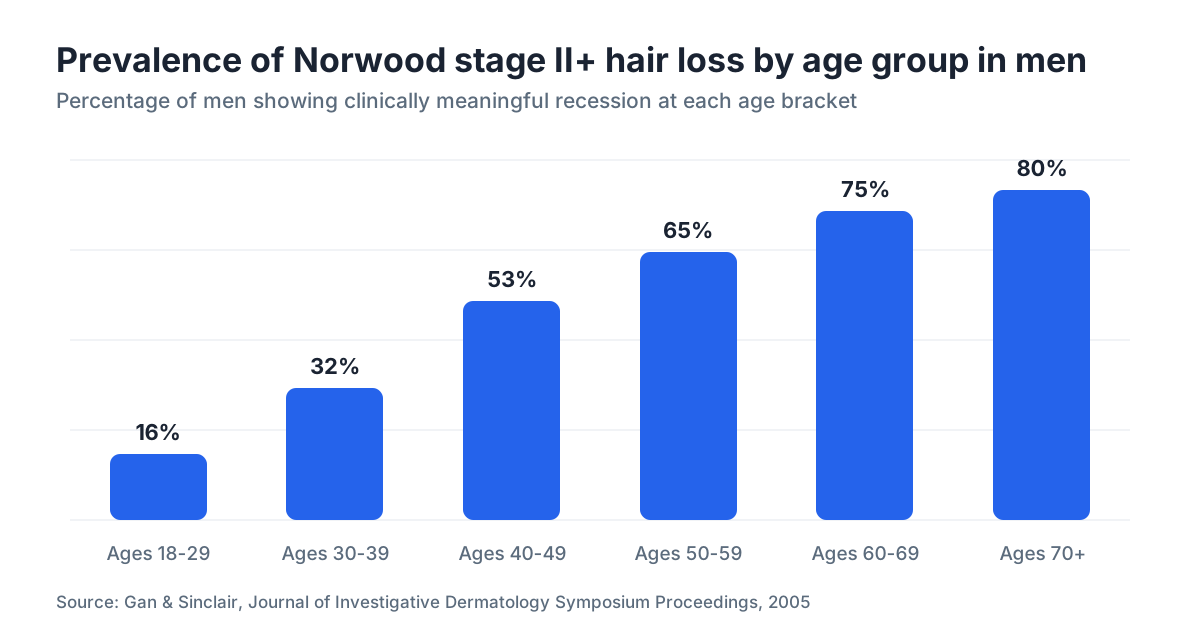
A population study of 1,000 men published in the Journal of Investigative Dermatology Symposium Proceedings found that about 16% of men aged 18-29 showed stage II or greater recession, rising to 53% by ages 40-49 and over 80% by age 70. [7] Those figures capture prevalence at each age, not individual speed, but they show that the 40s and 50s are when most men see meaningful jumps.
Early-onset loss (recession clearly visible before age 25) tends to predict faster progression and a higher eventual Norwood stage. Men who first notice recession after age 35 tend to move slower and often plateau at a moderate stage. That is why age at onset is one of the first things a hair specialist asks about.
Are there Norwood scale variants for different hair patterns?
Yes. The "A" variant stages (IIA, IIIA, IVA, VA) describe a front-to-back hairline recession pattern rather than the more common temple-first pattern. In the A variants, the whole front hairline recedes backward uniformly rather than deepening at the temples first, and the crown often stays relatively full until very late stages. Men with A-variant patterns can wrongly think they are at a lower stage because they lack the deep temple recession most people picture.
Norwood stage III Vertex is another variant used often in clinical notes. It describes men whose crown thinning is more prominent than expected for their degree of temple recession. It matters because vertex-dominant loss sometimes responds differently to treatment than hairline-dominant loss of the same Norwood number.
The scale was developed mostly in men of European descent. Some researchers note it maps less cleanly onto loss patterns in men of East Asian or sub-Saharan African heritage, where diffuse thinning or vertex-first loss is more common. The Modified Norwood-Hamilton scale and alternative tools like the BASP (Basic and Specific classification) have been proposed to capture these differences better, though the original Norwood scale remains the most cited in research. [3]
How is the Norwood stage used in hair transplant planning?
Surgeons use the Norwood stage to estimate total bald area in square centimeters, project where loss is heading, and calculate whether a patient has enough donor hair in the permanent zone (sides and back) to fill the anticipated bald area.
A standard FUE (follicular unit extraction) graft covers roughly 40 to 60 follicular units per square centimeter for natural density; a Norwood VI scalp may have 150 to 200 square centimeters of bald area, which demands 6,000 to 12,000 grafts. Most scalps can safely donate 4,000 to 8,000 grafts total over a lifetime without looking depleted. That arithmetic is why surgeons are cautious about operating on young men at stage III who might reach stage VI by their 40s. [8]
Norwood stage also drives hairline design. A surgeon designing a hairline for a stage IV patient has different goals than one working on a stage VI patient, where the priority shifts to creating the look of density across a large area rather than rebuilding a natural frontal hairline.
For men weighing surgery, pairing a realistic Norwood assessment with an honest conversation about lifetime progression (and staying on medical therapy after the transplant) is the framework surgeons keep coming back to.
Can Norwood stage be reversed, or can treatments move you back a stage?
Technically, yes, but modestly and rarely. The FDA approval language for finasteride 1 mg (Propecia, now generic) states it was shown to increase hair count and improve hair growth in men with mild to moderate male pattern hair loss. [6] Clinical photos in the original trials show some men moving from a borderline stage III to something closer to stage II over 12 to 24 months, but this was not universal and showed up more as stabilization than a clear stage reversal.
Minoxidil can stimulate regrowth in follicles that are miniaturized but not yet dead, which produces modest density gains across a population. The FDA-cleared label for 5% topical minoxidil states that in clinical studies, 48% of men rated their hair regrowth as minimal and 36% as moderate after 48 weeks. [9] That is improvement in density, not a systematic roll-back of Norwood stage.
The honest framing: treatments are brakes, not a reverse gear. Stage reversal is a possible bonus for some men, mostly those who start early. Treating hair loss as a progression you can slow is more realistic than expecting to recover lost ground after years of ignoring it. If lifestyle factors might be adding to your loss, hair loss supplements covers what the evidence actually supports for nutritional approaches.
What is the difference between the Norwood scale and other hair loss classification systems?
The Norwood scale is built specifically for male androgenetic alopecia. A few other systems exist for different purposes.
The Ludwig scale classifies female pattern hair loss on a three-point scale (I, II, III) based on diffuse central thinning rather than the hairline recession pattern seen in men. It is not interchangeable with Norwood.
The Sinclair scale is a newer five-point scale for women that is gaining traction in research because it tracks better with psychological impact scores and treatment response. [10]
The BASP (Basic and Specific classification) proposed by Lee et al. in 2007 attempts one system for both sexes by separating hairline type (the "basic" component) from specific patterns like frontal or vertex density loss. It is used in some Asian dermatology centers but has not displaced Norwood in North American or European practice.
For men, Norwood is the clinical standard. Read about finasteride trials, transplant graft calculations, or epidemiology studies and Norwood stages are almost always the unit of measurement. Learning it pays off.
When should you see a doctor about hairline recession rather than self-assessing?
Self-assessment with the Norwood scale is fine as a starting point. See a board-certified dermatologist if any of these apply.
You are losing hair rapidly over weeks or months rather than years. That speed points to telogen effluvium, alopecia areata, or a systemic cause rather than Norwood-pattern androgenetic alopecia. Telogen effluvium in particular can cause alarming shedding that resolves on its own, but it mimics AGA closely enough that the two get confused often. [4]
You have scalp redness, scaling, itching, or pain. These point to scarring alopecias (like frontal fibrosing alopecia or lichen planopilaris) where delay can cause permanent follicle loss.
You are a woman noticing Norwood-like recession. Women can have androgenetic alopecia, but the pattern and hormonal context differ, and other causes (thyroid disorders, PCOS, iron deficiency) need to be ruled out first.
You are under 20. Early-onset loss deserves a full workup before committing to long-term medication.
At the MyHairline /scan tool, you can get a free AI-based Norwood read from your photos in a few minutes, which helps you decide how urgent an in-person appointment really is before you book one.
For anyone who wants to understand every condition that can look like Norwood-pattern recession, receding hairline covers differential diagnosis in readable detail.
Sources
- Norwood OT. Male pattern baldness: classification and incidence. Southern Medical Journal, 1975
- Sinclair R. Male pattern androgenetic alopecia. BMJ, 1998
- Gupta AK et al. Reliability of the Hamilton-Norwood scale. Journal of the American Academy of Dermatology, 2017
- American Academy of Dermatology. Diagnosing and treating hair loss
- American Academy of Dermatology. Hair loss: who gets and causes
- Kaufman KD et al. Finasteride in the treatment of men with androgenetic alopecia. Journal of the American Academy of Dermatology, 1998
- Gan DCC, Sinclair RD. Prevalence of male and female pattern hair loss in Maryborough. Journal of Investigative Dermatology Symposium Proceedings, 2005
- Rassman WR, Bernstein RM et al. Follicular unit extraction. Dermatologic Surgery, 2002
- FDA. Minoxidil 5% topical solution for men - product label
- Sinclair R et al. The Sinclair scale: a new tool for assessing scalp hair loss in women. British Journal of Dermatology, 2004