

TL;DR: A mature hairline is a permanent, natural shift of about half an inch from your teenage hairline, usually finishing by your mid-20s. A receding hairline is androgenetic alopecia: it keeps moving backward, often following the Norwood scale from stage 2 onward. The difference is progression. If your hairline has held steady for two or more years, it's almost certainly mature, not balding.
What is a mature hairline and is it the same as going bald?
No. A mature hairline is not hair loss. It's the natural shift from the flat, low hairline you had as a child or teenager to the slightly higher, more angular hairline most adult men settle into. Normal changes in scalp tissue and hormone levels during early adulthood drive that shift. The follicle-destroying process behind male pattern baldness does not.
The shift usually amounts to roughly half an inch (about 1 to 1.5 cm) above your teenage hairline. It often creates subtle recession at the temples, giving the forehead a slightly more defined shape. Dermatologists describe this as a normal developmental stage, not a medical condition [1].
Here's the part that matters: it stops. A mature hairline reaches its adult position, usually somewhere between ages 17 and 29, and then holds there for life. If you're 24 and your hairline has moved a little but hasn't changed in 18 months, you very likely have a mature hairline. If it's still moving at 30, that's a different story.
What is a receding hairline and what causes it?
A receding hairline is androgenetic alopecia (AGA), commonly called male pattern hair loss. The engine behind it is dihydrotestosterone (DHT), a hormone made when testosterone gets converted by the enzyme 5-alpha reductase. In men who are genetically sensitive to DHT, the hormone binds to follicle receptors and shrinks the hair shaft over years or decades [2].
Miniaturization is the word to remember. Hair doesn't disappear overnight. It gets finer, shorter, and lighter with each growth cycle until the follicle eventually stops producing a visible strand. That's why early AGA often looks like thinning rather than baldness.
A receding hairline almost always progresses. Without treatment, most men with AGA move through several Norwood stages over the years. The American Academy of Dermatology notes that roughly 50 percent of men show significant hair loss by age 50 [3]. Genetics loads the gun, but the timeline varies enormously. Some men reach Norwood 3 by 25. Others sit near Norwood 2 for decades.
See what causes hair loss for a broader breakdown of every mechanism, not only DHT.
How does the Norwood scale classify hairlines, and where do mature and receding hairlines sit?
The Norwood-Hamilton scale, published in its modern form in 1975, is the standard classification system for male pattern hair loss [4]. It runs from Type 1 through Type 7, with a separate Type A variant track for men whose hairline recedes straight back rather than from the temples first.
Norwood Type 1: Minimal or no recession. This is basically the adolescent hairline. Very few adult men keep a true Type 1.
Norwood Type 2: Slight recession at the temples, forming a mild M-shape. This is where a mature hairline lives. The recession is symmetrical, limited, and stable.
Norwood Type 3: More pronounced recession at the temples, with the M-shape deepening. The sparse or bare areas at the temples run deeper than 2 cm from the scalp's frontotemporal corner. This is the first stage the scale calls clinically significant hair loss [4]. A receding hairline has crossed into Type 3 territory.
Norwood Type 4 and beyond: Recession merges with thinning at the crown, and the pattern of loss expands toward the vertex.
So in practical terms: a mature hairline fits comfortably at Norwood 1 or 2. Anything at Norwood 3 or higher, especially when it's progressing, is a receding hairline caused by AGA.
| Norwood Stage | Description | Mature or Receding? |
|---|---|---|
| 1 | Minimal or no recession | Mature (adolescent) |
| 2 | Slight temple recession, stable | Mature hairline |
| 2A | Hairline recedes evenly across front | Could be early AGA |
| 3 | Deep temple recession (>2 cm), M-shape | Early AGA, receding |
| 3 Vertex | Recession + crown thinning begins | AGA |
| 4 | Severe temple loss + crown thinning | AGA |
| 5-7 | Extensive or complete loss on top | Advanced AGA |
What are the visual signs that tell a mature hairline from a receding one?
Shape is the first clue. A mature hairline has a gentle, symmetrical curve, maybe with slight temple recession that creates a soft M or widow's peak. The border is clean: each hair at the edge is roughly the same thickness as the hairs farther back on the scalp.
A receding hairline from AGA looks different up close. Miniaturization means the hairs at the leading edge are finer and shorter than the hairs behind them. You might see vellus hairs (thin, near-invisible strands) where terminal hairs used to be. The skin at the temples may start to show through.
Temple depth matters too. As a rough guide, draw an imaginary line from the outer corner of your eye straight up to your hairline. On a mature hairline, the temporal recession usually sits close to that line. When recession has pulled well past it, you're looking at AGA territory, especially if it keeps moving.
Crown thinning alongside temple recession is almost always AGA, not a mature hairline. A mature hairline only affects the front. If you're losing density at the top back of your head at the same time, that's the Norwood 3 Vertex or 4 pattern.
Photos taken 12 months apart are the most reliable tool most people have. Take one now, in the same lighting, from the same angle, and compare it to photos from a year ago. If the line has moved, it's receding.
Does a mature hairline ever turn into a receding hairline?
Yes, but it's a separate event, not a continuation of the same process. A man can have a normal mature hairline from 20 to 35 and then start losing hair to AGA at 38. The two processes are independent. The mature hairline shift is developmental. AGA is a chronic condition driven by ongoing DHT sensitivity.
This is why stability over time is the only real confirmation that your hairline is mature rather than early AGA. Two years of no measurable change is a solid threshold. One year is suggestive but not definitive, because AGA can move slowly.
Men with a family history of significant baldness, particularly on the maternal grandfather's side (though both sides contribute), face higher risk of AGA starting earlier and progressing faster. Genetics accounts for a large share of AGA risk, though the exact heritability is complex and multigenic [2].
How do you measure whether your hairline is actually moving?
The most practical method is standardized photography. Same lighting, same camera distance, same angle. Take a photo looking straight into the camera, one from directly overhead, and one from each side. Do this every 6 to 12 months and compare.
A second approach is the ruler. Measure from the glabella (the flat area between your brows) to the middle of your hairline. Most mature hairlines in adult men sit somewhere between 6 and 8 cm from the glabella, though individual variation is real. The number itself matters less than whether it changes across successive measurements.
Dermatologists can use a dermatoscope to look directly at hair caliber and follicle density at the scalp. If miniaturized hairs show up at the hairline, that's early AGA, regardless of how the hairline looks to the naked eye. A trichoscopy exam can catch AGA before gross recession is visible [5].
Want a quick first read? The free AI hair analysis at MyHairline compares your hairline against reference Norwood images and flags patterns worth watching. It's not a diagnosis, but it's a useful starting point before you spend money on a dermatologist visit or treatments.
At what age should you expect a mature hairline, and when does early recession typically start?
The mature hairline transition usually happens between ages 17 and 29. Most men who develop a mature hairline have finished by 25. If your hairline shifts a little between 18 and 22 and then holds, that's textbook.
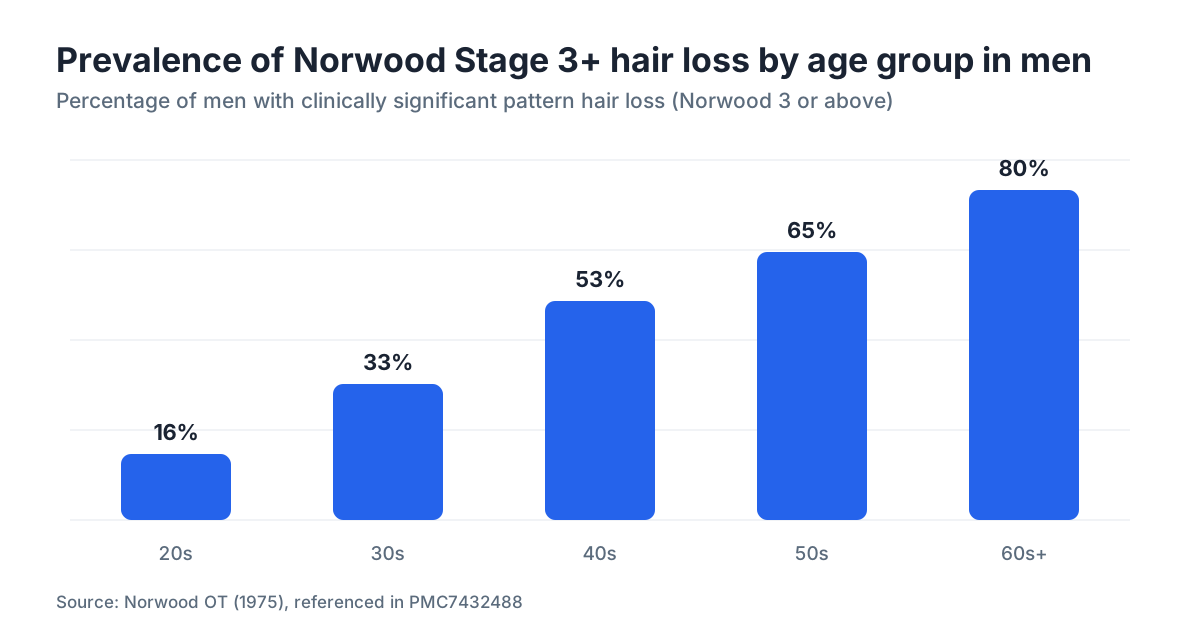
AGA can start as early as the late teens in men with strong genetic predisposition, though onset in the 20s is more common. The Hamilton-Norwood population data showed Norwood stage 3 or above in roughly 16 percent of men in their 20s, rising to about 53 percent by their 40s [4].
If your hairline is moving noticeably before age 22, it's worth a closer look, because the mature shift usually wraps up by then. Fast progression in the early 20s is more likely early-onset AGA than a late mature transition. Have a dermatologist confirm that rather than assume.
What treatments work for a receding hairline and do they help a mature one?
A mature hairline needs no treatment. Treating a stable, normal hairline with medications that carry real side effect profiles makes no sense.
For a genuinely receding hairline caused by AGA, two FDA-approved options have solid evidence behind them.
Minoxidil is a topical (or oral) vasodilator that stretches out the growth phase of hair follicles. The FDA approved 2% minoxidil for men in 1988 and 5% in 1997 [6]. It works best at holding existing hair and producing modest regrowth. It won't regenerate follicles that have fully shut down. See minoxidil for men for dosing and evidence, and minoxidil side effects before you start.
Finasteride is a 5-alpha reductase inhibitor that blocks DHT production at the follicle level. The FDA approved 1 mg finasteride (Propecia) for AGA in 1997 [7]. A five-year placebo-controlled trial found that finasteride maintained or improved hair count in roughly 90 percent of men, compared with continued loss in 75 percent of the placebo group [8]. That's the most-cited number in the field. Read more about finasteride and the evidence for using finasteride and minoxidil together.
For men at later Norwood stages (4 and above), a hair transplant can rebuild the hairline surgically. Transplants move DHT-resistant follicles from the back of the scalp to the front. They're permanent but expensive, and you'll likely still need medication to protect the hair you didn't transplant.
DHT blockers like saw palmetto are popular supplements, but the evidence is much weaker than for finasteride. Check hair loss supplements for an honest look at what the data actually shows.
Can women have a mature hairline, and does the Norwood scale apply to them?
Women also shift from a juvenile to a mature hairline, though the process is less dramatic than in men and rarely creates a visible M-shape. Female mature hairlines tend to stay relatively straight or gently curved.
The Norwood scale does not apply to women's hair loss. Female pattern hair loss follows the Ludwig scale, which describes diffuse thinning across the crown and top of the scalp rather than temple recession. Women with female pattern hair loss rarely develop the deep temple recession that marks male AGA [3].
Women can lose hair at the hairline from causes other than AGA: traction alopecia (from tight hairstyles), telogen effluvium, or frontal fibrosing alopecia. Each has a different pattern, timeline, and treatment. If you're a woman noticing hairline changes, the Ludwig classification and a dermatologist evaluation are better starting points than the Norwood scale.
When should you see a dermatologist about your hairline?
If your hairline has moved noticeably in the last 12 months, book an appointment. Early treatment with finasteride or minoxidil works far better than late treatment, because you can't regrow follicles that have been dormant for years.
Other reasons to go sooner: rapid loss over weeks rather than months (could be telogen effluvium or a medical trigger like thyroid disease), patchy loss rather than a continuous recession (could be alopecia areata), scalp inflammation, itching, or scaling alongside the hair loss, or if you're under 22 and your hairline is moving fast.
A dermatologist can run bloodwork to rule out thyroid issues, iron deficiency, and hormonal causes. They can also use trichoscopy to grade miniaturization before recession shows up to the naked eye, which buys you more time to decide [5].
What you don't need to do is panic at 20 because your hairline looks slightly higher than it did at 16. That's usually the mature transition doing exactly what it's supposed to do.
Is there a quick self-check to tell whether you have a mature or receding hairline right now?
Here's the most practical self-check, built on the clinical criteria above.
First, look at your hairline shape in good lighting. Is it symmetrical? Does it have a gentle M or widow's peak? If yes, that's consistent with a mature hairline.
Second, look at hair caliber at the temples. Get close to a mirror or use your phone camera. Are the hairs at the very edge fine and wispy compared to hairs an inch behind them? If yes, that points to miniaturization.
Third, check the top of your scalp. Is the density at your crown noticeably thinner than a few years ago? Crown thinning plus temple recession is a Norwood 3 Vertex or 4 pattern, not a mature hairline.
Fourth, look at photos from 1 to 2 years ago. Has the line moved? This is the most honest test.
Pass all four checks and your hairline is almost certainly mature. Fail one or more and a dermatologist visit makes sense. Since FDA-approved treatments can genuinely slow or halt progression [7][8], acting early beats waiting almost every time.
Sources
- American Academy of Dermatology (AAD), Hair Loss Overview
- National Library of Medicine (NIH/NLM), StatPearls: Androgenetic Alopecia
- American Academy of Dermatology (AAD), Hair Loss Types and Prevalence
- Hamilton JB (1951), Norwood OT (1975), Pattern of Male Hair Loss, republished reference in Dermatologic Surgery
- International Journal of Dermatology, Trichoscopy in the diagnosis of androgenetic alopecia
- FDA, Drug Approval Database: Minoxidil Topical
- FDA, Drug Approval: Finasteride 1 mg (Propecia) label
- Kaufman KD et al., Journal of the American Academy of Dermatology (1998), 5-year finasteride study
- van der Donk J et al., Journal of Dermatological Science, DHT and androgenetic alopecia review
- van Neste D, Rushton DH, Hair Problems in Women, Clinics in Dermatology
- Rogaine (Minoxidil 5%) FDA-approved label, DailyMed
- Crewther SG et al., Clinical Journal of Sport Medicine (2009), Creatine supplementation and DHT