

TL;DR: A Norwood 2 hairline has mild temple recession but plenty of hair to work with. The right cut, a little matte product, and understanding your growth direction can make recession nearly invisible. A textured crop with a forward fringe, or a side part swept away from the corners, both work. Avoid slicked-back styles, wet-look gel, and any cut that exposes the temple bays.
What does a Norwood 2 hairline actually look like, and why does it matter for styling?
Norwood 2 is the first stage on the Hamilton-Norwood scale that most dermatologists call real male pattern recession rather than a mature hairline [1]. The temples pull back slightly into shallow triangular bays on each side. The frontal hairline itself stays largely intact. You still have full coverage across the top of your scalp, and that changes everything about how you approach it. You are not hiding baldness. You are managing shape.
The scale started with James Hamilton in 1951 and was refined by O'Tar Norwood in 1975 [1]. At stage 2, recession angles back only a centimeter or two at the corners. The midpoint of the hairline has not retreated at all. Pull your hair straight back under a bright mirror and the temple bays jump out at you. In any normal setting, with even basic styling, most people never notice them.
That distinction should shape what you do next. Shaving your head or reaching for a hairpiece makes no sense here. A good haircut and some product knowledge are genuinely enough for most men at Norwood 2. You are not faking a perfect hairline. You are styling so nobody's eye lands on the corners.
Which haircuts actually hide Norwood 2 temple recession?
A textured fringe or French crop is the most effective cut for Norwood 2. Keep the top at 2 to 3 inches, let the fringe sit forward and slightly to one side, and fade the sides short. That forward fringe covers the exact point where recession starts. An overhang of just 1 to 1.5 cm closes the visual gap at the temples. Ask your barber for a "textured crop with a soft fade" and say you want length at the front to push forward.
A side part works too, but direction is everything. Part on the side where recession is less severe and sweep across and slightly forward. This needs at least 3 inches on top. A part that runs above the recession point on one side, letting hair fall toward the temple on the other, can make both corners read fuller.
What you avoid matters as much as what you choose. Anything slicked straight back exposes both temple bays. A high-and-tight with nothing on top turns the recession line into the first thing anyone sees. A comb-over that drags hair from one side to cover the other is the classic mistake. It usually makes recession look worse, because the second wind or movement disrupts it, the contrast is brutal.
Roughly 2 to 4 inches on top gives you the most room to work. Shorter than that strips your options without giving you the clean look of a truly shaved head. Much longer weighs hair down flat, which can reveal the temple gaps more than a shorter, textured cut would.
| Style | How it helps Norwood 2 | Risk |
|---|---|---|
| Textured French crop | Fringe covers temple recession directly | Needs regular trimming to maintain |
| Side part (swept forward) | Redirects eye toward crown, not corners | Wind or humidity can expose the part |
| Quiff or pompadour (low) | Adds height that draws eye up and away | Slicked finish makes temples more visible |
| Textured mess / tousled | Volume and movement distract from shape | Needs a good product and some practice |
| Buzz cut (very short) | Makes recession less dramatic relative to full scalp | Recession still fully visible |
| Slicked back | None | Fully exposes both temple bays |
What hair products work best for hiding temple thinning?
Product choice is the second biggest variable after the cut. The rule is short: matte finishes add volume and texture, glossy finishes flatten hair and expose scalp. Wet-look gel is one of the worst things you can put on a receding hairline. It makes hair look thinner than it is and shows every gap.
Clay and matte paste are your two most useful categories. A medium-hold clay (Baxter of California Clay Pomade is one well-known example) gives you the separation that makes hair read fuller at the roots. Work a pea-sized amount into slightly damp hair, distribute it, then use your fingers to push hair forward and slightly outward from the temples rather than inward. That outward push fills the bay visually.
Sea salt spray before blow-drying creates root lift and adds texture throughout. It earns its place if your hair is fine and tends to fall flat. Spray onto damp hair, scrunch lightly, then blow-dry with a diffuser or a regular nozzle aimed at the roots.
Volumizing powder (also sold as hair powder or root lift powder) is underrated. A small tap directly at the temple roots adds real grip and apparent density. Some barbers use it as a finishing step. It weighs almost nothing but makes fine temple hair behave like there is twice as much of it.
Scalp-tinted concealers like Toppik or Caboki fibers can make sparse temple areas look denser if you want to go further. At Norwood 2, with real hair still present, most men find they do not need this step.
Does hair color or highlights help hide a receding hairline?
Contrast is the enemy. The bigger the color gap between your scalp and your hair, the more any thin patch stands out. That is why men with jet black hair on pale skin often clock their temple recession before anyone else does.
Adding lightness around the hairline softens that gap. A subtle sun-bleached effect, light highlights from the temples upward, or just a warm tone that breaks up the stark line all work. You do not need to go blond. A colorist can add tone that reads as natural sun exposure and takes the hard edge off the hairline. A partial highlight runs roughly $60 to $120 at most salons.
Going lighter overall is the bigger swing, and it is worth a thought if your hair is very dark and your skin is fair. It is a genuine change and not for everyone, but the effect on hairline definition is large. Nobody stares at the temples when the whole hair-to-scalp contrast is low.
If your hair is already light, or your skin is medium to dark, color matters far less. Put your energy into cut and product instead.
How should you blow-dry hair to make temple recession less visible?
Blow-drying changes how hair sits at the temples more than most men expect. The principle: dry hair in the direction you want it to go, and build lift at the root before you set the ends.
Start with the nozzle aimed at your hairline from above and slightly forward. Push the front hair forward and down as you dry. This trains the hair near the recession to fall toward the temples instead of away from them. With a textured crop, the fringe ends up leaning forward and covering the recession line rather than pulling back from it.
For a side-parted style, reach for a round brush. Pull the hair on the heavier side up and over while drying from underneath. That builds lift and volume that cover more scalp around the temple. Apply product while the hair is still slightly warm, then let it cool before you touch it again. Hair sets its shape as it cools.
The cold shot matters. Most dryers have a cold button. Hit the cold air for 20 to 30 seconds on the areas you most want to hold, right at the end. It locks the style and buys you several extra hours of staying power.
Does facial hair or beard styling affect how noticeable hairline recession is?
Yes, and it is one of the most underused tools you have. A beard changes the frame of your face. With some beard presence, the eye moves between the beard and the eyes instead of tracing the hairline. This is not wishful thinking. Research on face perception shows observers lock onto the most prominent features of a face, and a groomed beard or stubble ranks as a strong focal point [2].
You do not need a full beard. Even maintained stubble, 3 to 5 mm kept trimmed, gives enough of an anchor to pull attention off the corners. Men who go clean-shaven with Norwood 2 recession tend to read as more receded than men with the identical hairline and some facial hair.
Keep the proportions sane. A heavy beard over very short or shaved sides can look top-heavy and odd. At Norwood 2 with a longer top, a short beard or stubble is usually the right balance.
Can the way you part your hair actually make recession less visible?
Absolutely. The part is where recession goes from abstract to visible, because a part exposes scalp. The move is to shift the part so it does not expose the sparsest area.
Most men at Norwood 2 recede fairly symmetrically. If one side is a little further along, put your part on the opposite side and sweep toward the better temple. That lays more hair over the side you are trying to hide.
Another option is no part at all. A textured crop or a tousled style worn without a defined parting removes the problem entirely. Hair distributes more evenly, there is no single line of exposed scalp, and the movement makes it harder for anyone to read the exact shape of your hairline.
A center part is the worst choice for Norwood 2. It runs straight toward the frontal hairline and drags the eye to exactly where recession begins on each side. Plenty of men switch from a center part to a side or no-part style and are surprised how different they look.
Is Norwood 2 recession likely to get worse, and should you also be treating it?
Styling solves today's problem. It does nothing for progression. Most men who reach Norwood 2 before their mid-30s keep progressing over time, though the rate varies widely from person to person [3]. Androgenetic alopecia (male pattern hair loss) is driven mainly by dihydrotestosterone (DHT) binding to hair follicles and shortening their growth cycle [3]. No amount of styling touches that process.
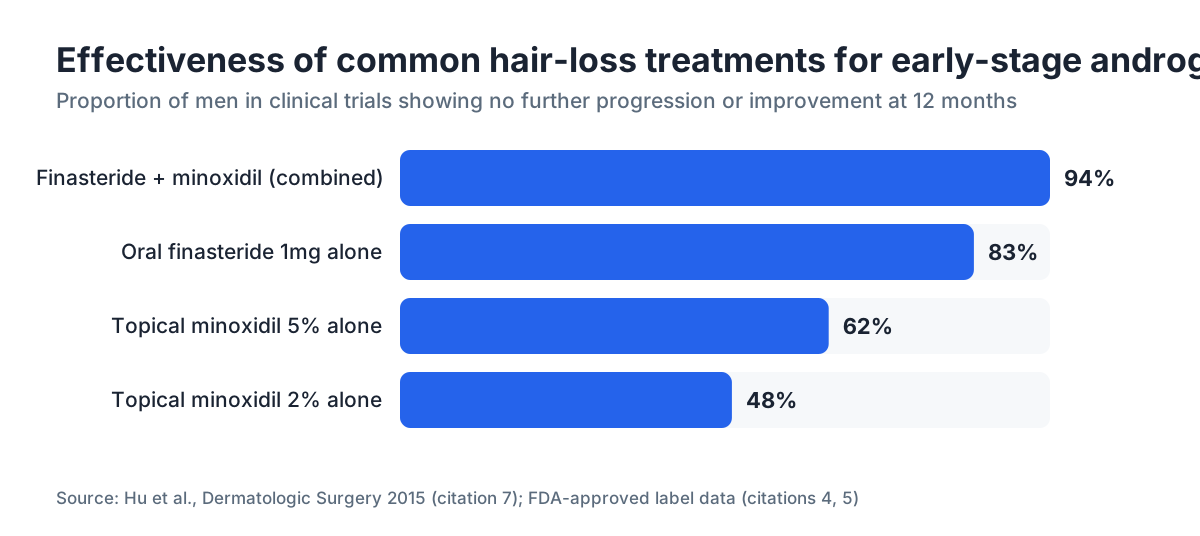
If you want to address the cause, the two treatments with the strongest evidence are minoxidil and finasteride. Topical minoxidil was FDA-approved for male pattern hair loss in 1988 [4]. Oral finasteride at 1 mg daily got FDA approval in 1997 specifically for male androgenetic alopecia [5]. Both work better the earlier you start, which makes Norwood 2 a good stage to begin if you want to keep what you have.
The American Academy of Dermatology describes minoxidil and finasteride as the mainstays of medical treatment for male pattern hair loss and notes that starting treatment early gives the best chance of holding onto existing hair [6]. Combining the two has shown additive benefit in several trials [7].
If you are not sure whether your hairline has slipped past what you can see in the mirror, a free AI hair analysis at MyHairline maps your hairline against Norwood stages from your photos. That gives you a baseline before you sit down with a dermatologist.
To understand what is happening at the follicle, read what causes hair loss and DHT blocker before you decide on treatment. If you are seeing more shedding than usual, telogen effluvium is a separate and often reversible cause that mimics pattern hair loss and is worth ruling out.
What everyday habits make hairline recession look worse than it is?
A few common grooming habits work against you without you noticing.
Washing your hair right before you need to look good is one. Freshly washed hair is at its flattest and most revealing. Styling holds better on day-two hair that has some natural oil and texture. If you must style straight after washing, hit it with a volumizing spray before you blow-dry.
Letting hair dry pulled straight back sets it in the shape you least want. A few minutes of air-drying with hair pushed forward, or a quick pass of the dryer, trains it to fall toward the temples. Dry it in the direction it should go from the start.
Bright overhead lighting is unforgiving. Open-plan offices, retail track lighting, midday sun straight overhead: all of it exaggerates the gaps. You cannot control every room, but knowing this explains why you look fine in one mirror and thin in another. A hat is a completely legitimate short-term fix in those conditions. A fitted cap worn slightly forward solves it outright.
Tight hats worn constantly get blamed for hair loss, but the evidence for that is weak. The real practical issue is that a snug hat pulled off in a hurry flattens your hair in an unflattering way. Keep a little product in your bag for those moments.
How long does it take to get a styling routine that works?
Two weeks. That is a fair expectation for most men to land on a product combination and drying method that reliably works for their hair. The first few days after a new cut are the hardest, because you are still learning how a fresh length behaves.
The most common mistake is too much product. Most men use two or three times what they need. Start with a pea-sized amount. You can always add more. Too much clay or paste drags hair down and kills the texture and volume the whole style depends on.
If humidity keeps wrecking your style by midday, a light-hold hairspray applied after styling, not as the main product, adds weather resistance without stiffness. Spray from about 12 inches away and barely mist the surface.
Find one barber who gets what you are after and stick with them. Tell them plainly that you want to minimize the temples and keep a forward fringe. A barber who understands that will cut the same shape every time, and that consistency is what makes the routine feel like nothing after a few cycles.
Should you tell your barber about the recession, or just describe the style you want?
Tell them directly. Barbers look at hairlines all day. Saying you want to minimize your temple recession is a clear, professional instruction that lets them make better calls. "I want a textured crop that covers the temples" is fine. "I have some recession at the temples and I want a cut that minimizes how visible it is" is better, because it tells them why.
A good barber studies your growth patterns, the natural fall of your hair, and the density at your temples before making a single cut. They may suggest a slightly different length or graduation than you had in mind based on what they see. Let them. Once they have the context, they are the right person to make that call.
If a barber brushes off the request or does not seem to register it, find another one. This is a routine ask, and a good barber handles it without making you feel self-conscious.
Sources
- Hamilton JB. Patterned loss of hair in man; types and incidence. Annals of the New York Academy of Sciences, 1951
- Dixson BJ et al. Masculine somatotype and hirsuteness as determinants of sexual attractiveness to women. Archives of Sexual Behavior, 2003
- Norwood OT. Male pattern baldness: classification and incidence. Southern Medical Journal, 1975
- U.S. National Library of Medicine, MedlinePlus: Minoxidil Topical
- U.S. National Library of Medicine, MedlinePlus: Finasteride
- American Academy of Dermatology, Hair loss overview and treatment information
- Hu R et al. Combined treatment with oral finasteride and topical minoxidil in male androgenetic alopecia: a randomized and comparative study in Chinese patients. Dermatologic Surgery, 2015
- Shapiro J, Price VH. Hair regrowth: therapeutic agents. Dermatologic Clinics, 1998