TL;DR: Crushing a 1 mg finasteride tablet and mixing it with a carrier is technically possible, but the result is unreliable, poorly absorbed, and potentially dangerous for anyone who handles it. Compounded topical finasteride (0.1 to 0.25% solutions) is the version with real trial data. Crushed tablets are not equivalent and not recommended by any dermatology body.
What actually happens when you crush a finasteride tablet and put it on your scalp?
A crushed finasteride tablet gives you a powder. That powder doesn't dissolve evenly in water, and finasteride is only sparingly water-soluble. What you end up with is a gritty suspension that sits unevenly on the scalp, dries inconsistently, and has no established absorption profile. [1]
Propecia (brand-name oral finasteride) is a film-coated tablet specifically because the coating controls how the drug breaks down. Crush it and you've removed that control. You've also lost any meaningful dose measurement, because you have no idea how much of the powder is making it through the skin versus flaking off into your pillow.
Skin absorption of finasteride is real. The drug does penetrate the stratum corneum. A 2018 study in the Journal of the European Academy of Dermatology and Venereology measured serum DHT suppression from topical finasteride solutions and found clinically meaningful absorption, though substantially lower than the oral route. [2] But those solutions were purpose-formulated with penetration enhancers like propylene glycol or ethanol at specific concentrations. A crushed tablet in tap water is not that.
Here's the short version. It probably delivers some finasteride to your scalp. The dose is unpredictable, the safety profile for this specific preparation is unknown, and you're running an uncontrolled experiment on yourself.
Is topical finasteride actually effective for hair loss?
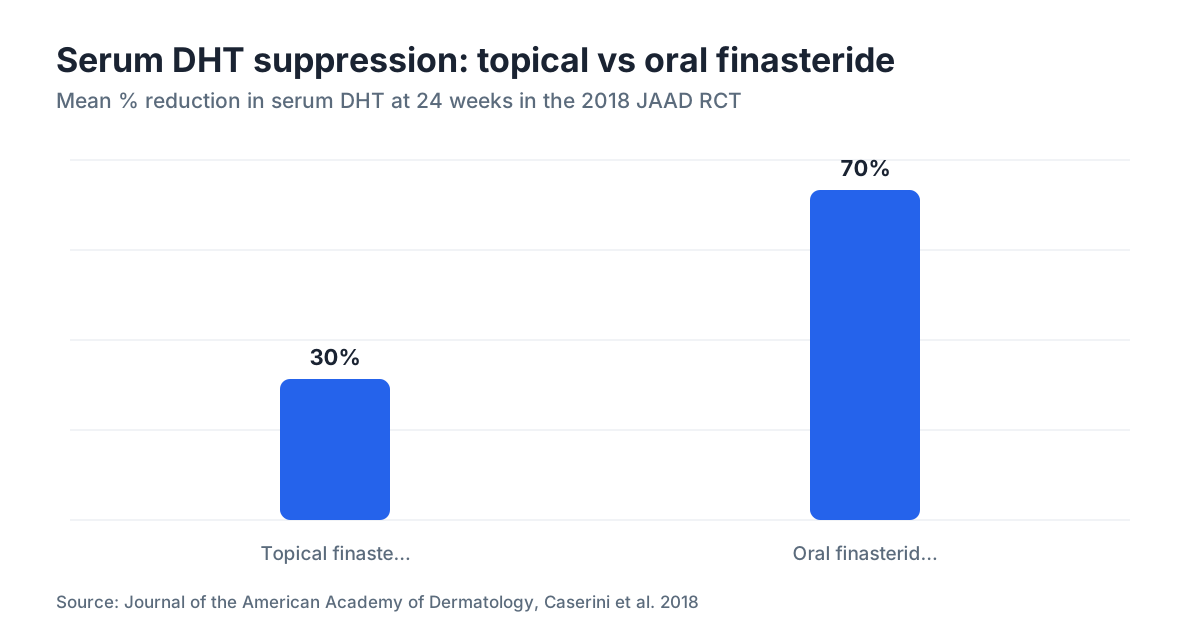
Yes. Properly formulated topical finasteride works, and the evidence is genuinely good. A randomized controlled trial published in the Journal of the American Academy of Dermatology in 2018 compared topical finasteride 0.25% solution applied once daily to oral finasteride 1 mg daily over 24 weeks. Both groups showed similar hair count improvements, and the topical group had significantly lower serum DHT suppression (roughly 30% vs 70% for oral), which matters for side effect risk. [3]
A 2020 systematic review covering 9 trials and roughly 1,800 patients concluded that topical finasteride at concentrations of 0.005% to 1% produced statistically significant improvements in hair density compared to placebo, with fewer sexual side effects reported than oral finasteride. [4]
So the molecule works topically. The delivery system is everything. Concentration, solvent, and excipients all determine how much drug reaches the dermal papillae where DHT suppression actually matters. None of that is controlled when you're crushing tablets at home.
For background on how finasteride works as a DHT blocker and what the oral data looks like, see our full guide on finasteride and the broader overview of DHT blockers.
How does compounded topical finasteride differ from crushed tablets?
Compounded topical finasteride is made by a licensed compounding pharmacy starting from pharmaceutical-grade active pharmaceutical ingredient (API), not from crushed retail tablets. The pharmacist dissolves a precise amount of finasteride in a vehicle (usually a hydroalcoholic solution or gel base) that has been tested for drug stability and skin penetration. You get a product with a known concentration, uniform distribution, and a stability period. [6]
Crushed tablets give you none of that.
The table below summarizes the key differences:
| Feature | Crushed tablet DIY | Compounded topical |
|---|---|---|
| Starting material | Retail film-coated tablet | Pharmaceutical-grade API |
| Known concentration | No | Yes (e.g., 0.1%, 0.25%) |
| Penetration enhancers | None unless you add them | Yes, formulated in |
| Stability tested | No | Yes (pharmacy sets BUD) |
| Dose consistency | Variable | Consistent |
| Regulatory oversight | None | State pharmacy board, USP 795/797 |
| Clinical trial data | None | Yes (multiple RCTs) |
USP Chapter 795 governs non-sterile compounding and sets standards for potency, stability testing, and beyond-use dating. A compounding pharmacy working under those standards is producing something categorically different from what you'd make with a mortar and pestle. [6]
Cost is a real difference too. Compounded topical finasteride typically runs $30 to $60 per month in the US, depending on the pharmacy and concentration. Crushing your own 1 mg tablets (generic finasteride costs roughly $15 to $30 per month for oral use) is cheaper, but the comparison isn't really valid because the products aren't equivalent.
What are the risks of making topical finasteride at home by crushing tablets?
Three categories of risk stand out: exposure, dosing uncertainty, and skin irritation.
Exposure is the most serious. Finasteride is a known teratogen for male fetuses. The FDA label for Propecia explicitly states that "women who are or may potentially be pregnant must not handle crushed or broken Propecia tablets because of the possibility of absorption of finasteride and the subsequent potential risk to a male fetus." [1] If you're crushing tablets, that warning applies to anyone who handles the powder or the resulting preparation, including a partner.
Dosing uncertainty matters more than people think. You don't know how much finasteride is absorbing through your skin from a homemade suspension. Too little and you're wasting time. But if absorption runs higher than expected, you could suppress serum DHT more than you intended, which is exactly the mechanism behind oral side effects like reduced libido and sexual dysfunction. Those side effects are not guaranteed at topical doses, but they're not impossible either, especially if your DIY preparation ends up absorbing more like an oral dose.
Skin irritation is a practical issue. Tablet excipients, including binders, fillers, and the coating itself, are not designed for topical application. Some of those ingredients cause contact dermatitis or follicular irritation when applied to the scalp. You might end up with scalp inflammation that actually worsens shedding in the short term, a process sometimes called telogen effluvium.
None of this means the world will end if you tried it once. But running the experiment long-term is a poor trade when properly compounded options exist.
What concentration of topical finasteride is supported by clinical evidence?
The concentrations that appear in peer-reviewed trials range from 0.005% to 1%, with the most studied being 0.1% and 0.25%. [4]
The 2018 JAAD trial used 0.25% once daily and found it comparable to oral 1 mg for hair count endpoints over 24 weeks. [3] Several smaller trials have used 0.1% twice daily with positive results. A 2021 study published in Dermatology and Therapy found that 0.25% topical finasteride produced a mean hair count increase of 18.6 hairs per cm² after 52 weeks, compared to a baseline loss trajectory in the placebo group. [7]
The sweet spot clinically seems to be 0.1% to 0.25%. Higher concentrations don't add proportional benefit and may increase systemic absorption.
For context, a 1 mg oral tablet dissolved in 1 mL of liquid would give you a 0.1% solution by weight. But that math is only meaningful if the drug is actually dissolved, not suspended, and only if you're applying exactly 1 mL every time. A crushed tablet in 1 mL of liquid is not a 0.1% solution, because the drug isn't uniformly distributed.
Does topical finasteride cause fewer sexual side effects than oral finasteride?
The evidence suggests yes, though the data isn't perfect.
In the 2018 randomized trial, serum DHT suppression was about 30% in the topical 0.25% group versus about 70% in the oral 1 mg group. [3] Since sexual side effects are thought to be at least partly mediated by systemic DHT suppression (and by direct CNS effects of finasteride itself), lower systemic exposure should in theory mean a lower side effect burden.
The 2020 systematic review found fewer self-reported sexual side effects in topical groups than oral groups across the pooled studies, though the authors noted that most trials were too short and too small to make strong claims about rare adverse events. [4]
Honest hedging. Post-finasteride syndrome, the reported persistence of sexual and cognitive side effects after stopping finasteride, is not well understood and not easily captured in short trials. Nobody has good long-term comparative safety data on topical versus oral finasteride for side effect persistence. The closest we have is mechanistic reasoning from the DHT suppression difference, and that's a reasonable proxy, not proof.
If side effects are your main concern, properly compounded topical finasteride looks like the lower-risk option compared to oral. A crushed tablet applied to the scalp probably lands somewhere in the middle of that spectrum, with unknown absorption making the picture murkier, not clearer.
If you're weighing finasteride alongside minoxidil, the article on finasteride and minoxidil combined covers how the two work together.
Can you buy topical finasteride without a prescription?
In the United States, finasteride in any form requires a prescription. [1] Compounded topical finasteride is no exception. You need a licensed prescriber to write for it, and a compounding pharmacy to fill it.
Telehealth platforms like Keeps, Hims, and others do prescribe compounded topical finasteride, and the process is typically an online consultation followed by mail delivery. Prices vary but tend to sit between $30 and $60 per month.
In some other countries, finasteride's prescription requirements differ. In the UK, it moved to a pharmacy-only medicine in 2023, meaning a pharmacist consultation without a GP visit is sufficient for oral finasteride. Topical formulations still require a private prescription in most cases.
Buying finasteride online without a prescription from unregulated overseas sources is both illegal in the US under federal law and genuinely risky, because product quality is not guaranteed. The FDA has warned repeatedly about counterfeit and adulterated products sold online without valid prescriptions. [8]
Is there any legitimate reason someone would crush finasteride tablets?
The most defensible scenario is someone already prescribed finasteride who wants to test topical application before getting access to a compounding pharmacy. It's a real situation. Access to compounders varies by region, telehealth isn't available everywhere, and some people genuinely can't afford the upcharge.
In that context, the harm-reduction approach is: use the smallest practical amount, dissolve it in a hydroalcoholic vehicle (like a minoxidil solution, which already contains propylene glycol and ethanol as penetration enhancers), and understand you're working with an uncertain dose. Some dermatologists describe this as a pragmatic interim option. But it's firmly in the DIY harm-reduction category, not a recommendation.
Another scenario: someone with genuine swallowing difficulties who has been prescribed oral finasteride and is trying to make it easier to take. In that case, the prescriber should be consulted before crushing, because the coating exists for a reason and the prescriber may have better alternatives.
If you're using topical minoxidil alongside any finasteride approach, the guide on minoxidil for men covers how minoxidil actually works and what results are realistic.
Myhairline.ai's free AI scan (/scan) can help you identify your Norwood stage and figure out which treatment pathway makes sense for your pattern of loss before you spend money on anything.
How would you actually mix a topical finasteride solution from tablets if you were going to try it?
This is harm-reduction information, not a recipe recommendation. If you're going to do this anyway, here's what the evidence suggests would maximize consistency and minimize risk.
Finasteride dissolves in ethanol but not well in water. The most practical approach is to crush one 1 mg tablet and dissolve it in 1 mL of high-percentage ethanol or in a minoxidil 5% solution (which already contains propylene glycol and ethanol). That gives you a roughly 0.1% theoretical concentration if the drug fully dissolves, which it likely won't entirely.
Stir hard, let it sit, filter out particulate matter if you can, and apply to the scalp. Use the same volume every time for any hope of dose consistency.
Problems with this approach:
- Tablet binders and fillers don't dissolve in ethanol; you'll have residue
- You can't verify how much finasteride is actually in solution
- The preparation has no established stability; finasteride in solution degrades over time
- You're mixing a prescription drug with an OTC product in a way that's not been tested
If your goal is topical finasteride with an evidence base, the compounded route is the right call. Getting a telehealth prescription takes about 15 minutes, and the resulting product is categorically better than anything you can make at home.
For people also looking at how receding hairlines typically progress, understanding your Norwood stage helps frame whether medication is even the right first step.
What do dermatologists actually recommend for topical finasteride use?
The American Academy of Dermatology's clinical guidelines for androgenetic alopecia recognize finasteride as a first-line treatment for male pattern hair loss, and the guidelines note that topical formulations are being studied and used off-label, but they stop short of formally recommending a specific topical concentration or formulation because the evidence base, while promising, is still building. [9]
In practice, many dermatologists and hair loss specialists prescribe compounded topical finasteride, particularly for patients concerned about systemic side effects or for women with pattern hair loss (for whom oral finasteride is off-label and involves more complex prescribing decisions).
No major dermatology society has issued guidance specifically on crushing tablets as a method of topical delivery. The silence is telling. The AAD does not recommend it, the FDA label warns against handling crushed tablets, and the compounding route exists precisely to solve this problem properly.
The honest practitioner take: if topical finasteride interests you, get the real compounded version. If cost is the barrier, discuss that with your prescriber, because some generic compounders are genuinely affordable. Crushing tablets is a workaround that introduces variables a compounding pharmacy exists to eliminate.
How does topical finasteride compare to other hair loss treatments?
Topical finasteride sits in an interesting spot on the treatment ladder. It's not as proven over the long term as oral finasteride (which has roughly 30 years of post-market data), but it appears to have a better side effect profile. Compared to minoxidil, it works by a completely different mechanism (blocking DHT conversion vs directly stimulating follicle growth), and combining the two may beat either alone. [10]
For pattern hair loss at Norwood stages 3 through 5, medication (finasteride with or without minoxidil) is the primary tool for slowing or reversing loss. Beyond stage 6, expectations need adjusting and a hair transplant conversation may be more relevant than adding another topical.
For women, the picture is more complicated. Oral finasteride is not approved for women by the FDA, and topical use is off-label. Some clinicians prescribe it for female pattern hair loss, particularly post-menopausal women, but it's not the standard first-line recommendation.
Other options like hair loss supplements and lifestyle changes may address contributing factors, particularly in cases where what causes hair loss goes beyond simple DHT sensitivity.
Myhairline.ai's free AI scan at /scan can help you identify your pattern and get pointed toward the right treatment tier before you spend money on anything.
Sources
- FDA, Propecia (finasteride) prescribing information
- Journal of the European Academy of Dermatology and Venereology, Mazzarella et al. 2018
- Journal of the American Academy of Dermatology, Caserini et al. 2018, topical vs oral finasteride RCT
- British Journal of Dermatology, Piraccini et al. 2020, topical finasteride systematic review and clinical trial
- U.S. National Library of Medicine, MedlinePlus finasteride drug information
- United States Pharmacopeia, USP Chapter 795 Non-Sterile Compounding
- Dermatology and Therapy, 2021, topical finasteride 52-week trial
- U.S. Food and Drug Administration, consumer warnings on buying medicine online
- American Academy of Dermatology, clinical guidelines for androgenetic alopecia
- Dermatology and Therapy, 2021, combination topical finasteride and minoxidil trial