

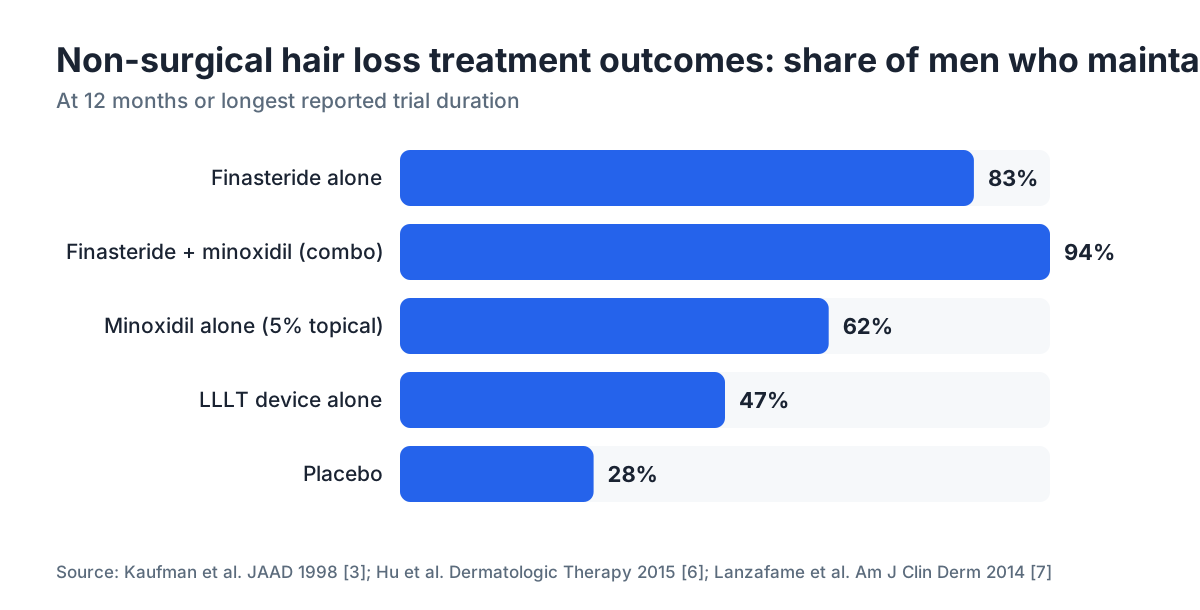
TL;DR: Norwood 4 is not too late for non-surgical treatment, but you need realistic expectations. Finasteride stops further loss in roughly 83% of men and can regrow some hair. Minoxidil adds visible density for many. Neither drug will fully restore a Norwood 4 pattern, but together they can meaningfully reduce how bald you look, often for years.
What does Norwood 4 actually look like?
The Norwood scale runs from 1 (full hair) to 7 (nearly everything gone). Stage 4 sits squarely in the middle. You have a well-defined receding hairline, significant thinning or loss at the crown, and a band of hair still connecting the sides, though that band is starting to thin. The front and crown bald zones are separate, which is the key visual difference from Norwood 5 where they start to merge.
In practical terms: you are noticeably balding to anyone who looks. Your hairline has moved back far enough that styling can no longer hide it. The crown patch is visible in photos and in certain lighting. But you are nowhere near the Norwood 6 or 7 territory where the top of the scalp is a single open plain. That distinction matters enormously for what treatments can do. [1]
Some men reach Norwood 4 in their mid-20s. Others don't arrive there until their 50s. Speed of progression matters more than the stage itself for figuring out how aggressive to be with treatment. Fast progressors, meaning men who jumped from Norwood 2 to 4 in under two years, are more likely to reach Norwood 6 or 7 without intervention than slow progressors who've been at 4 for five years.
Is Norwood 4 a point of no return for hair loss?
No. The "point of no return" idea usually refers to follicle death, not to a scale number. At Norwood 4, most of the miniaturized hairs in your hairline and crown are still alive. Miniaturized means the follicle is producing a thinner, shorter, less pigmented hair because DHT (dihydrotestosterone) has been progressively shrinking it. Shrunken is not dead. That is exactly what finasteride and minoxidil target. [2]
The honest ceiling is this: once a follicle has been miniaturized for long enough, it dies and is replaced by scar tissue. At that point, no drug brings it back. Research from the original finasteride trials suggests the window where reversal is meaningful is roughly the first 5 to 10 years of noticeable loss, and Norwood 4 is almost always inside that window. [3]
So the answer is not "it's too late." The answer is "it's later than it was at Norwood 2, and the ceiling for drugs is lower." That is a real difference. You should go in knowing it.
How effective is finasteride at Norwood 4?
Finasteride 1 mg daily (sold as Propecia, or generic) is the most studied non-surgical hair loss treatment for men. It blocks the 5-alpha reductase enzyme that converts testosterone into DHT, the hormone that drives androgenetic alopecia. Scalp DHT drops by roughly 60% on the drug. [3]
The five-year trial published in the Journal of the American Academy of Dermatology found that 83% of men on finasteride maintained or improved hair count versus baseline, compared to 28% on placebo. The study enrolled men with mild to moderate vertex (crown) loss, which overlaps closely with Norwood 3 to 5. [3]
At Norwood 4 specifically, here's the realistic picture. The drug stops further loss in the clear majority of men, and about half see some visible regrowth, mostly at the crown. Frontal regrowth is harder to get. Reporting from the same trial by Kaufman and colleagues noted that men with frontal hair loss experienced less benefit than those with primarily vertex loss. A separate 2010 systematic review in Archives of Dermatology reached the same conclusion: frontal response is consistently lower than vertex response. [3][12]
Finasteride is prescription only in the United States. It is not appropriate for women of childbearing potential because of teratogenicity risk. Post-menopausal women have used it off-label with some evidence of benefit, but that is a different clinical conversation. See the finasteride guide for a full breakdown of dosing, side effects, and what to expect in the first year.
How much can minoxidil actually help at this stage?
Minoxidil is available over the counter as a 2% or 5% topical solution or foam. A low-dose oral form is prescribed in many countries too, though in the US oral minoxidil is used off-label for hair loss. The drug started as a blood pressure medication. Hair regrowth was a noticed side effect that led to the topical version. [4]
The FDA approved topical minoxidil 5% for men based on trials showing statistically significant hair count increases versus placebo at 48 weeks. The agency's approval language notes that results vary and that the drug works best at the vertex (crown). [4]
At Norwood 4, minoxidil can produce real visible improvement at the crown for a meaningful subset of users. "Meaningful" here means a smaller visible bald spot, not full density. Hairline movement is harder, though some users see the finer hairs at the receding temples soften slightly. Oral minoxidil at 2.5 mg to 5 mg daily appears to produce somewhat better hair counts than topical in recent comparative data, according to a 2021 review in JAAD, though the topical stays the lower-risk starting point. [5]
Here's the limitation that trips people up: minoxidil requires ongoing use. Stop it and most regrowth sheds within 3 to 6 months. That's not a scam. It's just how the drug works. Hair maintained by minoxidil is hair that would otherwise be gone. Read the minoxidil for men overview before deciding on dosage and form, and check the minoxidil side effects article if you're concerned about the cardiovascular cautions on oral dosing.
Does combining finasteride and minoxidil work better than either alone?
Yes, and the data are fairly convincing. A 2015 randomized controlled trial in Dermatologic Therapy found that oral finasteride plus topical minoxidil produced significantly greater hair count improvements than either drug alone at 12 months, with the combination group showing roughly 32% more terminal hairs than the monotherapy groups. [6]
This makes mechanistic sense. Finasteride reduces the DHT signal that is killing follicles. Minoxidil extends the anagen (growth) phase and improves follicle circulation. They work through different pathways, so the effects stack. Many dermatologists who treat hair loss start men at Norwood 3 to 5 on both drugs at once rather than adding one after proving out the other.
The finasteride and minoxidil article goes deeper on how to layer the two and what the first 12 months usually look like.
What does "not looking bald" realistically mean at Norwood 4?
This is where honest expectations matter. "Not looking bald" is a spectrum. There are three realistic outcomes for a Norwood 4 man on combination therapy:
-
Best case (maybe 20 to 30% of users): Enough regrowth at the crown and enough slowing at the front that casual observers would hesitate to call you bald. You look like a man with thinning hair, not a man who is going bald.
-
Middle case (probably 40 to 50% of users): Loss stops. Some crown density returns. You still look like a balding man, but the progression halts and the picture doesn't get worse for years.
-
Lower end (remaining users): The drugs slow but don't stop progression, or side effects lead you to quit. You're back to natural progression.
Nobody has clean data stratified precisely by Norwood stage and treatment outcome. The closest large-scale evidence comes from the five-year finasteride trials, which skewed toward vertex loss. Here's the honest answer: drugs are most likely to prevent you from looking worse, somewhat likely to make you look noticeably better, and unlikely to make a Norwood 4 pattern invisible without surgery.
If your goal is simply "I don't want this to get worse," drugs are excellent tools. If your goal is "I want to look like I did at Norwood 2," surgery is the realistic path. The hair transplant guide covers what a procedure can and can't do at this stage.
Are there any other non-surgical options worth considering?
A few, with varying levels of evidence.
Low-level laser therapy (LLLT) devices, like laser combs and caps, have some randomized trial data supporting modest hair count increases, but the effect sizes are smaller than finasteride or minoxidil. A 2014 randomized trial in the American Journal of Clinical Dermatology found significant improvement in hair density with a 655 nm laser device, though the improvements were roughly half the magnitude of what finasteride produces. [7] LLLT is safe, has no systemic side effects, and can be used alongside drugs. On its own at Norwood 4, it's unlikely to prevent a visibly bald appearance.
Platelet-rich plasma (PRP) injections have generated a lot of clinic marketing. The actual evidence is mixed. A 2019 meta-analysis in Aesthetic Plastic Surgery found positive effects on hair density in most included trials, but flagged significant heterogeneity in protocols and a lack of long-term data. [8] PRP is expensive (roughly $1,500 to $3,500 per course of treatment), not covered by insurance, and requires periodic maintenance sessions. I'd treat it as an add-on for men already on finasteride and minoxidil who want to try something extra, not as a standalone fix at Norwood 4.
Ketoconazole shampoo at 2% (prescription in the US, 1% over the counter as Nizoral) has weak evidence for mild DHT reduction at the scalp and is sometimes added by dermatologists as an adjunct. The data are thin. It costs almost nothing and carries minimal risk, so it's worth adding if you're already doing everything else.
Hair loss supplements like saw palmetto, biotin, or LLLT-adjacent nutraceuticals have almost no rigorous trial data at a Norwood 4 level. See the hair loss supplements article for what the evidence actually says before spending money there. The short version: don't replace a proven drug with a supplement.
How fast does Norwood 4 progress without treatment?
There's no universal answer, but population data gives some shape to the risk. Norwood's original research and later studies suggest men with androgenetic alopecia who are already at Norwood 4 by age 30 have roughly a 50% chance of reaching Norwood 6 or 7 by age 50 without treatment. Men who reach Norwood 4 later in life tend to progress more slowly. [1]
Family history is your most useful predictor. If your father and maternal grandfather both went fully bald, your odds of continued progression are higher than someone with only one affected relative. This isn't deterministic, but it's the best signal available.
Genetics research has identified over 600 loci associated with male pattern baldness, but no commercial genetic test currently turns those findings into reliable individual predictions. [10] The what causes hair loss article covers the DHT pathway and genetic factors in more detail.
Bottom line on progression: at Norwood 4 without treatment, expect continued loss. The pace varies. Standing still is unlikely.
How do you know if treatment is actually working?
This is a genuinely hard question because hair grows about 1 cm per month and the early effect of treatment is mostly stopping loss rather than showing gain. Most people can't reliably detect a difference for at least 6 months, and the 12-month mark is usually when a real comparison becomes visible.
The most practical method: take standardized photos at month 0, 3, 6, and 12. Same lighting (flash off, daylight), same angle, same wet or dry state. Crown shots and front shots. Random phone photos are useless without this discipline because you will unconsciously take better or worse angles on different days.
Some dermatology practices use trichoscopy (a scalp microscope) or phototrichograms to measure terminal versus vellus hair ratios at baseline and follow-up. These are more objective but not widely available. If you want a baseline without a clinic visit, MyHairline's free AI scan at /scan can map your current pattern from uploaded photos, which at minimum gives you a documented starting point to measure against at 6 and 12 months.
The FDA defines treatment response in trials as an increase in terminal hair count in a standardized 1 inch diameter circle. In real life, the most useful signal is simpler: do you and the people around you think it looks better, or at least the same as a year ago?
Should you just shave your head instead of treating at Norwood 4?
This is a legitimate option that deserves a straight answer. A clean shave is not failure. For men whose loss is relatively symmetrical (the Norwood 4 pattern where the band of side hair is still reasonably thick), a close buzz or full shave looks dramatically better than fighting a losing battle with a combover or styling tricks.
The argument for shaving: it's free, it needs no daily drug habit, and it removes the anxiety of watching your hairline move. Some survey data suggests bald men are perceived as more dominant and confident, though somewhat less attractive on average. The effect is highly context-dependent.
The argument for treating first: if you are in your 20s or early 30s and drugs can genuinely stabilize your hair for another decade, that is a real quality-of-life gain. You're not locked in. You can always shave later. Starting treatment now and shaving at 50 is a different outcome than shaving at 30.
These aren't mutually exclusive. Some men use minoxidil and finasteride, hit stabilization, and keep a buzz cut that looks good with their maintained density. That is a reasonable middle path.
When does Norwood 4 become a case for surgery?
Hair transplant surgery (FUE or FUT) is worth serious thought at Norwood 4 if drugs haven't worked after 12 to 18 months of consistent use, you have enough donor hair (typically thick, dense hair at the back and sides), and your expectations match what a transplant can achieve at your pattern.
A Norwood 4 man typically needs 2,000 to 3,500 grafts to address the hairline and add density to the crown, though that estimate depends heavily on the size of the bald area and desired density. [9] Costs in the US generally run $6,000 to $18,000 for a procedure that size, depending on the method and clinic. That is not a small investment, and results depend enormously on surgeon skill and your donor density.
Here's the planning point that matters most. If you get a transplant at Norwood 4 and then keep losing native hair behind the transplanted zone (which is common), you can end up looking odd unless you stay on medications or plan for future procedures. Most experienced hair transplant surgeons will require or strongly recommend continued finasteride use after a transplant for exactly this reason. Read the hair transplant article for a fuller breakdown of what's involved.
If you're not sure where your loss currently stands or how fast it's moving, a detailed photo-based analysis can clarify your pattern before you commit to either drugs or surgery. MyHairline's free AI scan at /scan was built for exactly this kind of pre-decision mapping.
Sources
- Norwood OT. Male pattern baldness: classification and incidence. Southern Medical Journal, 1975.
- American Academy of Dermatology Association. Hair loss: diagnosis and treatment.
- Kaufman KD et al. Finasteride in the treatment of men with androgenetic alopecia. Journal of the American Academy of Dermatology, 1998.
- US Food and Drug Administration. Drugs@FDA database (minoxidil topical solution approval).
- Randolph M, Tosti A. Oral minoxidil treatment for hair loss: A review of efficacy and safety. Journal of the American Academy of Dermatology, 2021.
- Hu R et al. Combined treatment with oral finasteride and topical minoxidil in male androgenetic alopecia: a randomized and comparative study. Dermatologic Therapy, 2015.
- Lanzafame RJ et al. The growth of human scalp hair mediated by visible red light laser and LED sources. American Journal of Clinical Dermatology, 2014.
- Gupta AK et al. Platelet-rich plasma as a treatment for androgenetic alopecia. Aesthetic Plastic Surgery, 2019.
- International Society of Hair Restoration Surgery. Practice Census Statistics 2022.
- Ellis JA, Sinclair R, Harrap SB. Androgenetic alopecia: pathogenesis and potential for therapy. Expert Reviews in Molecular Medicine, 2002.
- Mella JM et al. Efficacy and safety of finasteride therapy for androgenetic alopecia: a systematic review. Archives of Dermatology, 2010.