

TL;DR: Minoxidil is FDA Pregnancy Category C: animal studies show fetal harm and there are no adequate human trials. Most dermatologists say stop topical minoxidil at least one month before trying to conceive, and stop oral minoxidil two to three months out. No dose has been proven safe during pregnancy or active conception attempts. Hair loss isn't life-threatening, so there's no benefit that justifies the risk.
What does the FDA say about minoxidil and pregnancy?
The FDA classifies minoxidil as Pregnancy Category C. That means animal reproduction studies showed harm to the fetus, no adequate human studies exist, and the potential benefits might sometimes justify the risk. For hair loss, nothing justifies that risk during pregnancy or while trying to conceive. Hair loss is not life-threatening.
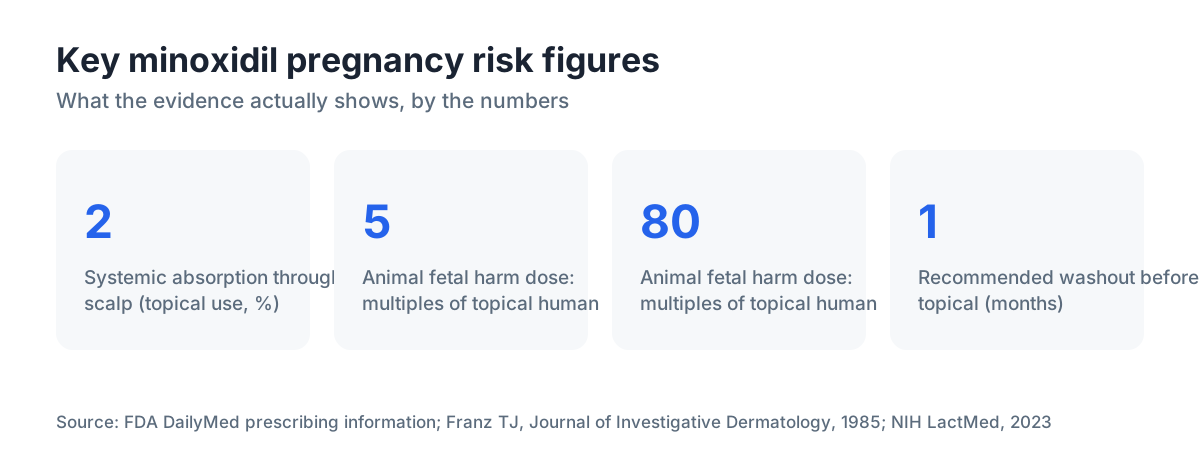
The FDA-approved labeling for topical minoxidil (Rogaine and generics) puts it plainly: minoxidil "is fetotoxic in rabbits and rats" when given orally at doses 5 and 80 times the maximum recommended human topical dose. [1] Fetotoxic means harmful to the developing fetus. That's more than a theoretical flag.
The oral minoxidil prescribing information carries the same Category C designation, plus a note that the drug is excreted in breast milk. That matters to anyone planning a pregnancy and continued nursing. [2]
Here's the honest summary. No regulatory agency anywhere has cleared minoxidil as safe to use while trying to conceive or during pregnancy.
How much minoxidil actually gets absorbed into the bloodstream from the scalp?
More than most people assume. This is the question that decides real-world risk, and the answer is not zero. Studies show roughly 1.4% to 2% of a topical dose gets absorbed through intact scalp skin into your bloodstream, and that number climbs if your scalp is irritated, inflamed, or broken. [3]
A 2% solution applied twice daily delivers about 1.7 mg systemically per day. A 5% solution or foam once daily delivers more. That sounds tiny next to oral doses. But an embryo sees the same blood concentration as the mother, and a first-trimester embryo is building cardiovascular structures that minoxidil, a strong vasodilator, can act on.
Oral minoxidil has near-100% systemic bioavailability. That's why most dermatologists treating women of childbearing age with the oral form time the stop earlier. If you're on oral minoxidil, quitting sooner than you would with topical is the sensible call.
The absorption data kills one comforting story. "It's only topical, it can't reach the baby" is wrong. It can, at low but non-zero concentrations.
What are the actual animal study findings that worry doctors?
The animal data behind the Category C label is worth understanding, not waving off. In rabbits, oral minoxidil at five times the maximum recommended human topical dose caused increased fetal resorption (early pregnancy loss, essentially) and lower fetal weight. In rats, doses 80 times the human topical dose produced similar outcomes. [1]
Nobody is giving pregnant women 80 times the topical dose. The worry is that these effects showed up at doses that weren't astronomical, which says the drug has real biological activity in fetal tissue, more than a toxicity blip at extreme exposures.
The medical literature also has case reports of newborns with hypertrichosis (excessive hair growth) born to mothers who used minoxidil during pregnancy. That confirms the drug crosses the placenta and reaches the fetus at active levels. [4] Those cases involved topical use, not oral.
Nobody has run a randomized controlled trial here, because it would be unethical. So the evidence will always have holes. Doctors are making judgment calls from animal data plus a handful of case reports. That's exactly the kind of uncertainty that argues for caution.
Should you stop minoxidil before trying to conceive, and how far in advance?
Yes, stop. How far in advance is where the guidance gets fuzzier, but dermatology's general recommendation is to stop topical minoxidil at least one month before you actively try to conceive. [5] For oral minoxidil, most prescribers want a longer washout, usually two to three months, because systemic exposure is so much higher.
Minoxidil has a short blood half-life, around four hours for the parent compound, so it clears fast in that sense. The one-month buffer with topical use is partly pharmacological caution and partly practical. Conception timing is a guessing game, and you want the drug gone before fertilization, not after.
The American Academy of Dermatology's guidance on androgenetic alopecia in women says minoxidil should be avoided during pregnancy. [5] Stopping before conception, rather than waiting for a positive test, fits that guidance, because a positive test usually lands two to four weeks after fertilization, by which point organogenesis (the formation of organs) is already running.
If you've used minoxidil for years and dread stopping, keep this in mind. The hair loss that comes back after you stop is your underlying condition returning, not damage from stopping. You lose no permanent gains by pausing.
What happens to your hair if you stop minoxidil while trying to conceive?
Shedding. This is the part people dread. When you stop minoxidil, follicles held in an extended anagen (growth) phase drop back into telogen (resting) and then shed. The shed usually starts four to eight weeks after you stop and peaks around two to three months. It is not permanent loss. It's your androgenetic alopecia returning plus a temporary transition shed. [6]
Pregnancy changes your hair too. Higher estrogen often stretches the anagen phase, so many women get thicker, fuller hair while pregnant. Then estrogen drops sharply about three to six months after delivery, a big batch of follicles enter telogen at once, and postpartum shedding hits. That's telogen effluvium. It's normal, even when it's alarming.
So the real picture for someone stopping minoxidil to conceive looks like this. A shed from stopping, possible improvement during pregnancy from estrogen, then a postpartum shed after delivery. That's a lot of movement in a 12 to 18 month window. Knowing it's coming takes the fear out of it.
After you're done nursing, if you nurse, minoxidil can usually be restarted. Your dermatologist can set the timing relative to weaning.
Is minoxidil safe to use while breastfeeding?
This is a separate question from pregnancy, and the evidence is just as thin. Minoxidil is excreted in human breast milk. [2] The LactMed database, run by the National Institutes of Health, lists minoxidil as a drug with insufficient data to establish nursing safety and notes that because it can cause cardiovascular effects in infants, it should generally be avoided. [7]
The concentrations reaching breast milk from topical use are probably low. But "probably low" isn't proven safe for a newborn whose cardiovascular system is still maturing. Most conservative guidelines say avoid minoxidil while breastfeeding entirely.
If postpartum hair loss is severe and wrecking your quality of life, it's reasonable to ask a dermatologist about the actual concentrations involved and your specific case. But the default is to wait until you finish nursing before restarting.
What hair loss treatments are safer during pregnancy or while trying to conceive?
Your options are limited, and knowing that upfront keeps you from chasing fixes that carry their own risks.
Finasteride and other DHT blockers are off the table during pregnancy. Finasteride is Pregnancy Category X, contraindicated because it causes feminization of male fetuses. Women of childbearing potential are warned against even handling crushed finasteride tablets. The finasteride and minoxidil combination that works well for hair loss is absolutely wrong during conception attempts.
Low-level laser therapy (LLLT), the laser combs and helmets, has no known systemic absorption and no evidence of fetal harm. The efficacy evidence is modest. A 2013 randomized controlled trial in the American Journal of Clinical Dermatology found statistically significant improvement in hair density with LLLT versus sham devices, though the effect was smaller than minoxidil. [8] If you need to do something during the trying-to-conceive window, it's the most defensible move.
Nutrient deficiencies matter. Iron, ferritin, vitamin D, and zinc are real drivers of hair shedding in women. Getting bloodwork and correcting any deficiency is safe and smart in this period. Ask your OB about appropriate hair loss supplements and dosing for someone who may be pregnant.
Scalp care, less mechanical stress, and minimal chemical processing are low-risk and genuinely help you keep what you have. They won't reverse androgenetic alopecia, but they stop needless extra loss.
Does minoxidil affect fertility or make it harder to get pregnant?
There is no clinical evidence that topical minoxidil reduces fertility in women at hair-loss doses. Its mechanism is vasodilation, which isn't known to interfere with ovulation, implantation, or hormonal cycling at typical scalp doses.
That said, no fertility-specific studies exist in women using topical minoxidil, because the ethical and methodological hurdles are steep. So "no evidence of harm to fertility" is not "proven fertility-neutral." Absence of evidence isn't evidence of absence.
The bigger issue is getting pregnant while still on minoxidil, which brings you back to stopping before conception. Minoxidil doesn't prevent pregnancy. If you become pregnant accidentally while using it, stop immediately and call your OB-GYN. Early exposure before you knew you were pregnant is a common scenario. Your doctor can put it in context and help you decide on monitoring.
What should you actually do if you got pregnant while using minoxidil?
Stop using it immediately. Then call your OB-GYN or midwife. Don't panic before that conversation.
Accidental first-trimester exposure to topical minoxidil isn't rare, because many women don't know they're pregnant until four to six weeks in. The case reports of bad outcomes mostly involve prolonged use throughout pregnancy, not brief early exposure. Your doctor will likely recommend monitoring and can assess your exposure level, duration, and timing.
Be honest with your provider. Tell them the formulation (2% solution, 5% solution, 5% foam), how often you applied it, how long you used it, and the date of your last application. That detail shapes the clinical picture.
In most cases of brief inadvertent early topical exposure, pregnancy outcomes have been normal. But that comes from case series and retrospective reports, not a controlled safety study. You need a physician's guidance for your situation, not reassurance from a forum.
How does this compare for men using minoxidil whose partner is trying to conceive?
Men using topical or oral minoxidil while a partner tries to conceive face a different risk profile, because the man isn't carrying the fetus. There's no evidence that minoxidil use in men causes sperm abnormalities or reduces fertility at standard topical doses. [9]
The practical concern is transfer. Avoid moving minoxidil solution or foam onto a pregnant partner's skin through direct contact. If you apply topical minoxidil to your scalp and then have scalp-to-skin contact before it dries, there's a theoretical secondary exposure risk. The FDA label for topical minoxidil says contact with eyes and mucous membranes should be avoided, and caution with contact transfer makes sense during pregnancy. Let it dry fully first.
Oral minoxidil in men is mostly prescribed for hair loss at 2.5 mg to 5 mg daily, far below the old blood pressure doses. There's no fertility trial data at these doses, but the pharmacology doesn't point to a direct fertility mechanism. If you're worried, raise it with a urologist or your prescribing physician.
If you're a man researching minoxidil for men and your partner is pregnant, the moves are simple. Keep minoxidil off shared surfaces. Let it dry fully before contact. Store it away from her reach.
When can you restart minoxidil after pregnancy and breastfeeding?
After delivery, if you're not breastfeeding, most dermatologists are fine with restarting topical minoxidil. Timing varies by provider, but starting after the six-week postpartum checkup is a common milestone.
If you're breastfeeding, the conservative call is to wait until you've fully weaned. Some providers will talk through the risk-benefit math with patients who are partially nursing or pumping less often, but there's no published threshold below which breast milk minoxidil concentrations are confirmed safe for infants.
Postpartum hair loss, the telogen effluvium that peaks around three to four months after delivery, often resolves on its own by 12 months without any treatment. [6] So there's a real argument for not rushing to restart minoxidil right after weaning. Watch the shed, give it six months, and reassess. If the hair hasn't returned and your underlying androgenetic alopecia is progressing, that's when to get back into treatment.
A tool like the free AI hair analysis at MyHairline can help you track your hairline and density over time, so you're deciding on real change instead of anxiety about a temporary shed. That objective baseline earns its keep after your hair has been through the swings of pregnancy and the postpartum months.
What do dermatologists actually recommend in clinical practice?
In practice, most board-certified dermatologists follow a consistent set of rules for women of childbearing age on minoxidil. Stop topical minoxidil at least one month before actively trying to conceive. Stop oral minoxidil two to three months before. Don't use either during pregnancy. Don't use during breastfeeding. Restart after weaning if the hair loss warrants it.
The American Academy of Dermatology's guidelines on female pattern hair loss state that minoxidil is contraindicated in pregnancy, and that women should be counseled about this before starting treatment. [5] That's not a hedge. It's a clear contraindication.
Some dermatologists will add that the evidence is thin enough that they lean on the patient's risk tolerance and situation. A woman with severe hair loss who isn't trying for another few months might decide differently than one who's actively trying now. These are conversations to have with your own dermatologist, not questions to settle alone.
If your hair loss follows a receding hairline pattern or fits a Norwood or Ludwig scale progression, your dermatologist can judge whether pausing treatment for 12 to 24 months will meaningfully change your long-term outlook. For most patients with modest progression, it won't.
And if your hair loss doesn't respond well to minoxidil and you want to plan ahead, a hair transplant consultation is something you can do during pregnancy or while trying to conceive, even if the procedure itself waits.
Sources
- FDA, Minoxidil Topical Solution Prescribing Information (DailyMed)
- FDA, Oral Minoxidil Prescribing Information (DailyMed)
- Franz TJ, Journal of Investigative Dermatology, 1985, Percutaneous absorption of minoxidil
- MedlinePlus, U.S. National Library of Medicine, Minoxidil Topical
- American Academy of Dermatology, Guidelines of Care for Androgenetic Alopecia
- Grover C, Khurana A, Indian Journal of Dermatology, Venereology and Leprology, 2013, Telogen effluvium overview
- NIH LactMed Database, Minoxidil entry
- Lanzafame RJ et al., American Journal of Clinical Dermatology, 2013, RCT of low-level laser therapy for androgenetic alopecia
- FDA, Minoxidil Topical Solution Patient Information Leaflet (DailyMed)
- Olsen EA et al., Journal of the American Academy of Dermatology, 2002, Female pattern hair loss and minoxidil efficacy
- MedlinePlus, U.S. National Library of Medicine, Minoxidil Topical