

TL;DR: Most men in their 20s have a hairline that has already moved slightly back from childhood. A mature hairline sitting 1-1.5 cm above the highest forehead wrinkle is normal. True recession beyond that, especially at the temples, may be androgenetic alopecia. About 16% of men aged 18-29 have moderate-to-extensive hair loss, so you're not imagining it if something looks off.
What does a normal hairline look like for men in their 20s?
One word solves a lot of anxiety here: mature hairline. Between your late teens and mid-20s, almost every man's hairline shifts backward slightly from where it sat in childhood. The American Academy of Dermatology separates this from actual hair loss, and for good reason. A mature hairline usually settles about 1 to 1.5 centimeters above the highest forehead wrinkle, forming a fairly even, mildly curved line across the front [1].
The shape matters too. A normal mature hairline for a man has a gentle curve or a slight widow's peak in the center. The temples may recede just a touch, but the overall line stays relatively even. If your hairline has moved back symmetrically and then stopped, that's almost certainly a mature hairline rather than androgenetic alopecia (male pattern baldness).
What you should not see, if loss isn't happening: a pronounced triangular recession at both temples (the classic 'M' shape), thinning at the crown, or a hairline that keeps moving back month over month. If you're seeing those things, that's a different conversation.
What percentage of men in their 20s actually have hair loss?
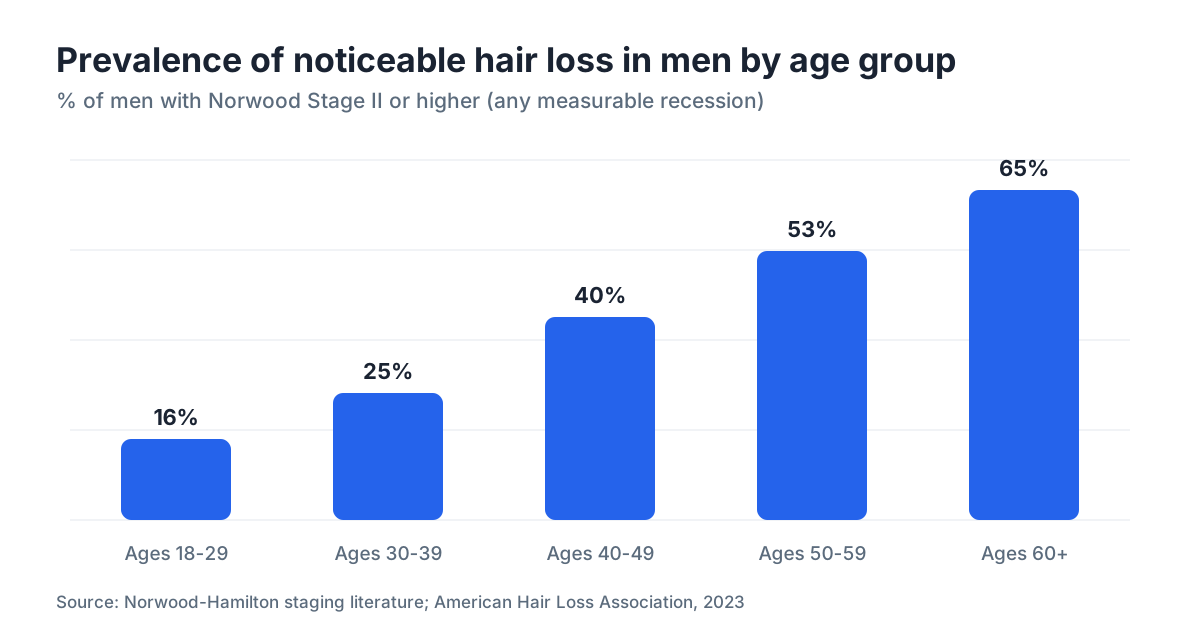
More than most people think. Prevalence data compiled from the Norwood-Hamilton staging literature puts the share of men with any noticeable hair loss (Norwood II or above) at roughly 16% in the 18-29 age bracket [2].
By age 30, that figure climbs to around 25%. By 50, it's past 50% [10]. So if you're 23 and already seeing your temples creep back or your part widen, you're not unusual. You're just earlier in a process that eventually reaches most men.
The under-reported fact is that androgenetic alopecia can start as early as 15 or 16 in genetically predisposed men. Dermatologists who treat hair loss commonly see men come in during their mid-20s, right when the change gets noticeable enough to worry about but hasn't yet moved past what's treatable.
Nobody has perfectly clean prevalence data for narrow age slices like 20-24 versus 25-29. The closest reliable figures come from Norwood-Hamilton staging surveys, which consistently show that roughly 1 in 6 to 1 in 5 men under 30 has measurable recession [2].
What is the Norwood scale and which stage is normal for a 20-something?
The Norwood-Hamilton scale (often just called the Norwood scale) is the standard classification system for male pattern baldness. It runs from Type I to Type VII [3].
| Norwood Stage | What it looks like | Typical interpretation for a man in his 20s |
|---|---|---|
| I | No recession, full juvenile hairline | Most men don't stay here past their early 20s |
| II | Slight temple recession, mature hairline | Very common and normal in the 20s |
| IIa | Slight recession all the way across the front | Still mild, but worth watching |
| III | Deeper temple recession forming early M-shape | Early androgenetic alopecia, treatment is well worth considering |
| III Vertex | Recession plus thinning at the crown | Clear androgenetic alopecia |
| IV | More pronounced M plus crown thinning connecting | Significant loss, but treatments still work |
| V-VII | Extensive loss | Less common in the 20s, but not unheard of in fast-progressors |
For most men in their 20s, Norwood I and II are the expected range. Reaching Norwood III in your 20s isn't a catastrophe, but it does mean androgenetic alopecia is active and moving. At that point, doing nothing is a real choice with predictable consequences.
Rate of change matters as much as current stage. A Norwood II hairline on a 22-year-old who has had it since 19 and hasn't seen it budge is very different from a Norwood II hairline on a 22-year-old who was at Norwood I eight months ago.
How do I tell if my hairline is receding or just maturing?
This is the question most men actually want answered, and it comes down to three things: pattern, speed, and family history.
Pattern: A maturing hairline moves back somewhat evenly, keeps a widow's peak or gentle center curve, and doesn't produce noticeable thinning. A receding hairline moves most aggressively at the temples first, creating that M or V shape. You might also notice the hairs at the temples turning finer before they disappear entirely. That miniaturization (individual hairs shrinking in diameter with each growth cycle) is the hallmark of androgenetic alopecia driven by dihydrotestosterone (DHT) [4].
Speed: Take a photo now. Take another in three months under the same lighting, same angle. If the line has moved visibly, that's recession. A maturing hairline finishes its transition and stabilizes, usually by the mid-20s.
Family history: Androgenetic alopecia is polygenic, meaning it comes from many genes on both sides of the family, more than your maternal grandfather as the old myth goes. If men on both your mother's and father's sides lost hair early, your risk is meaningfully higher [5]. That doesn't mean you're destined to go bald, but it shifts the odds.
If you want an objective look without going to a dermatologist, MyHairline's free AI scan can compare your hairline to the Norwood scale, which is a reasonable starting point before you decide whether a clinical visit makes sense.
One thing a mirror can't tell you: whether your existing hairs are miniaturizing. A dermatologist can assess this with a dermatoscope. If you're uncertain and the stakes feel high to you, one in-person visit is genuinely worth it.
What causes a hairline to recede in your 20s?
The main driver is androgenetic alopecia, caused by a genetic sensitivity of hair follicles to DHT, a byproduct of testosterone [4]. DHT binds to receptors in susceptible follicles and shrinks them over successive growth cycles until they stop producing visible hair.
But DHT isn't the only cause of hairline changes in your 20s, and getting the diagnosis right matters before you spend money on treatment. Other things that cause hair loss or hairline changes in young men:
Telogen effluvium is diffuse shedding triggered by a physical or emotional stressor, rapid weight loss, illness, surgery, or nutritional deficiency. It typically peaks two to three months after the trigger and then reverses. It doesn't cause the temple-first M-shape pattern. If your hair seems to be falling out everywhere at once, read more about telogen effluvium.
Nutritional deficiencies, especially iron deficiency (common even in young men who eat poorly), zinc deficiency, and low ferritin, can drive shedding. These are worth a simple blood panel if your loss seems diffuse.
Traction alopecia from tight hairstyles (man buns, braids worn too tight) can pull the hairline back, particularly at the temples and sides. Unlike androgenetic alopecia, this is mechanical, and reversal is possible if caught early.
Thyroid disorders can cause diffuse hair loss and are easy to screen for with a blood test.
For a deeper look at all the mechanisms, the full breakdown of what causes hair loss covers each one with specifics.
Does my forehead size mean I'm going bald?
No. Forehead size mostly comes from skull structure and genetics, independent of hairline position. Some men have naturally high foreheads with full, stable hairlines. The confusion usually comes from comparing yourself to others, or to old photos, without accounting for the fact that your forehead has also grown since childhood.
What does matter is where your hairline sits relative to your own forehead anatomy. The rough guide most dermatologists use: a normal mature hairline sits about a finger's width (roughly 1.5 cm) above the highest forehead crease when you raise your eyebrows. If your hairline is well above that, and especially if it's uneven or thinning at the temples, it's worth a closer look.
Big foreheads get blamed unfairly all the time. Plenty of men with enormous foreheads keep every single hair until they're 80.
At what age should I start worrying about hair loss?
The more useful question is: when should you start paying attention? Whenever you notice something changing, regardless of age.
If you're 20 and your hairline has been in the same spot since you were 18, that's probably a mature hairline. If you're 20 and your hairline has moved noticeably in the past year, that warrants attention now, not at 25. Early-onset androgenetic alopecia (before age 21) tends to progress more aggressively over time than late-onset cases [5].
Here's the honest practical reality: the FDA-approved treatments for androgenetic alopecia, finasteride and minoxidil, work by slowing or stopping loss and sometimes recovering some hair already lost. They don't regrow hair from follicles that have been gone for years. Starting earlier, when more follicles are still active, gives treatment more to work with [6].
There's no absolute age threshold, though. Dermatologists don't tell 20-year-olds to panic at the first sign of a mature hairline. The point is to pay attention, track changes, and act when you see actual progression rather than waiting years.
What treatments actually work for hair loss in men in their 20s?
Two treatments have FDA approval for male androgenetic alopecia. Everything else is either adjunctive or unproven [6].
Finasteride (Propecia, 1mg daily) works by blocking the enzyme 5-alpha reductase, which converts testosterone to DHT. A widely cited 1998 randomized trial published in the Journal of the American Academy of Dermatology found that 83% of men taking finasteride maintained or improved their hair count over two years, compared to 28% on placebo [7]. It requires a prescription. Side effects including sexual dysfunction occur in roughly 2-4% of users in clinical trials, and for most men they resolve if the drug is stopped. Read the full picture on finasteride before deciding.
Minoxidil (Rogaine and generics, 2% or 5% topical, or oral) works differently, by widening blood vessels in the scalp and extending the hair growth cycle. The topical form is available over the counter. The 5% solution shows better results than 2% in men [6]. Oral minoxidil at low doses (0.625-2.5 mg daily) has been gaining attention in dermatology as a potentially more effective alternative; for that discussion, see oral minoxidil.
Using both together is common practice in dermatology because they work through different mechanisms. The research on finasteride and minoxidil in combination shows additive benefit in most studies.
DHT-blocking supplements like saw palmetto have a few small trials behind them but nothing close to the clinical evidence for finasteride. If you're curious, the honest breakdown is in the DHT blocker article.
For men with significant or advanced loss, a hair transplant can redistribute existing follicles. At 20-24, most surgeons won't operate, because the eventual pattern of loss isn't clear enough yet to place grafts wisely.
The short version: if your hair is actively receding in your 20s, the evidence strongly supports early treatment. The longer you wait, the fewer follicles remain to save.
Should I see a doctor or dermatologist about my hairline in my 20s?
If your hairline is clearly moving, yes. A dermatologist can do a scalp exam with a dermatoscope, rule out conditions other than androgenetic alopecia, assess how far follicle miniaturization has gone, and write a prescription if appropriate. One visit typically runs $100-300 without insurance, though many insurers cover dermatology visits.
If you're genuinely unsure whether what you're seeing is recession or just a mature hairline, a telehealth service (several specialize in hair loss and now operate in all 50 states) can review photos and get you a prescription without an in-person visit, often faster and cheaper.
The AAD recommends seeing a board-certified dermatologist for any hair loss you find distressing or that seems to be progressing [1]. That's a reasonable bar. If it's bothering you enough to research it at length, a professional look is justified.
What lifestyle factors affect whether a 20-something loses his hair faster?
If you have the genetics for androgenetic alopecia, no lifestyle change will prevent it entirely. But some factors genuinely seem to speed up loss, and cleaning them up is worth doing anyway.
Smoking is linked to increased severity of androgenetic alopecia in epidemiologic studies. The proposed mechanism involves reduced scalp blood flow and oxidative stress on follicles [8].
Chronically high stress raises cortisol, which can push follicles into a resting phase and worsen shedding. This is real but often overstated. Stress alone doesn't cause male pattern baldness. It can accelerate loss in men who are already genetically susceptible.
Diet and nutrition matter at the margins. Severe caloric restriction, crash diets, and protein deficiency can cause telogen effluvium. But there's no good evidence that eating 'superfoods' or taking hair-specific supplements prevents androgenetic alopecia in men with DHT-sensitive follicles. The supplement market for hair loss is largely built on weak data. The honest review of hair loss supplements covers what the trials actually show.
Creatine deserves its own mention because it comes up constantly in young men who lift. The evidence is limited to one small trial, but it does suggest creatine may raise DHT levels. If you're worried, read does creatine cause hair loss before making a call.
For a full look at what the evidence shows about minoxidil for men as a medical intervention (as opposed to lifestyle factors), that's its own worthwhile read if you're weighing options.
How can I track whether my hairline is actually changing over time?
The single most useful thing you can do right now: take a standardized photo. Stand under consistent overhead lighting, face the mirror directly, and also take a top-down shot from directly above. Note the date.
Repeat in exactly three months. Consistent lighting and angle are everything here. Differences that look alarming under different light sources (bathroom fluorescents versus daylight) often disappear once you control for that.
If you want more precision without paying for a dermatologist visit, MyHairline's free AI scan stages your hairline against the Norwood scale from a photo, which gives you a baseline to compare future scans against.
What you're looking for in the comparison: did the temples recede further? Did a widow's peak disappear? Is there new visible scalp at the crown? If the answer to any of those is yes after three to six months, that's real information to bring to a doctor or telehealth provider.
Most men who discover they have significant hair loss look back and wish they'd started tracking earlier. A folder of dated photos costs nothing.
Sources
- Norwood OT, 'Male pattern baldness: classification and incidence,' Southern Medical Journal, 1975; prevalence estimates in dermatologic surgery literature
- Hamilton JB, 'Patterned loss of hair in man,' Annals of the New York Academy of Sciences, 1951; Norwood 1975 update
- FDA, 'Finasteride (Propecia) label' via DailyMed
- Heilmann-Heimbach S et al., 'Meta-analysis identifies novel risk loci and yields systematic insights into the biology of male-pattern baldness,' Nature Communications, 2017
- FDA, 'Minoxidil (Rogaine) OTC label' via DailyMed
- Kaufman KD et al., 'Finasteride in the treatment of men with androgenetic alopecia,' Journal of the American Academy of Dermatology, 1998
- Su LH, Chen TH, 'Association of androgenetic alopecia with smoking and its prevalence among Asian men,' Archives of Dermatology, 2007
- National Library of Medicine MedlinePlus, Androgenetic Alopecia