

TL;DR: A male hair transplant moves permanent hair follicles from the back and sides of your scalp to thinning or bald areas. FUE and FUT are the two main techniques. Costs run $4,000 to $15,000 in the US, most often $6,000 to $10,000. Results are permanent, but you still need medication to protect your native hair or you keep losing ground.
What is a male hair transplant and how does it actually work?
A hair transplant is surgery that takes follicles from a donor area, almost always the back and sides of your scalp, and implants them where hair has thinned or stopped growing. Those donor follicles are genetically resistant to DHT, the hormone behind male pattern baldness, which is why transplanted hair stays put even as the native hair around it keeps falling out. [1]
Two techniques dominate: FUT (follicular unit transplantation) and FUE (follicular unit extraction). In FUT, the surgeon cuts a horizontal strip of scalp from the donor zone, closes the wound with sutures, then dissects the strip into individual follicular units under a microscope. In FUE, individual units are punched out one by one with a small circular tool, leaving tiny round scars instead of one long line. Both deliver the same grafts to the same recipient sites. The difference is how they're harvested and what scarring you're left with.
Neither technique creates new hair. They move what you already have.
That's the single most important idea to get clear before you spend a dollar. If your donor supply is thin, your options are limited no matter how good the surgeon is.
FUE vs FUT: which technique is better for men?
It genuinely depends, and that's not a dodge. FUE leaves no linear scar, which matters if you wear the sides short. FUT yields more grafts per session but leaves a permanent line at the back. The right pick comes down to how you wear your hair and how many grafts you need.
FUE recovery is faster and there's less tension on the scalp. The tradeoffs: it usually takes longer in the operating room, costs more per graft, and can have slightly lower graft survival if the punch technique isn't precise, because follicles get transected (accidentally cut) during extraction.
FUT lets the surgeon dissect follicular units under magnification, which some experienced surgeons argue produces cleaner, more viable grafts. The downside is that linear scar, noticeable with very short hair, plus a longer healing period around the donor wound.
Want to wear your hair at a number 2 guard or shorter on the sides? FUE is almost always the better call. Need a large number of grafts (3,000 or more) and don't mind keeping the back an inch or two long? FUT can be more efficient and cheaper.
| FUE | FUT | |
|---|---|---|
| Scarring | Multiple small round scars | Single linear scar |
| Grafts per session | 1,500 to 4,000 typical | 2,000 to 4,500 typical |
| Recovery time | 7 to 10 days | 10 to 14 days |
| Average US cost | Higher per graft | Lower per graft |
| Best for | Short hairstyles, smaller sessions | Large sessions, longer hairstyles |
| Transection risk | Higher if technique is poor | Lower (dissected under microscope) |
Robotic FUE systems like ARTAS get heavy marketing. The data on whether they beat a skilled manual FUE surgeon is mixed. A 2020 review in the Journal of Cosmetic Dermatology found no statistically significant difference in graft survival between robotic and manual FUE when experienced operators did the work. [2] I'd put more weight on surgeon experience than on the robot.
How much does a male hair transplant cost in the US?
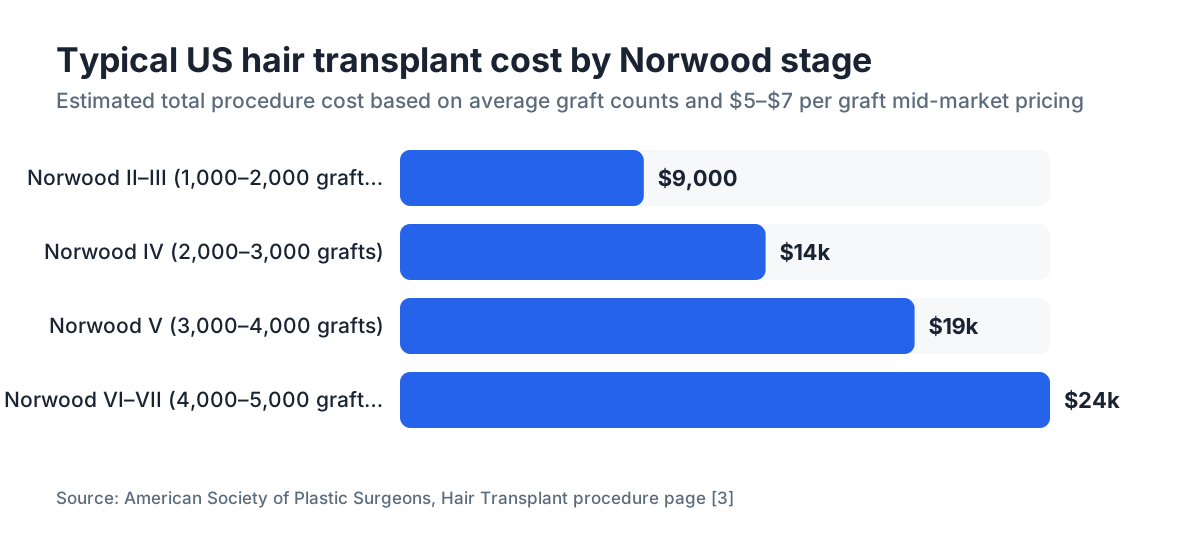
Expect $4,000 to $15,000 at a reputable US clinic, with most procedures for moderate male pattern baldness landing between $6,000 and $10,000. [3] Large sessions and premium big-city practices run higher.
Pricing is usually quoted per graft, at roughly $3 to $10 each. A typical session for a Norwood III or IV patient runs 1,500 to 2,500 grafts. A Norwood VI might need 3,000 to 5,000, sometimes across two sessions.
Hair transplants are cosmetic. Insurance doesn't cover them. There's no tax workaround for cosmetic surgery under current IRS rules unless there's documented medical necessity, which almost never applies to pattern baldness. Some clinics offer financing through third-party lenders. Read the APR carefully.
Turkey and other medical tourism spots advertise packages for $1,500 to $3,500 all-in, and some of those clinics do produce excellent results. The risks are real, though. Regulatory oversight differs a lot, follow-up care if something goes wrong gets complicated, and the patient photos on clinic websites are not audited by anyone. If you go abroad, ask for unedited patient contact references, verify the surgeon's credentials on your own, and budget for a follow-up with a US dermatologist when you get home.
The cheap option that leaves you with bad scarring, a fake-looking hairline, or poor graft survival is the most expensive outcome there is. Get three consultations minimum before you commit.
Who is actually a good candidate for a hair transplant?
Not everyone with hair loss should get one. Surgeons who run thorough consultations say this plainly. The ones who push you toward surgery at the first visit are a red flag.
Good candidates are men with stable, well-defined male pattern baldness (androgenetic alopecia), enough donor supply at the back and sides, and realistic expectations. The American Academy of Dermatology suggests most patients be at least 25 to 30 before considering a transplant, because loss in younger men is hard to predict, and a hairline designed for a 22-year-old can look wrong by 40. [4]
You're probably not a good candidate if:
- Your hair loss is still moving fast without medical stabilization
- Your donor zone is diffusely thin (a condition called diffuse unpatterned alopecia)
- You have scalp conditions like lichen planopilaris or alopecia areata, which aren't androgenetic and can destroy transplanted follicles too
- You expect a full, dense head of hair from Norwood VI in a single session
A blood panel checking ferritin, thyroid function, and androgens is reasonable before surgery. Some loss that looks like androgenetic alopecia is at least partly driven by telogen effluvium or nutritional deficiency, and those respond to completely different treatment.
Donor supply is the hard ceiling. Most men have between 6,000 and 8,000 harvestable follicular units across a lifetime, though this varies a lot. A surgeon who won't discuss your lifetime donor budget in the consultation is skipping a step.
What Norwood stage do you need to be for a hair transplant?
Transplants are technically possible at most Norwood stages, but the math gets harder the further you advance. The scale runs from Type I (no visible recession) to Type VII (only a horseshoe band of hair remains). Earlier stages have more donor hair and need fewer grafts, so they tend to produce the most satisfying results.
Norwood II and III patients usually see the best outcomes because they need fewer grafts to build a natural hairline and have plenty of donor hair. Norwood IV and V men can get meaningful improvement but often need more than one session or need to manage density expectations. Norwood VI and VII are the hardest: the gap between the density patients want and the donor supply available often can't be closed.
For men early in their loss, the sharper question is whether surgery now is wise given where the loss might end up. A 28-year-old Norwood III who skips finasteride and minoxidil for men may be Norwood V by 40, and a hairline placed at 28 can end up looking disconnected from the thinning hair behind it.
This is why most experienced surgeons treat medication and surgery as partners, not rivals. The transplant handles what medication can't restore. Medication protects the native hair around the transplant zone.
What happens during the procedure and what is recovery like?
The surgery runs under local anesthesia. You're awake, sometimes given an oral sedative for nerves, but you don't feel the grafts going in once the anesthetic takes hold. Most sessions last 4 to 8 hours depending on graft count.
The first 72 hours matter most. Grafts aren't yet anchored by new blood vessels, so physical disruption, heavy sweating, or touching the recipient area can dislodge them. Most surgeons hand you a spray bottle to keep the area moist and tell you to sleep with your head elevated.
Shock loss is real and expected. A large chunk of transplanted hairs sheds within the first 2 to 6 weeks. This is normal. The follicle enters a resting phase, then restarts the growth cycle. Most patients see new hair around months 3 to 4, real thickness by month 6 to 8, and final results at 12 to 18 months. [5]
Around month 3, when the shed is obvious and new growth hasn't filled in, is when a lot of patients panic and assume the surgery failed. It almost certainly hasn't. This is the expected timeline.
Return to desk work is usually possible within a few days. Strenuous exercise is normally restricted for 2 to 4 weeks. Keep direct sun off the scalp for several months.
Donor-zone scarring differs by technique. FUE scars are small punch marks that get hard to see once the surrounding hair grows back, though they show at very short lengths. FUT leaves a linear scar that ranges from a thin, barely visible line with good closure to a wider band if the wound healed under tension.
How successful are hair transplants? What does the evidence say?
"Success" gets defined inconsistently across hair transplant research, which makes comparison hard. Most studies measure graft survival rate (the percentage of transplanted follicles that grow), patient satisfaction, or blinded physician assessments of density.
Graft survival in experienced hands typically runs 85% to 95% for both FUE and FUT. The lower end shows up more often with less experienced FUE operators, thanks to transection during extraction. [2]
A 2019 systematic review in Dermatologic Surgery pooled outcomes across multiple studies and found most patients reported high satisfaction with both FUE and FUT when a skilled surgeon did the work, commonly above 80%. [6] Satisfaction is subjective, though, and partly a function of how well expectations got set before surgery.
Here's the honest caveat. Most hair transplant outcome studies are short-term (12 to 24 months), funded by or run at transplant centers, and don't account for continued native hair loss after surgery. A result that looks great at 18 months can look far less impressive at 50 if the patient never went on medication and kept losing surrounding hair.
To track your current pattern before you commit to anything, MyHairline's free AI scan gives you a starting point on staging and progression, useful information to bring to a surgical consultation.
Results are heavily operator-dependent. Hairline design, graft angulation, recipient site creation, and the skill of the team dissecting grafts under magnification all shape the outcome. Unedited, multi-year follow-up photos from real patients are the closest thing to real due diligence you can get.
What are the real risks and side effects of hair transplants?
Most risks are low-probability with a qualified surgeon, but they're real and worth knowing before you sign a consent form.
Infection is uncommon (rates under 1% show up in most case series) but possible. Most protocols give you prophylactic antibiotics. Folliculitis, small pimples around new grafts, hits a fair number of patients and usually clears on its own or with a topical.
Poor hairline design is probably the most underrated risk, because it's permanent and hard to fix. A hairline set too low, too straight, or without natural irregularity looks surgical. This is a judgment call that rides entirely on the surgeon's aesthetic sense and experience. Ask to see hairline-specific results, more than density results.
Some scarring is guaranteed with any technique. What varies is how visible it is. Keloid formers face higher risk and should raise that history with the surgeon.
Temporary numbness in the donor or recipient area is common and usually clears in weeks to months. Lasting numbness is uncommon but reported.
Graft failure, where a meaningful share of follicles don't survive, can happen if blood supply to the recipient area is compromised, if grafts dry out during handling, or if the patient has an uncontrolled scalp condition. This is part of why the team doing graft dissection and storage matters as much as the surgeon placing them.
Overharvesting is a long-term risk specific to FUE. Pull too many grafts from the donor zone and the back of the scalp goes visibly thin. A surgeon who isn't thinking about your lifetime donor budget when planning a session isn't doing right by you.
Do you still need finasteride or minoxidil after a hair transplant?
Almost certainly yes, and clinic marketing tends to bury this. Transplanted follicles are DHT-resistant, so they won't fall out from pattern baldness. But your native hair, the hair already growing beside or behind the transplanted zone, is still vulnerable.
Without medication, that native hair keeps thinning, and you end up with transplanted islands of hair surrounded by ground that keeps receding. It looks odd and often means another procedure.
Finasteride (1 mg daily, the FDA-approved dose for androgenetic alopecia) blocks the conversion of testosterone to DHT and has been shown in clinical trials to halt or slow loss in most men who take it. [7] It won't regrow the transplanted areas, but it protects the native hair around them.
Minoxidil for men applied topically (2% or 5% solution, or 5% foam) is FDA-approved for male pattern hair loss and works through a different mechanism, improving follicle blood supply and stretching the growth phase. Many surgeons recommend starting or staying on minoxidil after a transplant to support graft survival and protect native hair at the same time.
The combination of finasteride and minoxidil is what most hair loss specialists treat as standard practice for transplant candidates. A transplant without medication is a short-term fix on a long-term problem for most men under 55.
If you're worried about finasteride's side effects (real, reported in roughly 2% to 4% of users in clinical trials, and worth discussing with your doctor), look at the full picture honestly instead of trusting forum horror stories or pharma dismissal. [7]
How do you choose a qualified hair transplant surgeon?
Board certification in dermatology or plastic surgery is the floor, not the ceiling. Many excellent hair transplant surgeons are board-certified dermatologists with fellowship training in hair restoration. Look for membership in the International Society of Hair Restoration Surgery (ISHRS), which publishes practice standards and ethics guidelines. [8]
Ask these questions at your consultation:
- How many procedures do you personally perform per week (not your clinic total)?
- Who dissects and handles the grafts, you or technicians, and what's their training?
- Can I see unedited 12-month and 24-month follow-up photos of patients with a similar Norwood stage and hair texture to mine?
- What's your plan for my native hair loss over the next 10 to 20 years?
- What happens if I'm not satisfied with the result?
Red flags: surgeons who guarantee a specific outcome, practices leaning on before-and-after photos with dramatically different lighting or styling, high-pressure sales tactics at the first consultation, and clinics where you consult with a physician but the procedure gets done mostly by unlicensed technicians with no physician supervision. That last one is an ongoing regulatory issue in the US. State medical board rules on physician supervision of unlicensed staff vary, but unsupervised graft handling by non-physicians is a known practice in some high-volume clinics. [9]
Getting a second and third opinion from surgeons at different practices is normal and expected. A surgeon who discourages it isn't confident in the recommendation.
Want a baseline read on your loss pattern before you start consultations? MyHairline's free AI scan helps you understand your current Norwood staging, useful context to bring into any surgical conversation.
What about non-surgical alternatives to a hair transplant?
If you're not ready for surgery, or not a good surgical candidate, the evidence-based options are worth knowing. Two medications have FDA approval. The rest range from modestly supported to mostly marketing.
Finasteride (oral) and minoxidil (topical or oral) are the only FDA-approved drugs for male pattern hair loss. Oral minoxidil at low doses (0.625 mg to 2.5 mg daily) has growing evidence for efficacy with a somewhat different side effect profile than topical, and dermatologists increasingly prescribe it off-label. [10]
Low-level laser therapy (LLLT) devices are FDA-cleared for male hair loss. The evidence is thinner than for the two oral/topical medications. A 2021 meta-analysis in the Journal of the American Academy of Dermatology found statistically significant improvements in hair density with LLLT, though the effect sizes were modest next to finasteride. [11]
Platelet-rich plasma (PRP) injections get marketed hard. The evidence is inconsistent, with trials all over the map on PRP preparation, injection protocols, and patient selection. It may help as an add-on after a transplant, but calling it a primary treatment needs stronger trial data than exists today. Nobody has good data on the optimal protocol.
DHT blockers beyond finasteride include dutasteride (off-label in the US, approved in some other countries), which blocks both forms of the 5-alpha reductase enzyme instead of just Type II. Some dermatologists prescribe it for men who don't respond well enough to finasteride.
Supplement claims mostly lack strong evidence. If you want to sort real from marketing, the hair loss supplements breakdown covers it.
For men with a receding hairline still in early stages, starting medication now and revisiting surgery in a few years once the pattern settles is often the smartest sequence.
How does male pattern baldness cause the hair loss a transplant is fixing?
Understanding this clearly changes how you think about every treatment. Male pattern baldness (androgenetic alopecia) comes from genetic predisposition plus DHT (dihydrotestosterone). DHT binds to receptors in susceptible follicles and makes them miniaturize: each growth cycle produces a thinner, shorter hair until the follicle goes dormant. The follicles at the back and sides don't carry that sensitivity in most men, which is why the donor area stays stable. [1]
For a closer look at the mechanisms, what causes hair loss covers androgenetic alopecia alongside other causes a transplant won't fix, like autoimmune conditions, scarring alopecias, and nutritional problems.
The point for transplant planning: the surgery moves DHT-resistant follicles. It doesn't change the DHT environment your scalp creates. Your native hair keeps getting the same hormonal signals. That's why medication and surgery work better together than either alone for most men.
Sources
- American Academy of Dermatology, Hair Loss: Causes
- Journal of Cosmetic Dermatology, Robotic vs. Manual FUE Comparison (2020)
- American Society of Plastic Surgeons, Hair Transplant procedure page
- American Academy of Dermatology, Hair Loss: Diagnosis and Treatment
- International Society of Hair Restoration Surgery, Patient Education
- U.S. National Library of Medicine, MedlinePlus: Hair Transplant
- U.S. National Library of Medicine, MedlinePlus: Finasteride
- International Society of Hair Restoration Surgery, Physician Membership and Ethics
- Medical Board of California, Physician Assistant supervision rules
- U.S. National Library of Medicine, MedlinePlus: Minoxidil
- Journal of the American Academy of Dermatology, LLLT Meta-Analysis (2021)