

TL;DR: Male pattern baldness follows a predictable path mapped by the Norwood scale's 7 stages. Most men progress slowly over 15 to 25 years, but roughly 12% reach advanced stages (Norwood 5 to 7) by their 50s. Early signs are temple recession and crown thinning. Finasteride and minoxidil are the only FDA-approved treatments proven to slow progression.
What is the Norwood scale and why does it matter?
The Norwood scale, formally the Hamilton-Norwood scale, is the standard classification system doctors and researchers use to describe male pattern baldness (androgenetic alopecia). It runs from Type 1, essentially a full head of hair with minimal or no recession, to Type 7, where only a horseshoe-shaped band of hair remains along the sides and back of the head. Every major clinical trial for hair loss treatments uses it. Without it, saying "I'm losing my hair" tells a dermatologist almost nothing actionable.
James Hamilton first published the classification in 1951, and O'Tar Norwood updated it in 1975 with additional subtypes, including the Type A variants that show frontal recession marching straight back rather than the classic M-shape [1][9]. That updated version is what most clinics use today.
Why does it matter practically? Because the stage you're at largely determines which treatments are realistic, whether a hair transplant is feasible, and roughly how much donor hair you have left to work with. A Norwood 3 and a Norwood 6 are completely different clinical situations.
What are the early signs of male pattern baldness on the Norwood scale?
The first visible sign for most men is not a bald spot. It's a subtle change in hairline shape, specifically the temples pulling back slightly to form a gentle M. That's Norwood Type 2. Hair at the crown is typically still dense at this point. Many men dismiss it as a "mature hairline," which is a real thing but worth watching.
Crown thinning as an early sign deserves its own mention. Some men skip obvious temple recession and notice thinning at the vertex first. That's still androgenetic alopecia, typically landing in the Norwood 2 to 3A range. The crown is actually more cosmetically alarming early on because it's visible to others even when you can't easily see it yourself.
Here are the specific things to look for in early stages:
- The central forelock gradually narrows
- The scalp becomes visible under fluorescent or overhead lighting
- Hair density at the temples feels thinner when you run a hand through it
- Your part widens slightly at the crown
- Shedding increases modestly, though this is unreliable as a standalone signal
Shedding alone is not a reliable early sign. Telogen effluvium, stress-related diffuse shedding, mimics the early feel of hair loss without following the Norwood pattern. The key differentiator is where the hair thins. Androgenetic alopecia targets the temples and crown in a pattern. Diffuse shedding hits everywhere.
If you're uncertain which category you're in, a free AI hair scan at MyHairline can map your recession against the Norwood stages using your own photos before you spend money on a dermatology appointment.
What does each Norwood stage actually look like?
Here's a plain-language breakdown of all seven types, including the A variants:
Norwood Type 1: No significant recession. The adolescent or juvenile hairline. Many men in their 20s and early 30s are here and never progress much further.
Norwood Type 2: Slight recession at the temples. The hairline still looks relatively full from the front. This is the "mature hairline" gray zone. The transition from Type 1 to 2 often happens between ages 17 and 29 and is not necessarily pathological [2].
Norwood Type 2A: A variation where recession moves uniformly back across the frontal hairline rather than forming an M. The A variants tend to lack the classic island of hair at the front.
Norwood Type 3: The temples have receded more deeply, typically more than 2 centimeters from the original hairline. This is where most dermatologists and guidelines agree treatment is clearly worth considering. The crown may still be intact.
Norwood Type 3 Vertex: Temple recession similar to Type 3, but now combined with noticeable thinning at the crown (vertex). This is a common pattern and often catches men off guard because they've been focused on the temples.
Norwood Type 4: Significant hairline recession plus clear crown baldness. A band of denser hair still connects the two areas, separating the frontal and vertex zones of loss.
Norwood Type 5: The band separating frontal and crown loss gets thinner and narrower. The two bald areas are close to merging. Donor hair supply for transplants starts to become a genuine planning concern at this stage.
Norwood Type 6: The bridge is gone. The frontal and crown zones have merged into one large bald area. The sides and back still hold hair.
Norwood Type 7: The most advanced stage. Only a narrow horseshoe of hair remains along the sides and back. Hair density in the remaining zones is also typically lower than it was at younger ages.
The A variants (2A, 3A, 4A) follow the same progression but without the classic M recession pattern, moving instead as a receding line across the whole front.
How fast does male pattern baldness progress from one Norwood stage to the next?
This is the question most men actually want answered, and the honest answer is: it varies enormously, and the research on exact stage-to-stage timelines is thin.
What we do know from large population studies:
- Approximately 16% of men aged 18 to 29 show moderate to extensive hair loss [3]
- By ages 40 to 49, that figure rises to roughly 53% [3]
- By the time men reach their 70s, about 80% show some degree of androgenetic alopecia [3]
A widely cited Australian study published in the Journal of Investigative Dermatology examined baldness prevalence across age groups. It found that the prevalence of Norwood Type 3 and above roughly doubled between the third and fourth decades of life [5].
For most men, progression is slow. Moving from Norwood 2 to Norwood 4 might take 10 to 20 years. But a meaningful minority (estimates vary from 10% to 20%) progress quickly, reaching Norwood 5 or above before age 40. Genetics is the dominant driver, specifically whether your androgen receptors are sensitized to dihydrotestosterone (DHT). Understanding what causes hair loss at a hormonal level explains why the timeline is so individual.
The "skip-a-generation" folk wisdom about inheriting baldness from your mother's father has some biological basis but is oversimplified. The AR gene (androgen receptor gene) is on the X chromosome, which you get from your mother, but dozens of other loci also contribute [4]. Looking at your father's and maternal grandfather's hairlines together gives a better rough prediction than either alone.
One practical note: progression tends to be faster in the years immediately following onset. If you notice you've moved from Norwood 2 to Norwood 3 in under two years, that's meaningful velocity and worth treating sooner rather than later.
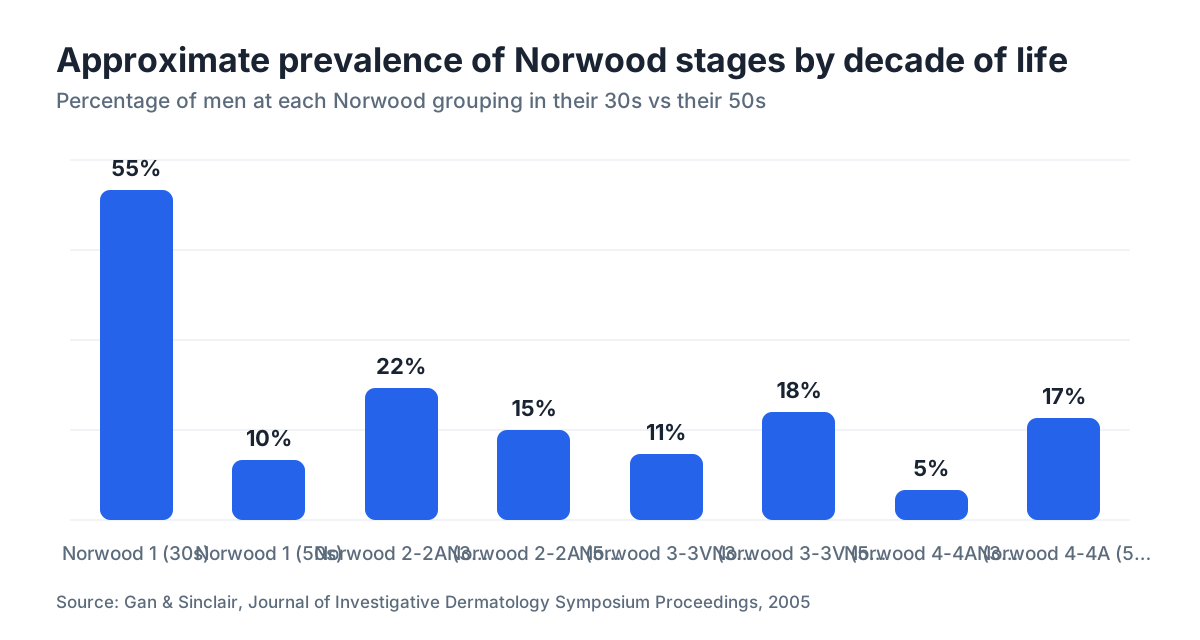
How common is each Norwood stage by age group?
Real prevalence data by stage is hard to come by in pristine form, but the best available figures come from the Norwood classification work and the Sinclair dermatology studies of Caucasian men. The numbers below use the Norwood prevalence estimates most frequently cited in the clinical literature [3][5].
| Norwood Stage | Approx. % of men in their 30s | Approx. % of men in their 50s |
|---|---|---|
| 1 | 55% | 10% |
| 2-2A | 22% | 15% |
| 3-3V | 11% | 18% |
| 4-4A | 5% | 17% |
| 5-5A | 3% | 15% |
| 6 | 2% | 13% |
| 7 | 1% | 12% |
These are rough estimates, and racial and ethnic variation is significant. Studies consistently show lower rates of androgenetic alopecia in East Asian men compared to men of European descent, with South Asian and African-American men falling somewhere in between, though the research on non-Caucasian groups is thinner [5].
The practical takeaway: if you're in your 30s and at Norwood 3, you're in a minority but far from alone. About 1 in 5 men your age is dealing with visible hair loss.
What causes male pattern baldness to progress through the Norwood stages?
The underlying mechanism is well established. DHT (dihydrotestosterone), a potent androgen derived from testosterone via the enzyme 5-alpha reductase, binds to androgen receptors in genetically susceptible hair follicles. This binding progressively miniaturizes the follicle over successive hair cycles. Each cycle, the hair that grows back is a little thinner, a little shorter, a little lighter. Eventually the follicle stops producing a visible terminal hair entirely [4].
The follicles vulnerable to this process are concentrated at the temples and crown, which is exactly the Norwood pattern. The back and sides of the scalp have follicles with androgen receptors that are much less responsive to DHT, which is why that hair persists even at Norwood 7 and why it works as donor hair for transplants.
You can read more about this mechanism and what blocks DHT in our guide to DHT blockers.
Stress, nutrition, and illness can accelerate shedding temporarily (see telogen effluvium) but they don't change the underlying Norwood trajectory in a meaningful way long-term. The rate of Norwood progression is almost entirely genetic and hormonal. There's no diet, supplement, or scalp massage that alters the androgenetic pathway.
Can male pattern baldness stop progressing on its own?
Sometimes. A subset of men stabilize at a given stage for years or even decades without treatment. Nobody can reliably predict who will stabilize, and there's no good prospective data on the rate of spontaneous stabilization.
What's clear is that spontaneous stabilization becomes more likely as men age and testosterone levels decline somewhat. A 60-year-old at Norwood 4 may stay at Norwood 4 for the rest of his life. A 28-year-old at Norwood 3 with fast recent progression almost certainly will not.
Relying on spontaneous stabilization as a strategy is a gamble, and it's a gamble where the downside is losing follicles that can't be recovered without surgery. The evidence-based treatments exist precisely because the natural history of the condition is continued progression for most men.
What treatments actually slow Norwood progression, and what's the evidence?
Two treatments have genuine FDA-approval-level evidence: finasteride and minoxidil.
Finasteride (oral, 1 mg daily) is a 5-alpha reductase inhibitor. It reduces serum DHT by approximately 70%, which directly addresses the primary driver of androgenetic alopecia [6]. The Merck trials that supported FDA approval showed that 83% of men taking finasteride had no further hair loss over two years, and 66% had visible regrowth [6]. It works best when started early, at Norwood 2 to 4, before follicles are dead rather than just dormant. It does not work on already-bald skin. Our full breakdown is in the finasteride guide.
Minoxidil (topical, 2% or 5%) is a vasodilator that prolongs the anagen (growth) phase of the hair cycle. The FDA approved 5% topical minoxidil for men in 1997 [7]. It does not block DHT, so it addresses the symptom rather than the mechanism. That said, it does produce measurable regrowth and density improvement, particularly at the crown [10]. Combining it with finasteride is the most effective medical regimen available. See finasteride and minoxidil for the combination data.
Oral minoxidil at low doses (0.625 to 2.5 mg daily) is increasingly used off-label and appears more effective than topical for some men, though the side effect profile is different. That's covered in detail in oral minoxidil.
Hair transplants are the only way to permanently restore hair to already-bald areas, but they require adequate donor supply, which is why Norwood stage matters so much pre-surgically. They don't stop the underlying progression either, so most surgeons recommend concurrent medical therapy post-transplant.
For Norwood 1 to 3, medical therapy alone can be very effective. For Norwood 4 to 5, combination therapy gives the best results and may delay or replace the need for surgery for years. For Norwood 6 to 7, realistic options narrow: a good transplant surgeon and possibly scalp micropigmentation are the primary cosmetic options, with medical therapy playing a maintenance role for remaining native hair.
One honest note on hair loss supplements: nothing in the supplement market has clinical trial evidence comparable to finasteride or minoxidil. Some ingredients like saw palmetto have weak evidence; most have none.
How do doctors actually diagnose your Norwood stage?
A dermatologist or trichologist assesses Norwood stage visually, sometimes aided by dermoscopy (a magnifying tool that lets them see the scalp skin and follicle caliber directly). There's no blood test for Norwood stage, though blood work (checking thyroid, ferritin, hormones) rules out other causes of hair loss.
In practice, most men self-classify reasonably accurately using the Norwood diagram, and self-classification at a rough level (early, mid, advanced) is enough to make initial treatment decisions. The distinction between Norwood 3 and Norwood 4 rarely changes whether you'd benefit from finasteride. It does matter for surgical planning.
If your hairline is changing and you're not sure whether you're looking at androgenetic alopecia or something else, the American Academy of Dermatology recommends seeing a board-certified dermatologist before self-treating [8]. A receding hairline in a teenager or a woman looks like pattern baldness but often has different causes.
MyHairline's AI scan can give you a Norwood estimate from a photo set and flag whether the pattern looks consistent with androgenetic alopecia, which can be a useful first step before booking a clinical appointment.
Does the Norwood scale apply to women and people assigned female at birth?
No. Women get a separate classification, the Ludwig scale, which describes diffuse thinning primarily at the crown and central part rather than the M-shaped recession and vertex pattern of Norwood. Androgenetic alopecia in women has the same underlying DHT mechanism but expresses differently because of different androgen receptor distribution and the protective effect of estrogen on follicles.
The Norwood scale can technically describe hair loss patterns in women with hyperandrogenism (elevated androgens from conditions like PCOS), but it's not the standard tool and can mislead. For female-pattern hair loss, the Ludwig scale and physician evaluation are more appropriate.
This article focuses on male pattern baldness. If you're a woman reading this because you're concerned about your own hair loss, the Norwood stages shown here won't map cleanly to your situation.
What should you actually do if you think you're progressing through the Norwood stages?
Act earlier than feels necessary. That's the single most useful piece of advice the evidence supports. Finasteride and minoxidil maintain existing hair far better than they restore lost hair. Every Norwood stage you progress before starting treatment represents follicle miniaturization that is hard or impossible to reverse without surgery.
A practical sequence that makes sense for most men:
- Confirm the pattern looks like androgenetic alopecia, not diffuse shedding or another cause.
- Honestly assess your Norwood stage against the diagram. Be honest: most men initially underestimate their stage.
- If you're Norwood 2 or above with confirmed recession over 6 to 12 months, talk to a doctor about finasteride. The conversation is short and the prescription is cheap (generic finasteride costs roughly $10 to $30 per month in the US).
- Add topical or oral minoxidil for crown density if the crown is thinning.
- Photograph your hairline every 3 to 6 months in the same lighting. This is genuinely useful. Memory is unreliable for slow changes.
- Revisit transplant options at Norwood 4 to 5 if medical therapy hasn't been sufficient, with realistic expectations about donor supply.
Be skeptical of anyone, online or in a clinic, who promises to regrow a Norwood 6 hairline without surgery. They're either misinformed or selling something.
Sources
- Norwood OT, 'Male pattern baldness: classification and incidence', Southern Medical Journal, 1975
- American Academy of Dermatology, Hair Loss overview
- Sinclair R, 'Male pattern androgenetic alopecia', BMJ, 1998
- Heilmann-Heimbach S et al, 'Meta-analysis identifies novel risk loci and yields systematic insights into the biology of male-pattern baldness', Nature Communications, 2017
- Gan DC, Sinclair RD, 'Prevalence of male and female pattern hair loss in Maryborough', Journal of Investigative Dermatology Symposium Proceedings, 2005
- FDA, Propecia (finasteride 1 mg) prescribing information and approval history
- FDA, Minoxidil topical 5% OTC approval for men, 1997
- American Academy of Dermatology, Diagnosis and treatment of hair loss
- Hamilton JB, 'Patterned loss of hair in man: types and incidence', Annals of the New York Academy of Sciences, 1951
- Rossi A et al, 'Minoxidil use in dermatology, side effects and recent patents', Recent Patents on Inflammation & Allergy Drug Discovery, 2012