TL;DR: Minoxidil works mainly by opening ATP-sensitive potassium channels in vascular smooth muscle, which widens blood vessels around hair follicles. That extends the anagen (growth) phase, shortens the resting phase, and may increase follicle size. Clinical trials show 5% topical minoxidil produces measurable regrowth in roughly 40 to 60% of men with androgenetic alopecia after 4 to 6 months.
What does minoxidil actually do to a hair follicle?
Minoxidil does not block DHT. It does not change your hormone levels. What it does is physically change how the follicle and the blood supply around it behave, through a mechanism researchers largely worked out by accident.
The short version: minoxidil opens potassium channels in the smooth muscle cells of blood vessel walls near hair follicles. Open channels let potassium ions flow out of the cells, which hyperpolarizes the cell membrane, which relaxes the muscle, which widens the vessel. Wider vessels mean more blood, oxygen, and nutrients reaching the follicle. The follicle, better supplied, stays in the active growth phase (anagen) longer and tends to grow a thicker, larger hair [1].
That is the dominant theory. It is backed by solid pharmacology and makes sense mechanically. But there is a second layer: minoxidil is a prodrug. When you apply it topically, the follicle's own sulfotransferase enzyme (SULT1A1) has to convert it to minoxidil sulfate, the active form, before any of that channel-opening happens [2]. People with low SULT1A1 activity in their scalp often respond poorly to topical minoxidil. That is not a fringe idea anymore. It explains a large chunk of the non-responder population.
Beyond vasodilation, minoxidil appears to act directly on follicle cells in ways that do not depend entirely on blood flow. Studies in cell culture, where there is no blood supply to improve, show minoxidil sulfate extends the survival of dermal papilla cells, the fibroblast-like cells at the base of the follicle that direct hair growth [3]. It seems to do this partly by opening mitochondrial potassium channels and reducing oxidative stress. So the mechanism is probably both vascular and cellular.
What is the potassium channel theory and why does it matter?
Hair follicles sit inside a dense network of tiny blood vessels called the perifollicular vasculature. These vessels are wrapped in smooth muscle cells, and those cells are studded with ATP-sensitive potassium channels (KATP channels). In a healthy, well-fed follicle, these channels work normally. In a follicle under stress (from DHT sensitivity, aging, or poor circulation), the local environment may cause them to malfunction, cutting blood flow.
Minoxidil started life as an oral blood pressure drug. Researchers at Upjohn in the 1970s found it lowered blood pressure by opening exactly these KATP channels throughout the body. The hair growth was a side effect they noticed in hypertensive patients [4]. Someone had the sense to ask whether applying it to the scalp might do locally what it was doing everywhere.
The KATP channel connection matters for a few practical reasons. First, it explains why minoxidil works regardless of the cause of hair loss. You do not need androgenetic alopecia specifically. Any condition that has compressed or damaged the perifollicular blood supply can potentially respond. Second, it helps explain dose-response: 5% topical solution beats 2% in men because you are delivering more drug to those channels [5]. Third, it is why oral minoxidil at low doses (0.625 to 5 mg/day) works despite skipping the scalp sulfotransferase step, since enough systemic minoxidil sulfate is made in the liver and circulates to follicles anyway. Our oral minoxidil guide covers the tradeoffs.
A 2019 study in the Journal of the American Academy of Dermatology found that scalp SULT1A1 activity predicted topical minoxidil response, which makes the potassium channel theory clinically testable [2]. Labs can measure your sulfotransferase activity from a hair pluck. It is not standard practice yet, but it is available.
How does minoxidil extend the hair growth cycle?
Hair grows in three phases. Anagen is the active growing phase, lasting 2 to 6 years in a healthy follicle. Catagen is a short transitional phase. Telogen is the resting phase, lasting about 3 months, after which the hair sheds and a new cycle begins [6].
In androgenetic alopecia, DHT progressively miniaturizes follicles and shortens anagen. Each cycle, the hair grows for less time and comes back thinner and shorter, until the follicle produces only fine vellus hair or goes silent. Minoxidil does not stop DHT from doing this. It pushes back a different way: it prolongs anagen and may also shorten telogen, so more follicles are actively growing at any given time [3].
This has a counterintuitive early consequence. When you start minoxidil, you may see more shedding for the first 2 to 8 weeks. People call it minoxidil shed, and it happens because telogen hairs get pushed out faster as follicles enter a new anagen cycle. It is not a sign the drug is failing. It is mechanically predictable. Quit here and you miss the regrowth phase. Our telogen effluvium article breaks down why shedding can paradoxically signal activity.
The anagen-prolonging effect is also why minoxidil needs continuous use. Once you stop, follicles return to their prior cycle length within 3 to 4 months, and any regrown hair sheds. The drug is not correcting an underlying defect. It is maintaining a pharmacological state.
Does minoxidil work differently for men and women?
The underlying mechanism is the same. Potassium channels do not behave differently based on sex. But the clinical application differs, which is why different formulations and doses are approved for men versus women.
For men, both 2% and 5% minoxidil are FDA-approved for androgenetic alopecia (vertex/crown pattern). The 5% formulation works better. A randomized controlled trial of 393 men showed 5% minoxidil foam produced 45% more hair regrowth than 2% solution at 48 weeks [5]. For women, only 2% minoxidil solution is formally FDA-approved for female pattern hair loss, though dermatologists routinely use 5% off-label and low-dose oral minoxidil. Women tend to see diffuse thinning rather than the vertex-specific loss in men, and the perifollicular vasculature mechanism operates the same way either way.
Our minoxidil for men article has more on dosing and application for male pattern loss. One practical note: women who are pregnant or may become pregnant should not use minoxidil. The drug is teratogenic in animal models at systemic exposures, and while topical absorption is low, the FDA label warns clearly against use in pregnancy [1].
Hormone environment matters indirectly. In men with high DHT activity, minoxidil fights a losing battle at holding follicle size if it is not paired with a DHT blocker. The vasodilation helps, but if DHT keeps miniaturizing the follicle structurally, minoxidil can only do so much. That is why combining minoxidil with finasteride tends to beat either drug alone.
Why does minoxidil cause an early shedding phase?
This is one of the most common reasons people quit a drug that is actually working. Understanding the mechanism makes it much easier to stay the course.
When minoxidil signals follicles to enter anagen, follicles currently in telogen get synchronized into the new cycle. To start a new anagen, the old club hair (the dead shaft sitting in the follicle) has to shed first. Push a large number of follicles into a new cycle at once in weeks 2 to 8 of treatment, and you see a noticeable surge in daily hair loss.
This is not the same as the miniaturization-driven shedding of progressive hair loss. It is a mechanically distinct event. The shed hairs from minoxidil initiation have a club (rounded, white) root, not a tapered dystrophic one. They should be replaced by new anagen hairs within 1 to 3 months. If shedding drags past week 12 with no visible regrowth, that is when it is worth reassessing whether the drug is working, or whether you are a sulfotransferase low-responder.
How long does minoxidil take to work, and what does the evidence show?
Honest answer: slower than most people expect, and partial for most people.
The FDA approval for 5% topical minoxidil in men rests on trials showing statistically significant hair count increases at 48 weeks. Do not judge the drug at 8 weeks or even 12 weeks. The earliest credible time to evaluate is 4 to 6 months, and peak response usually lands around 12 months [5].
Here is what the trial data actually shows:
| Timepoint | 5% minoxidil (hair count change) | 2% minoxidil (hair count change) | Placebo |
|---|---|---|---|
| 8 weeks | modest increase | minimal | none |
| 16 weeks | moderate increase | small increase | minimal |
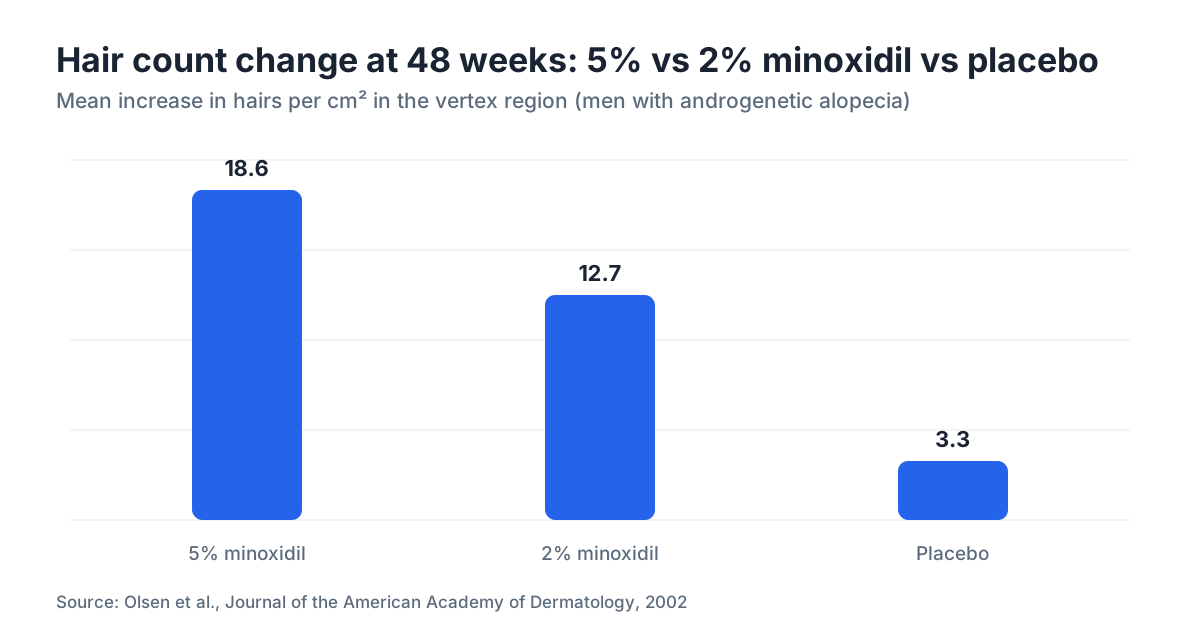
| 48 weeks | +18.6 hairs/cm² (mean) | +12.7 hairs/cm² (mean) | +3.3 hairs/cm² |
Data from the Olsen et al. 2002 RCT (n=393) published in JAAD [5].
Those numbers look modest, but hair count per square centimeter is a dense metric. An increase of 15 to 18 hairs per cm² in the vertex is visible to the naked eye. About 40 to 60% of men see "moderate to marked" regrowth in controlled trials; roughly 40% see minimal change; a small percentage see nothing [5].
Women tend to see better density and thickness rather than dramatic spot regrowth, which makes self-assessment harder. Standardized photography at baseline and again at 6 to 12 months is the most reliable way to judge response.
If you want an objective read on your hair density before starting, the free AI scan at MyHairline gives you a baseline photo analysis to compare against later. That beats eyeballing it in the mirror.
Why does minoxidil stop working when you stop using it?
This question gets at what minoxidil does and does not do at a root cause level.
Minoxidil does not fix the underlying reason follicles are struggling. In androgenetic alopecia, that reason is DHT-driven miniaturization, a genetic sensitivity baked into follicle androgen receptors. Minoxidil does not touch androgen receptors. It does not lower DHT. It improves follicle function through vasodilation and cell-survival mechanisms that sit entirely apart from the androgen pathway.
So while you are on minoxidil, follicles are better supplied and stay in anagen longer. The moment you stop, those vascular effects fade within days (minoxidil has a short half-life). Follicles lose the support, return to their pre-treatment cycle, and miniaturization picks up from wherever it left off.
In clinical practice, stopping minoxidil after 12+ months of use returns hair density to pre-treatment levels within roughly 3 to 4 months [6]. Some people describe it as shedding all the gained hair fast, which is accurate. This is not a withdrawal effect in the pharmacological sense. It is just the end of pharmacological support.
That is why the treatment is maintenance, not cure. If you understand and accept that before starting, the long-term commitment makes more sense. For people who want to address the root cause in androgenetic alopecia, combining minoxidil with a DHT blocker like finasteride gives you both the structural (anti-DHT) and vascular (minoxidil) angle at once.
Does minoxidil work for hair loss types other than pattern baldness?
Minoxidil's mechanism (vasodilation, potassium channel opening, anagen prolongation) is not specific to androgenetic alopecia. It acts on follicle biology generally. That is why it helps in several other hair loss conditions, though the evidence is thinner outside androgenetic alopecia.
Alopecia areata is an autoimmune condition where immune cells attack follicles. Minoxidil is not an immunosuppressant and does nothing to the immune mechanism. But it is often used alongside treatments like corticosteroids or JAK inhibitors to stimulate regrowth in recovering follicles. The American Academy of Dermatology lists topical minoxidil as an adjunctive option in alopecia areata management [7].
Telogen effluvium (diffuse shedding triggered by stress, illness, or nutritional deficiency) often resolves on its own once the trigger is gone. Minoxidil can speed follicle re-entry into anagen, though it is not required. Most dermatologists say fix the underlying trigger first. Our what causes hair loss article covers how to tell these apart.
Chemo-induced hair loss, traction alopecia, and scarring alopecias are different matters. Minoxidil has limited evidence in chemotherapy-related loss and is generally useless once follicles are permanently scarred. The vascular mechanism needs living follicles to support.
For beard and eyebrow regrowth, minoxidil is used off-label with some supporting evidence, though the concentration, frequency, and expected outcomes differ from scalp application.
What is the sulfotransferase connection, and are you a non-responder?
This is probably the most underappreciated piece of minoxidil science, and it has real clinical implications.
Minoxidil itself (the molecule in the bottle) is pharmacologically inactive. It is a prodrug. To open potassium channels, it first has to be converted to minoxidil sulfate by sulfotransferase enzymes, mainly SULT1A1. In the scalp, that conversion happens in the outer root sheath of the follicle [2].
Here is the problem: SULT1A1 activity varies enormously between people. Some have naturally high scalp sulfotransferase activity. Others have very little. Studies suggest SULT1A1 activity levels can predict topical minoxidil response with meaningful accuracy. Patients with low enzyme activity may see minimal benefit from topical application because they simply are not converting enough minoxidil to its active form at the follicle.
A 2019 study in the Journal of the American Academy of Dermatology by Goren et al. measured SULT1A1 activity from a hair pluck test in minoxidil users and found a strong correlation between low enzyme activity and non-response [2]. That test is now sold by a few labs, though it is not yet standard practice.
If you have tried topical minoxidil for 9 to 12 months with no visible result, low sulfotransferase activity is worth considering. Oral minoxidil sidesteps this because the liver converts minoxidil to its active sulfate form systemically, delivering active drug to follicles regardless of scalp enzyme levels. That said, oral minoxidil carries different risks. The oral minoxidil article covers those tradeoffs directly.
How does the combination of minoxidil and finasteride compare to either alone?
Minoxidil and finasteride work through completely different pathways, which makes them genuinely complementary rather than redundant.
Finasteride blocks the 5-alpha reductase enzyme, cutting DHT production by roughly 60 to 70% in scalp tissue. That addresses the root cause of follicle miniaturization in androgenetic alopecia. Minoxidil, as covered above, does nothing to DHT. It improves blood supply, extends anagen, and supports follicle cell survival through vasodilation.
A 2002 study by Khandpur et al. in the Journal of Dermatology comparing finasteride alone, minoxidil alone, and the combination found that combination therapy produced greater improvements in hair density at 12 months than either drug used alone [8]. The effect is additive.
In practice, finasteride prevents further structural deterioration while minoxidil actively drives the vascular and cellular support for regrowth. For men with moderate to significant androgenetic alopecia, most hair loss specialists consider combination therapy the most effective non-surgical approach. Our finasteride and minoxidil article breaks down what to expect from combining them.
For people who cannot or do not want to take finasteride (side effect concerns, or because they are women), minoxidil alone is still the best-evidenced monotherapy. But knowing its mechanism makes clear exactly what it can and cannot do on its own.
What are the main side effects and how does the mechanism explain them?
Most side effects of topical minoxidil trace directly back to its mechanism. Vasodilation does not stay perfectly localized to the scalp.
Hypertrichosis (unwanted facial or body hair) is the most common side effect, hitting roughly 3 to 5% of women using topical minoxidil and less often in men. The mechanism: minoxidil or absorbed minoxidil sulfate reaches follicles elsewhere on the body and triggers the same anagen-prolonging effects. It is much more common with the 5% strength.
Contact dermatitis and scalp irritation are also common, often blamed on the propylene glycol carrier in solution formulations rather than minoxidil itself. Foam formulations were developed partly to reduce this.
Systemic absorption of topical minoxidil is low (estimated at roughly 1 to 2% under normal conditions), but enough can be absorbed to cause rare cardiovascular effects: palpitations, fluid retention, and blood pressure changes [1]. These are more likely with the 5% solution applied over a large area or on broken skin.
With oral minoxidil, systemic effects matter more. Fluid retention, facial hypertrichosis, and in rare cases pericardial effusion have been reported. The FDA label for oral minoxidil tablets (approved for hypertension, used off-label for hair loss) carries a black box warning about serious cardiovascular risks at antihypertensive doses, though the low doses used for hair loss (0.625 to 5 mg/day versus 10 to 40 mg/day for blood pressure) carry a much more favorable profile [1].
A full side effect profile with frequency data is in the minoxidil side effects article. The mechanism-level point here: every significant side effect has a direct pharmacological explanation. Nothing mysterious is happening.
Does minoxidil work better as a foam, solution, or oral tablet?
The formulation affects delivery, tolerability, and which side effects show up, but the underlying mechanism is identical across all three.
Topical solution (2% or 5%) contains propylene glycol, which increases skin penetration but also irritates the scalp in a meaningful subset of users. The solution spreads easily and may be preferred for large areas.
Topical foam (5%) uses ethanol and isobutane as carriers, no propylene glycol. In the Olsen 2002 RCT, the 5% foam produced 45% more hair count increase than the 2% solution, though that comparison was 5% versus 2%, not foam versus solution head-to-head [5]. The foam got FDA approval in 2006 for men and in 2014 for women. For sensitive scalps, foam is often the better-tolerated starting point.
Oral minoxidil is a once-daily pill. As noted above, it skips the scalp sulfotransferase step because the liver converts minoxidil to its active form and delivers it systemically. That makes it useful for topical non-responders. It also reaches follicles more uniformly, which may be why some users report better results across the whole scalp rather than just the vertex. Systemic exposure is meaningfully higher than with topical use, which is why cardiovascular screening is recommended before starting oral minoxidil.
There is no RCT definitively showing oral minoxidil beats topical 5% minoxidil head-to-head for all users. The evidence for oral is mostly retrospective studies and open-label trials. It is promising but not yet as solid as the topical data.
Can minoxidil regrow a completely bald area, or does it only maintain hair?
This is a critical expectation-setting question, and the mechanism gives an honest answer.
Minoxidil works by supporting existing follicles. It can wake up follicles stuck in extended telogen or miniaturized but still structurally alive. It cannot generate new follicles or revive follicles replaced by scar tissue or fat.
In practice, minoxidil works best where hair is thinning, and poorly or not at all where an area has been completely bald for years. The rule of thumb in dermatology: if an area has been smooth and hairless for more than 5 years, the follicles may be too atrophied to respond [6]. Earlier intervention produces better results.
For significantly receded hairlines or large bald patches, the realistic options shift toward hair transplant surgery, which physically relocates DHT-resistant donor follicles. Minoxidil is often used after a transplant to help the transplanted follicles establish and to maintain the native hair around them. More on receding hairlines and treatment options is in our receding hairline guide.
For anyone noticing early thinning and wondering whether to start minoxidil, the mechanism strongly favors starting earlier. The more active follicles you have to work with, the better the potential outcome. The MyHairline AI scan can help you see which areas are thinning and how advanced the pattern is before you decide.
Sources
- FDA, Rogaine (minoxidil) 5% topical aerosol label
- Goren A et al., Journal of the American Academy of Dermatology, 2019: scalp SULT1A1 activity predicts minoxidil response
- Messenger AG, Rundegren J. Minoxidil: mechanisms of action on hair growth. British Journal of Dermatology, 2004
- Headington JT. Transverse microscopic anatomy of the human scalp. Archives of Dermatology, 1984. Background on follicle vasculature and minoxidil discovery history
- Olsen EA et al. A randomized clinical trial of 5% topical minoxidil versus 2% topical minoxidil and placebo in the treatment of androgenetic alopecia in men. Journal of the American Academy of Dermatology, 2002
- American Academy of Dermatology Association, Hair loss: Diagnosis and treatment
- American Academy of Dermatology Association, Alopecia areata: Diagnosis and treatment guidelines
- Khandpur S et al. Comparative efficacy of various treatment regimens for androgenetic alopecia in men. Journal of Dermatology, 2002
- NIH MedlinePlus, Minoxidil topical
- Suchonwanit P, Thammarucha S, Leerunyakul K. Minoxidil and its use in hair disorders: a review. Drug Design, Development and Therapy, 2019