

TL;DR: Most men with androgenetic alopecia progress from Norwood 2 to Norwood 3 somewhere between 1 and 5 years, though the range is genuinely wide. Aggressive DHT sensitivity can push the transition in under 12 months; slower progressors may sit at Norwood 2 for a decade or more. Proven treatments like finasteride and minoxidil can slow or sometimes halt this progression.
What are Norwood 2 and Norwood 3, exactly?
The Norwood-Hamilton scale is the standard classification system for male-pattern baldness, first published by James Hamilton in 1951 and revised by O'Tar Norwood in 1975 [1]. It runs from Type 1 (no visible recession) through Type 7 (only a horseshoe fringe remains).
Norwood 2 is mild. You have slight temples that have receded back from the original hairline, but not dramatically. Most people outside your immediate family probably haven't noticed. The hairline forms a shallow "M" or shows triangular recession at the temples, but the frontal forelock is still largely intact.
Norwood 3 is the first stage the scale formally classifies as significant hair loss [1]. The temples have receded further and deeper, often past an imaginary vertical line drawn through the outer corner of each eye. The "M" shape is now obvious. Some men also show early thinning at the crown in a variant called Norwood 3 Vertex.
The gap between these two stages feels small on a diagram. In real life, it's the transition most men find emotionally significant, because it's the point where other people start to notice.
How quickly does the average man move from Norwood 2 to Norwood 3?
No published study tracked a large group of men exclusively from Norwood 2 to Norwood 3 and reported the median time. That kind of longitudinal precision doesn't exist in the hair loss literature yet, and anyone who gives you an exact average number is extrapolating.
What we do have is solid data on overall progression. A 2017 meta-analysis in Nature Communications confirms androgenetic alopecia affects roughly half of men by age 50, and that earlier onset predicts faster, more severe loss [2]. Clinicians commonly describe progression, where it occurs, as roughly half a Norwood stage per year on average, though the variance is enormous. At that pace, the 2-to-3 transition takes around 2 years. But "average" here is nearly meaningless given the spread.
Dermatologists tend to describe three rough groups:
- Fast progressors: Norwood 2 to 3 in under 12 months. This happens most often in men in their late teens or early 20s with strong family history on both sides and high androgen receptor sensitivity.
- Typical progressors: 2 to 5 years. The most common range.
- Slow progressors: 5 to 15 years, or indefinite stabilization at Norwood 2. Some men genuinely plateau and never advance further.
Age matters a lot. Men who hit Norwood 2 at 19 are much more likely to progress quickly than men who first notice recession at 45 [2]. The younger the onset, the more aggressive the trajectory tends to be.
What drives how fast you move through the Norwood stages?
The root mechanism is androgenetic alopecia, which depends on three things converging: the presence of dihydrotestosterone (DHT), hair follicles with androgen receptors that are sensitive to it, and the genetic programming that makes those follicles miniaturize over time [3]. The speed of progression depends on all three, and you inherited all three from your parents.
Genetics is the biggest lever. Research consistently shows that variants in the AR gene (androgen receptor gene on the X chromosome, inherited from your mother) strongly predict both onset and progression rate [3]. But paternal genetics matter too; the idea that baldness comes only from your mother's father is a myth. Multiple gene variants across several chromosomes are involved.
DHT levels help but aren't the whole story. Men with identical DHT serum levels can progress at wildly different rates based purely on receptor sensitivity. This is why DHT blockers like finasteride reduce progression in most men but don't stop it entirely in others.
Stress and nutrition can accelerate shedding in ways that mimic or worsen progression. Telogen effluvium, the acute shedding triggered by physical or emotional stress, can temporarily push a Norwood 2 hairline into looking like a 3 before partially recovering. That's not true androgenetic progression, but it complicates self-assessment.
Hormonal changes, particularly spikes in testosterone that accompany puberty or anabolic steroid use, can accelerate the timeline significantly. So can scalp inflammation, though the mechanism there is less well understood.
Can you tell you're progressing before it becomes visible?
Sometimes, yes. The most common early signal is increased shedding at the temples and hairline, especially noticeable on a pillow or in the shower. Miniaturized hairs (thinner, shorter, paler than the surrounding hair) appearing along the hairline are a reliable sign that follicles are under DHT attack and that progression is already underway.
A trichoscopy exam, where a dermatologist uses a handheld dermoscope to examine individual follicles, can detect miniaturization before it's visible to the naked eye. If more than 20% of follicles in a given area show miniaturization, that's considered a marker of active androgenetic alopecia [4].
Photography is underrated. Taking standardized photos (same lighting, same angle, same wet or dry state) every 3 months lets you compare objectively. Most people's subjective perception is unreliable because hair loss is gradual and humans adapt to it. A free AI hair analysis tool like MyHairline's scan (/scan) can help you track changes over time with consistent framing, which removes some of that subjectivity.
The main thing to watch for is the angle and depth of temple recession. Norwood 2 stays above and forward of that vertical line through the outer eye corner. Once recession crosses that line, you're at 3.
Does everyone with Norwood 2 eventually reach Norwood 3?
No. Progression is not guaranteed.
Some men genuinely stabilize at Norwood 2 for decades, or permanently. The biological reason isn't fully understood, but it likely relates to gradual changes in androgen sensitivity as men age, along with natural variation in DHT metabolism. Some men's follicles simply stop responding as aggressively over time.
The problem is that you can't know in advance which group you're in. A dermatologist can give you a probability estimate based on your age at onset, family history, and current rate of change, but not a guarantee. What you can do is monitor consistently and act on early evidence of continued progression rather than waiting until loss is advanced.
If you've been at Norwood 2 for more than 5 years with no measurable change, you're likely a slow progressor, though not guaranteed to stay that way forever.
What does the research say about slowing down the Norwood 2 to 3 transition?
This is where things get concrete. Two treatments have FDA approval for androgenetic alopecia in men and genuine evidence behind them [5][6].
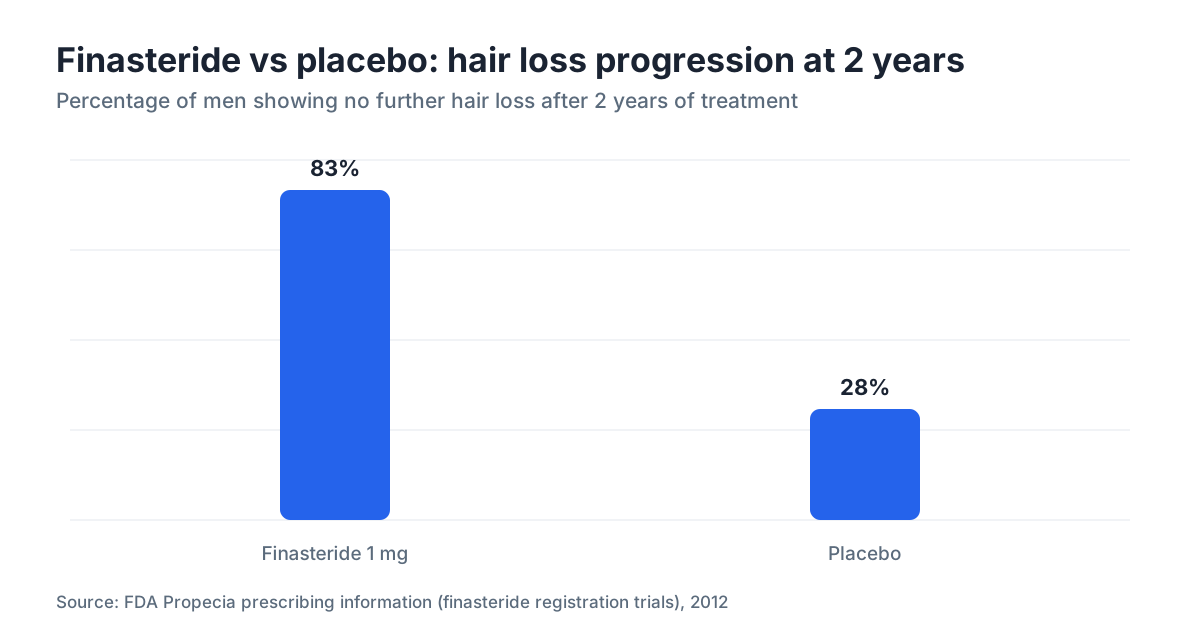
Finasteride (1 mg oral, brand name Propecia) inhibits the 5-alpha reductase enzyme that converts testosterone to DHT, reducing scalp DHT by roughly 60 to 70% [5]. In the original registration trials, 83% of men taking finasteride over 2 years showed no further progression compared to 28% on placebo. About 66% showed some regrowth. These are real, replicated numbers. Finasteride won't help everyone, but it's the strongest single intervention for slowing progression. It requires a prescription.
Minoxidil, applied topically or taken as a low-dose oral tablet, prolongs the hair growth phase and increases follicle size [6]. It doesn't block DHT, so it doesn't address the root cause, but it can visibly maintain and sometimes partially restore hair at the hairline and temples. The FDA-approved topical concentration for men is 5% [6]. See minoxidil for men for full dosing detail.
Used together, finasteride and minoxidil work through different mechanisms and have additive effect [7]. A 2015 study published in the Journal of the American Academy of Dermatology found the combination produced significantly greater hair count improvement than either agent alone [7]. For someone sitting at Norwood 2 who doesn't want to reach Norwood 3, starting both is the most aggressive non-surgical option available. See finasteride and minoxidil for the practicalities.
Hair loss supplements like biotin and saw palmetto have much weaker evidence and shouldn't be treated as equivalent. The honest answer is that the data there is thin.
None of these treatments are cures. They manage progression. If you stop, loss resumes, typically within 6 to 12 months.
How is Norwood 3 different from Norwood 3 Vertex, and does it change your prognosis?
Norwood 3 Vertex is a variant where the primary progression is at the crown rather than (or in addition to) the temples. The hairline recession may still look like Norwood 2 at the front while significant thinning is happening at the back of the scalp.
This matters for prognosis because crown thinning at an early overall stage often predicts a faster eventual progression to higher Norwood stages. It suggests the androgenetic process is active across a larger portion of the scalp simultaneously.
For treatment, crown thinning responds well to minoxidil and is also slowed by finasteride. For transplant planning down the road, surgeons pay close attention to whether a patient is a Norwood 3 or 3 Vertex because the donor supply and future loss pattern affect the surgical design significantly. See hair transplant for how surgeons plan around this.
If you're noticing thinning at the crown while your front hairline still looks relatively intact, don't assume you're just at Norwood 2. Get a proper assessment.
What should you actually do right now if you're at Norwood 2 and worried about progression?
First, confirm your staging accurately. Lighting, hairstyle, and hair length all create optical illusions. A wet-hair photo taken in harsh overhead light is the most honest view of your actual hairline.
Second, establish a baseline. Date-stamped photos every 3 months, same conditions. If you want a more structured baseline, MyHairline's free AI scan (/scan) can classify your stage and flag change over time. Use it as a tracking tool, not a diagnosis.
Third, see a dermatologist if you're seeing change. A board-certified dermatologist or trichologist can do a trichoscopy, assess your family history, and have a real conversation about whether your rate of change warrants medication. The American Academy of Dermatology publishes guidance on this process [8].
Fourth, if you decide to treat, start sooner rather than later. Finasteride and minoxidil preserve existing hair better than they restore lost hair. Starting at Norwood 2 gives you more to protect than starting at Norwood 4.
Fifth, understand what you're signing up for. Both main medications require ongoing use. Finasteride has real side effects in a minority of users that you should read about before starting [5]. Minoxidil also has side effects worth knowing (see minoxidil side effects). Go in informed.
And if you're losing hair faster than expected, read up on what causes hair loss and rule out non-androgenetic causes first. Not all hairline recession is male-pattern baldness.
Does the age you reach Norwood 2 predict how fast you'll get to Norwood 3?
It's one of the stronger predictors we have. Onset age correlates fairly well with eventual severity and speed of progression.
A study in Dermatologic Surgery found that men who first showed significant androgenetic alopecia before age 30 were substantially more likely to reach advanced stages (Norwood 5 through 7) by age 60 than men whose recession began after 40 [9]. The mechanism is that early onset reflects higher androgen receptor sensitivity and stronger genetic loading, both of which drive faster progression.
Practically: if you're 19 and already at Norwood 2, treat that differently than a 48-year-old who just noticed mild temple recession. The 19-year-old has decades of DHT exposure ahead and a high-sensitivity system. The 48-year-old may plateau with minimal further change.
This is one of the biggest factors a dermatologist weighs when talking to you about whether and how aggressively to treat. Age at onset isn't destiny, but it's signal.
Can a receding hairline at Norwood 2 ever reverse without treatment?
Spontaneous reversal of androgenetic alopecia doesn't happen. Once DHT-driven miniaturization reaches a follicle, that follicle won't recover on its own.
What can look like reversal is the resolution of telogen effluvium layered on top of androgenetic alopecia. If stress, illness, rapid weight loss, or nutritional deficiency triggered a shedding episode that made your Norwood 2 look worse, fixing the underlying cause can restore the shed hair and return you to your baseline Norwood 2 appearance. But the baseline doesn't improve.
Some men also notice apparent improvement when they fix hairstyle, start using volumizing products, or grow their hair longer to cover recession. That's cosmetic, not biological.
The short answer: true reversal of a genetically driven receding hairline requires either medical treatment or hair restoration surgery. Untreated, androgenetic alopecia at any Norwood stage either stays the same or progresses.
Sources
- Norwood OT. Male pattern baldness: Classification and incidence. Southern Medical Journal, 1975
- Heilmann-Heimbach S et al. Meta-analysis identifies novel risk loci and yields systematic insights into the biology of male-pattern baldness. Nature Communications, 2017
- Ellis JA et al. The androgen receptor and male pattern baldness. Clinical and Experimental Dermatology, 2002
- Rakowska A et al. Trichoscopy of cicatricial alopecia and hair shaft disorders. Journal of Dermatological Case Reports, 2008
- U.S. Food and Drug Administration. Propecia (finasteride) prescribing information
- U.S. Food and Drug Administration. Minoxidil topical solution approval and labeling
- Hu R et al. Combined treatment with oral finasteride and topical minoxidil in male androgenetic alopecia. Journal of the American Academy of Dermatology, 2015
- American Academy of Dermatology. Hair loss: diagnosis and treatment
- Rhodes T et al. Prevalence of male pattern hair loss in 18-49 year old men. Dermatologic Surgery, 1998
- van der Donk J et al. Psychosocial aspects of hair loss among young men. Dermatology, 1994
- Goren A et al. Clinical utility and validity of minoxidil response testing in androgenetic alopecia. Dermatologic Therapy, 2015
- van der Merwe J et al. Three weeks of creatine monohydrate supplementation affects dihydrotestosterone to testosterone ratio in college-aged rugby players. Clinical Journal of Sport Medicine, 2009