

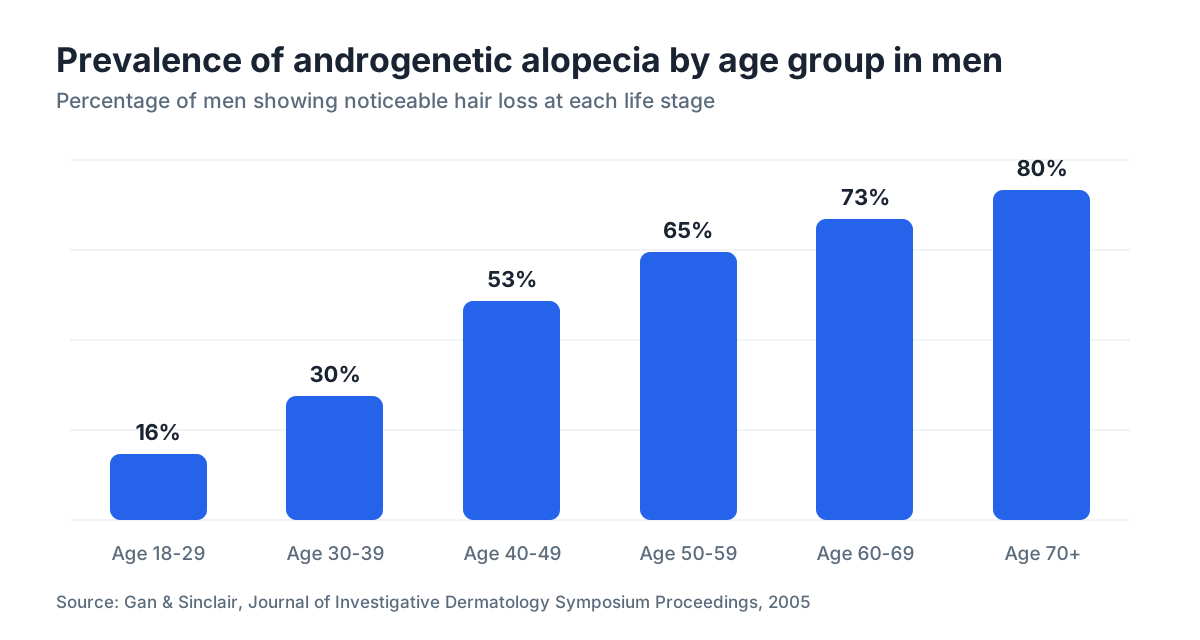
TL;DR: The Norwood scale runs from Type 1 (no loss) to Type 7 (nearly complete baldness). About 16% of men aged 18-29 already show hair loss, climbing to 53% by their 40s. Most young men who are losing hair sit at Norwood 2 or 3. That's the stage where finasteride and minoxidil have the strongest evidence, and where starting early actually changes your future.
What is the Norwood scale and why does it matter?
The Norwood-Hamilton scale is the standard system doctors and researchers use to describe male pattern baldness (androgenetic alopecia). James Hamilton published the original in 1951. O'Tar Norwood revised it into the version everyone uses today in 1975 [1]. It has seven main types, plus a Type A variant for men whose hairline recedes straight back rather than forming the classic M-shape.
Why should you care? The stage you're at right now predicts your trajectory, decides which treatments are even worth discussing, and is the language every dermatologist and transplant surgeon speaks. Walk into a consultation not knowing your Norwood type and you're negotiating in a language you don't understand.
The scale tracks two zones of loss: the frontal hairline (temples and leading edge) and the vertex, or crown. Types 1 through 3 are mostly about the hairline receding. Types 4 through 7 involve the crown collapsing inward. By Type 5 those two zones start to merge. By Type 7, only a horseshoe band around the sides and back is left.
One thing worth saying plainly: the Norwood scale describes pattern, not speed. Two men at Norwood 3 at age 25 can have completely different futures. One holds at Norwood 3 for a decade. The other hits Norwood 5 before he's 30. The scale tells you where you are. It says nothing about how fast you're moving.
What does each Norwood stage actually look like?
Here's what each type means in plain terms, what you'd see in a mirror or in Norwood scale hair loss stages images of young men.
Norwood Type 1 is the baseline. No meaningful recession. Most men in their early teens look like this. If you're here and worried, study your temples under good light before drawing any conclusions.
Norwood Type 2 is where most young men first notice something. The hairline moves back slightly at the temples, hinting at an M-shape. Recession is usually under 2 cm from the original juvenile hairline [1]. A lot of men mistake this for a maturing hairline, which is a real thing, and sometimes they're right. The gap between a maturing hairline and early androgenetic alopecia is subtle, and a dermatologist with a dermoscope can usually settle it.
Norwood Type 3 is the first stage the original Norwood classification called clinically significant baldness [1]. The temples have receded deeper and the M-shape is obvious. Type 3 Vertex is a subtype where the crown also starts thinning even while the front still looks fine. This is the most common stage at which young men start searching for answers.
Norwood Type 4 is a real jump. The hairline has moved back further, and there's now a clearly defined bald or very thin patch on the crown. A dense band of hair still separates the two zones.
Norwood Type 5 is where those two zones begin to merge. The band between them is narrow and thin. Non-surgical treatments can slow things at this point but are unlikely to give you your old hairline back.
Norwood Type 6 means the bridge between front and crown is gone. The temple loss and crown loss have connected into one large area. The sides and back remain.
Norwood Type 7 is the most advanced stage. Only a narrow horseshoe of hair remains at the back and sides. Transplant planning gets hardest here, because donor supply on the back and sides is limited and the area to cover is large.
The Type A variant runs through several of these stages and describes a different pattern: the hairline recedes straight back across the whole front rather than holding in the middle while the temples retreat. Young men with this pattern often never see the classic M at all, just a uniform march backward across the frontal band.
| Norwood Type | Primary feature | Crown involvement | Typical age of onset |
|---|---|---|---|
| 1 | No recession | None | Teen years |
| 2 | Slight temple recession | None | Late teens to early 20s |
| 3 | Deeper M-shape recession | None (3) or early (3V) | Early to mid-20s |
| 4 | Clear recession + crown patch | Moderate | Mid-20s to 30s |
| 5 | Zones beginning to merge | Significant | Late 20s to 30s |
| 6 | Zones merged, no bridge | Extensive | 30s to 40s |
| 7 | Horseshoe only | Near-total | 40s+ |
These ages are approximate. Androgenetic alopecia can start earlier in men with strong genetic predisposition.
How common is hair loss in men in their 20s?
More common than most young men expect. A large population study published in the Journal of Investigative Dermatology Symposium Proceedings found about 16% of men aged 18-29 already show signs of androgenetic alopecia, rising to around 53% by ages 40-49 [2]. By their 70s, roughly 80% of men are affected.
Sit with that 16% figure. It means about 1 in 6 young men aged 18 to 29 is already somewhere above Norwood Type 1. Most are at Norwood 2 or early 3, and plenty haven't connected what they see in the mirror to androgenetic alopecia yet.
Hair loss starting in your early 20s is not rare and not a sign something is medically wrong. It does tend to predict a more aggressive eventual pattern, though. Men who start losing hair at 20 usually end up at higher Norwood stages than men who start at 40. That's exactly why acting early matters if you want to keep what you have.
Here's what young men often miss: the loss you can see is usually preceded by months or years of miniaturization underneath. Follicles shrink gradually, producing finer and shorter hairs before they quit entirely. Early treatment, even before the loss is obvious, works so well precisely because you're stopping miniaturization before follicles go dormant.
What causes young men to progress through Norwood stages?
The short answer: genetics and dihydrotestosterone (DHT). Androgenetic alopecia happens when hair follicles in genetically susceptible areas (temples, crown) are sensitive to DHT, a hormone derived from testosterone [3]. DHT binds to receptors in those follicles and shortens the growth cycle over time. Hairs get shorter and finer with each cycle until the follicle stops producing terminal hair at all.
There's much more on the mechanics in our piece on what causes hair loss, and the specific hormone pathway in our DHT blocker guide.
Genetics is the dominant factor. If your father and maternal grandfather both went bald early, your odds are high. But genetics isn't destiny and the relationship isn't clean. Multiple genes are involved, the inheritance pattern is messy, and plenty of men with bald fathers keep their hair well into middle age.
Other things can trigger or speed up shedding in young men: severe calorie restriction, high psychological stress, thyroid disorders, iron deficiency, and certain medications [4]. Those usually cause a different type of shedding called telogen effluvium, which tends to be diffuse rather than patterned. A dermatologist can tell the two apart. If you're shedding rapidly all over your scalp instead of in the temple-and-crown pattern, get bloodwork before assuming it's androgenetic alopecia.
Some young men ask about specific lifestyle factors. Creatine comes up constantly. For the full look at that question, see our article on does creatine cause hair loss.
How do you accurately figure out your Norwood stage?
This is harder than it sounds in your 20s, for a few reasons.
First, hairlines genuinely mature between ages 17 and 25. Slight temple recession in a 20-year-old is not automatically Norwood 2 androgenetic alopecia. The mature hairline usually sits about 1 to 1.5 cm above the highest forehead crease [5]. If your recession has held steady for a couple of years, it might just be your adult hairline settling in.
Second, diffuse crown thinning is easy to miss early. Hair in that area has to lose about 50% of its density before it's obvious under overhead light [6]. Many men at Norwood 3 Vertex have real crown thinning they've never spotted, because they never look at the top of their head from the right angle.
The most reliable way to stage yourself: photograph your hairline from the front and both sides in consistent lighting, and photograph your crown from directly above. Compare those photos month to month. Progression, not a single snapshot, tells you whether you have androgenetic alopecia.
A board-certified dermatologist, ideally one who specializes in hair disorders, can do a pull test and a dermoscopic exam (looking at follicle caliber under magnification) to confirm miniaturization and measure density. That's genuinely useful when you're unsure. The American Academy of Dermatology has resources on finding a board-certified dermatologist [4].
Want a first-pass read before a clinic visit? MyHairline's free AI hair analysis at /scan can classify your likely Norwood stage from photos and flag whether the pattern looks like androgenetic alopecia. It's a screening tool, not a diagnosis.
Which treatments work at each Norwood stage?
The evidence changes a lot depending on where you sit on the scale. Here's what the data actually supports.
Norwood 1-2: You probably don't need treatment yet, unless you're seeing active progression. If you are progressing, this is the best time to start. Follicles aren't gone, they're just beginning to shrink. The FDA has approved two treatments for androgenetic alopecia in men: topical minoxidil and oral finasteride [7][8].
Minoxidil 5% solution or foam is FDA-approved for men [7]. It appears to extend the anagen (growth) phase and increase blood flow around follicles. It does not block DHT, so it treats the symptom rather than the cause. A large controlled trial found 5% topical minoxidil produced significantly more regrowth than 2% at 48 weeks [9]. Our full guide on minoxidil for men covers dosing, timing, and what to expect in the first few months, and if you're weighing oral formulations, see our piece on oral minoxidil.
Finasteride 1 mg daily is the other FDA-approved option. It inhibits the enzyme that converts testosterone to DHT, cutting scalp DHT levels by roughly 60 to 70% [8]. A two-year clinical trial found finasteride stopped progression in 83% of men and produced visible regrowth in 66% [8]. It needs a prescription. For the full picture of how it works and what to watch for, see our finasteride guide.
Using both together is an option many dermatologists discuss. The combination has shown additive benefit in several trials. Our piece on finasteride and minoxidil covers that pairing specifically.
Norwood 3-4: This is where most treatment decisions get made. Both approved treatments can still slow progression meaningfully. Regrowth at the hairline is possible but less predictable than at the crown. Finasteride tends to perform better at the crown than the frontal hairline in clinical data [8]. Men at this stage should also start thinking about what happens if medications aren't enough, which means an honest conversation about eventual hair transplant candidacy.
Norwood 5-7: Medications can preserve what's left. They're very unlikely to restore hair you've already lost at this stage. Transplant surgery is the realistic route to visible restoration, but donor supply limits what's achievable. A good surgeon will tell you most Type 7 men can get a solid cosmetic result covering the front and midscalp, but full coverage isn't on the table.
A few things with weak or no real evidence: laser combs, hair loss shampoos, biotin supplements in men without a deficiency, and scalp massage alone. You can burn through a lot of money here before realizing none of it moves the needle. Our article on hair loss supplements walks through the evidence on popular products honestly.
| Treatment | FDA approved for men? | Best evidence at which stage | Regrowth expected? |
|---|---|---|---|
| Topical minoxidil 5% | Yes | Norwood 2-4 | Modest, crown best |
| Finasteride 1 mg | Yes | Norwood 2-5 | Moderate, mainly crown |
| Both combined | Off-label combination | Norwood 2-5 | Better than either alone |
| Hair transplant | N/A (surgery) | Norwood 3-7 | Yes, permanent |
| Low-level laser therapy | FDA cleared (not approved) | Weak at all stages | Marginal at best |
Can you predict how far your hair loss will progress?
Honestly, no, not with precision. Dermatologists weigh age of onset, rate of progression so far, family history, and current pattern to make a rough estimate. That's educated guessing, not prediction.
What the research does show: younger age at onset generally predicts a higher eventual Norwood stage. Men who start losing hair at 20 have a higher probability of reaching Norwood 5 or above than men who start at 40 [2]. Not a certainty, just a higher chance.
Some dermatologists use the rule of thumb that your Norwood stage at 40 is a fair estimate of your final pattern, but it varies a lot. Some men stabilize at Norwood 3 for life without touching a single treatment.
The most useful thing you can do is track change over time. Monthly photos, same angle, same lighting. Same stage for two years? You may be in a slow phase. Moved a full stage in six months? That's aggressive and worth treating now.
Nothing on the market today reliably predicts your genetic end-stage. Consumer genetic tests marketed for hair loss (which look at a handful of androgen receptor variants) have not been shown to predict progression accurately in clinical validation [10]. Save the money.
Is crown thinning a different problem from hairline recession?
Same underlying cause, different scalp geography. Androgenetic alopecia crown thinning and frontal hairline recession are both driven by DHT sensitivity in genetically vulnerable follicles. But the timeline and treatment response differ in ways that matter.
Crown thinning is easy to miss early, because you're looking at the back of your own head. It usually shows up on the Norwood scale at the Type 3 Vertex or Type 4 stage. Men often discover it from a photo, or from a barber mentioning it.
Finasteride's clinical trial data shows stronger regrowth at the vertex than the frontal hairline [8]. The two-year trial in the original FDA submission found vertex regrowth in the majority of finasteride users, with frontal results less consistent. Minoxidil also tends to do more in the crown zone. The likely reason: crown follicles stay miniaturized longer before going permanently dormant, compared to the more exposed frontal hairline.
Crown thinning also looks most dramatic in photos taken from above, so it's often what first sends men searching for help. If you see a visible scalp patch on top but your hairline still looks okay, you're probably at Norwood 3 Vertex or early Type 4, and those follicles likely still respond to treatment.
When should a young man start treatment for hair loss?
As soon as you can confirm you have androgenetic alopecia and it's progressing. That's the honest answer.
The biology is unforgiving in one specific way. Once a follicle miniaturizes past a certain point, it stops producing hair that treatment can rescue. Medications preserve, they don't resurrect. So the window where drugs make a real difference is early, while follicles are still producing hair, just thinner and shorter hair than before.
Whether a 19 or 20 year old should take finasteride is genuinely more complicated. The drug works through a hormonal mechanism, it carries a small but real risk of sexual side effects in some men [8], and committing to a daily pill at 19 is a different proposition than at 29. Have that conversation with a physician who knows your health history. Don't make the call off an article online.
Minoxidil has a simpler risk profile for most young men and can start without a prescription. It won't touch DHT, but it can keep more hairs in the growth phase while you sort out a longer-term plan.
Delaying is not a neutral choice. Every month of active miniaturization is a month of follicles drifting closer to permanent loss. Regret over not starting sooner is one of the most common stories in any hair loss forum. If you're at Norwood 2, progressing, and in good health, most dermatologists would tell you finasteride's benefit-to-risk ratio is favorable.
What should you actually do next if you think you're losing hair?
Step one: stop and actually look. Take photos from the front, both sides, and directly overhead. Compare them to photos from a year ago if you have any. Change over time is what separates androgenetic alopecia from a normal mature hairline.
Step two: see a dermatologist if you can. A dermoscopic exam takes about ten minutes and can tell you whether miniaturization is happening. Bloodwork to rule out thyroid issues and iron deficiency is also worth doing, especially if the shedding looks more diffuse than patterned.
Step three: read up on the options before you sit in that appointment. Knowing the difference between minoxidil's mechanism and finasteride's, understanding the side effect profiles, and having a sense of your Norwood stage going in makes that conversation far more productive. Our guides on minoxidil side effects and finasteride are good starting points.
Want a fast first read on your likely Norwood stage? MyHairline offers a free AI hair analysis at /scan that classifies your pattern from photos. It's not a substitute for a dermatologist, but it can tell you whether what you're seeing looks like early androgenetic alopecia or something else entirely.
Don't spend money on unproven treatments before you have a diagnosis. The hair loss supplement market is large and mostly useless. The two FDA-approved options exist for a reason: real clinical trial data stands behind them. Start there.
Sources
- Norwood OT. Male pattern baldness: classification and incidence. Southern Medical Journal, 1975
- Gan DC, Sinclair RD. Prevalence of male and female pattern hair loss in Maryborough. Journal of Investigative Dermatology Symposium Proceedings, 2005
- American Academy of Dermatology Association. Hair loss types: androgenetic alopecia
- American Academy of Dermatology Association. Hair loss: diagnosis and treatment
- Rassman WR et al. Follicular unit extraction: minimally invasive surgery for hair transplantation. Dermatologic Surgery, 2002
- Olsen EA. Female pattern hair loss. Journal of the American Academy of Dermatology, 2001
- U.S. Food and Drug Administration. Minoxidil 5% topical solution label
- U.S. Food and Drug Administration. Propecia (finasteride 1 mg) prescribing information
- Olsen EA et al. A randomized clinical trial of 5% topical minoxidil versus 2% topical minoxidil and placebo. Journal of the American Academy of Dermatology, 2002
- Heilmann-Heimbach S et al. Meta-analysis identifies novel risk loci and yields systematic insights into the biology of male-pattern baldness. Nature Communications, 2017