
TL;DR: Rogaine (minoxidil) is not a first-line treatment for telogen effluvium because TE usually reverses once its trigger is gone. Some dermatologists use it short-term to speed regrowth or to manage cases that have dragged past six months. Evidence is limited but cautiously positive. Fixing the root cause matters far more than any topical.
What is telogen effluvium and why does it cause shedding?
Telogen effluvium (TE) is diffuse hair shedding that happens when a large share of follicles get pushed out of their growing phase (anagen) and into the resting phase (telogen) all at once. The trigger can be almost anything: a high fever, surgery, childbirth, rapid weight loss, thyroid disruption, crash dieting, or severe emotional stress [1]. About two to three months after the trigger, those telogen hairs fall out together. That lag is why the shedding feels random and terrifying.
Normal scalps have roughly 85-90% of follicles in anagen at any given time [1]. During TE, that number drops sharply. The follicles themselves are not destroyed, so the condition is almost always reversible once you find and remove whatever started it. That reversibility is the single most important fact to understand before reaching for any treatment.
Acute TE typically resolves within three to six months. Chronic TE is defined as shedding that persists past six months, and it is harder to untangle because the trigger may not be obvious or may still be active [2]. Learn more about the full picture at telogen effluvium.
How does Rogaine (minoxidil) work on hair follicles?
Rogaine is the brand name for topical minoxidil, a vasodilator first developed as an oral blood pressure drug [8]. On the scalp it opens potassium channels in follicle cells, which appears to shorten the telogen phase and prolong anagen, keeping hairs in active growth longer [3]. It also seems to increase the size of follicles that have miniaturized.
The FDA approved topical minoxidil 2% for women and 5% for men with androgenetic alopecia (pattern hair loss), not for telogen effluvium [4]. That distinction matters. Pattern hair loss involves progressive follicle miniaturization driven by DHT. Telogen effluvium does not involve miniaturization at all; the follicles are structurally intact and just waiting to re-enter anagen.
So minoxidil's strongest suit (preventing further miniaturization) does not apply to TE. What does apply is its ability to shorten telogen and nudge follicles back into anagen faster. That is the entire rationale when dermatologists use it off-label for TE [3].
For a broader look at how minoxidil works in men, see minoxidil for men. And if you are curious about adding a DHT blocker alongside, finasteride and minoxidil covers the combination.
Does the evidence support using Rogaine specifically for telogen effluvium?
Honest answer: the evidence is thin and mostly indirect. There are no large randomized controlled trials of minoxidil in acute TE patients. What we have comes from smaller studies, case series, and the fact that minoxidil's mechanism overlaps with what TE follicles need to recover.
A 2003 review in the Journal of the American Academy of Dermatology described minoxidil as shortening telogen and prolonging anagen, which is the pharmacological basis for using it in shed-heavy conditions [3]. A 2021 review in the Journal of the European Academy of Dermatology and Venereology noted that while topical minoxidil is not routinely recommended for acute TE, it can be considered for chronic TE when spontaneous recovery has stalled [2].
The AAD's guidance on hair loss acknowledges that minoxidil is used off-label in various non-androgenetic conditions, but stops short of endorsing it as a primary therapy for TE [5]. The American Hair Loss Association similarly frames it as a supportive option, never a standalone fix.
Here is a practical wrinkle. Some TE patients are also developing early androgenetic alopecia, so they have two problems at once. In those mixed cases, minoxidil has a clearer rationale because you are treating the temporary shed and the underlying pattern loss at the same time [2].
Bottom line: minoxidil probably does no harm in TE and may shorten the recovery window a little. Calling it proven would overstate what the literature actually shows.
When do dermatologists actually recommend Rogaine for telogen effluvium?
Most dermatologists will not prescribe Rogaine as step one when TE is straightforwardly acute and the trigger is identified. The reasoning is sound. If you find and fix the cause (address the iron deficiency, stabilize the thyroid, stop the crash diet, wait out the postpartum period), hair typically comes back on its own within three to six months [1].
Rogaine gets a more serious look in a few scenarios.
First, chronic TE lasting more than six months where the trigger cannot be fully eliminated or is still being investigated. Waiting indefinitely is not a satisfying plan, and off-label minoxidil seems reasonable to many clinicians here [2].
Second, patients who are anxious about density loss and want to do something active during recovery. Starting minoxidil can reduce distress, and if it shortens telogen even slightly, it helps rather than harms.
Third, patients with co-existing pattern hair loss. If bloodwork or a scalp exam points to androgenetic alopecia running in the background, minoxidil is no longer off-label; it is the correct treatment for that component [4].
A dermatologist visit and bloodwork (TSH, ferritin, CBC, B12) should come before any treatment. Treating suspected TE with Rogaine without ruling out other causes of diffuse shedding misses the point entirely.
Does Rogaine cause more shedding at first, and will that make telogen effluvium worse?
This is the question that makes TE patients most nervous about starting minoxidil. The answer needs a little nuance.
Minoxidil does cause an initial shedding phase in many users, usually starting within the first two to eight weeks [4]. It happens because minoxidil forces resting telogen hairs to shed so that new anagen hairs can take their place. It is a normal part of how the drug works.
For someone already living through heavy TE shedding, this initial minoxidil shed can look alarming on top of an already alarming baseline. The shed is real, not imaginary. It is also temporary, and it does not represent new follicle damage.
Here is the guidance most dermatologists give. If you start minoxidil during active TE, expect a bump in shedding for four to eight weeks, then watch for improvement. If the shedding does not settle and new growth does not appear by month three or four, revisit the diagnosis and the bloodwork.
You can read more about what the initial shedding phase looks and feels like at minoxidil side effects.
Rogaine 2% vs 5% vs foam: which formulation makes sense for telogen effluvium?
The FDA-approved formulations are 2% solution for women and 5% solution or foam for men [4]. For androgenetic alopecia, 5% produces faster and more pronounced regrowth than 2% in clinical studies. Whether that hierarchy holds for TE is unknown, because those trials were never designed with TE in mind.
For women using Rogaine off-label for TE, most dermatologists start with 2% to limit side effects like unwanted facial hair, which can happen when solution drips off the scalp. The 5% foam was FDA-approved for women in 2014 partly because foam is less likely to run, making the higher concentration more tolerable [4].
Men are typically pointed toward the 5% formulation regardless of the indication.
Low-dose oral minoxidil (0.625 mg to 2.5 mg per day) is gaining ground as an alternative that skips the scalp application hassle. A 2022 randomized trial in JAMA Dermatology found low-dose oral minoxidil effective for female pattern hair loss, and some dermatologists now use it off-label for chronic TE. It is not FDA-approved for any form of hair loss yet [6]. More detail is at oral minoxidil.
| Formulation | FDA-approved use | Typical TE use? | Notes |
|---|---|---|---|
| Topical 2% solution (women) | Androgenetic alopecia | Off-label, sometimes | Less facial hair risk |
| Topical 5% solution (men) | Androgenetic alopecia | Off-label, sometimes | Standard male formulation |
| Topical 5% foam | Androgenetic alopecia (men + women) | Off-label, sometimes | Less drip, easier application |
| Oral minoxidil 0.625-2.5 mg | Not FDA-approved for hair loss | Off-label, emerging | Requires BP monitoring |
How long does it take to see results if you use Rogaine for telogen effluvium?
Timeline expectations matter because quitting too early is one of the most common mistakes people make.
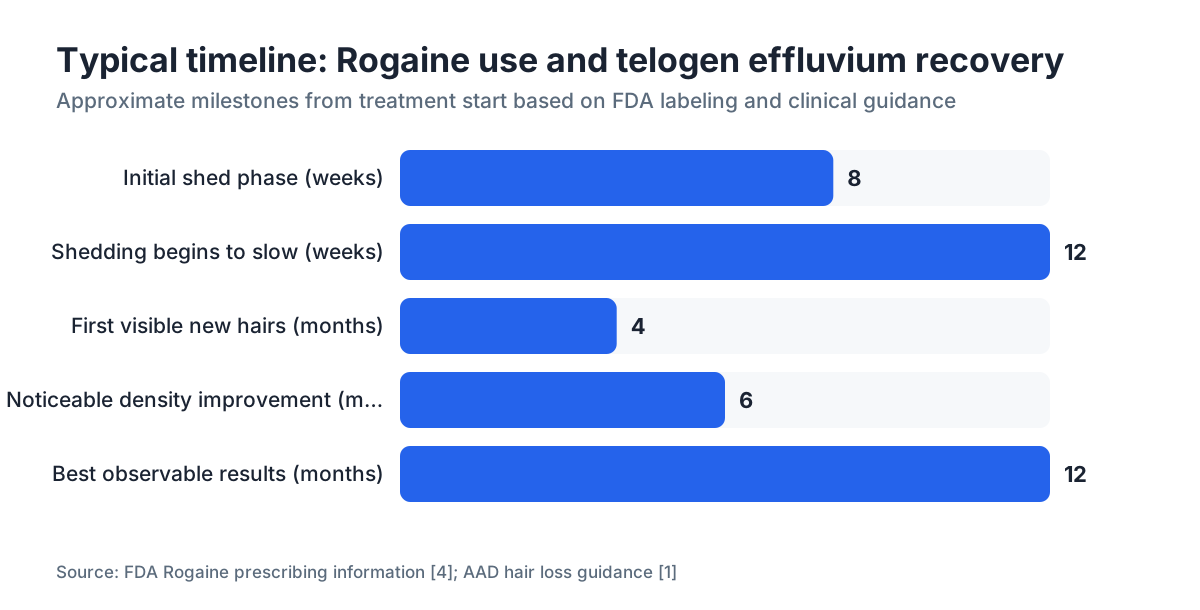
For androgenetic alopecia, FDA labeling states that meaningful results with topical minoxidil typically appear at four months, with the best results visible at twelve months [4]. That clock is relevant for TE too, because the biology of hair cycling does not speed up just because the cause is different.
In practice, someone using Rogaine for TE should expect:
Weeks 1 to 8: possible initial shed, no visible improvement. Normal, and not a sign the drug is failing.
Months 2 to 4: shedding rate starts to slow. Some patients notice short, fine new hairs at the hairline and part line.
Months 4 to 6: if TE is resolving and minoxidil is working, density starts to improve noticeably. For acute TE where the trigger was already removed, natural recovery and minoxidil effects are hard to separate at this point.
Months 6 to 12: continued improvement. If nothing is visible at six months, the diagnosis or the treatment plan needs a fresh look.
One honest complication. Because acute TE often resolves naturally inside this same window, it is genuinely hard to know how much credit Rogaine deserves versus the body's own recovery. No controlled trial has cleanly isolated minoxidil's contribution to the TE recovery timeline.
What happens if you stop using Rogaine after telogen effluvium resolves?
This is a real concern and worth being upfront about.
For androgenetic alopecia, stopping minoxidil causes a notable shed within three to six months as the drug's support is withdrawn and follicles that had been held in anagen return to telogen. You effectively lose the gains [4].
For TE, the picture is different. If the underlying trigger has been corrected, the follicles were never permanently compromised, and stopping minoxidil after recovery should not cause that same dramatic loss. The hairs that grew during recovery will stay. You are not trading temporary TE for permanent minoxidil dependence.
The exception is if, during treatment, it became clear that androgenetic alopecia is also present. In that case, stopping minoxidil will let the pattern loss progress again, independent of what happened with the TE.
Practical advice: if you used Rogaine for an acute TE episode and your shedding has resolved, it is reasonable to taper off under dermatologist guidance. If you started it and discovered you have pattern loss too, you have a longer-term decision to make.
What should you actually do first if you think you have telogen effluvium?
Rogaine is not step one. Step one is figuring out why your hair is shedding.
See a dermatologist or a primary care doctor. Ask for bloodwork including ferritin (rather than hemoglobin alone, since iron stores can run low while hemoglobin looks normal), TSH, free T4, a CBC, vitamin D, and B12 [1]. Iron deficiency is probably the most commonly missed reversible cause of chronic TE, especially in women.
Review your recent history honestly. Major illness, surgery, childbirth, significant weight loss, or a new medication in the past two to four months is often the culprit [1]. You do not need a drug to fix an event that has already passed.
If bloodwork points to a deficiency, correcting it will do more for your hair than any topical. Fixing iron stores, for example, can take four to six months to show up as visible regrowth, but it treats the actual problem.
If everything comes back normal and shedding has lasted more than six months, that is when a conversation about adjunct treatments like minoxidil makes sense.
For more on what drives hair loss generally, what causes hair loss is a solid starting point. If you want to understand your own scalp and shedding pattern before your appointment, the free AI hair analysis at MyHairline can help you visualize what is happening and frame the right questions.
Are there alternatives to Rogaine for speeding up recovery from telogen effluvium?
Minoxidil gets most of the attention, but it is not the only option in the literature.
Nutritional correction is arguably better evidenced for TE than any topical. Ferritin below 30 mcg/L is commonly associated with chronic TE in women, and bringing ferritin above 70 mcg/L is a frequently cited target, though the exact threshold is still debated [1]. Zinc, biotin, and vitamin D deficiencies have also been linked to diffuse shedding, though the evidence quality varies a lot.
Low-level laser therapy (LLLT) devices (combs, helmets, caps) have FDA clearance for androgenetic alopecia, and a few small studies suggest benefit in TE, but the evidence is not strong enough for a confident recommendation [7].
Platelet-rich plasma (PRP) injections have been studied for pattern hair loss and have some early data for TE. Cost (typically $1,500 to $3,500 per course in the US), limited insurance coverage, and uneven study quality keep it off the routine list.
Spironolactone is sometimes used in women with chronic TE that may have a hormonal component, particularly when androgens are implicated, but it requires a prescription and carries its own side effect profile.
Hair loss supplements marketed for TE deserve real skepticism. Some contain useful doses of key nutrients. Others are proprietary blends where the active ingredients are present in amounts too small to matter. Hair loss supplements covers what the evidence actually says.
Finasteride and other DHT blockers are not typically used for TE, because TE is not driven by DHT. They make sense only if androgenetic alopecia is co-occurring. See DHT blocker for more.
Can you use Rogaine long-term without negative effects on your scalp?
Long-term safety data for topical minoxidil is reasonably reassuring. The drug has been on the market since 1988, and FDA labeling covers long-term use for androgenetic alopecia without flagging major cumulative toxicity [4].
The most common local side effects are scalp irritation, dryness, and itching, often caused by the propylene glycol carrier in the solution rather than the minoxidil itself [8]. Switching to the foam formulation (which uses ethanol instead) usually clears those up.
Systemic side effects from topical application are uncommon, because absorption through intact scalp skin is relatively low [8]. That changes if you have scalp inflammation, use far more than directed, or apply it to broken skin.
The 2022 JAMA Dermatology trial on low-dose oral minoxidil reported side effects including fluid retention, increased heart rate, and hypertrichosis (body hair growth), mostly at doses well above the hair-loss range [6]. At the low doses used for hair loss, serious events were rare, but a patient's cardiac history matters and a physician should be involved.
For a full rundown of what to watch for across minoxidil formulations, see minoxidil side effects.
Sources
- American Academy of Dermatology, Hair loss information and types
- Journal of the European Academy of Dermatology and Venereology (JEADV), chronic telogen effluvium review, 2021
- Journal of the American Academy of Dermatology, minoxidil mechanisms in hair cycling, 2003
- U.S. FDA, Rogaine (minoxidil topical solution and foam) prescribing information
- American Academy of Dermatology, Hair loss diagnosis and treatment
- JAMA Dermatology, low-dose oral minoxidil for female pattern hair loss, 2022
- Lasers in Surgery and Medicine, low-level laser therapy for hair loss systematic review
- NCBI Bookshelf (StatPearls), Minoxidil pharmacology review
- NCBI Bookshelf (StatPearls), Telogen Effluvium
- NCBI Bookshelf (StatPearls), Telogen Effluvium clinical course