TL;DR: Rogaine for men is 5% minoxidil in a liquid you apply twice a day to a dry scalp. In FDA-reviewed trials, about 40% of men saw moderate to dense regrowth after 4 months. It works best on the crown, has to be used indefinitely, and takes 3 to 4 months before anything shows. It does nothing to DHT, so it slows hereditary loss without stopping it at the root.
What is Rogaine men's liquid and how does it differ from other minoxidil products?
Rogaine is the original brand-name minoxidil. The FDA approved it for hair loss in 1988 and cleared it for over-the-counter sale in 1996 [1]. The men's liquid is 5% minoxidil dissolved in a propylene glycol and alcohol base. You apply 1 mL twice a day directly to a dry scalp.
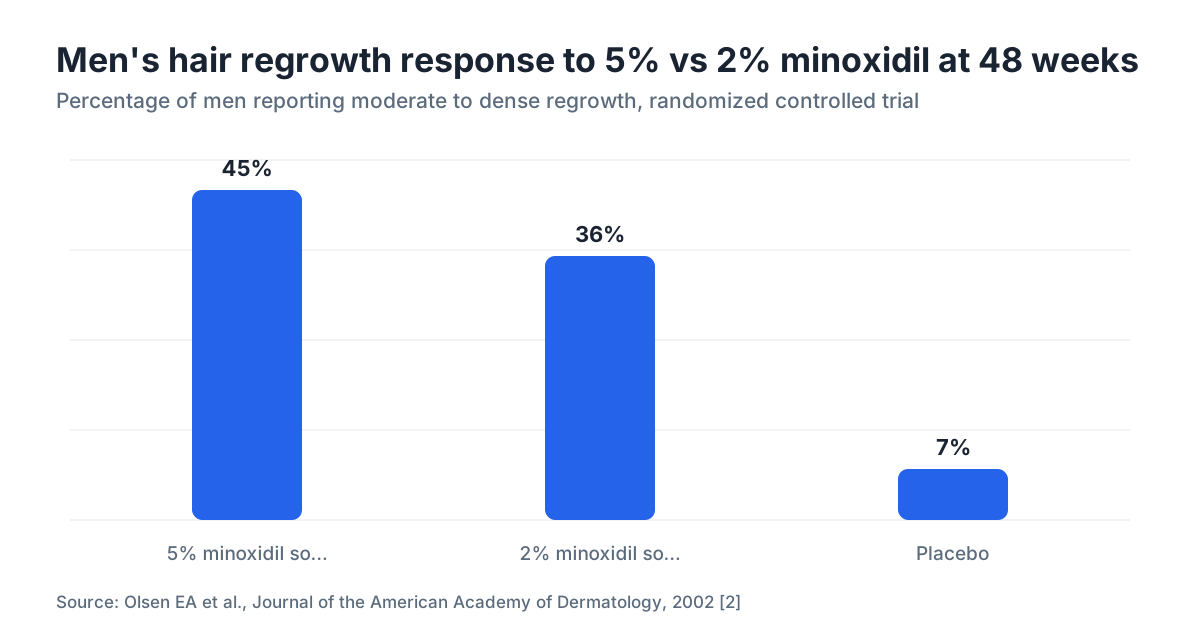
The 5% concentration is what separates the men's product from the 2% solution historically sold to women. A randomized trial in the Journal of the American Academy of Dermatology found 5% solution beat 2% in men with androgenetic alopecia: 45% of the 5% group reported moderate to dense regrowth versus 36% in the 2% group after 48 weeks [2].
Rogaine also sells a 5% foam. Same active ingredient, same concentration. The liquid carries the drug in propylene glycol; the foam uses a cetyl alcohol base. Propylene glycol irritates some scalps, and the foam exists partly to dodge that. The trade-off is that the liquid costs less per dose, and some dermatologists think propylene glycol slightly helps minoxidil penetrate, though the evidence on that specific point is thin.
Generic 5% minoxidil liquid is the same molecule at the same dose. Rogaine runs roughly $25 to $50 for a three-month supply. Generics often run $10 to $20 for the same amount. The FDA requires generics to be bioequivalent to the original, so paying for the brand is a preference, not a performance decision.
How does minoxidil actually work to regrow hair?
Minoxidil started life as a blood pressure pill. Doctors noticed patients taking it grew hair in odd places. Nobody has fully mapped the mechanism even now, but the leading explanation is that minoxidil opens ATP-sensitive potassium channels in hair follicle cells. That appears to stretch out the anagen (growth) phase and cut the telogen (resting) phase short, pushing more follicles into active production at once [3].
Minoxidil also widens blood vessels at the scalp, raising local blood flow and maybe improving nutrient delivery. Vasodilation isn't the whole story though. Topical minoxidil works even where blood flow doesn't seem to be the bottleneck.
Here's the part people miss. Minoxidil does not block dihydrotestosterone (DHT). DHT is the androgen that slowly miniaturizes follicles in men with the hereditary pattern, and minoxidil ignores it completely. That's why the drug works better alongside a DHT blocker than on its own for androgenetic alopecia. It can offset some of the miniaturization by driving growth cycles, but the underlying process keeps running.
Same reason applies to quitting. Men with androgenetic alopecia who stop minoxidil usually lose whatever they gained within three to six months, sliding back to roughly where they would have been without it.
What results can men realistically expect from Rogaine liquid?
The FDA-cleared label for Rogaine 5% men's solution states that in clinical studies, "39% of men reported moderate to dense regrowth" after 4 months of twice-daily use [1]. That number is real, and it's worth reading plainly: about 4 in 10 men see meaningful regrowth, roughly 3 in 10 see minimal growth, and a real share see nothing.
The crown responds better than the hairline. Rogaine's approved use is specifically vertex (crown) hair loss. The frontal hairline is harder to move with minoxidil because those follicles tend to be further along in miniaturization, and the FDA label says the product is not meant for a receding hairline at the temples. If a receding hairline is your main worry, keep your expectations low with this drug.
Timing trips up a lot of men. The first two months often look worse, not better, because minoxidil can kick off a shedding phase. Hairs in late telogen get pushed out faster as follicles cycle into anagen. That's telogen effluvium, and it's normal, though it scares people who don't expect it. Our telogen effluvium explainer walks through the shed cycle.
Visible improvement usually starts around month 3 to 4. Most trials measure peak results at 12 months. Past that, the drug mostly holds the gain rather than adding much more.
How do you apply Rogaine 5% liquid correctly?
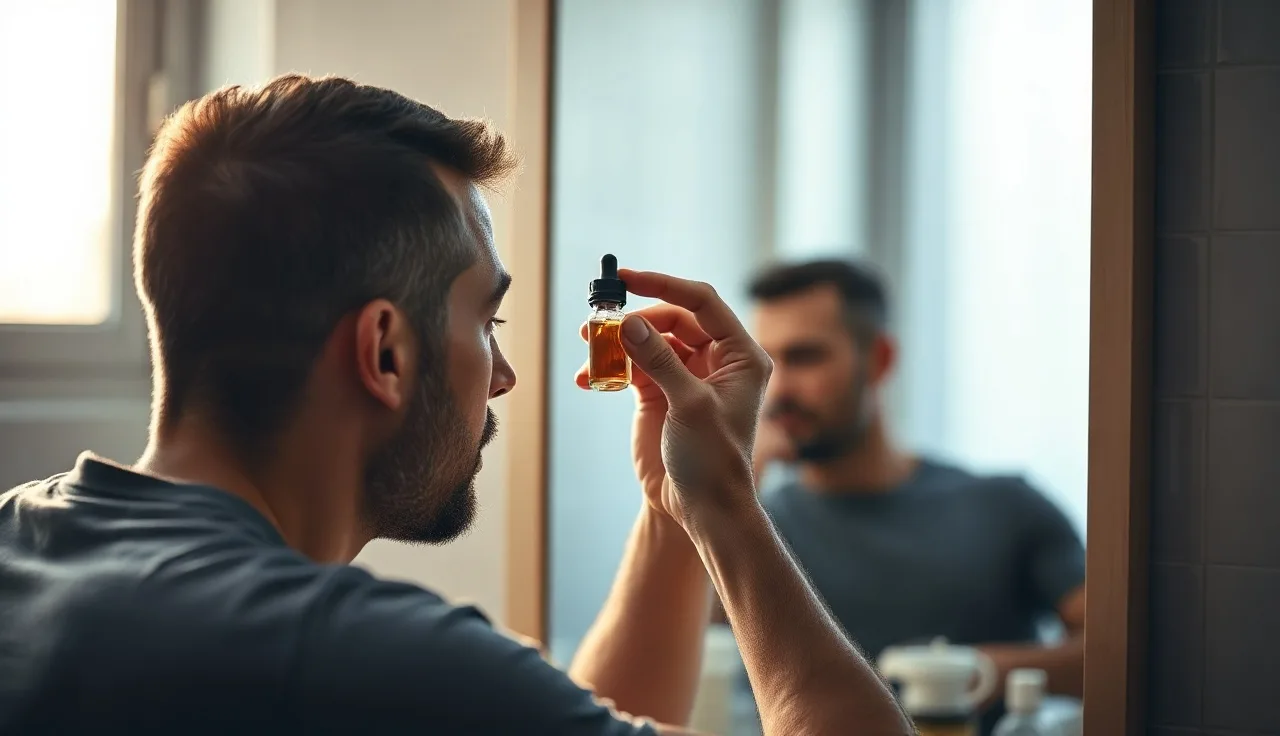
The dose is 1 mL to the scalp twice a day, morning and night. The bottle comes with a dropper or a flow-through applicator tip depending on the package. Part your hair, expose the thinning area, and put the liquid on the scalp, not the hair.
Spread it gently with your fingertips, then wash your hands right away. The alcohol and propylene glycol base dries in about 2 to 4 minutes. Wait at least 4 hours before washing your hair after applying, and the FDA label says not to use it on a wet or damp scalp.
Space the doses roughly 12 hours apart if you can, but don't obsess. Missing an evening dose now and then won't wreck your results. Consistency across months is what counts.
The classic mistake is dosing the hair instead of the scalp. Minoxidil has to reach the follicle. Soaking your hair does almost nothing and adds the drip-down that irritates the forehead and face.
If you use styling products, put minoxidil on a dry scalp first, let it soak in, then style. Applying it over pomade or cream cuts how much actually touches the scalp.
Rogaine liquid vs foam: which one should men choose?
Both deliver 5% minoxidil. The real differences are the carrier, the feel, and the price.
The liquid uses propylene glycol, which irritates some scalps and occasionally causes contact dermatitis. It feels wet and can leave hair looking greasy, especially fine hair applied in the morning. It takes a few minutes to fully soak in.
The foam is lighter, dries in about 30 seconds, and skips propylene glycol. It's easier to apply if you have a lot of hair because it doesn't drip. The catch is it costs noticeably more per dose and is harder to aim at small spots.
A 2015 comparison in Dermatologic Therapy found no statistically significant difference in hair count changes between the liquid and foam at 24 weeks [4]. The choice comes down to scalp sensitivity and daily routine, not effectiveness.
Sensitive scalp, go foam. Tight budget and a scalp that tolerates it, go liquid. Generic liquid is the cheapest option by a wide margin, and the FDA's bioequivalence standard means you're getting the same drug.
What are the side effects of Rogaine liquid men should know about?
The most common side effect is scalp irritation: itching, dryness, flaking, redness. It hits harder with the liquid than the foam thanks to propylene glycol. Switching to a generic foam or backing off the frequency for a while usually helps. Serious allergic contact dermatitis is less common but real [3].
Heart effects are the bigger concern. Minoxidil widens blood vessels. Topical use at the recommended dose absorbs into the body in small amounts. For most healthy men that's a non-event. For men with existing heart conditions, low blood pressure, or those on other blood pressure drugs, flag it with a doctor first. Fast or irregular heartbeat, chest pain, or dizziness after applying are reasons to stop and call your physician.
Unwanted facial or body hair can show up if the liquid runs down your face during application, or if you lie down too soon after. The fix is letting it dry fully before your hands touch your face or your head hits the pillow.
The shedding in months 1 to 2, described above, is a recognized side effect, not a failure. It clears on its own.
For the full list with real frequencies from trial data, our minoxidil side effects guide breaks down each one.
Does Rogaine work better when combined with finasteride?
Yes, and the data behind this is solid. Minoxidil drives growth cycles. Finasteride lowers scalp DHT and slows or stops follicle miniaturization. They hit the problem from two directions, which is why combination therapy beats either drug alone.
A 12-month randomized controlled trial in Dermatology found men using both 5% minoxidil and 1 mg oral finasteride had significantly bigger total hair count gains than men on either drug alone [5]. The combination group averaged around a 35% increase in hair count versus roughly 16% to 18% for single-drug treatment.
Finasteride (sold as Propecia or generic) needs a prescription. It blocks the 5-alpha reductase enzyme that turns testosterone into DHT. Its main risks are sexual side effects, which the FDA label puts at roughly 2% to 4% of users, and which reverse in most men who stop [6]. Understand those trade-offs before you combine anything. See our detailed look at finasteride and minoxidil together and the standalone finasteride overview.
If you want combination therapy but worry about systemic finasteride, topical finasteride paired with topical minoxidil is an emerging option. Early studies look promising, but the long-term data is thinner than for the oral drug.
Who is a good candidate for Rogaine men's liquid and who isn't?
Rogaine works best for men with mild to moderate androgenetic alopecia at the crown, where follicles are still alive but shrinking. The FDA indication is specifically the vertex. A Norwood 1 to 4 with active crown thinning and some hair left in the target zone is right in the sweet spot.
It does nothing on fully bald skin where the follicles are gone. Run your hand over a spot: if you feel no peach-fuzz stubble or vellus hair at all, minoxidil probably won't produce visible results there. The drug revives and extends existing follicle activity. It doesn't grow new follicles out of scar tissue.
Men losing hair from something other than androgenetic alopecia (thyroid problems, iron deficiency, stress shedding) often see little from minoxidil alone. Get a real diagnosis before you spend months on a drug aimed at the wrong problem. Our what causes hair loss overview covers the differential.
Age matters too. Younger men catching thinning early respond better than men who've been well into baldness for a decade. Start earlier, while there's still a meaningful follicle population to work with, and the drug has its best odds.
Want an objective read on where your hairline actually stands before committing? The free AI scan at MyHairline maps your current Norwood stage and thinning pattern in a few minutes at myhairline.ai/scan.
How long do you have to use Rogaine, and what happens when you stop?
Indefinitely. That's the honest answer.
Minoxidil does not cure androgenetic alopecia. It manages it by constantly stimulating follicle activity. Stop, and the follicles slide back onto their DHT-driven miniaturization track. Most men who quit return to their pre-treatment baseline within 3 to 6 months, and some land worse off than if they'd never started, because the regrown hair is gone and the underlying loss kept marching in the background [11].
This is the single most under-communicated fact about minoxidil. Dermatologists aren't hiding it. It's on the label. The marketing just rarely leads with it. If you're going to use Rogaine, plan on years, not months.
For men who genuinely can't or won't commit to lifelong topical therapy, a hair transplant is the only intervention that produces permanent results. The moved follicles are usually DHT-resistant because they come from the back and sides of the scalp. Transplants and minoxidil aren't either-or. Many transplant surgeons tell patients to keep using minoxidil afterward to protect the native follicles that weren't moved.
How does Rogaine liquid compare to oral minoxidil for men?
Low-dose oral minoxidil (0.625 mg to 2.5 mg daily) is increasingly prescribed off-label for hair loss, and early trial data suggests it may match or beat topical minoxidil for some patients [7]. The draw is convenience: one pill a day instead of two topical applications, no greasy scalp, no spots missed.
The trade-offs are real. Oral minoxidil puts more drug into your system, which raises the chance of heart effects. Fluid retention is the main worry at higher doses. At the very low doses used for hair loss (under 5 mg), the side effect profile looks manageable for most healthy adults, but it's a prescription drug for a reason and needs a physician watching over it.
Topical Rogaine liquid, by contrast, sells over the counter in the US with no prescription, and systemic absorption at the recommended topical dose is low. For someone who wants to start today without a doctor's visit, topical is the accessible entry point.
Our full comparison of the two delivery routes lives in the oral minoxidil guide.
What does Rogaine cost and where is it available?
Rogaine brand 5% men's liquid runs $25 to $45 for a 2-month supply (two 60 mL bottles) at major US retailers including CVS, Walgreens, Target, and Amazon as of mid-2025. Prices bounce around, and store-brand generics at the same concentration usually cost 40% to 60% less.
A three-month supply of generic 5% minoxidil liquid can go for $10 to $20 online. The FDA requires generic makers to show bioequivalence to the reference listed drug, meaning the same active ingredient at the same absorption level [8]. There's no clinical reason to pay brand prices if money is a factor.
Telehealth subscription services sometimes bundle topical minoxidil with a finasteride prescription. Those packages run $20 to $50 a month depending on what's inside. If you want the combination approach, that route is often cheaper than buying each product separately at retail.
Insurance rarely covers Rogaine or generic minoxidil for hair loss, since these count as cosmetic. FSA and HSA accounts generally don't cover them either, though plan rules vary.
Sources
- FDA, Rogaine 5% Minoxidil Topical Solution OTC label (DailyMed)
- Olsen EA et al., Journal of the American Academy of Dermatology, 2002 (5% vs 2% minoxidil RCT)
- American Academy of Dermatology, Hair Loss: Diagnosis and Treatment
- Blume-Peytavi U et al., Dermatologic Therapy, 2015 (minoxidil foam vs solution comparison)
- Khandpur S et al., Dermatology, 2002 (finasteride plus minoxidil combination RCT)
- FDA, Propecia (finasteride 1 mg) prescribing information
- Randolph M and Tosti A, Journal of the American Academy of Dermatology, 2021 (oral minoxidil review)
- FDA, Generic Drugs: Understanding Bioequivalence
- NIH MedlinePlus, Minoxidil Topical