

TL;DR: Telogen effluvium recovery usually starts 3 to 6 months after the trigger ends. The clearest signs: daily shedding drops back toward baseline, short new hairs sprout at the temples and part line, and the scalp shows through less. Full regrowth takes 6 to 12 months. Shedding past 6 months means see a dermatologist to rule out other causes.
What is telogen effluvium and why does it happen?
Telogen effluvium is diffuse hair shedding caused by a shock to your hair cycle. Normally about 85 to 90% of your scalp hairs are actively growing (the anagen phase) and 10 to 15% are resting (the telogen phase) at any given moment [1]. A big physical or psychological stressor can shove a large share of those growing hairs into rest all at once. Two to four months later they fall out together. That's when most people panic and start counting drain hairs.
Common triggers: major illness or fever, surgery, rapid weight loss, childbirth, severe stress, thyroid problems, iron deficiency, and starting or stopping certain drugs. The list is long. For a full breakdown of upstream causes, the what causes hair loss article covers them.
Recovery takes months because the biology is slow. A telogen hair sits dormant for roughly 100 days before it drops, and the new hair replacing it grows about 1 centimeter per month [2]. So from the moment your body clears the stressor, you're looking at several months before real new growth shows up. Frustrating, but normal.
Here's the fact that matters most. Telogen effluvium is almost always reversible once you fix the underlying trigger [11]. That's what separates it from pattern hair loss, which does not fix itself.
What are the first signs of telogen effluvium recovery?
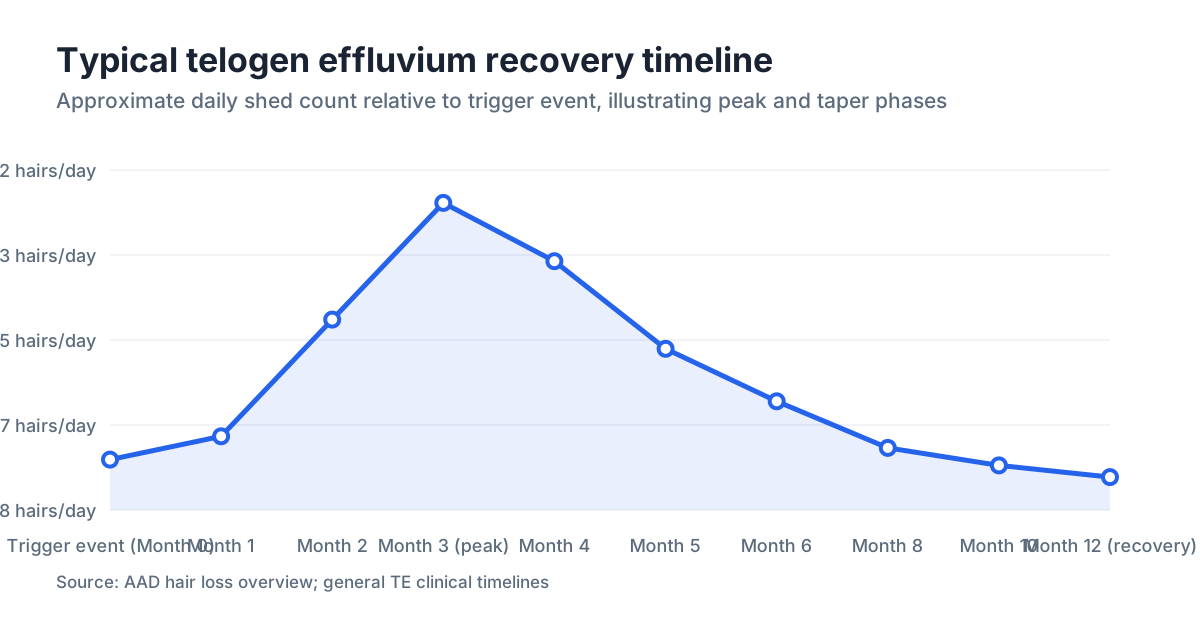
The first sign most people notice is less hair coming out every day. Obvious, but easy to miss, because shedding tapers instead of stopping cold. If you peaked at 200 to 400 hairs a day (normal is 50 to 100 [3]), you might drop to 150, then 100, then baseline over six to ten weeks. Photograph your shower drain weekly. Your memory will lie to you; the photos won't.
Short, fine new hairs are the second sign, and honestly the more reassuring one. They show up most visibly along the hairline at the temples, the part, and the crown. They're usually 1 to 3 centimeters long and stand upright because they're too short to lie flat. People call them baby hairs. Dermatologists call them regrowing anagen hairs. Either way, they mean the follicles woke up.
A third early sign is less scalp showing through the part. At peak shedding the scalp looks exposed under bright light. As density comes back, the part looks less stark. This creeps in slowly and is far easier to catch in photos a month apart than in the bathroom mirror each morning.
Some people also say their hair feels thicker in their hands at wash time. Part of that is relief that clumps aren't coming out. Part of it is real: new hairs add strand count before they're long enough to change what you see.
How long does telogen effluvium recovery take?
The honest timeline has three phases, and they overlap.
Shedding starts to slow 1 to 3 months after the trigger resolves, assuming it actually resolved. Had a fever in January and fully recovered? Expect shedding to peak around March or April and start tapering by May or June.
Visible new growth shows up 3 to 6 months after the trigger. That's when the short hairs become noticeable in photos. By month 6, most people with a clean single-trigger case can see real improvement in coverage.
Full recovery, meaning density that looks and feels like your pre-shedding baseline, takes 6 to 12 months from the trigger in most cases [4]. Thicker starting density recovers faster. Finer hair can take closer to 12 months because each strand contributes less to how full things look.
Chronic telogen effluvium, defined as diffuse shedding lasting more than 6 months, runs longer and less predictably. It can persist for years and usually points to an ongoing trigger (low ferritin, undertreated thyroid disease, continued caloric restriction) rather than one resolved event. Past the 6-month mark and still shedding hard? The job is finding what's still active, not waiting it out.
| Phase | Typical timing after trigger resolves |
|---|---|
| Peak shedding | 2-4 months after trigger |
| Shedding begins to taper | 3-5 months |
| Visible new short hairs | 3-6 months |
| Noticeable density improvement | 6-9 months |
| Near-full recovery | 9-12 months |
How can you tell if shedding is slowing down?
The drain test is the most practical method. Photograph your shower drain after washing on the same day each week. Keep the lighting consistent. A clear downward trend over 4 to 6 weeks is a reliable sign of recovery, even when the daily numbers still feel high.
The pillow count is less reliable than people think. Hair on a pillow depends on how much you tossed overnight, your pillowcase fabric, and whether you washed the night before. One bad pillow morning and people spiral. Skip it. Stick to the weekly drain photo.
Some dermatologists use a gentle pull test in clinic. They grasp 40 to 60 hairs between thumb and forefinger, pull with moderate traction, and count what comes free. More than 6 hairs per pull is positive for active shedding [5]. You can do a rough version at home. Clinic conditions are more standardized, but if your at-home pull yields fewer hairs each month, that's progress you can feel.
Trichoscopy, a magnified scalp view done in clinic, can spot new anagen hairs coming out of follicles before your eyes can. If you're anxious about whether recovery is really happening and your dermatologist has a dermatoscope, ask about it.
What do telogen effluvium regrowth hairs look like?
Regrowth hairs have a specific look, and knowing it lets you spot them with confidence.
They're short. In the first 2 to 3 months of regrowth they usually run 0.5 to 3 centimeters. They're thinner at the base than a mature hair because the follicle is still ramping up. The tip tapers to a point rather than ending blunt. A blunt tip means a hair that was cut. A tapered tip means a hair that grew in naturally from a follicle.
They often stand straight up. Short hairs lack the weight and sebum coat of mature strands, so they point out from the scalp instead of lying down. Along the hairline this makes a fuzzy, flyaway look that annoys people but is genuinely good news.
They show up first at the temples, the part, and the front hairline. Those spots had the most visible thinning, and new hairs there are easiest to see against skin. Crown regrowth is harder to judge on yourself without a mirror or photos.
One thing to watch. If new hairs come in progressively thinner and shorter with each cycle (miniaturization), that points to androgenetic alopecia, not clean TE recovery. The two often coexist, and a shedding event frequently unmasks AGA that was hiding in plain sight. If your recovery hairs look much finer than your original texture, tell a dermatologist. The telogen effluvium article goes deeper on the TE-versus-AGA split.
What blood tests confirm recovery is happening?
Blood tests don't measure hair regrowth directly. They tell you whether the physiological triggers are resolving, which is the only way to be confident recovery will hold.
Ferritin is the marker to check first. Iron deficiency, even without full anemia, is one of the most common reasons TE drags on. Many dermatologists want ferritin at 40 to 70 ng/mL for hair health, while labs often flag deficiency only below 12 to 15 ng/mL [6]. Your ferritin can read normal by the lab range and still be too low for good follicle cycling. Ask for the actual number, more than a pass or fail.
Thyroid function (TSH, free T3, free T4) should be checked if it hasn't been. Both an underactive and overactive thyroid cause TE, and both are treatable. A TSH that has moved back into range for someone previously out of range is a concrete recovery sign.
Complete blood count, vitamin D, zinc, and B12 fill out the standard panel most dermatologists run. None are perfect predictors, but a deficiency in any of them can keep shedding going after the first trigger clears.
Ferritin climbing from 12 ng/mL to 60 ng/mL over 3 to 4 months of supplementation, alongside slowing shedding, is about as close to a confirmable recovery signal as bloodwork gives you. That trend hands you something objective to track between visits.
Can you speed up telogen effluvium recovery?
Honest answer: fix the trigger first, then think about add-ons. No topical or supplement speeds recovery in any real way if ferritin is still low, thyroid is untreated, or you're still crash-dieting.
Once the cause is handled, minoxidil is the one intervention with actual evidence for shortening recovery. Topical minoxidil (2% or 5%) prolongs the anagen phase and can nudge resting follicles back into growth [7]. It won't stop TE from happening, but used during recovery it may help new hairs mature faster. The FDA approved topical minoxidil for hair loss, though the label covers androgenetic alopecia, not TE. See minoxidil for men for dosing if you're weighing it.
Iron supplementation is not optional when ferritin is low. That's correcting a deficit, not taking a supplement in the marketing sense. Getting ferritin above 40 to 70 ng/mL is tied to better hair cycling in iron-deficient patients [6].
Protein matters more than people think. Hair is almost pure keratin, a protein. Caloric restriction and very low protein diets are TE triggers on their own. Aiming for at least 1.2 grams of protein per kilogram of body weight during recovery is reasonable and fits the evidence.
Biotin, collagen powders, and most hair loss supplements have weak or no evidence for TE. Biotin deficiency is genuinely rare. Unless a blood test confirms it, biotin won't do anything.
Scalp massage has some small supporting evidence for hair thickness and blood flow [8], though those studies are limited. It costs nothing and carries no risk, so add it if you want. It's an add-on, not a substitute for fixing the root cause.
Want an honest baseline of where your hair stands right now? A free AI scan at MyHairline lets you see current density and track changes over time.
When should you see a dermatologist about telogen effluvium?
See a dermatologist if shedding keeps up past 6 months with no clear taper. Chronic telogen effluvium and androgenetic alopecia need different management than acute TE, and you can't reliably tell them apart at home.
Also go if any of these hit: the hairline recedes in a pattern (temples and crown rather than diffuse thinning), a known trigger resolved more than 4 months ago and shedding hasn't slowed, blood tests come back normal but shedding continues, or new hairs look finer and shorter than your original texture.
A board-certified dermatologist who focuses on hair is the right referral. The American Academy of Dermatology runs a public dermatologist locator you can filter by specialty [9].
Advocate for yourself here. Plenty of people, especially those with one round of normal bloodwork, get told it'll sort itself out and sent home with no ferritin checked and no trichoscopy done. If that happens, ask specifically about ferritin, a full thyroid panel, and whether trichoscopy or a scalp biopsy makes sense. A scalp biopsy can definitively separate TE from other causes of diffuse shedding.
How is telogen effluvium different from androgenetic alopecia during recovery?
This distinction matters because the treatments and the long-term outlook are not the same.
In telogen effluvium, shedding is diffuse across the whole scalp, the hairline stays put (no recession), regrowth comes in at the original caliber, and shedding stops once the trigger clears. Recovery is expected to be complete.
In androgenetic alopecia (AGA), loss follows a pattern (the Norwood scale in men, the Ludwig scale in women), the hairline recedes, and regrowth miniaturizes over successive cycles. It's progressive and chronic. It does not resolve on its own. See what causes hair loss for how AGA works.
The wrinkle is that TE often coexists with or unmasks AGA. Someone with mild background AGA may never notice it until a TE event drops overall density. Once TE resolves, they find their density doesn't fully return and the recovered hairs run thinner at the front and crown. That's AGA showing itself, not ongoing TE.
If you suspect AGA alongside TE, finasteride (for men) or spironolactone (for women) targets the hormonal driver directly. Minoxidil works for both. Starting these during TE recovery is reasonable if AGA is confirmed, though some dermatologists prefer to wait until TE fully clears before reading the AGA baseline.
A receding hairline that doesn't recover after TE resolves is usually the first clear sign AGA is riding along.
What does full telogen effluvium recovery look like?
Full recovery looks like your pre-shedding density coming back, the part no wider than before, and the daily shed count back in the 50 to 100 hair range [3]. Short regrowth hairs will have grown out to normal length, which means 6 to 12 months of growth, or roughly 6 to 12 centimeters from those follicles.
Nobody has perfect before photos of their own scalp, which makes full recovery a bit subjective. What most people actually feel is a return to normal: no more alarming hair on the pillow or in the drain, the hair carrying its usual weight and fullness, and people around you no longer asking if something's wrong.
One caveat. A small number of people keep shedding at a low grade for 1 to 2 years after TE, even with no identifiable ongoing trigger. This is chronic telogen effluvium, and it's more common in women in their 30s and 40s. The AAD notes that this kind of long-running shedding rarely leads to complete baldness and often improves with time [10].
Photo documentation is underrated. Shoot the same scalp angle (part, temples, crown) in the same lighting every 4 to 6 weeks. The change from month 3 to month 9 is often dramatic and nearly impossible to see in the mirror, where you look daily and adapt to slow change.
Still unsure where you stand? A structured tool like the free AI scan at MyHairline gives you a density snapshot to compare over time and takes some of the guesswork out.
Can telogen effluvium come back after you recover?
Yes. Telogen effluvium isn't a one-time event tied to a single cause. Any significant physical or psychological stressor can set it off again. Having had TE once doesn't make you inherently more fragile; it just means you'll recognize the pattern faster next time.
The usual cause of a repeat is a repeat trigger: another surgery, a second pregnancy and postpartum stretch, a new run of severe stress, or thyroid trouble coming back. Identifying and controlling the changeable triggers (iron, thyroid, adequate nutrition) lowers the odds of a repeat.
Some people do have a lower threshold, where a relatively minor stressor causes shedding that wouldn't touch the average person. That seems to be a mix of follicle sensitivity and baseline nutrition. Keeping ferritin above 50 ng/mL and eating enough protein are the two best-supported buffers against another round.
A new episode can also land during an otherwise normal recovery if a fresh stressor hits before the first one fully clears. It can look like a stall or even a second shedding peak, which understandably causes panic. The play is the same every time: find the new trigger, fix it, wait.
Sources
- American Academy of Dermatology, Hair loss: Types and causes
- Journal of Investigative Dermatology (published by Elsevier for the Society for Investigative Dermatology), hair growth biology review
- American Academy of Dermatology, Do you have hair loss or hair shedding?
- American Academy of Dermatology, Hair loss: Diagnosis and treatment
- Journal of the American Academy of Dermatology, Whiting DA - Chronic telogen effluvium
- U.S. National Library of Medicine (PubMed Central), Rushton DH - nutritional factors and hair loss review
- U.S. Food and Drug Administration, Drugs (minoxidil topical solution)
- U.S. National Library of Medicine (PubMed Central), Koyama T et al. - standardized scalp massage and hair thickness
- American Academy of Dermatology, Find a Dermatologist locator
- American Academy of Dermatology, Hair loss: Types and causes
- U.S. National Library of Medicine (PubMed Central), Malkud S - Telogen effluvium: A review