
TL;DR: Telogen effluvium regrowth usually begins 3 to 6 months after the trigger and is mostly complete within 12 months. You'll see short, fine baby hairs along the hairline and part first. Shedding stops before regrowth becomes visible, which confuses a lot of people. If nothing has returned after 12 months, something else is likely going on.
What is telogen effluvium and why does regrowth happen at all?
Telogen effluvium is temporary, diffuse shedding that happens when a large batch of follicles shift together from the active growth phase (anagen) into the resting phase (telogen). Normally about 5-15% of scalp follicles rest at any time. In telogen effluvium that number spikes, sometimes to 30% or more [1].
The follicle itself survives. That single fact separates telogen effluvium from scarring alopecias and from advanced androgenetic alopecia: the root is dormant, not dead. Because the follicle stays structurally intact, it re-enters anagen and pushes out a new shaft. Regrowth is just the follicle waking back up.
The trigger, whether a fever, surgery, crash diet, childbirth, or a hard emotional stretch, causes the disruption without causing permanent damage [2]. Remove or resolve the trigger and the hair cycle corrects itself. For most people the job is to wait, keep the scalp healthy, and avoid making things worse by panicking and buying every product on the shelf.
If you want the full picture on what sets the condition off in the first place, the telogen effluvium overview covers triggers, diagnosis, and how long acute versus chronic cases last.
How long does telogen effluvium regrowth take?
The timeline has two phases people mix up: the end of shedding, and the start of visible regrowth. They are not the same moment.
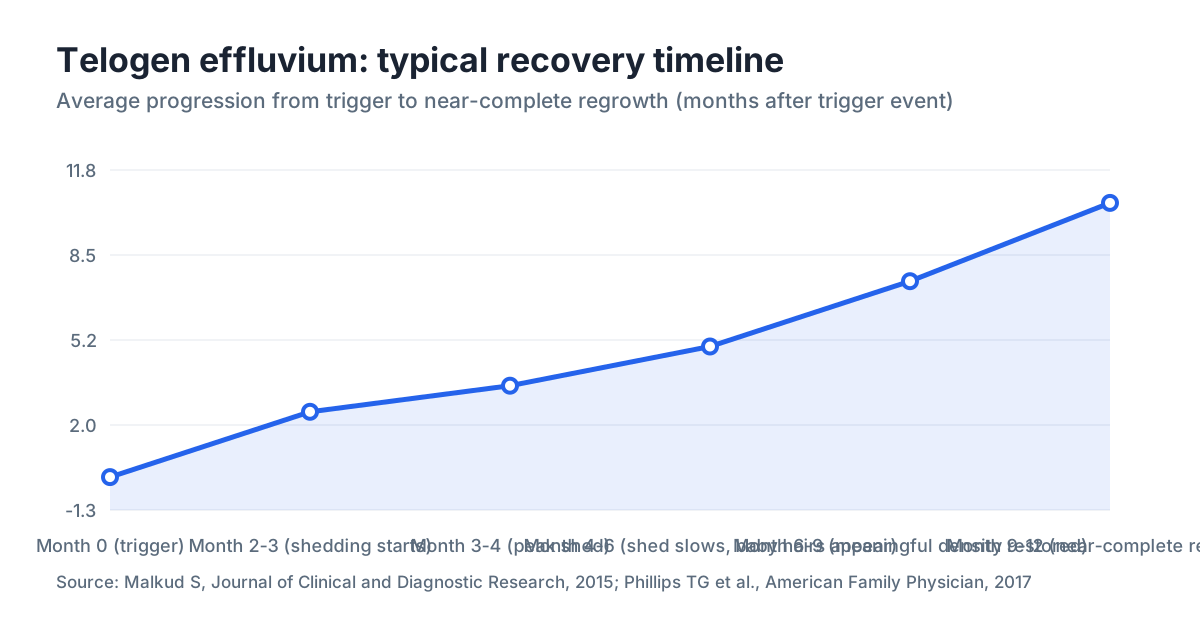
Shedding usually peaks around 2-3 months after the original trigger, then slows. Most people stop losing excess hair by month 4-6. But new hairs already growing underneath won't reach the scalp surface until they're roughly a centimeter long, which adds another 4-6 weeks on top.
Here's the honest timeline [2][3]:
| Phase | Typical timing after trigger |
|---|---|
| Trigger event | Month 0 |
| Noticeable shedding begins | Month 2-3 |
| Shedding peaks | Month 3-4 |
| Shedding slows significantly | Month 4-6 |
| First baby hairs visible at scalp | Month 4-6 |
| Meaningful density restoration | Month 6-9 |
| Near-complete regrowth | Month 9-12 |
For most people, 80-90% of shed hair returns within 6-12 months [3]. Cases triggered by a single discrete event (one surgery, one high fever, a short nutritional gap) resolve faster. Chronic telogen effluvium, where the trigger runs longer than six months, takes longer and often needs the underlying cause addressed before regrowth picks up.
The 12-month mark carries weight clinically. If hair hasn't substantially recovered by then, a dermatologist should look for an overlapping cause: iron deficiency that was never corrected, thyroid trouble, or early androgenetic alopecia running alongside.
What does telogen effluvium regrowth look like?
This is one of the most searched questions on the topic, and for good reason. Early regrowth looks nothing like normal hair, so it's easy to miss or mistake for something else.
The first signs are short, fine, tapered hairs. They're often softer and slightly lighter than your existing hair because they haven't fully pigmented yet. At the scalp you may see fuzz along your part, temples, or hairline. Run a hand gently across your scalp and you may feel a rough, bristly texture. That's the new growth.
What people commonly report seeing:
- Very short hairs (1-2 cm) standing slightly upright around the hairline and temples
- A visible "halo" of fine short hairs around the scalp perimeter in certain light
- Hairs with a thin, pointed tip instead of a blunt cut end (they've never been trimmed)
- A general fuzziness or baby-hair texture across areas that looked thin
What does the shedding itself look like, by comparison? During active telogen effluvium, shed hairs usually carry a small white bulb at the root end. That bulb is the club hair root, the sign a follicle released the hair naturally at the end of telogen. Lots of white-bulb hairs in your brush point to telogen effluvium, not breakage.
As you recover, white-bulb hairs drop off and shorter hairs show up. The part narrows. For women with longer hair, the ponytail thickens. Those are the metrics that matter, not how much hair you see in the drain on a given day.
What triggers set back regrowth or slow it down?
Regrowth stalls when the original trigger hasn't fully cleared, and that happens more than people expect. Someone recovers from a major illness but stays severely calorie-restricted. Someone's thyroid dose was adjusted but their TSH still isn't right. Someone had a postpartum shed and then started a crash diet at month 4. Any fresh or ongoing stressor can drag out the telogen phase of the newly waking follicles.
Nutrition deserves specific attention. Iron deficiency, even without full-blown anemia, is one of the best-documented factors that extends telogen effluvium [4]. Ferritin (stored iron) below 30 ng/mL has been tied to hair shedding in multiple studies, though the exact cutoff is debated. Some dermatologists aim for ferritin above 70 ng/mL in women with active loss. Get a full panel (ferritin, serum iron, TIBC, complete blood count) before assuming your regrowth is just slow.
Zinc, vitamin D, and B12 deficiencies can each contribute. The evidence is clearest for iron; for the rest it's weaker but worth ruling out, especially on a restrictive diet. The hair loss supplements piece goes through what the studies actually show.
Stress runs in a loop. Worrying hard about hair loss can keep the stress that caused the shedding alive. That's not a reason to feel blamed. It's a reason to treat sleep, cortisol, and mental load as part of recovery instead of an afterthought.
Medications matter too. Starting minoxidil during or right after a telogen effluvium shed can set off a second, temporary shed as follicles resync into a new cycle. That's a known effect, not a sign the product is hurting your hair. The minoxidil side effects article walks through it.
Does telogen effluvium regrowth always happen on its own, or do you need treatment?
For acute telogen effluvium from a single, self-resolving cause, regrowth usually happens without treatment. The American Academy of Dermatology describes acute telogen effluvium as self-limited [2]. You fix the cause, you wait, hair comes back.
Doing nothing is harder in practice than it sounds, and a few interventions genuinely help.
Minoxidil has the most evidence behind it for supporting or speeding regrowth. Topical minoxidil (2% for women, 5% for men and some women) is FDA-approved for androgenetic alopecia, not specifically for telogen effluvium [5]. But because it lengthens anagen and shortens telogen, it can push follicles back into active growth sooner. Some dermatologists recommend it during and after telogen effluvium, especially for people who also have pattern hair loss underneath. If you're weighing it, minoxidil for men covers the practical side of using it.
Finasteride usually isn't the first choice for telogen effluvium, because the condition isn't driven by DHT. It matters only if there's concurrent androgenetic alopecia. The finasteride article explains how the two overlap.
Iron supplementation, when ferritin is low, has shown benefit in some studies [4]. Correcting a thyroid, autoimmune, or metabolic problem that's driving the shed is treatment, even when it doesn't feel like a hair treatment.
Platelet-rich plasma (PRP) injections are used by some dermatologists for telogen effluvium, with promising early data, but the evidence is still thin next to what exists for androgenetic alopecia. Fine to ask about. I wouldn't spend money on it first.
How do you tell if hair is actually regrowing or if you're still shedding?
This is one of the harder things to judge at home, and it drives a lot of anxiety.
The most reliable home method is a scalp check in bright, direct light, ideally with a hand mirror and a second mirror to see the back. Look for short hairs with tapered (not blunt) tips, especially around the part, temples, and hairline. See them and you're looking at active regrowth.
Other signals that regrowth is happening:
- Daily shed count trending down over weeks (not day to day, which bounces around)
- Your ponytail feels a little thicker than it did two months ago
- Photos one month apart show a slight change in part width or density
Photography is underrated. Take a consistent photo every 4 weeks: same lighting, same part, same position. Regrowth is almost always too slow to see day-to-day and clear enough to see month-to-month.
Want an objective baseline? Trichoscopy or a hair density assessment from a dermatologist gives you real follicle counts. Some people use a free AI hair analysis as a starting point. MyHairline's free AI scan reads patterns and changes from photos, which helps you track progress between appointments.
One warning: don't confuse "shedding has slowed" with "I'm recovering." Sometimes shedding slows because you've simply run out of excess hairs to lose, not because follicles have re-entered anagen. Short new hairs are the better proof.
Can telogen effluvium become permanent?
Rarely, but it can, and it helps to know when to get properly evaluated.
Chronic telogen effluvium is diffuse shedding that persists beyond six months. It shows up more in middle-aged women and often has no single identifiable trigger [6]. Even the chronic form is usually reversible, but it takes longer and needs a more thorough look at underlying causes.
True permanent loss from telogen effluvium is uncommon. What happens more often is that a telogen shed unmasks androgenetic alopecia that was already creeping along and hadn't been noticed. The shed makes the thinning obvious. When the telogen effluvium clears, the hair returns, but now the person sees their baseline pattern loss more clearly. It's easy to blame the telogen effluvium for loss that was already there.
Scarring alopecias like lichen planopilaris and frontal fibrosing alopecia can be misread as telogen effluvium early on. If shedding runs past 12 months with no clear trigger and no regrowth, a scalp biopsy is how you get a definitive answer.
For most people who had a clear trigger and whose shedding has stopped, the follicles aren't gone. They're resting. The biology strongly favors recovery [1][2].
Does telogen effluvium regrowth look different after postpartum shedding?
Postpartum telogen effluvium is one of the most common versions of the condition, and its regrowth has a few features worth knowing.
During pregnancy, elevated estrogen extends anagen, so hair looks thicker than usual. After delivery estrogen drops sharply, and all those follicles that were held in anagen enter telogen at once. The shed typically starts around weeks 8-12 postpartum and peaks around months 3-4 [7]. Many women describe alarming amounts of hair in the shower and on the brush.
Regrowth begins around 4-6 months postpartum for most women and is largely complete by 12 months. Baby hairs appear first around the hairline, sometimes making a halo of short, upright hairs that you can style flat or leave alone.
Breastfeeding does not meaningfully extend the shed or delay regrowth, despite the common belief. The data isn't strong in either direction. The main driver is estrogen normalizing, not lactation.
If hair hasn't substantially recovered by 12 months postpartum, check ferritin (postpartum iron depletion is very common), thyroid function (postpartum thyroiditis affects up to 10% of women [8]), and rule out concurrent female pattern hair loss, which can start or become more visible after pregnancy.
To see whether pattern loss might be part of the picture, what causes hair loss covers the distinction.
What actually helps telogen effluvium regrowth: evidence vs. hype
There's a lot of noise in the supplement and topical market aimed at people mid-shed. Here's an honest read of what has real evidence, what has a plausible mechanism but limited data, and what's a waste of money.
Good evidence:
- Correcting iron deficiency (ferritin) and other documented nutritional gaps [4]
- Topical minoxidil, especially with an androgenetic component or to shorten recovery time [5]
- Treating the underlying cause (thyroid, autoimmune, medications) directly
Plausible but limited data:
- Low-level laser therapy (LLLT) devices; some evidence for androgenetic alopecia, very little specific to telogen effluvium
- Ketoconazole shampoo; cuts scalp inflammation and may mildly extend anagen, but not a primary treatment
- Low-dose oral minoxidil; increasingly used off-label with a reasonable evidence base across several alopecias [see oral minoxidil]
Probably not worth it:
- Biotin supplements if you're not biotin-deficient (most people aren't, and the FDA has warned that biotin can skew lab tests [9])
- Most "hair growth" shampoos with no active pharmaceutical ingredient
- High-dose vitamin cocktails without a documented deficiency
The most expensive thing you can do is buy everything at once and then not know what worked. If you add something, add one thing at a time and give it at least 3 months before you judge it.
When should you see a dermatologist about hair regrowth?
Telogen effluvium is often diagnosed and managed without a specialist, but certain situations call for a board-certified dermatologist, ideally one who focuses on hair.
See a dermatologist if:
- Shedding is still heavy at month 6 with no sign of slowing
- You've had no regrowth by month 9-12
- You also notice temple recession or diffuse crown thinning (possible androgenetic alopecia running alongside)
- You see patches of complete loss rather than diffuse thinning (could be alopecia areata)
- There's scalp redness, scaling, or itching that wasn't there before (rule out scarring alopecia or seborrheic dermatitis)
- Your bloodwork hasn't been checked and you have fatigue, weight changes, or other systemic symptoms
A dermatologist can run a pull test, trichoscopy, and a scalp biopsy if needed. The blood panels they typically order include CBC, ferritin, TSH, free T4, ANA, DHEAS, and sometimes total and free testosterone in women.
If you have both telogen effluvium and androgenetic alopecia, the approach shifts. Combining finasteride and minoxidil is an option some clinicians use, and finasteride and minoxidil covers that pairing in depth.
If you're worried about a receding hairline separate from diffuse shedding, receding hairline helps you tell them apart.
How do you track telogen effluvium regrowth at home?
Consistent tracking turns anxiety into data, which is far easier to sit with.
The four methods worth doing:
-
Monthly scalp photos. Same lighting (natural window light works well), same part placement, same distance. Compare part width and hairline density month to month. One month of change is usually too subtle; three months is often visible.
-
Ponytail diameter for women with longer hair. Wrap a hair tie around a gathered ponytail and mark where the first wrap ends. Measure that circumference monthly. A thickening ponytail is direct evidence of regrowth.
-
Clip count or daily shed count. Better for confirming the shed is slowing than for tracking regrowth. Count (or roughly estimate) hairs lost in the shower three days in a row, once a month. Averages above 100-150 hairs per day suggest active effluvium; counts dropping toward 50-80 suggest it's resolving [6].
-
Scalp exam for baby hairs. Do this in bright light every 4-6 weeks. Short, tapered hairs that weren't there last month are your best direct evidence.
MyHairline's free AI scan is one way to get a baseline and track changes from photos, without a clinic visit for every check.
Don't check daily. Daily shed counts swing on their own and tell you almost nothing about the trend. Weekly at most. Monthly is better.
Sources
- Harrison S, Sinclair R. Telogen effluvium. Clinical and Experimental Dermatology, 2002.
- American Academy of Dermatology Association, Hair loss types and treatment resources.
- Phillips TG, Slomiany WP, Allison R. Hair Loss: Common Causes and Treatment. American Family Physician, 2017.
- Rushton DH. Nutritional factors and hair loss. Clinical and Experimental Dermatology, 2002.
- Olsen EA et al. A multicenter, randomized, placebo-controlled, double-blind clinical trial of 5% minoxidil topical foam in the treatment of androgenetic alopecia in men. Journal of the American Academy of Dermatology, 2007.
- Malkud S. Telogen Effluvium: A Review. Journal of Clinical and Diagnostic Research, 2015.
- Lynfield YL. Effect of pregnancy on the human hair cycle. Journal of Investigative Dermatology, 1960.
- De Groot L et al. Management of thyroid dysfunction during pregnancy and postpartum. Journal of Clinical Endocrinology and Metabolism, 2012.
- U.S. Food and Drug Administration. Biotin (Vitamin B7) safety communication on lab test interference.
- Grover C, Khurana A. Telogen effluvium. Indian Journal of Dermatology, Venereology and Leprology, 2013.