

TL;DR: Androgenetic alopecia (AGA) progresses in most people if left untreated, but the pace varies widely. Large population studies find about 50% of white men show visible AGA by age 50, and roughly 80% by age 70. Progression averages one Norwood stage over several years in active cases, though some men stay stable for a decade. Women follow a slower, more diffuse pattern.
What exactly is androgenetic alopecia and why does it progress?
Androgenetic alopecia is the most common form of hair loss in both men and women. It is driven by the hormone dihydrotestosterone (DHT), a byproduct of testosterone converted by the enzyme 5-alpha reductase. DHT binds to androgen receptors in genetically susceptible hair follicles, gradually shrinking them in a process called follicular miniaturization. Over repeated cycles, the follicle produces thinner, shorter hairs until it eventually stops producing visible hair altogether. [1]
The word "androgenetic" tells you both causes are required: androgens (hormones) and genetics. You can have high DHT and no family history of baldness and keep a full head of hair. You can also have a moderate androgen level but high receptor sensitivity in your scalp and lose hair quickly. That gene-hormone interaction is why two brothers from the same family can have completely different trajectories. [1]
Progression is not constant. The follicle miniaturization happens in cycles tied to the natural hair growth cycle: anagen (growth), catagen (transition), and telogen (shedding). Each successive anagen phase becomes shorter than the last in an affected follicle, so the shed-to-regrowth balance tips slowly toward net loss. This is why early AGA often looks like general thinning before the pattern becomes obvious. To understand more about what triggers the process in the first place, see what causes hair loss.
How common is AGA and who gets it?
AGA is the single most common cause of hair loss worldwide. The most-cited prevalence figures come from population studies conducted across multiple ethnic groups and decades.
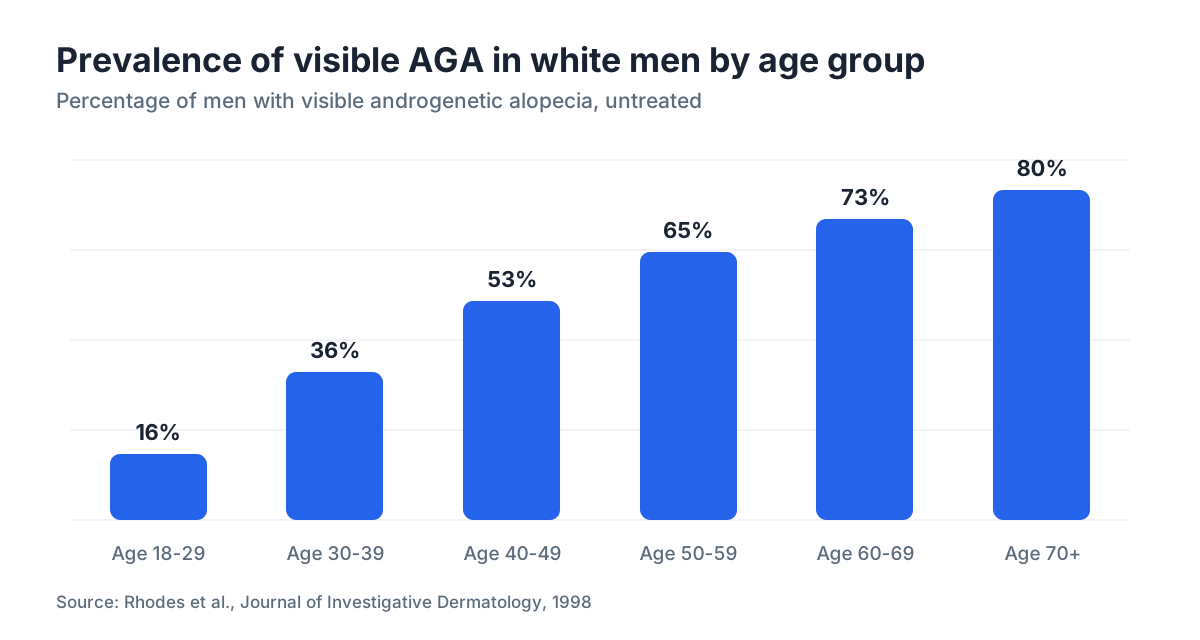
For men, a large study by Rhodes et al. (1998) examined a European-ancestry population and found roughly 16% of men aged 18-29 had visible AGA, rising to about 53% in men aged 40-49, and approximately 80% by their late 60s and 70s. [2] Those numbers are specific to men of European descent; rates are somewhat lower in men of Asian and African ancestry, though the gap narrows with age.
For women, prevalence is harder to pin down because female-pattern hair loss (FPHL) presents differently, often as a diffuse crown thinning rather than a receding hairline. A commonly cited figure is that roughly 40% of women show some degree of FPHL by age 70. [3]
Ethnicity matters more than most people realize. Studies of Japanese and Korean men show AGA prevalence roughly 30-40% lower than European cohorts at equivalent ages, likely due to differences in androgen receptor gene variants. African American men also show lower rates of frontal recession, though vertex thinning rates are more comparable. None of this means AGA is rare in non-European populations; it just means the Norwood scale (calibrated on European men) slightly overestimates severity when applied universally. [2]
How fast does AGA actually progress? What do the numbers say?
This is the question most people really want answered, and the honest answer is: it depends, but the data gives useful anchors.
A prospective study by Sinclair (1998) followed men with AGA and found that without any treatment, progression of one full Norwood stage took an average of roughly five to ten years, but there was enormous individual variance. Some men progressed one full stage in under two years; others stayed stable for more than a decade before any further loss was measurable. [4]
The Hamilton-Norwood scale runs from Stage I (no visible loss) to Stage VII (only a horseshoe fringe remains). If the average progression is one stage per five to ten years, a man who notices first recession in his mid-twenties at Stage II could reach Stage IV or V by his mid-forties without treatment. That is a rough model, not a certainty.
For women using the Ludwig scale (Grades I through III), progression tends to be slower and less predictable, partly because estrogen partially counteracts DHT's effects on follicles. Many women stay at Ludwig Grade I for years before any visible worsening. [3]
A few things are known to accelerate progression: starting young (onset before age 25 is associated with faster and more extensive eventual loss), high scalp DHT levels, and stress events that trigger telogen effluvium, which can unmask or worsen underlying AGA. [4]
What does AGA progression look like by decade of life?
The pattern below is based on population prevalence data from Rhodes et al. and Hamilton-Norwood grading studies. It is an average, not a prediction for any individual.
| Age range | Approximate % of white men with visible AGA | Typical Norwood stage in affected men |
|---|---|---|
| 18-29 | ~16% | I-II |
| 30-39 | ~36% | II-III |
| 40-49 | ~53% | III-IV |
| 50-59 | ~65% | III-V |
| 60-69 | ~73% | IV-VI |
| 70+ | ~80% | V-VII |
These numbers are for men of European descent. [2] The figures are lower for Asian and African ancestry groups. For women, roughly 6% show Ludwig Grade I by age 30, rising to about 38% by age 70. [3]
What this table shows most clearly is that the 30s and 40s are the decades where the most men cross from "barely noticeable" into "clearly visible" loss. That timing matters for treatment decisions: most of the FDA-approved and evidence-backed interventions work best when there are still miniaturizing follicles to rescue, not scar tissue where follicles used to be.
Does untreated AGA always keep getting worse?
Not always, but it usually does over long enough time horizons.
AGA is generally described as a progressive condition, and the large population data supports that framing. A study following untreated men over five years found that approximately 85% showed measurable progression in hair density or hairline position by the end of the study period. [4] The remaining 15% were stable during that window, though whether they would have progressed over 10 or 20 years is unknown.
There is a real phenomenon called "plateau," where AGA appears to stabilize, particularly in older men. The leading hypothesis is that once androgen receptor sensitivity in the surviving follicles decreases with age, the miniaturization process slows. But this plateau typically happens after significant loss has already occurred, so it is not much comfort if you are in your 30s.
Younger onset is the clearest predictor of more extensive eventual loss. Men who first develop AGA before age 25 are more likely to progress to higher Norwood stages than men who first notice changes after 40. [4] This is not a guarantee in either direction, but it is the strongest single predictor in the literature.
What are the best predictors of how fast your AGA will progress?
Nobody can tell you exactly where your hairline will be in ten years. But these are the factors with the most evidence behind them.
Age of onset is the strongest predictor. Earlier onset correlates with faster progression and ultimately more severe loss. [4] If your father or maternal grandfather (both lines matter) went bald in their 20s, take that seriously.
Family history on both sides matters. AGA is polygenic, meaning many genes contribute. The androgen receptor gene is on the X chromosome, which is why the maternal grandfather pattern became a folk heuristic, but paternal-side baldness is also predictive. Studies show that men with a first-degree relative with AGA have roughly twice the risk of developing significant loss themselves. [1]
Baseline DHT and androgen sensitivity are factors, but measuring serum DHT is not very useful clinically because it is scalp-level receptor sensitivity that drives miniaturization, not blood levels. This is why some men with normal testosterone still lose hair aggressively. [1]
Stress and nutritional deficiency do not cause AGA, but they can accelerate it by pushing follicles into telogen effluvium, which overlaps with and worsens AGA progression. Iron deficiency in women is particularly documented in this context. [3]
If you want to know where you stand right now, the free AI analysis at MyHairline can map your current hairline and Norwood stage from a photo, which at least gives you a baseline to measure against over time.
How does DHT cause follicle miniaturization step by step?
Understanding the mechanism matters because it explains why treatments that block DHT work, and why they have to be taken continuously.
DHT is made in the scalp from testosterone by the enzyme 5-alpha reductase type II. DHT binds to androgen receptors inside hair follicle dermal papilla cells. That binding activates genes that produce proteins (including a protein called DKK-1) that inhibit hair follicle growth signals and promote early catagen entry. [1]
The result is a shortened anagen phase. A follicle that used to spend six years growing before shedding now spends two years, then one, then months. The resulting hair shaft gets thinner with each cycle because the matrix cells producing it have less time to work. This is miniaturization: a thick terminal hair becomes an intermediate "vellus-like" hair, then effectively invisible vellus fuzz, then nothing.
The window for reversal is when the follicle is still producing miniaturized hair. A follicle that still has some activity can, in principle, be restored with DHT blockade. A follicle that has been inactive long enough to be replaced by scar tissue cannot. This is why finasteride, which blocks 5-alpha reductase, is much more effective at preserving existing hair than regrowing hair that was lost years ago. And it is why starting treatment at Norwood II gives far better outcomes than starting at Norwood V. [5]
For more on blocking DHT as a treatment strategy, the article on DHT blockers covers both prescription and over-the-counter options with evidence grades.
How does AGA progression differ between men and women?
The mechanism is the same but the pattern, speed, and severity differ significantly.
In men, AGA typically follows the Hamilton-Norwood pattern: recession at the temples, thinning at the vertex (crown), and eventual confluence of the two zones. Frontal hairline recession is the usual first visible sign. [2]
In women, the Ludwig pattern is more common: diffuse thinning across the crown and top of the scalp, with the frontal hairline often preserved. This is partly because women have lower circulating androgens and a higher ratio of aromatase enzyme in the frontal scalp, which converts testosterone to estrogen instead of DHT. [3]
Women's AGA typically progresses more slowly and rarely reaches the severe stages (Norwood VI-VII equivalent) seen in men. Hormonal fluctuations around menopause, when estrogen drops sharply, often trigger a noticeable acceleration. [3] This is why many women first notice significant thinning in their late 40s and 50s, even if the underlying genetic susceptibility was present for decades.
Diagnosis is also more complicated in women because female hair loss frequently has overlapping causes: AGA plus iron deficiency, AGA plus thyroid disease, or AGA plus hormonal changes from oral contraceptives. Isolating the AGA component requires ruling out these other contributors. If a woman's hair loss seems to have started rapidly rather than gradually over years, telogen effluvium is worth considering as a co-diagnosis.
What does the evidence say about slowing progression with treatment?
Two treatments have FDA approval for AGA and the strongest long-term data behind them: finasteride (for men) and minoxidil (for men and women).
Finasteride 1 mg daily inhibits 5-alpha reductase type II, reducing scalp DHT by approximately 60-70%. [5] The main trials published in the Journal of the American Academy of Dermatology found that after five years, men on finasteride showed net hair count increases of about 277 hairs per square centimeter compared to placebo, and that men on placebo lost a meaningful amount of density over the same period. The FDA-approved labeling states that finasteride "slows the progression of hair loss" and promotes regrowth in a significant portion of men. [5]
Minoxidil's mechanism in AGA is not fully understood, but it appears to extend the anagen phase and improve follicular blood supply. Topical minoxidil 5% in men and 2% in women (both FDA-approved doses) slows progression and in many users produces modest regrowth. A 48-week trial of 5% minoxidil versus 2% in men found the 5% formulation produced greater increases in nonvellus hair count. [6] For details on dosing and side effects, see minoxidil for men and minoxidil side effects.
Combining finasteride and minoxidil has additive effects. A randomized controlled trial published in the Journal of the American Academy of Dermatology found the combination superior to either agent alone in hair count outcomes. [7] Read more in the article on finasteride and minoxidil together.
Neither treatment stops progression permanently. Stopping either medication results in resumption of AGA progression within roughly six to twelve months, returning to approximately where progression would have been without treatment. [5][6] For men with advanced loss, a hair transplant moves permanent follicles from the donor zone, but even then ongoing medical treatment is usually needed to protect the native hair.
If you want to track whether your hairline is actually changing over time, getting a documented baseline now is the most useful thing you can do. The MyHairline AI scan gives you a Norwood stage estimate you can compare against in six or twelve months.
Can lifestyle changes slow AGA progression?
This is an area where enthusiasm tends to run ahead of evidence. The honest summary: lifestyle factors can modify the rate of progression modestly, but they cannot stop it, and for most people the effects are small compared to medical treatment.
Stress management matters because chronic psychological stress elevates cortisol, which can disrupt the hair cycle and push more follicles into telogen. This is the mechanism behind stress-related shedding, and it can worsen AGA by accelerating the rate at which miniaturizing follicles shed. But managing stress will not reverse miniaturization; it just removes one accelerant.
Nutritional status affects hair cycling. Iron deficiency is the most documented nutritional factor, particularly in women: serum ferritin below 40 ng/mL is associated with increased hair shedding. Correcting it often slows shedding, though this treats the effluvium component rather than AGA itself. Zinc, vitamin D, and biotin deficiencies have some evidence of a relationship with hair shedding, but the data for supplementation in people who are not deficient is weak. For a deeper look at the evidence on hair loss supplements, that article covers what is and is not supported.
Some preliminary data suggests that scalp massage (about 4 minutes daily) may increase stretch-induced mechanical signaling in dermal papilla cells, potentially prolonging anagen. A small Japanese study found increased hair thickness after 24 weeks of standardized massage. [8] The effect size was modest and the study was small, but scalp massage has no real downside.
Creatine supplementation has been discussed as a potential AGA accelerant because one small study found it increased DHT levels by about 56% after three weeks of loading. [9] The evidence is limited to that single study and no hair loss outcomes were measured, but men with significant AGA may reasonably want to be aware of it. The article on does creatine cause hair loss reviews the data in detail.
When should you stop watching and actually do something?
There is no single right time, but there is a clearly wrong one: waiting until significant miniaturized territory is already scar tissue.
Most dermatologists who specialize in hair loss suggest that if you have confirmed AGA (more than acute shedding), are bothered by it, and are otherwise healthy, it is reasonable to start treatment at Norwood Stage II or III, before the hairline has receded substantially. At those stages, finasteride has its strongest evidence for preservation and partial regrowth. [5]
Waiting for the pattern to be "really obvious" often means waiting until you are at Stage IV or V, where preservation is harder and regrowth is minimal. That said, even late-stage treatment is not futile for stabilization, and a hair transplant remains an option for restoration at any advanced stage when donor supply is adequate.
For women, the calculus is slightly different. Finasteride is not FDA-approved for women (and is contraindicated in women of childbearing potential due to teratogenicity). Minoxidil is the first-line option, and starting it when diffuse thinning at the crown is first noticed gives better outcomes than waiting until thinning is severe. [3]
The AAD recommends that anyone noticing hair loss consult a dermatologist to confirm the diagnosis and rule out reversible causes before starting long-term treatment. [3] That recommendation exists because treating AGA with minoxidil when the actual cause is iron deficiency or thyroid disease is not only expensive but delays fixing the real problem.
Sources
- Genetics Home Reference, NIH - Androgenetic Alopecia
- Rhodes T et al., Journal of Investigative Dermatology, 1998 - Prevalence of Male Pattern Baldness
- American Academy of Dermatology - Hair Loss: Who Gets and Causes
- Sinclair R, Journal of Investigative Dermatology Symposium Proceedings, 1998 - Male pattern androgenetic alopecia
- Olsen EA et al., Journal of the American Academy of Dermatology, 2002 - 5% vs 2% minoxidil in men
- Khandpur S et al., Journal of the American Academy of Dermatology, 2002 - Combination finasteride and minoxidil
- Koyama T et al., ePlasty, 2016 - Standardized scalp massage results in increased hair thickness
- van der Merwe J et al., Clinical Journal of Sport Medicine, 2009 - Three weeks of creatine monohydrate supplementation affects dihydrotestosterone
- Norwood OT, Southern Medical Journal, 1975 - Male pattern baldness: Classification and incidence