
TL;DR: The cheapest effective stack for male pattern hair loss is generic topical minoxidil (about $5-10/month) plus generic oral finasteride (about $10-20/month), totaling roughly $15-30/month. Both have FDA approval for hair loss, decades of trial data behind them, and no expensive add-ons have been proven to meaningfully improve on that foundation.
What does 'effective' actually mean for a hair loss treatment?
Effective means one thing: the treatment measurably slows or stops further loss, and in a meaningful share of users, regrows some hair. That standard eliminates most of the hair care aisle before you spend a dollar.
The FDA has approved exactly two drugs for androgenetic alopecia (pattern hair loss): minoxidil and finasteride [1][2]. A third, dutasteride, is approved for pattern hair loss in some countries (South Korea, Japan) but not in the US for that use. Everything else, shampoos, serums, laser combs, biotin gummies, sits in a different category: either unproven or proven only weakly.
For women, the picture is narrower. Minoxidil is FDA-approved; finasteride and dutasteride are generally avoided in premenopausal women because of teratogenicity risk [1]. Spironolactone is used off-label for women and has decent clinical data, but it's a prescription drug and costs more than the base stack.
So the honest foundation of any cheap-and-effective stack is those two approved drugs. Everything else is optional and mostly speculative.
What is the cheapest hair loss treatment stack that is actually proven?
For most men with androgenetic alopecia, the cheapest proven stack is two generic drugs:
- Generic topical minoxidil 5% solution or foam
- Generic oral finasteride 1 mg
That's it. No proprietary formula required.
Minoxidil started life as a blood pressure medication. The hair growth showed up as a side effect, and by 1988 the FDA approved topical minoxidil for hair loss [1]. The mechanism still isn't fully understood, but it appears to prolong the anagen (growth) phase of the hair cycle and increase follicle size. The 5% concentration beats the 2% version in men [3].
Finasteride blocks the enzyme 5-alpha reductase type II, which converts testosterone into dihydrotestosterone (DHT), the androgen mainly responsible for follicle miniaturization in pattern hair loss [2]. The 1998 trial published in the Journal of the American Academy of Dermatology found that 83% of men taking 1 mg finasteride maintained or increased hair count over two years, against 28% on placebo [4].
Used together, they hit two different targets: finasteride cuts the hormonal signal shrinking your follicles, while minoxidil stimulates blood flow and growth regardless of DHT. A 2021 trial in the Journal of the American Academy of Dermatology found the combination produced greater hair density gains than either drug alone [5].
If you want to understand what's driving your loss before you start spending money, what causes hair loss breaks down the biology in plain terms.
How much does the generic stack cost per month?
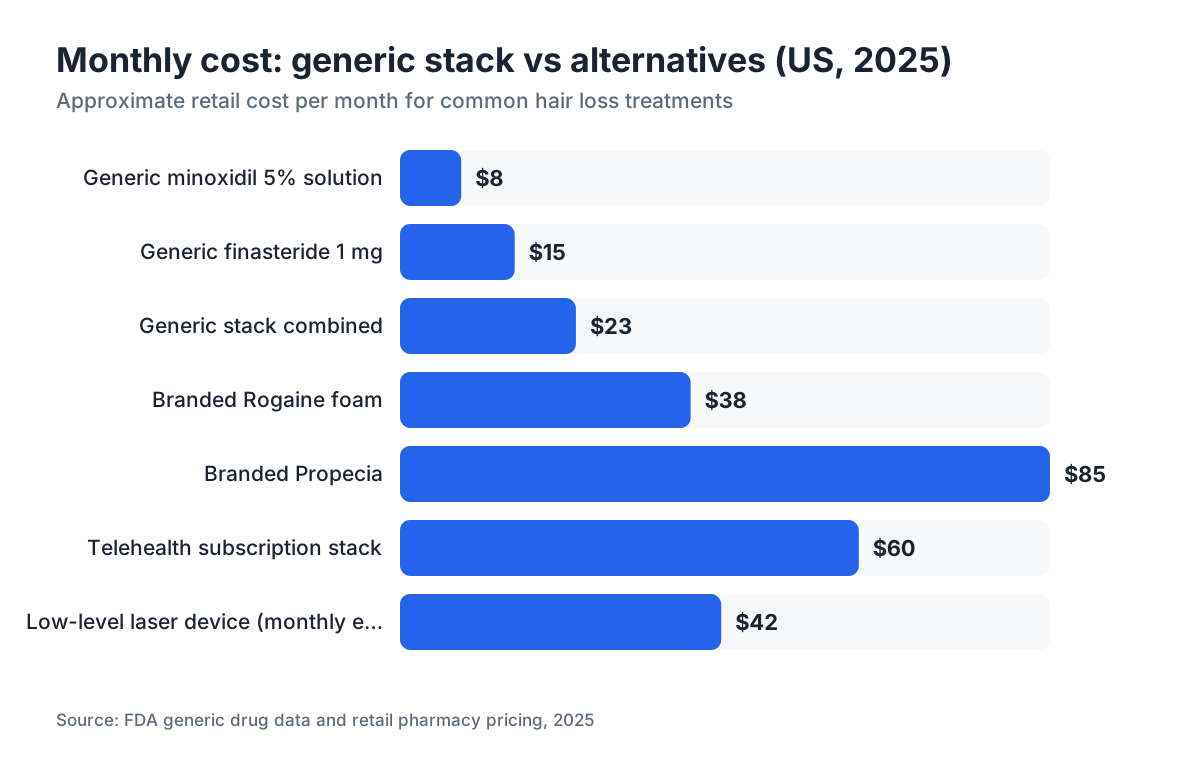
Generic pricing varies by pharmacy and country, but here are realistic US retail ranges as of mid-2025:
| Treatment | Form | Monthly cost (US) |
|---|---|---|
| Generic minoxidil 5% solution (60 mL) | Topical | $5 - $10 |
| Generic minoxidil 5% foam (2-month supply) | Topical | $12 - $20 |
| Generic finasteride 1 mg (30 tabs) | Oral pill | $10 - $20 |
| Generic finasteride 5 mg (cut into quarters) | Oral pill | $5 - $12 |
| Basic stack total | $15 - $30/month | |
| Branded Rogaine foam | Topical | $30 - $45 |
| Branded Propecia | Oral pill | $70 - $100+ |
| Telehealth subscription stacks | Various | $40 - $80 |
A few notes on that table. Finasteride 5 mg tablets (approved for BPH, not for hair loss at that dose) can be quartered to approximate a 1.25 mg dose, and many men and their doctors do this to cut cost further. This is off-label. The pharmacokinetics run roughly linear at those doses, so 1.25 mg is slightly more than the standard hair loss dose but not dramatically so. Talk to your prescribing physician before doing it.
Generic minoxidil solution is chemically identical to branded Rogaine. The FDA requires generics to demonstrate bioequivalence [6]. There's no proven benefit to paying for the brand name.
Oral minoxidil (typically 2.5 mg or 5 mg) has become more popular as an alternative or addition to topical. It runs about $10-20/month generic, and some people find it easier to stick with than twice-daily topical. The evidence base is smaller than for topical, but oral minoxidil covers the current data in detail.
Does the combination of minoxidil and finasteride work better than either alone?
Yes, and this is more than theory. The 2021 randomized controlled trial by Hu et al. in the Journal of the American Academy of Dermatology assigned 184 men with androgenetic alopecia to four groups: placebo, topical minoxidil alone, oral finasteride alone, and the combination. After 24 weeks, the combination group showed a mean increase of 25.8 hairs per cm2, versus 20.1 for finasteride alone and 18.6 for minoxidil alone [5]. The combination was statistically better than either single drug.
The practical read: if you can only afford one, finasteride is usually the stronger option for stopping progression in men with DHT-driven loss. But if you can afford both for $25-30/month combined, there's real evidence you'll do better.
For a closer look at how the two drugs interact, finasteride and minoxidil together covers the trial data, dosing, and what to realistically expect.
One thing people underrate: the timeline. Neither drug produces visible results in the first two months. Most dermatologists treat six months as the minimum assessment point, and a year is more realistic for judging your full response [1][4]. Quitting at three months because nothing has changed is the most common reason the treatment fails.
What do the add-ons actually do, and are any of them worth the money?
Once the core stack is covered, you'll hit a wall of products marketed as boosters. Here's an honest read on the main ones.
Ketoconazole shampoo (1% or 2%): Some clinical data suggests a modest benefit, possibly through anti-inflammatory or mild anti-androgenic effects at the scalp. A small randomized study in 1998 found that 2% ketoconazole shampoo produced hair density improvements against placebo, though the study was small and hasn't been strongly replicated [7]. The 2% version needs a prescription in the US; the 1% version (Nizoral A-D) is OTC and costs about $10-15 for a month if you use it 2-3 times a week. The evidence isn't strong, but the cost is low and the risk is negligible. It's the only add-on I'd consider in a budget stack.
Saw palmetto: A plant extract that may weakly inhibit 5-alpha reductase. The evidence is thin next to finasteride. A 2002 trial in the Journal of Alternative and Complementary Medicine found some benefit in a small group, but it can't be meaningfully compared to finasteride trials [8]. If you've decided against finasteride (side effect concern, cost, preference), saw palmetto isn't a substitute. It's a weaker version of the same mechanism. DHT blockers covers the full spectrum if you want the comparison.
Biotin and hair supplements: There's no good evidence that biotin helps androgenetic alopecia in people who aren't biotin-deficient, which is rare [9]. The FDA has warned that biotin supplementation can interfere with lab test results [9]. Most hair growth supplements aren't worth the money for pattern hair loss. Hair loss supplements works through the evidence for specific ingredients.
Low-level laser therapy (LLLT): Devices like the iRestore and Capillus combs are FDA-cleared (not approved, a different and lower standard) for hair loss. The mechanism is unclear. A randomized trial found statistically significant hair count improvements against a sham device [10], but effect sizes are modest and devices cost $200-600 upfront. Not the best use of a tight budget.
Microneedling: Dermarolling at 0.5-1.5 mm depth may improve minoxidil absorption and trigger wound-healing responses that stimulate growth. A 2013 trial in the International Journal of Trichology found that a dermaroller plus minoxidil beat minoxidil alone at 12 weeks [11]. A basic dermaroller costs $10-20, which makes this the best-value add-on after ketoconazole shampoo. Use it weekly, not daily.
Are there any real risks or side effects I should know before starting?
Yes. Both drugs carry real side effect profiles, and you should start clear-eyed.
Finasteride: The most discussed side effects are sexual: reduced libido, erectile dysfunction, decreased ejaculate volume. These showed up in roughly 2-4% of men in clinical trials, and they reversed after stopping the drug in nearly all cases in controlled studies [2][4]. There's ongoing discussion (and some case reports) of persistent sexual side effects after discontinuation, sometimes called post-finasteride syndrome. The FDA added a label update in 2012 acknowledging this as a possibility, though the causal evidence stays debated [2]. Anyone who has had depression or anxiety should raise this with a doctor before starting, since mood changes have been reported. Full discussion at finasteride.
Minoxidil (topical): The most common problem is scalp irritation, which often comes from the propylene glycol in solutions rather than the minoxidil itself. Foam formulations skip propylene glycol and tend to be tolerated better. Initial shedding in the first 4-8 weeks is normal and doesn't mean the drug is failing; it reflects hair entering a new growth cycle. More at minoxidil side effects.
Minoxidil (oral): Fluid retention, lowered blood pressure, and unwanted facial or body hair growth are more common with oral than topical. These are dose-dependent. At 2.5 mg (the common hair loss dose), most people tolerate it well, but it needs a doctor's involvement.
Neither drug should be started without a physician's knowledge, especially if you have cardiovascular conditions or take other medications. Telehealth platforms have made prescriptions easier to get, but that convenience doesn't remove the need for a real medical review.
What is the cheapest way to get a finasteride prescription?
Finasteride needs a prescription in the US. A few ways to get one without spending much:
Your primary care doctor can prescribe it. This is often the cheapest path if you already have a primary care relationship; many GoodRx coupons bring generic finasteride under $15/month at major pharmacy chains. GoodRx and similar discount tools are free to use.
Telehealth platforms (Hims, Keeps, Ro, and others) charge a monthly subscription that usually bundles the prescription fee and the medication. These tend to run $20-40/month for finasteride alone, which is competitive if you don't have a primary care doctor or you want the convenience. They're not a scam, but they're not magic either. The drug is the same generic.
Mark Cuban's Cost Plus Drugs (costplusdrugs.com) lists finasteride 1 mg under $15 for 90 tablets as of this writing, though you still need an independent prescription to fill it there. Pairing a one-time telehealth consultation with Cost Plus Drugs can land you the lowest total cost.
Generic minoxidil is OTC. No prescription needed. Walmart and Costco store brands are typically the cheapest per mL.
Does this stack work for women too?
Partially. Minoxidil 2% is FDA-approved for women with androgenetic alopecia, and the 5% concentration is used off-label and appears more effective, though it carries a higher rate of unwanted facial hair [1][3]. Minoxidil is the backbone of any budget stack for women.
Finasteride is generally avoided in premenopausal women because of teratogenicity risk (it can cause genital abnormalities in a male fetus) and because female pattern hair loss often has a different hormonal driver [1]. Spironolactone (25-200 mg) is the most commonly prescribed DHT-blocking alternative for women in the US, available as a generic for roughly $10-20/month, but it needs a prescription and monitoring for blood pressure and potassium.
For women, the practical cheap stack tends to be minoxidil 5% topical plus spironolactone if a doctor agrees it's appropriate. If hair loss is diffuse rather than patterned, it might be telogen effluvium rather than androgenetic alopecia, and the treatment approach is completely different.
If you're a woman with a receding hairline or thinning crown and you're not sure what type of loss you have, get an assessment before you start spending money.
How long before I see results from the cheap stack?
The honest timeline:
- Weeks 1-4: Nothing visible. Some people get an initial shedding surge with minoxidil. This is normal.
- Months 2-3: Still mostly nothing you'd notice in the mirror. Labs or standardized photos might show early change.
- Month 6: A reasonable first checkpoint. Many people see stabilization; a portion see early regrowth.
- Month 12: The clearest picture of how well you're responding. Real regrowth, if it happens, is usually visible by now.
- Year 2 and beyond: Maintenance. The drugs need to continue long-term. Stopping finasteride typically brings the loss back within 6-12 months as DHT activity recovers [4].
Patience is the hardest part of this. The drugs are cheap. The wait is not. Getting a baseline photo (front, top, sides) before you start is one of the most useful things you can do, so you're comparing real data instead of memory.
If you want a structured way to track your baseline and monitor change, MyHairline's free AI scan (/scan) analyzes your hairline and Norwood stage from a photo, which gives you something concrete to compare against in six months.
What should I not waste money on?
Some products do a great job of looking like treatment without doing much.
Thickening shampoos and hair density sprays: These are cosmetic. They can make hair look fuller for a few hours but have no effect on follicle health or loss rate. Nothing wrong with using them for looks, but they aren't treatment.
Expensive proprietary 'hair growth systems': Several brands sell kits bundling a serum, shampoo, conditioner, and supplement for $80-150/month. The active ingredients are nearly always the same OTC minoxidil and ketoconazole you could buy separately for a fraction of the price. Read the label.
High-dose biotin supplements: As noted above, biotin deficiency is rare, supplementation hasn't been shown to help pattern hair loss, and high-dose biotin can skew thyroid and cardiac lab tests [9].
PRP (platelet-rich plasma) injections: In-office procedures costing $500-2,000 per session, sometimes requiring multiple sessions. The evidence is promising in small trials but not yet consistent enough to recommend as a primary treatment, especially at that price.
Hair transplants are a permanent fix for hair that's already gone, and the results can be excellent, but hair transplant costs $4,000-15,000+ and isn't a substitute for stopping ongoing loss first. You need to stabilize loss with medication before a transplant makes sense.
What is the minimum viable stack if I can only afford one thing?
If budget is severely tight and you can only do one thing, finasteride wins for most men with androgenetic alopecia. Here's why. It addresses the underlying cause (DHT-driven follicle miniaturization), while minoxidil is more of a symptomatic treatment that stimulates growth without touching why the follicles are shrinking. Stopping finasteride resumes progression; stopping minoxidil generally means losing any regrown hair within a few months, but progression returns to its natural rate rather than accelerating dramatically.
The 2021 combination trial confirms this order: finasteride alone beat minoxidil alone on hair density metrics at 24 weeks [5].
That said, if you have any contraindication to finasteride (sexual side effect sensitivity, planning conception, and so on) or you're a woman, then minoxidil alone is the minimum viable starting point. It genuinely works for a meaningful share of users. The FDA's own labeling states that 5% minoxidil twice daily produced hair count increases in men compared to placebo over 48 weeks [1].
More context on exactly how minoxidil works and what doses make sense for men: minoxidil for men.
Is the cheap stack just as good as expensive treatments?
For most people with androgenetic alopecia: yes, the generic stack is as good as far more expensive options.
Branded Propecia and branded Rogaine contain the same active molecules at the same doses as their generics. The FDA's generic approval process requires demonstrated bioequivalence [6]. You're not getting a better drug by paying more for the brand name.
Where cost differences legitimately matter is delivery vehicle and formulation. Minoxidil foam was reformulated to avoid propylene glycol, which helps people with sensitive scalps. Some compounded topical formulations combine minoxidil and finasteride into a single daily application. Those compounded versions aren't FDA-approved as finished drug products (the individual actives are), and quality varies by compounding pharmacy. They can be convenient, but they're not proven better.
The real gap between cheap and expensive treatments shows up with PRP, hair transplants, or emerging biologics. Those are a different category in mechanism and cost. For someone in early-to-mid pattern loss, the generic stack covers most of what's pharmacologically available, and it costs less per month than a pizza delivery order.
Sources
- FDA, Rogaine (minoxidil) prescribing information and OTC labeling
- FDA, Propecia (finasteride) prescribing information including 2012 label update
- Olsen EA et al., Journal of the American Academy of Dermatology, 2002
- Kaufman KD et al., Journal of the American Academy of Dermatology, 1998
- Hu R et al., Journal of the American Academy of Dermatology, 2021 - combination minoxidil and finasteride trial
- FDA, Generic Drugs program and bioequivalence requirements
- Piérard-Franchimont C et al., Dermatology (Karger), 1998 - ketoconazole shampoo and hair density
- Prager N et al., Journal of Alternative and Complementary Medicine, 2002 - saw palmetto trial
- FDA, Safety Communication on biotin interference with lab tests
- Leavitt M et al., Lasers in Surgery and Medicine (Wiley), 2009 - LLLT randomized controlled trial
- Dhurat R et al., International Journal of Trichology, 2013 - microneedling and minoxidil trial