TL;DR: Minoxidil is FDA-approved for hair loss and sold over the counter in topical 2% and 5% strengths, plus off-label as an oral pill. Generic topical 5% foam or solution runs $15-30 per month. Oral minoxidil requires a prescription. Both work best when started early and used consistently for at least four to six months before judging results.
What is minoxidil and why do people buy it?
Minoxidil is the most widely used hair-loss treatment in the world. It's the only topical ingredient the FDA has approved for androgenetic alopecia in both men and women, and it's been on pharmacy shelves since 1988 [1]. That's a long track record.
Originally developed as an oral blood-pressure drug in the 1970s, researchers noticed patients were growing unexpected hair. That observation turned into Rogaine, and eventually into dozens of generics once the patent expired. Now you can buy it without a prescription at any drugstore, on Amazon, or through telehealth platforms that ship it to your door.
What it does mechanically is keep hair follicles in the active growth phase (anagen) longer and widens the blood vessels around the follicle, improving nutrient delivery. It doesn't block DHT, the hormone most responsible for male-pattern and female-pattern hair loss. That distinction matters when you're deciding whether minoxidil alone is enough for your situation, or whether you need to pair it with a DHT blocker like finasteride.
Minoxidil works best on hair that's thinning but not completely gone. If a follicle is dead, no topical treatment brings it back. That's why starting early, before significant miniaturization, gives you the best shot at real results.
What forms of minoxidil can you actually buy?
There are three forms in practical circulation: topical solution, topical foam, and oral tablets. Each has real differences beyond just the delivery method.
Topical solution (2% and 5%): The original form. Liquid, applied with a dropper, 1 mL per application. The 2% version is FDA-approved specifically for women; the 5% solution is approved for men but used off-label by women at lower doses. Solution can feel wet and oily, and the propylene glycol base causes scalp irritation in some people.
Topical foam (5%): Introduced partly to ditch the propylene glycol. It dries faster, leaves less residue, and has better adherence rates in studies because people actually stick with it. A 2011 trial published in the Journal of the American Academy of Dermatology found 5% foam applied once daily was comparable to 5% solution applied twice daily for male androgenetic alopecia [2]. That's a meaningful finding: once-a-day foam may match twice-a-day liquid.
Oral minoxidil (0.625 mg to 5 mg): This requires a prescription in the United States. It's off-label for hair loss (the approved oral indication is hypertension), but its use in dermatology has grown fast. Low-dose oral minoxidil at 0.25 mg to 2.5 mg daily has shown strong results in multiple trials, including a study in the Journal of the American Academy of Dermatology showing significant hair density improvements versus placebo [3]. The trade-off is systemic side effects, mainly unwanted body hair (hypertrichosis) and, at higher doses, blood-pressure effects. Learn more about the full picture in our oral minoxidil guide.
For most people buying minoxidil for the first time, 5% topical foam is the reasonable starting point. It has the best adherence data, skips the irritating solvent, and the once-daily dosing is simpler.
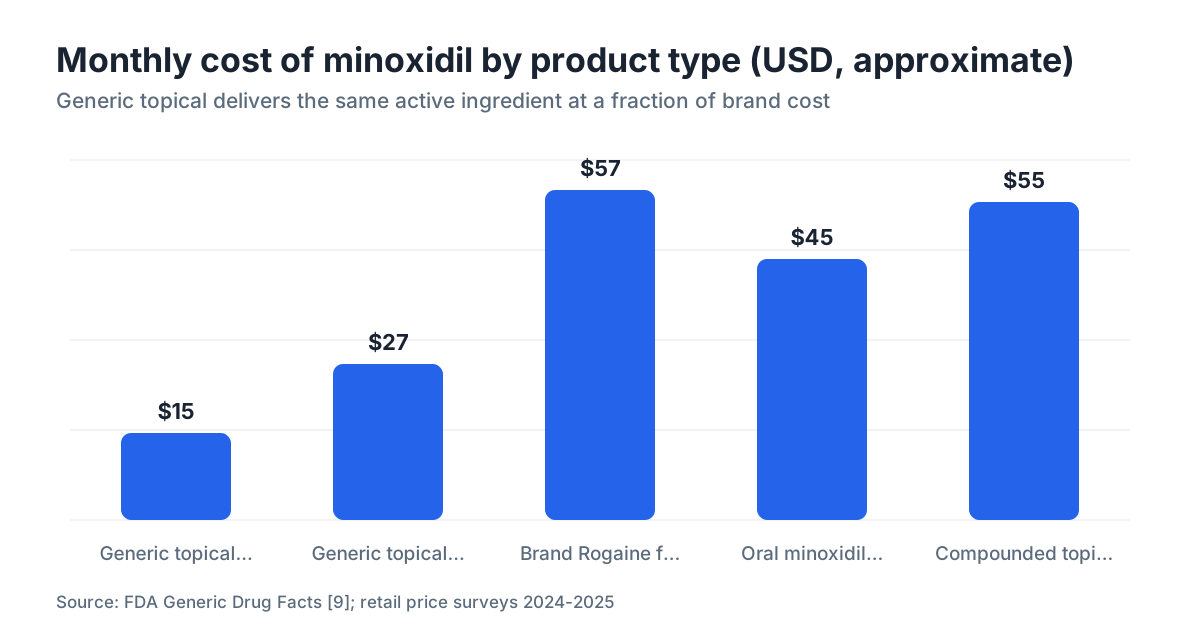
How much does minoxidil cost, and where should you buy it?
Price varies more than most people expect, so let's be specific.
| Product | Strength | Monthly cost (approx.) | Prescription needed? |
|---|---|---|---|
| Generic topical solution | 2% or 5% | $10-20 | No |
| Generic topical foam | 5% | $20-35 | No |
| Brand (Rogaine) foam | 5% | $45-65 | No |
| Oral minoxidil tablet | 0.625-5 mg | $15-40 + telehealth fee | Yes |
| Compounded topical | Varies | $30-80 | Sometimes |
Generic topical is your best value. The active ingredient is chemically identical to Rogaine; what differs is sometimes the inactive ingredients, which can affect feel and irritation potential but not efficacy. The FDA requires generics to meet the same bioequivalence standards [9], so paying $65 for branded foam when $25 generic foam is available is not a decision the evidence supports.
Where to buy:
Drugstores and big-box retailers (CVS, Walgreens, Costco, Walmart): Reliable, immediate, no subscription. Costco's Kirkland Signature 5% solution is frequently cited as the cheapest per-ounce option in existence, around $10-15 for a six-month supply at typical doses.
Amazon: Convenient but check the seller. Buy from the brand directly or from Amazon itself as seller, not third-party resellers, to avoid temperature-damaged or counterfeit stock.
Telehealth platforms (Keeps, Hims, Ro, Forhims): These bundle a physician consult with a prescription if needed. Their pricing often includes a markup over pharmacy cost, but the convenience and access to a prescriber who can recommend oral minoxidil or combination therapy can be worth it. Expect $20-50/month for topical, more for oral.
GoodRx: For oral minoxidil or if you already have a prescription, GoodRx coupons at local pharmacies often beat telehealth pricing by a wide margin. Worth checking before you commit to any subscription.
If you're not sure which type of hair loss you're dealing with, get a proper assessment first. The free AI hair analysis at MyHairline can help you understand your pattern before you commit to a product.
Is a prescription required to buy minoxidil?
For topical minoxidil at 2% or 5%, no prescription is needed in the United States. You can walk into any pharmacy and buy it today [1].
Oral minoxidil is different. Because it's prescribed off-label for hair loss and carries systemic cardiovascular effects at higher doses, every legitimate US provider requires a prescription. Telehealth platforms handle this with an online consultation, typically $0-25 for the visit, after which a prescription is issued electronically to a pharmacy.
Compounded minoxidil, which sometimes includes finasteride or other ingredients in one solution, also requires a prescription through a licensed compounding pharmacy. The FDA has flagged some compounded drug products for quality concerns over the years, so if you go that route, look for a pharmacy with 503B outsourcing facility status or at minimum PCAB accreditation.
Outside the US, rules vary. In the UK, 5% topical minoxidil switched to over-the-counter status in 2023. Canada permits OTC sales. Australia requires a prescription for the 5% product in some states. If you're buying internationally, check your own country's regulatory status rather than assuming.
How do you use minoxidil correctly to get results?
The instruction that gets ignored most often: apply it to a dry scalp, not wet hair. Solution and foam both absorb better into dry skin. Applying to soaking-wet hair after a shower dilutes the product and reduces contact time with the scalp.
For topical solution: 1 mL per application, directly to the scalp in the affected area, twice daily. Spread it with your fingertips, let it dry 4 hours before washing, and wash your hands after. The FDA-approved dosing for the 5% solution is twice daily for men [10].
For topical foam: half a capful, applied to dry scalp, once daily (the once-daily dosing supported by the 2011 JAAD trial [2]). Press the can without turning it upside down (the foam collapses), then apply with fingertips.
For oral: your prescribing doctor sets the dose. Common starting doses are 0.625 mg to 1.25 mg daily. Do not adjust oral minoxidil dosing yourself. Blood pressure effects are real.
The shedding phase is real and most people quit during it. Around weeks 2-8, minoxidil accelerates the natural shedding of older hairs to make way for new growth. This is called telogen effluvium. It's temporary and expected. If you stop at week 6 because of shedding, you've quit right at the worst moment. Read more about telogen effluvium if this concerns you.
Results take time. The standard dermatology guidance is a minimum four to six month trial before evaluating effectiveness, with peak density gains often not visible until months 12-16 [4]. Anyone promising visible results in 30 days is overselling.
Does minoxidil actually work? What does the evidence say?
Yes, it works for most people who use it consistently and started before their follicles were fully miniaturized. The effect size varies by person and pattern.
The registration trial submitted to the FDA for the 5% topical solution showed that after 48 weeks, men using 5% minoxidil had 45% more hair regrowth than placebo, and performed significantly better than the 2% formulation [4]. The American Academy of Dermatology lists topical minoxidil as a Level A recommended treatment for androgenetic alopecia in both sexes [5].
For women specifically, a large multicenter trial showed that 5% solution used twice daily produced significantly greater hair counts at 48 weeks versus placebo, and was modestly better than 2% [6].
Oral low-dose minoxidil data is newer but strong. A JAAD study reported "a statistically significant improvement in hair density" at 6 months with 0.25 mg daily in women versus placebo [3]. Several open-label studies in men using 2.5-5 mg oral show similar or stronger effects than topical, though head-to-head RCT data comparing the two routes directly is still thin.
What minoxidil doesn't do: it doesn't stop the underlying hormonal cause of androgenetic alopecia. The moment you stop using it, benefits reverse within 3-6 months. This is a maintenance treatment, not a one-time fix. That reality shapes the cost calculation: you're committing to years of use, not a few months.
For men with significant recession at the hairline, combining minoxidil with finasteride has better outcome data than either alone. A meta-analysis published in Dermatologic Therapy found combination therapy superior to monotherapy on hair count outcomes [7]. See our full breakdown of finasteride and minoxidil together.
What are the side effects you should know before buying?
Topical minoxidil is well-tolerated by most people. The common complaints are scalp irritation (more with solution than foam, due to propylene glycol), dryness, and the temporary shedding already mentioned. Rare but reported: unwanted facial hair growth if the product runs down the face, and contact dermatitis.
Systemic absorption from topical minoxidil is low but not zero. A small percentage of users report headaches or lightheadedness, particularly in the first weeks. If you have known cardiovascular disease, talk to your doctor before starting even OTC topical.
Oral minoxidil carries a more meaningful side effect profile. Hypertrichosis, which means increased body and facial hair, occurs in a significant portion of users, more so at doses above 2.5 mg. Fluid retention and a fast or pounding heartbeat are possible. At the doses used for hair loss (typically under 5 mg) in healthy adults without hypertension, serious cardiovascular events appear rare, but the data comes from relatively small observational studies, not long-term safety trials [3].
Women of childbearing age: minoxidil is listed as FDA Pregnancy Category C, meaning animal studies showed harm and there are no adequate human studies. The FDA label advises against use in pregnancy [1]. This applies to both topical and oral formulations.
For the complete breakdown including what to do if you experience side effects, read the dedicated minoxidil side effects guide.
How is minoxidil different for men versus women?
The FDA-approved strengths differ. The 2% topical solution is approved for women; the 5% solution and 5% foam are approved for men. In practice, dermatologists routinely prescribe 5% to women at the same or reduced dosing, and the evidence supports this being effective and reasonably safe [6].
The mechanism is the same in both sexes. The pattern of loss differs: men typically lose in the classic Norwood progression starting at the temples and crown, while women more often show diffuse thinning across the top. Minoxidil addresses both patterns, though the visibility of results on a diffuse female pattern can be harder to photograph and quantify.
For men, the combination of minoxidil with a DHT blocker like finasteride or dutasteride is more commonly recommended because the androgenetic driver is stronger and the DHT-blocking drugs are better studied in men. Women cannot take finasteride (it's contraindicated due to teratogenicity), so minoxidil often carries more of the treatment burden. Spironolactone is an alternative DHT-adjacent option for women in the US.
For a full treatment guide by sex, see minoxidil for men for the male-specific picture, or the receding hairline guide for pattern context.
Should you buy generic or brand-name minoxidil?
Buy generic. Full stop.
The FDA requires generic drugs to demonstrate bioequivalence to the reference listed drug, meaning the active ingredient reaches the same concentration in your bloodstream (or in this case, your scalp tissue) within an acceptable range [9]. The active ingredient is identical. The inactives may vary, which can matter for skin feel or irritation potential, but not for efficacy in any trial data available.
The Kirkland Signature 5% minoxidil solution (made by Perrigo, a major pharmaceutical manufacturer) costs roughly $25-30 for a year's supply on some platforms. Rogaine's branded 5% foam costs around $50-65 for a three-month supply. You're paying for the brand, the marketing, and sometimes a slightly more elegant foam formulation, not a meaningfully better drug.
The one case where branded or compounded may matter: if you've tried the generic and had significant irritation from propylene glycol, a PG-free formula (like certain branded foams or compounded solutions using alcohol only) may reduce that. That's a real and legitimate reason to spend more.
What should you know if you're combining minoxidil with other treatments?
Minoxidil combines well with finasteride, and the combination is genuinely more effective than either alone for male androgenetic alopecia [7]. Finasteride addresses the upstream cause (DHT-driven miniaturization); minoxidil improves follicle activity directly. They work through different mechanisms, so there's no pharmacological reason not to use both.
Combining topical minoxidil with dermarolling (microneedling) is a real area of research. A 2013 randomized trial in the International Journal of Trichology found that men who combined 5% minoxidil with weekly 0.5 mm microneedling had significantly greater hair count increases than those using minoxidil alone at 12 weeks [8]. The proposed mechanism is that needle channels increase minoxidil absorption and microneedling itself stimulates wound-healing growth factors. If you go this route, don't apply minoxidil immediately after needling. Wait 24 hours to avoid excessive systemic absorption through open channels.
Platelet-rich plasma (PRP) is sometimes combined with minoxidil in clinical settings. The evidence base for PRP alone is mixed and expensive to access; it's not something to prioritize before exhausting the cheap, proven options.
If you're considering hair transplant surgery eventually, keep using minoxidil throughout. A transplant moves permanent follicles that are resistant to DHT, but the native hair around the transplant will continue miniaturizing without treatment. Surgeons routinely recommend continuing minoxidil post-transplant to protect existing hair. See the hair transplant guide for more on sequencing.
For anyone who has also heard that supplements help, the evidence is much weaker than for minoxidil, but the hair loss supplements guide lays out what has any data and what's marketing.
What are the most common mistakes people make when buying minoxidil?
Buying the wrong strength for their goal. Women who buy 2% because it says "women" on the box may get a meaningful but smaller response than 5% provides; the 5% is off-label but widely used and better studied at this point for both sexes.
Buying it too late. Minoxidil works on living follicles. Completely bald patches with shiny, scarred skin have little to no follicular activity left; the treatment doesn't apply there. Getting started when you first notice thinning, not after years of visible loss, dramatically changes the outcome ceiling.
Quitting during the shed. Already covered, but it can't be overstated: the 2-8 week shedding phase makes most people think the product is making things worse. It isn't. The shed is a pharmacological effect of the drug cycling follicles into new growth phase.
Expecting it to fix a hairline. Minoxidil's strongest evidence is for the crown and mid-scalp. Hairline recession responds more weakly, and in many cases a transplant or combination therapy is needed for meaningful frontal results. Understanding what minoxidil can and can't do prevents expensive frustration.
Not reassessing after 12-16 months. If you've used it correctly for over a year with zero response, your follicular situation may be different from the typical androgenetic alopecia pattern, or you may have a hair loss cause that minoxidil doesn't address. What causes hair loss is worth reading if you're not sure of your diagnosis. If your situation is genuinely puzzling, a quick pattern assessment can save months of misapplied treatment. MyHairline's free AI scan at myhairline.ai/scan can show your Norwood stage and suggest whether your pattern is likely to respond to minoxidil, finasteride, or something else entirely.
How long do you have to keep buying and using minoxidil?
Indefinitely, if you want to keep the results.
This is the part of the minoxidil conversation that gets glossed over in marketing. Minoxidil does not treat the cause of androgenetic alopecia. When you stop, the follicles that responded to the treatment revert to their miniaturized trajectory, and most of the regrown hair sheds within 3-6 months. Several long-term studies confirm this reversal pattern [4].
Some people on finasteride find they can reduce their minoxidil use over time because finasteride slows DHT-driven loss at the root. But minoxidil monotherapy requires continuous use.
This makes the monthly cost calculation matter a lot. At $20-30/month for generic topical, that's $240-360 per year, $2,400-3,600 per decade. Oral at $30-50/month with the telehealth fee comes out higher. Worth it for most people who respond well, but you're signing up for a long commitment, not a course of treatment.
Sources
- FDA - Minoxidil Topical Solution Prescribing Information / OTC labeling
- Blume-Peytavi U et al., Journal of the American Academy of Dermatology, 2011 - 5% minoxidil foam once daily vs 2% solution twice daily
- Sinclair RD, Journal of the American Academy of Dermatology, 2018 - Low-dose oral minoxidil for female pattern hair loss
- Olsen EA et al., Journal of the American Academy of Dermatology, 2002 - 5% minoxidil vs 2% and placebo RCT
- American Academy of Dermatology - Hair Loss Guidelines
- Lucky AW et al., Journal of the American Academy of Dermatology, 2004 - 5% minoxidil solution in women
- Gupta AK et al., Dermatologic Therapy, 2021 - Combination minoxidil and finasteride meta-analysis
- Dhurat R et al., International Journal of Trichology, 2013 - Microneedling plus minoxidil RCT
- FDA - Generic Drug Facts: Bioequivalence
- NLM DailyMed - Minoxidil Topical Solution USP 5%