
TL;DR: Scalp tension theory proposes that tightness in the connective tissue over the skull compresses blood vessels and follicles, worsening androgenic alopecia. Small trials show daily scalp massage increases hair thickness. But tension is not the main cause of male pattern baldness. DHT is the dominant driver. Treat massage as a cheap add-on, never a replacement for finasteride or minoxidil.
What is scalp tension theory?
Scalp tension theory says chronic mechanical tightness in the galea aponeurotica, the flat sheet of connective tissue over the top of the skull, compresses the dermal blood supply and distorts follicles enough to speed up androgenic alopecia. The idea is old. Anatomists noticed decades ago that scalp skin over the vertex and frontal hairline is thicker and less mobile than skin over the sides and back. Those stiff zones map almost exactly onto where male pattern baldness hits hardest.
The theory's best-known modern proponent is plastic surgeon Michael Lopresti, who published a 2021 review in Plastic and Reconstructive Surgery arguing that galeal tension creates a low-oxygen microenvironment around follicles [1]. His argument runs like this: the galea tightens as the skull grows in early adulthood, that tension squeezes the small vessels feeding follicles, and the resulting restricted blood flow plus mechanical deformation triggers the same miniaturization cascade DHT drives on its own. He is not claiming tension replaces DHT. He is claiming it amplifies it.
It's a plausible hypothesis. Wound-healing research is clear that mechanical compression slows the growth of new blood vessels. The open question is whether the forces involved are big enough to matter for follicles sitting a few millimeters below the skin. That part is still genuinely unsettled.
What does the evidence actually show?
The evidence is suggestive and nowhere near definitive. Here's an honest map of what researchers have actually found.
The Lopresti 2021 paper [1] is a review and a mechanistic argument, not a clinical trial. It pulls together anatomical studies, wound-healing literature, and surgical observations. It's the intellectual base of the modern tension hypothesis. It does not, by itself, prove that releasing tension regrows hair.
The most cited data point comes from a 2019 study by Koyama and colleagues in ePlasty, where 9 men did standardized scalp massage for 24 weeks [2]. The headline finding was a statistically significant rise in hair thickness, from roughly 65.1 micrometers to 70.9 micrometers at 24 weeks, with a sustained increase to 77.6 micrometers at follow-up in a second group. Hair count did not change significantly. The authors proposed that mechanical stretching of dermal papilla cells stimulated them directly, pointing to a separate lab experiment where stretch raised expression of hair-cycle genes. They did not claim tension causes loss. They claimed massage mechanically stimulates follicles that are still alive.
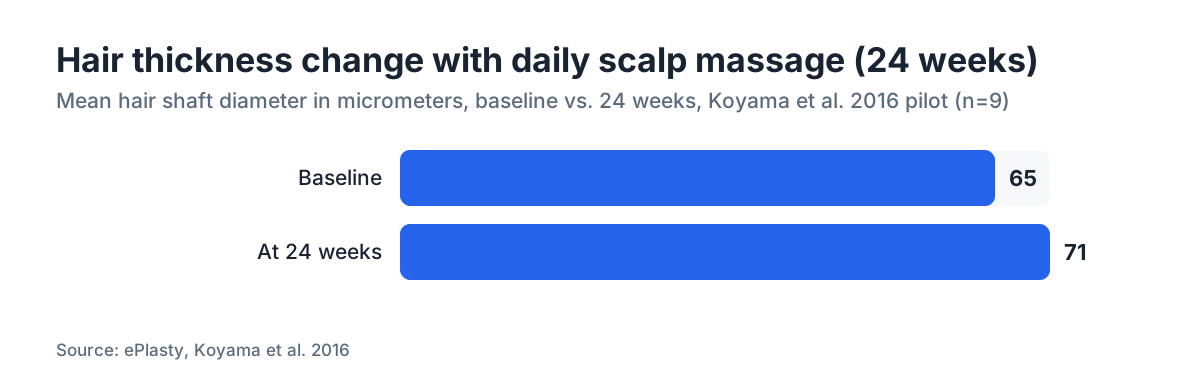
A 2016 pilot from the same group (Koyama et al., ePlasty), also 9 healthy men, found mean hair thickness of about 65 micrometers at baseline and 70 micrometers after 24 weeks of 4-minute daily massage [3]. Nine men can't support confident conclusions. The direction is at least consistent.
Traction alopecia is the clearest real-world proof that mechanical force damages follicles. Prolonged pulling from tight braids, weaves, or ponytails causes permanent loss in the pulled zone [4]. The American Academy of Dermatology treats traction alopecia as a distinct condition. That's physical damage from sustained high-force pulling, not the low-level internal compression the tension theory describes, but it does prove that mechanical stress can wreck follicle health.
What the evidence does not show: no large randomized controlled trial has tested whether regular scalp massage halts or reverses androgenic alopecia at a scale that matters clinically. Nobody has good head-to-head data on massage versus finasteride or minoxidil.
Is scalp tension the main cause of male pattern baldness?
No. The clinical consensus is that androgenetic alopecia is driven mainly by dihydrotestosterone (DHT) acting on genetically susceptible follicles [5]. DHT binds androgen receptors in the dermal papilla, shortens the anagen growth phase, and shrinks the follicle a little more with each cycle over years. That's why finasteride, a 5-alpha reductase inhibitor that cuts scalp DHT by roughly 60 to 70 percent, works for most men who take it [5].
Scalp tension, if it matters at all, is probably a secondary or modifying factor. The honest framing: the top of the skull is mechanically different from the sides, and that difference tracks the pattern of loss. The correlation is real. Whether the actual mechanism is compression-driven low oxygen, direct follicle distortion, or something else is not settled.
Here's the clean test. If tension were the primary cause, men who can't respond to androgens should still go bald over time from mechanical stress alone. They don't. Men with androgen insensitivity syndrome, genetically male but with cells that can't respond to androgens, never develop male pattern baldness as they age. That's about as clean a natural experiment as biology offers, and it points hard at androgens as the dominant driver.
For the fuller picture of what drives hair loss across conditions, see what causes hair loss.
How does scalp massage supposedly work, and is the mechanism real?
There are two proposed mechanisms, and they're actually different claims.
The first is tension relief: massage loosens chronic compression in the galea, blood flow returns, and the low-oxygen stress on follicles eases. That's the Lopresti hypothesis. The evidence here is indirect, borrowed from wound-healing and vascular anatomy, not from measuring scalp blood flow before and after a massage session.
The second is mechanical stimulation: stretching the dermal papilla cells directly, independent of blood flow, switches on genes tied to the anagen growth phase. The Koyama 2016 lab work showed exactly this in cell culture [3]. Cells stretched at the right frequency and duration increased expression of genes including NOGGIN, which pushes hair growth. This claim is more biologically specific, and it does not need the tension-compression story to be true.
Popular articles blur these two together. They're separable. You can believe massage stimulates follicles mechanically without buying that chronic scalp tension causes hair loss in the first place. The trial results, small as they are, fit the mechanical-stimulation story better.
There's a simpler candidate too: massage bumps up local blood flow right away, delivering more oxygen and nutrients to follicles. That happens with any soft tissue massage. Whether the short-term bump adds up over 24 weeks is speculative. It isn't a crazy idea.
Does scalp massage actually regrow hair or just thicken existing strands?
The honest answer: the trial data points to massage thickening existing hairs more reliably than adding new ones.
In the Koyama 2016 pilot [3], hair thickness went up meaningfully but total hair count showed no significant change. That split matters. Thicker hair means follicles are less shrunken, which is a genuine improvement. It also suggests massage is coaxing follicles that are still alive rather than waking up dormant or dead ones.
This is not nothing. Early in androgenic alopecia, follicles miniaturize, meaning hairs get finer and finer before the follicle quits making anything visible. Keeping follicles at a thicker diameter for longer is a real goal. But once follicles are gone, massage won't bring them back. That takes minoxidil for men, which has FDA approval for promoting regrowth [6], or a hair transplant.
So here's the practical read: scalp massage makes the most sense as an early tool for people who still have miniaturizing follicles, not as a rescue plan for advanced loss.
What does the galea aponeurotica actually do, and why does it matter here?
The galea aponeurotica is a tough fibrous sheet linking the frontalis muscle at the forehead to the occipitalis muscle at the back of the skull. It sits just under the fat layer and above the loose tissue that lets the scalp slide over bone. The scalp over the vertex and frontal hairline, the zones that go bald in male pattern baldness, connects directly to the galea and moves less than the temporal and occipital scalp.
Lopresti's 2021 paper [1] argues that the galea in these regions transmits real mechanical force every time the frontalis and occipitalis contract, over decades. He suggests men with larger heads, more muscular foreheads, or busier frontalis activity may carry more tension. That could partly explain why some men bald faster than others despite similar androgen levels.
The anatomical overlap is striking. Draw the tension lines of the galea on a skull and they aim almost exactly at Norwood baldness zones. That's either a real clue or a very tidy coincidence. Most dermatologists who've looked at the theory call it a likely contributor, not the cause.
Surgeons who do scalp reductions and forehead lifts have reported, anecdotally, that releasing galea tension can change scalp texture and sometimes density in the operated area. Those are clinical observations, not controlled trials. They're still worth noting.
How should you do scalp massage if you want to try it?
The Koyama 2016 protocol [3] was simple and standardized: 4 minutes daily, fingertips only, firm circular pressure across the whole scalp with attention to the vertex. No device. The researchers described enough pressure to cause mild discomfort but not pain.
A 2019 survey by English and Barazesh in ePlasty collected self-reported results from people who massaged on their own [7]. Of 327 respondents who reported daily massage for at least 6 months, 68.9 percent said they saw stabilization or regrowth. This is self-reported and wide open to selection bias, since people who got nothing probably quit and never answered. It can't stand as a clinical finding. The direction lines up with the controlled work.
Practical guidance, built from what the studies actually used:
- Duration: 4 to 20 minutes a day. The Koyama trial used 4. Longer sessions showed up in the survey's improvements, but returns likely flatten fast.
- Frequency: daily.
- Pressure: firm circular motions with fingertips. Enough that you feel it.
- Location: vertex and frontal regions where thinning is happening.
- Tools: electric scalp massagers with silicone nodes are popular, but no head-to-head trial has tested them against fingertips.
No evidence says oils or serums applied during massage add real benefit beyond the mechanical stimulation itself, though some oils cut scalp dryness. Rosemary oil often rides along with massage advice. One small trial (Panahi et al., Skinmed 2015) compared it against minoxidil 2% and found comparable results at 6 months [8]. That result gets cited constantly, but it came from a single trial of 100 people. Minoxidil's evidence base is vastly larger.
How does scalp massage compare to proven hair loss treatments?
Here's the honest lineup. Read the evidence column first, because that's where these options separate.
| Treatment | Evidence level | Typical effect on hair count | FDA status |
|---|---|---|---|
| Finasteride (oral) | Multiple large RCTs | 10-15% increase over 2 years vs placebo [5] | FDA approved for men |
| Minoxidil (topical 5%) | Multiple large RCTs | Meaningful regrowth in ~40-60% of users [6] | FDA approved for men and women |
| Scalp massage | Two small pilots (n=9 each) | Increased hair thickness, no significant count change | Not regulated |
| Rosemary oil | One RCT (n=100) | Comparable to minoxidil 2% at 6 months [8] | Not regulated |
| Low-level laser therapy | Multiple small RCTs, some industry-funded | Modest count increases | FDA cleared (not approved) |
Finasteride and minoxidil win on evidence by a wide margin [5][6]. If you're losing real hair, starting one or both before you bother with massage is the evidence-based move. Massage is a fine add-on with almost no downside. Choosing massage instead of proven treatment, especially early when intervention matters most, is a mistake that costs you follicles you can't get back.
If you can't take finasteride, or you want the wider view, see finasteride and minoxidil and dht blocker.
Does scalp tension explain why hair loss follows the Norwood pattern?
This is one of the more interesting structural arguments in the whole hypothesis. The Norwood scale describes a predictable front-to-back and vertex progression that stays remarkably consistent across men with different genetics, habits, and androgen levels [9]. Tension theorists note this pattern tracks the zones of highest galea tension.
Standard dermatology counters that the Norwood pattern reflects androgen receptor density, which is simply higher at the vertex and frontal scalp. Both explanations predict the same map. Correlation alone can't tell you which mechanism is doing the work.
One observation tilts slightly toward the receptor explanation: follicles moved from the androgen-resistant occipital zone to the balding vertex keep their resistance, an effect called donor dominance. If tension were the primary driver, you'd expect transplanted follicles sitting in a high-tension zone to miniaturize again. Most don't, at least not at the same rate. That's a big reason most hair restoration surgeons stay skeptical of tension as a primary cause, even while they'll grant it may contribute.
If you're figuring out where you sit on the Norwood scale, see receding hairline for the full breakdown.
Are there risks to scalp massage, and can it make hair loss worse?
For most people, scalp massage carries little risk. Three concerns are worth naming.
Shedding early on. Some people notice more shedding in the first few weeks of daily massage. It's likely the same thing that happens when you start minoxidil, where stimulation pushes telogen-phase hairs out sooner. It usually passes. If shedding is heavy or drags on, see a dermatologist.
Traction alopecia from rough technique. This is possible if you're yanking or tugging hairs instead of pressing in circles. Firm circular fingertip pressure is correct. Pulling is not.
Missing the real cause. The bigger danger is spending months massaging while androgenic alopecia marches on, right through the early window when finasteride or minoxidil does the most good. Massage also won't treat telogen effluvium, which needs its underlying trigger addressed.
Scalp massage has no drug interactions and is safe alongside any standard hair loss treatment. Add it to your routine if you're already on proven therapy. Just don't let it stand in for that therapy.
What should you actually do if you're losing your hair?
Here's a priority order built on the evidence.
Start with a real diagnosis. Androgenic alopecia, telogen effluvium, alopecia areata, and traction alopecia all look different and need different approaches. A dermatologist can usually sort it from an exam and a short history. For a faster first look, MyHairline's free AI scan at myhairline.ai/scan gives you an initial read on your pattern before you see a doctor.
Next, if you have androgenic alopecia and you're still early, the evidence strongly favors starting finasteride (if you're a man with no contraindications) and/or minoxidil. Those are the only FDA-approved treatments for the pattern. See finasteride and minoxidil for men for side effects and what to realistically expect.
Then add scalp massage as a daily habit. It costs nothing, risks almost nothing, and the small trials point toward modest gains in follicle thickness. Four minutes a day is easy to hit. Whether it works through tension relief, mechanical stimulation, or better blood flow, the downside is basically zero.
If you have significant loss and proven treatments haven't done enough, a hair transplant consultation is the next real conversation, not more massage or supplements.
And if you've been price-comparing every supplement on the shelf, hair loss supplements is a good reality check.
Sources
- Plastic and Reconstructive Surgery, Lopresti 2021 review
- ePlasty, Koyama et al. 2019
- ePlasty, Koyama et al. 2016 pilot study
- American Academy of Dermatology, Traction Alopecia overview
- National Library of Medicine (StatPearls), Androgenetic Alopecia
- FDA, Minoxidil topical OTC label information
- ePlasty, English and Barazesh 2019 survey study
- Skinmed, Panahi et al. 2015 RCT
- American Academy of Dermatology, Androgenetic Alopecia overview