TL;DR: Skip minoxidil during active chemotherapy. Your scalp barrier is compromised and systemic absorption climbs unpredictably on top of drugs that may already stress your heart. After chemo ends, minoxidil has real evidence for faster regrowth, especially 2% topical solution started in the first week after your last cycle. Regrowth usually starts within 3 to 6 months regardless.
Why does chemotherapy cause hair loss in the first place?
Chemotherapy drugs go after rapidly dividing cells. Hair follicles are some of the fastest-dividing cells in the body, so they get caught in the blast radius. The medical term is chemotherapy-induced alopecia, or CIA. It works differently from the pattern hair loss most people picture when they hear "hair loss."
Not every drug sheds hair the same way. Taxanes (paclitaxel, docetaxel) and anthracyclines (doxorubicin) cause severe shedding in the vast majority of patients. Cyclophosphamide is also high-risk. Low-dose methotrexate and vincristine tend to thin hair rather than clear the scalp [1].
Shedding usually starts 2 to 4 weeks after the first infusion and peaks around 4 to 8 weeks. It's a form of telogen effluvium, but the mechanism differs. Chemo forces an abrupt anagen arrest (follicles get shocked out of the growth phase) instead of the slower stress-triggered shift you see after surgery or illness. Reading up on what causes hair loss more broadly makes it clearer why chemo hair loss reacts to treatment differently than genetic hair loss.
CIA is almost always temporary. But "almost always" carries weight in that sentence. A small group of patients, mostly those on high-dose docetaxel, still show thinning at 6 months or beyond. One multicenter analysis put persistent alopecia at roughly 10 to 15% of docetaxel-treated patients, though the number swings with dose and duration [2].
Is it safe to use minoxidil during active chemotherapy?
Short answer: most oncologists say no, or at least not without explicit clearance from your care team. Here's the reasoning.
Minoxidil is a vasodilator. Rub it on your scalp and some of it gets absorbed into your bloodstream. Normally that absorption is too low to matter. During chemo, your scalp skin is often a mess. Inflammation, dry patches, and tiny scratches from scratching push absorption up in ways nobody can predict [3]. Higher systemic exposure carries real cardiovascular risk: fluid retention, fast heart rate, low blood pressure. Those aren't hypothetical worries for someone whose heart may already be strained by anthracyclines.
There's also no strong randomized trial showing minoxidil applied during active chemo prevents hair loss from high-dose taxanes or anthracyclines. The drug works by stretching out the anagen (growth) phase of follicles you already have. Chemo shuts anagen down entirely. So you'd be taking on the absorption risk for very little upside.
One exception. Some oncology dermatology protocols use scalp cooling (hypothermia caps) during infusion to cut CIA, and a handful of centers have started testing minoxidil alongside the cooling. That's a supervised clinical setting, not a bathroom cabinet decision. If your oncologist or a dermatologist who works with cancer patients specifically tells you to use minoxidil during treatment, follow that. Don't start it solo without the conversation.
What does the research say about using minoxidil after chemo ends?
Here the evidence turns genuinely encouraging. A randomized controlled trial in the Journal of the American Academy of Dermatology tested 2% topical minoxidil solution against placebo in women after chemotherapy. The minoxidil group regrew hair faster and reported higher satisfaction. Time to first visible regrowth was shorter, and total hair count at the follow-up mark was meaningfully greater [4].
The trial's stated conclusion was that topical 2% minoxidil accelerated hair regrowth in patients with CIA with no serious adverse events reported [4].
That detail matters. The finding isn't that minoxidil creates hair that wouldn't come back anyway. It almost always does after CIA. The benefit is speed and density during the recovery window, which carries real psychological weight for patients staring at a bald scalp in the mirror.
A smaller pilot study in the journal Dermatology found that starting minoxidil within the first week after the last cycle beat starting it 4 to 6 weeks later [5]. Timing seems to matter. The follicles are climbing out of their arrested state during that window and appear more responsive to what minoxidil does.
Oral minoxidil hasn't been studied in large post-CIA trials, though some dermatologists now prescribe it off-label for this. If you want the tradeoffs between the two forms, the oral minoxidil article lays them out.
How long after chemotherapy should you wait before starting minoxidil?
Start as close to your last cycle as your oncologist allows, ideally within the first week after the final infusion [5]. That doesn't mean the day you walk out of the infusion center, especially if your scalp is irritated or you have active mucositis or skin breakdown.
Here's the practical timeline most dermatologists work with:
- Days 0 to 7 post-final-cycle: check scalp condition with your dermatologist. If skin is intact and not visibly inflamed, starting 2% topical solution is generally reasonable.
- Week 2 onward: most patients tolerate topical application well.
- Month 1 to 3: the stretch where regrowth acceleration peaks if you started early.
Missed the early window? Say you're already 2 or 3 months out. Starting is still worth it. The follicles aren't locked out after that point. You're just working with hair that has already begun its natural comeback instead of catching it right at the transition.
Persistent CIA (thinning that hangs on at 6 months post-treatment) is a different animal. At that stage the loss can overlap with telogen effluvium or even genetic androgenetic alopecia that chemo unmasked. A dermatologist can run a scalp biopsy or trichoscopy to sort them out, and that matters, because androgenetic alopecia responds to finasteride and DHT blockers in ways CIA does not.
Which form of minoxidil is better for post-chemo regrowth: topical or oral?
The published trial evidence for CIA covers topical 2% solution [4]. That's the formulation with the clearest data in this group.
Topical 5% solution and foam (the standard doses in minoxidil for men for androgenetic alopecia) haven't been tested in CIA-specific trials. The 2% concentration got used partly because most early trials enrolled women, and 2% was the standard female dose back then. Nothing suggests higher concentrations are harmful here, but there's no CIA trial data behind them either.
Oral minoxidil at low doses (0.625 mg to 2.5 mg daily) is increasingly prescribed off-label for post-CIA regrowth, especially for patients who struggle with topical application or have a sensitive scalp. The cardiovascular concerns that make topical minoxidil risky during active chemo hit harder with the oral form, so the timing conversation with your oncologist matters even more before you start it.
Before you pick either form, read the full minoxidil side effects profile, especially the fluid retention and cardiovascular effects that hit anyone coming off cardiotoxic chemo drugs.
| Form | CIA Trial Evidence | Notes for post-chemo use |
|---|---|---|
| Topical 2% solution | Yes, RCT data [4] | First-line choice with evidence |
| Topical 5% solution/foam | No CIA-specific trial | Used off-label; likely safe but less studied |
| Oral minoxidil | No CIA-specific RCT | Off-label; stronger cardiovascular screening needed |
Can minoxidil prevent hair loss during chemotherapy if started early?
Plenty of patients ask this before their first cycle. The honest answer: probably not for high-dose taxane or anthracycline regimens.
CIA is an abrupt follicular arrest driven by DNA damage and oxidative stress in the hair matrix. Minoxidil stretches out the anagen phase by opening potassium channels and boosting local blood flow. Those are two different biological levers. While the chemo drug is actively wrecking matrix cell DNA, minoxidil's channel-opening trick isn't strong enough to fight it off [1].
Scalp cooling is the only intervention with solid evidence for CIA prevention, and even it doesn't fit every cancer type (it's not recommended when the goal includes preventing scalp metastases, for example). The FDA cleared the DigniCap and Paxman scalp cooling systems for reducing CIA [6].
A few small studies have looked at topical minoxidil as a preventive agent alongside scalp cooling, but the sample sizes are too small to conclude anything. If your center offers scalp cooling and your oncologist says it fits your cancer type, that's the evidence-based way to prevent loss. Minoxidil is the evidence-based way to recover from it.
Does hair grow back differently after chemo, and does minoxidil affect that?
Yes. Post-chemo regrowth is famously different from what you had. It even has a nickname: "chemo curls." Straight hair often comes back wavy or curly. Color can shift temporarily. The new hair tends to be finer and more fragile in the first 3 to 6 months.
The biology behind it: the follicle goes through a full reset during the arrested period. The hair shaft protein structure can change as the follicle rebuilds. Most of these texture shifts resolve within 12 to 18 months as the follicle cycles through more growth phases.
Minoxidil doesn't seem to change the texture of post-chemo regrowth. Its job is timing and density, not the character of the hair shaft. No evidence says it prevents chemo curls or makes them worse.
If regrowth is slow, patchy, or hasn't started by 6 months post-chemo, see a dermatologist who specializes in hair loss. Persistent CIA is uncommon but real, and early dermatoscopy can tell you whether you're looking at slow normal regrowth, persistent CIA, or newly unmasked androgenetic alopecia.
Should women use minoxidil differently than men after chemo?
The published CIA trial data comes mostly from women, so in a way women have better direct evidence for post-chemo minoxidil than men do [4]. The 2% topical concentration in that trial was the historically standard female dose, though the FDA has also approved the 5% concentration for women.
For post-chemo use, most dermatologists start women on 2% or 5% topical based on scalp tolerance rather than a sex-based dosing rule. Same timing principle either way: start as early as your oncologist and dermatologist agree is safe after the final cycle.
One practical wrinkle. Women in hormone-sensitive breast cancer treatment may be on aromatase inhibitors (anastrozole, letrozole, exemestane) or tamoxifen at the same time. Those drugs can cause their own thinning, separate from CIA. Minoxidil handles the CIA part, but the hormone-suppression thinning is a different problem with few good options. Finasteride is not appropriate for women on these therapies, and DHT blockers get complicated in hormonally sensitive cancers. That conversation needs a dermatologist who understands the oncology side.
What do oncologists and dermatologists actually recommend?
The American Academy of Dermatology recognizes topical minoxidil as a treatment that can help hair regrow faster after CIA [7]. The AAD doesn't set one universal protocol for exact timing or concentration. That call goes to the treating dermatologist working with the oncology team.
Most oncology nursing guidelines say wait until treatment is done before adding new topical agents to the scalp, mainly to protect skin integrity during active treatment. The Oncology Nursing Society and several NCCN member institutions publish patient guidance on CIA, though specific minoxidil timing varies by center [8].
The practical consensus in academic dermatology clinics runs like this: no minoxidil during active chemo unless scalp cooling is being used under medical supervision; start topical minoxidil promptly after the last cycle with oncologist clearance; use 2% or 5% topical first-line; reassess at 3 months.
If you want a clear picture of your hair loss status before starting anything, the free AI hair analysis at MyHairline can help you document a baseline so you can track change over time. That kind of objective record is genuinely useful when you're talking through progress with your dermatologist.
Are there other treatments worth considering alongside minoxidil after chemo?
A few options have real evidence, a few have hype, a few have both.
Low-level laser therapy (LLLT), also called photobiomodulation, has FDA clearance for hair loss and a handful of small CIA-specific trials showing modest benefit. Weaker evidence than the minoxidil RCT, but a low-risk add-on for motivated patients [9].
Platelet-rich plasma (PRP) injections show up in some dermatology practices for post-CIA regrowth. The CIA-specific evidence is limited to case series and small pilots. It's expensive and insurance won't cover it. The data doesn't justify choosing it over topical minoxidil as a first step.
Finasteride is not appropriate for CIA recovery in women. In men, if persistent CIA eventually turns out to have an androgenetic component (the genetic hair loss that hits roughly 50% of men over 50), finasteride and minoxidil together address that pattern more completely. But that's a secondary concern during the first 12 months of recovery.
Hair transplant surgery isn't appropriate until natural post-CIA regrowth has fully stabilized, which takes at least 12 to 18 months. A hair transplant into a scalp still mid-recovery risks poor graft survival. Surgeons who work with oncology patients usually want a year of stable regrowth before operating.
Nutrition matters more than most people expect after chemo. Iron, ferritin, zinc, and protein deficiencies all drag down regrowth and are common after treatment. A metabolic panel and iron studies before you start any topical treatment give you a sensible baseline. Some hair loss supplements fix these deficiencies, but testing first tells you whether you actually need them.
What realistic timeline should you expect for hair regrowth after chemo?
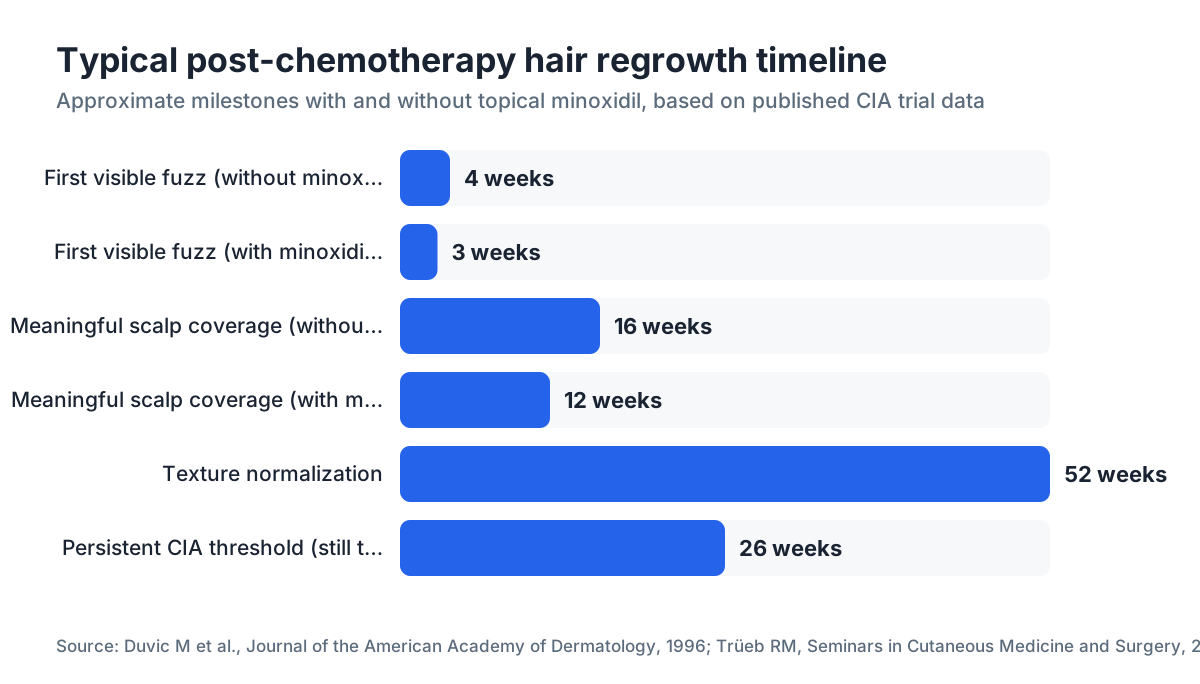
Even without minoxidil, most patients see visible fuzz within 3 to 4 weeks of the final cycle. That early growth is usually fine and may not match the texture or color of your pre-treatment hair. Here's a rough timeline built from published data and clinical observation [4][5]:
- Weeks 2 to 4 post-chemo: fine peach-fuzz regrowth starts in most patients.
- Months 1 to 3: coverage improving; minoxidil-treated patients gain density faster here.
- Months 3 to 6: most patients have meaningful coverage; texture changes (chemo curls) peak.
- Months 6 to 12: hair approaches pre-treatment length and density for most; texture usually starts to normalize.
- Months 12 to 18: full recovery for the majority; persistent CIA is significant thinning past this point.
Minoxidil's measured benefit is compressing the early timeline and improving density at the 3-month mark [4]. It doesn't skip the process. It speeds it up.
Patients still thinning at 12 months should get worked up for other factors: ongoing hormonal treatment, nutritional deficiencies, newly unmasked androgenetic alopecia, or (rarely) permanent follicular damage. That evaluation changes the treatment plan a lot.
Sources
- National Cancer Institute, Hair Loss (Alopecia) and Cancer Treatment
- Freites-Martinez A et al., "Assessment of Quality of Life and Treatment Outcomes of Patients With Persistent Postchemotherapy Alopecia," JAMA Dermatology, 2019
- MedlinePlus (NIH), Minoxidil Topical
- Duvic M et al., "2% topical minoxidil for chemotherapy-induced alopecia," Journal of the American Academy of Dermatology, 1996
- Rodriguez R et al., pilot study on minoxidil timing post-chemotherapy, Dermatology, 2009
- FDA, Humanitarian Device Exemption, DigniCap Scalp Cooling System (H140004)
- American Academy of Dermatology, Hair loss: tips for managing
- Oncology Nursing Society, Chemotherapy-Induced Alopecia clinical resource
- Avci P et al., "Low-level laser (light) therapy (LLLT) in skin: stimulating, healing, restoring," Seminars in Cutaneous Medicine and Surgery, 2013
- Trüeb RM, "Chemotherapy-induced alopecia," Seminars in Cutaneous Medicine and Surgery, 2009
- National Comprehensive Cancer Network (NCCN), Patient Guidelines: Managing Chemotherapy Side Effects
- MedlinePlus (NIH), Minoxidil Topical