TL;DR: You can use minoxidil with box braids or other protective styles, but most of the drug ends up on the braid rather than your scalp unless you apply it carefully with a dropper or syringe directly to the scalp between parts. Foam formulations absorb faster and leave less residue on hair. Taking a break from protective styles is not required, but the less product reaches your scalp, the less it works.
Why this question matters for people who wear protective styles
Box braids, cornrows, sew-ins, and locs are popular partly because they cut down on daily manipulation. That same quality, less touching your hair, creates a real problem for topical minoxidil, which has to reach the scalp to do anything at all.
Minoxidil is not a shampoo. It works by being absorbed through the skin of your scalp, where it widens blood vessels around hair follicles and appears to extend the growth phase of the hair cycle [1]. If most of your application lands on a braid shaft instead of skin, you get a fraction of the intended dose on your scalp and a sticky, build-up-prone mess on your style.
Hair loss in Black women is also disproportionately common. Central centrifugal cicatricial alopecia (CCCA) affects an estimated 5 to 17 percent of Black women according to the American Academy of Dermatology [2], and traction alopecia from tight styles is a separate and very real concern. Many of these women are already on or considering minoxidil for men or women's versions of the drug, and they wear protective styles routinely. The two things do not have to be mutually exclusive.
The short answer: apply minoxidil with a dropper directly to your scalp through the parts, not onto the braid itself, and you can use the drug without taking your hair down every day.
Does minoxidil actually work if hair is braided?
Probably less efficiently, but still meaningfully if your technique is good. That is the honest answer.
Minoxidil's effect is dose-dependent at the scalp level. The FDA-approved label for the 5% topical solution specifies 1 mL applied to the scalp twice daily for androgenetic alopecia [1]. If you apply 1 mL and half of it absorbs into braid fibers or synthetic hair, your effective scalp dose is closer to 0.5 mL. Over weeks, that adds up to a real drop in drug exposure.
No published randomized controlled trial has specifically studied minoxidil application in braided hair as of mid-2026. That is a real gap in the literature. The closest proxy data come from absorption studies on hairy versus shaved skin: topical minoxidil absorption is meaningfully affected by hair follicle density and skin surface contact area [3]. A braided style does not shave your head, but it does create a physical barrier.
What this means in practice: if you can get your dropper tip through the part to touch skin before squeezing, you are doing fine. If you are squirting liquid onto a braid and hoping it migrates down, you are wasting drug and money.
Oral minoxidil sidesteps this entirely. Oral minoxidil is taken as a pill and reaches hair follicles through the bloodstream, so your hairstyle is completely irrelevant. Some dermatologists are shifting patients who wear protective styles toward low-dose oral minoxidil for exactly this reason, though the systemic side effect profile is different and it requires a prescription in the US.
How to apply minoxidil to box braids without wasting it
Technique is everything here. These are the approaches that make the most physical sense given how the drug absorbs.
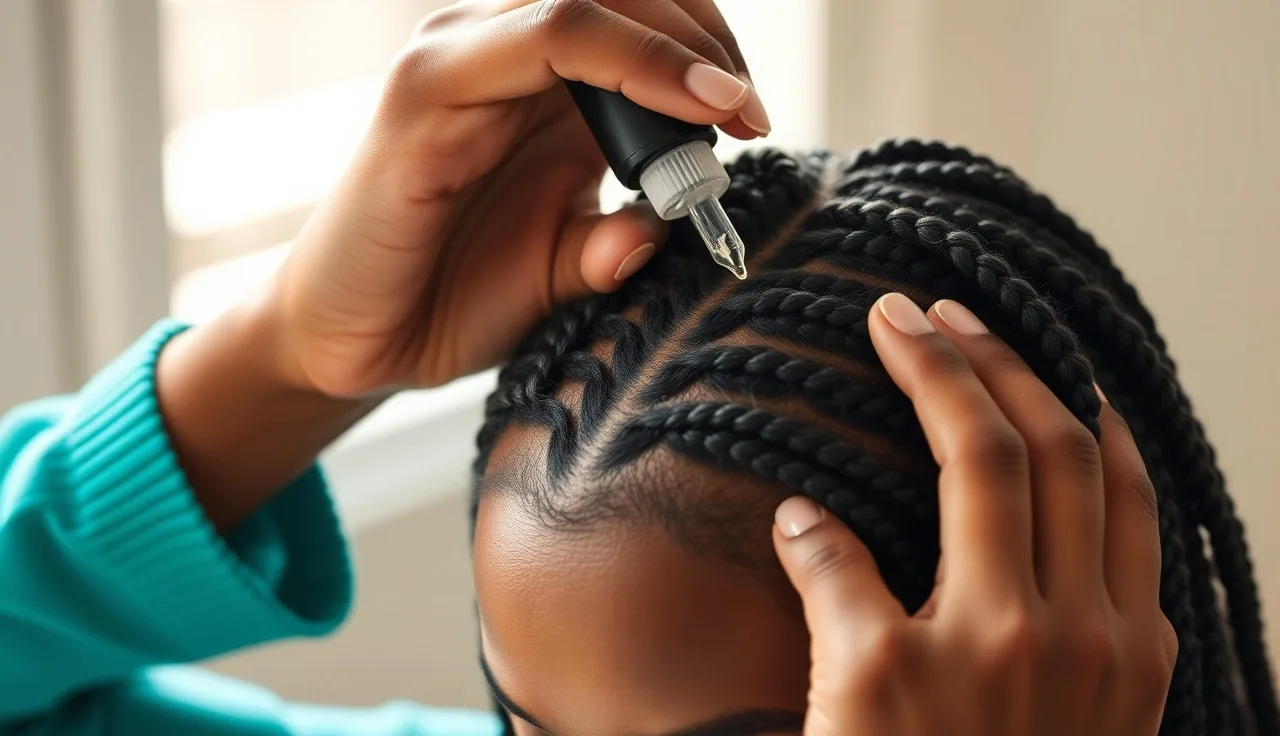
Use a dropper or curved-tip applicator. Standard minoxidil solution bottles come with a dropper. Part your braids with a rattail comb or the applicator tip itself, and place the tip as close to the scalp as you can before releasing any liquid. This sounds tedious. It takes about two minutes once you are used to it.
Follow your parts methodically. Box braids already give you a grid of exposed scalp. Apply a small amount at each intersection or along each parting line rather than flooding one area. Spreading the dose across the scalp matters: the FDA label says to apply to the entire affected area of the scalp, not a single spot [1].
Consider foam over solution. The 5% minoxidil foam (Rogaine and generics) was developed partly because foam spreads less and dries faster than liquid solution. The propylene glycol vehicle in the solution is the ingredient most likely to drip down braid shafts and cause buildup or scalp irritation. Foam gives you more control. Dispense it onto your fingertip, then press it through the part to the scalp.
Apply to dry hair. Wet hair dilutes the product and makes it run. Wait until your hair is fully dry after any washing or conditioning.
Do not rub or massage hard. Vigorous scalp massage under braids can loosen the root tension and move product away from where you placed it.
One mL still applies. The labeled dose does not change because you have braids. Use a measuring dropper or count your applications to stay consistent. Piling on more to compensate for absorption losses is a bad idea and raises the risk of minoxidil side effects like scalp irritation or, at high doses, systemic absorption effects.
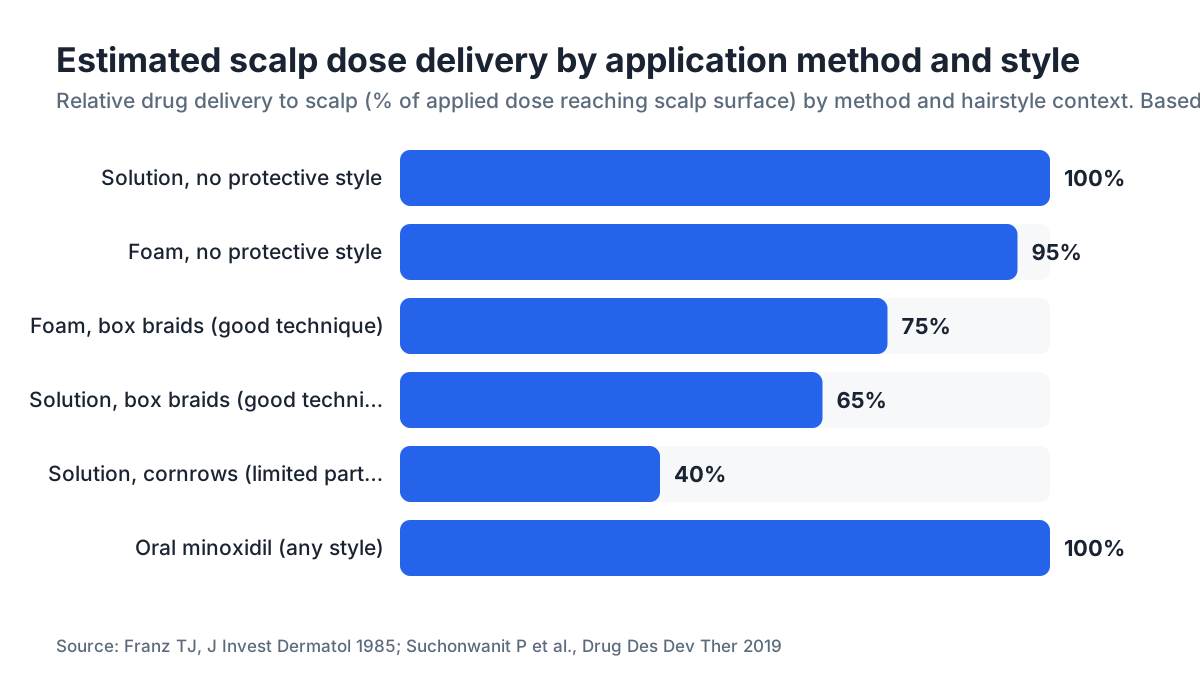
Does the type of protective style change how you should apply it?
Yes, and the difference is big.
Box braids with a grid part pattern are the friendliest for topical minoxidil. The parts are wide, spaced, and visible. You can reach the scalp easily.
Cornrows are tighter and flatter. The braids sit directly against the scalp and the parts are narrow. Getting a dropper tip to actual skin is harder, and the flat braid covers follicles that would otherwise be accessible. Foam on a fingertip worked through the groove of the part is your best bet here.
Sew-in weaves with a closure or frontal depend entirely on what is underneath. If your natural hair is cornrowed underneath, see above. If you have a leave-out, you can apply normally to the leave-out section but still face the cornrow problem under the weft.
Locs are the hardest scenario. Mature locs have no visible part in the traditional sense, and the loc itself sits over the follicle. Many dermatologists managing alopecia in loc-wearing patients reach for oral minoxidil here rather than fighting the topical application problem.
Crochet styles with synthetic hair installed over cornrows: the synthetic fibers do not absorb minoxidil in any meaningful way (they are not human hair), but they do block access. The cornrow grid underneath still gives you parts to work with.
Wigs over a natural hairline are the easiest case. Your natural hair is either loose or lightly braided underneath, the wig comes off at night, and you can apply minoxidil normally to your scalp before bed and replace the wig in the morning.
Can minoxidil cause buildup or damage to braids or extensions?
Yes, the liquid solution can leave visible residue, and this is a real reason some people quit using it.
The solution formulation contains propylene glycol as its main carrier vehicle. Propylene glycol is a humectant and can leave a white or slightly tacky film on synthetic and human hair extensions when it dries. This is cosmetically annoying and, over weeks, can make locs or braids look dull.
The foam formulation causes noticeably less buildup because it uses a different vehicle (no propylene glycol) and evaporates faster [10]. If product buildup on your style bothers you, foam is the better choice.
On your natural hair, repeated solution application without enough washing can lead to scalp buildup that potentially clogs follicles. If you are wearing a style for six to eight weeks without washing, this is worth thinking about. A dry shampoo or a gentle diluted shampoo applied carefully with a squeeze bottle to the scalp (not the braids) every two to three weeks handles this without requiring you to take your style down.
Minoxidil itself does not chemically damage hair. It does not alter the hair shaft, bleach color, or weaken extensions. The concern is purely residue and scalp cleanliness over a long install.
What about traction alopecia? Does minoxidil help?
Traction alopecia is hair loss from repeated tension on the follicle, most often along the hairline and temples. It is common in people who wear tight protective styles regularly [8].
Minoxidil can help with traction alopecia if it is caught early, when the follicles are still alive but dormant from mechanical stress. The American Academy of Dermatology lists topical minoxidil as one of the treatments dermatologists use for traction alopecia, alongside reducing tension on the scalp [2]. The keyword is early. If traction alopecia has progressed to scarring (follicle destruction), minoxidil will not regrow hair in those spots because there is nothing left to stimulate.
If you are seeing hairline recession, thinning at your temples, or breakage at your edges, the right move is: (1) loosen the style or take a break from tight braiding, (2) see a dermatologist to check whether follicles are still present and active, and (3) consider starting minoxidil on that dermatologist's advice. Waiting while continuing tight installs makes the prognosis worse.
For a broader picture of what drives hair loss beyond traction, see what causes hair loss.
CCCA is a different diagnosis, a progressive scarring alopecia that often starts at the crown, and it needs a different treatment approach. Minoxidil alone is not the primary treatment for active CCCA, which usually involves anti-inflammatory agents. If you are not sure what type of hair loss you have, getting a proper diagnosis before committing to a treatment protocol matters a lot.
Is oral minoxidil a better option if you wear protective styles regularly?
For many people, yes.
Oral minoxidil at low doses (0.625 mg to 2.5 mg daily for women, 2.5 mg to 5 mg for men) is prescribed off-label for hair loss in the US, meaning the FDA has not approved it specifically for this indication, though several published clinical trials support its use [4]. Because it works systemically, your hairstyle has zero effect on how the drug reaches your follicles.
A 2020 retrospective study in the Journal of the American Academy of Dermatology found that low-dose oral minoxidil was effective for hair loss across multiple diagnoses with a relatively low side-effect burden at doses under 5 mg [4]. The most common side effect was hypertrichosis (unwanted body hair growth), which occurred in roughly 14 percent of patients in that study.
The tradeoffs are real. Oral minoxidil requires a prescription. It can lower blood pressure modestly, cause fluid retention, and is not recommended during pregnancy. Topical minoxidil is available over the counter and its systemic absorption is limited (though not zero).
If you wear protective styles for six to twelve weeks at a time and the topical application logistics feel unsustainable, talking to a dermatologist about oral minoxidil is a genuinely reasonable conversation to have.
How often do you need to apply minoxidil when your hair is braided?
The labeled frequency for topical minoxidil is twice daily. That is the regimen used in the clinical trials that led to FDA approval [1].
Twice daily with box braids is doable but takes commitment. Many people with protective styles find they can do the morning application before putting on a wig or scarf, and the evening application before bed.
Once-daily application is less studied for the topical form, but some dermatologists accept it as a practical compromise when twice daily is not sustainable. The evidence base for once-daily topical minoxidil is weaker than for twice daily. If you are going to reduce frequency, oral minoxidil (typically dosed once daily) may actually give you a more consistent blood level than an inconsistent topical routine.
Consistency over weeks and months is what counts. Hair growth cycles are slow. Minoxidil needs roughly four to six months of steady use before results show, and the benefit goes away when you stop [1]. Starting, stopping, and restarting because you got a new install is the worst pattern: it stretches out the time to results and can trigger a temporary shed each time you stop.
If you want help understanding your specific pattern of loss before committing to a regimen, MyHairline's free AI hair scan at myhairline.ai/scan can analyze your hairline and give you a starting point for that conversation with a dermatologist.
Does minoxidil cause a shedding phase and will protective styles hide it?
Yes, minoxidil commonly causes a temporary shedding phase in the first four to eight weeks of use. It is called the minoxidil shed, and it happens because the drug pushes telogen (resting) phase hairs out to make room for new anagen (growth) phase hairs [5].
Protective styles do not prevent this shedding at the follicle level. The hairs still shed. What a protective style does is trap those shed hairs inside the braid, so you do not see them on your pillow or in the sink. That can be reassuring during the shed phase, but it also means that when you take the braids down, you may see a large clump of accumulated shed hair all at once. It looks alarming and is usually just weeks of normal and shed-related hair that was held in place.
For more on normal shedding patterns and when to worry, see telogen effluvium.
The shed phase resolves on its own. If shedding is still heavy past three months of consistent use, flag it for a dermatologist.
A comparison of minoxidil delivery methods for protective style wearers
Here is a practical look at how the main options stack up if you regularly wear braids, locs, or weaves.
| Delivery method | Reaches scalp under braids? | Prescription needed? | Buildup risk | Frequency |
|---|---|---|---|---|
| Topical solution (2% or 5%) | Only with careful dropper technique | No (OTC) | High (propylene glycol) | Twice daily |
| Topical foam (5%) | Easier with fingertip placement | No (OTC) | Low | Twice daily |
| Oral minoxidil (low dose) | Yes, via bloodstream | Yes (off-label Rx) | None | Once daily |
| Topical minoxidil spray | Moderate, depends on nozzle type | No (OTC, some Rx) | Moderate | Twice daily |
For most box braid wearers, the topical foam or oral minoxidil are the most practical choices. For loc wearers or tight cornrows, oral minoxidil is often the only approach that delivers a steady dose without frustrating application logistics.
If you are thinking about combining minoxidil with a DHT-blocking approach, see finasteride and minoxidil for how those two treatments interact, or check DHT blocker for a broader look at the options.
When should you take your protective style down before applying minoxidil?
You do not have to take your style down every time you apply minoxidil. That would defeat the whole point of a protective style.
The situations where taking the style down first makes sense:
First, if you are starting minoxidil for the first time and want to assess your baseline scalp condition. Applying correctly from day one builds the habit.
Second, if your install is older than eight weeks and you are noticing scalp flaking, itching, or odor that suggests buildup or inflammation. In that case, take the style down, clarify the scalp, and treat any dermatitis before resuming minoxidil.
Third, if you suspect a scalp condition like seborrheic dermatitis or folliculitis is developing under the braids. Minoxidil on an inflamed scalp can worsen irritation.
Otherwise, a well-maintained protective style with steady, careful minoxidil application through the parts is a reasonable long-term approach. Many dermatologists tell patients outright they do not need to choose between their hair care practice and their hair loss treatment.
What dermatologists actually recommend for Black patients on minoxidil
Dermatologists who specialize in hair loss in patients of African descent have published on this, and the message is consistent: do not tell patients to stop wearing protective styles to use minoxidil. That advice is culturally out of touch and not medically necessary.
Dr. Amy McMichael at Wake Forest University, one of the most cited researchers on hair disorders in patients of color, has written about tailoring hair loss treatment protocols to individual hair care practices [7]. The American Academy of Dermatology's resources on hair loss in Black women specifically note that treatment should be compatible with the patient's regular hair care routine [2].
The practical consensus from dermatology literature:
Topical minoxidil through braid parts is acceptable and effective if technique is good. Foam is preferred over solution for protective style wearers because of lower buildup and faster absorption. Oral minoxidil is increasingly used for patients who find topical application impractical with their style. Scalp health checks every four to eight weeks matter more when hair is braided, because you cannot easily see what is happening under there.
If you are dealing with a receding hairline on top of traction or CCCA concerns, the combination of loosening styles and starting treatment early is consistently the strongest recommendation in the literature.
Sources
- FDA, Rogaine (minoxidil 5% topical solution) prescribing information
- American Academy of Dermatology, Hair Loss in Black Women
- Franz TJ, Minoxidil absorption through human skin, Journal of Investigative Dermatology, 1985
- Ramos PM et al., Low-dose oral minoxidil for hair loss, Journal of the American Academy of Dermatology, 2020
- Messenger AG, Rundegren J, Minoxidil: mechanisms of action on hair growth, British Journal of Dermatology, 2004
- FDA, Minoxidil OTC monograph and approval history
- McMichael AJ, Hair and scalp disorders in ethnic populations, Dermatologic Clinics, 2003
- Khumalo NP et al., Traction alopecia: the root of the problem, Clinical, Cosmetic and Investigational Dermatology, 2014
- NIH National Library of Medicine, Minoxidil drug entry, MedlinePlus
- Suchonwanit P et al., Minoxidil and its use in hair disorders: a review, Drug Design, Development and Therapy, 2019