TL;DR: Finasteride has a plasma half-life of 6 to 8 hours, so the drug itself clears your blood within about two days. But its DHT-suppressing effect on the scalp and serum persists for roughly two to six weeks after stopping. Fertility and sexual side effects generally resolve within weeks too, though a small number of men report longer timelines. Expect hair loss to resume within three to six months of quitting.
What is finasteride's half-life and how fast does it leave your blood?
Finasteride's elimination half-life sits at 6 to 8 hours in most men. That figure comes straight from the FDA-approved prescribing information for Propecia (finasteride 1 mg), which reports a mean plasma half-life of 4.7 to 7.1 hours in men aged 18 to 60 and a longer 8.2 hours in men over 70 [1].
A half-life tells you how long it takes for the concentration in your blood to drop by half. Run the math five times over and you've cleared roughly 97 percent of the drug. At six to eight hours per half-life, that puts full plasma clearance at around 30 to 40 hours, or a day and a half to two days, for most men under 60.
Older men clear the drug more slowly because kidney function tends to decline with age, and finasteride is partly excreted via the renal route. If you're in your 60s or 70s, assume the high end of that range.
The drug binds Type II 5-alpha reductase, the enzyme that converts testosterone into dihydrotestosterone (DHT). That enzyme complex takes time to recover even after the drug is gone, which is why the blood half-life tells only part of the story.
How long does finasteride's DHT-blocking effect last after stopping?
This is the question most people actually care about, and it's different from the plasma half-life. DHT suppression outlasts the drug itself by a wide margin.
A study published in the Journal of Investigative Dermatology found that a single 1 mg dose of finasteride reduced serum DHT by about 65 percent within 24 hours, and measurable suppression persisted beyond 24 hours even as plasma levels fell [2]. With daily dosing, serum DHT drops roughly 60 to 70 percent from baseline, and that suppression takes two to four weeks to fully reverse after the last dose [3].
At the scalp tissue level, recovery may take even longer. Scalp DHT suppression with chronic finasteride use is generally considered to normalize within about six weeks of stopping, though good long-term tissue pharmacokinetic data in humans is limited. Nobody has run a large, well-controlled biopsy study tracking scalp DHT week by week for months after discontinuation, so that six-week figure is the best clinical estimate, not a hard measurement.
So here's the practical picture. Stop finasteride today and your DHT is still meaningfully suppressed for at least one to two weeks, probably two to four weeks for full enzyme recovery. Your body is not simply back to normal the morning after your last pill.
How long until hair loss returns after stopping finasteride?
Hair loss resumes, and it usually becomes obvious within three to six months. That's the part that matters most if you're thinking about quitting.
The longer answer involves understanding what finasteride is actually doing. It doesn't regenerate follicles that are already dead. It slows the miniaturization process driven by DHT on genetically sensitive follicles. Once you stop the drug, DHT climbs back toward baseline over a few weeks, and the miniaturization process picks up roughly where it left off.
A five-year placebo-controlled study of finasteride 1 mg (the Phase III trials used to gain FDA approval) showed that men who stopped taking the drug lost the hair gains they'd made and returned toward the placebo trajectory within one to two years [3]. Anecdotally, many men report noticing increased shedding within two to three months of stopping.
There's sometimes a short-lived catch-up shed after stopping, where hairs that were being held in the growth phase by DHT suppression enter telogen at once. This can look alarming. It's essentially the same mechanism as telogen effluvium, though it typically self-limits as DHT levels restabilize.
If you've been on finasteride for several years and stop, you're not necessarily going to lose all your hair overnight. But within six to twelve months, most men are back to where they would have been without the drug.
Does finasteride show up on a drug test?
No. Standard employment drug panels (the SAMHSA-5 panel used by most US employers) test for cannabinoids, cocaine, amphetamines, opiates, and PCP. Finasteride is not on that panel and won't trigger a positive result [4].
The issue that gets more attention is in competitive sports. The World Anti-Doping Agency (WADA) prohibits finasteride because it can mask steroid use by suppressing DHT levels, making detection of certain anabolic steroids harder [5]. WADA banned finasteride outright in 2009. If you compete in any WADA-governed sport, finishing the drug a few days before competition is not a solution, because anti-doping labs specifically test for finasteride metabolites.
For standard clinical drug tests, a urine immunoassay, or a workplace panel, finasteride creates no issues whatsoever.
If you're curious about the broader category of DHT blockers and how they interact with hormone panels or other tests, know that finasteride can lower serum PSA (prostate-specific antigen) by approximately 50 percent [1]. If you're having a PSA test for prostate cancer screening, your doctor needs to know you're on finasteride, because the lab value needs to be interpreted differently.
How long until finasteride side effects go away after stopping?
Most side effects tied to finasteride resolve within a few weeks to a few months of stopping. That's the consistent finding across the clinical literature, and it lines up with the pharmacology: once DHT recovers, the physiological effects of its suppression reverse.
Sexual side effects (reduced libido, erectile dysfunction, ejaculatory disorders) are the most discussed. The FDA label for Propecia reports these in roughly 1 to 4 percent of men in clinical trials, and states that resolution occurred in all men who stopped and were followed [1]. In the Phase III trials, most resolution happened within a few weeks to a couple of months.
The complication is Post-Finasteride Syndrome (PFS), a contested condition in which some men report persistent sexual, neurological, or psychological symptoms after stopping finasteride. The FDA updated the Propecia label in 2012 to note that libido disorders, ejaculatory disorders, and orgasm disorders have been reported to continue after stopping the drug in some men [7]. The prevalence and mechanism of PFS remain genuinely unresolved. Some researchers point to lasting neuroactive steroid changes; others point to nocebo effects or attribution bias. There's no consensus.
If you experienced sexual side effects while on finasteride, the honest expectation is that they clear up within weeks to months for the vast majority of men. A minority reports longer timelines. That minority deserves to be taken seriously rather than dismissed.
Breast tenderness or gynecomastia, also listed as a possible side effect, typically resolves after stopping but may need medical attention if it persists.
How long does finasteride stay in your system if you're pregnant or trying to conceive?
Finasteride is Category X in pregnancy. The FDA label states: "PROPECIA is contraindicated for use by women when they are or may potentially be pregnant" [1]. The concern is finasteride's effect on the developing male fetus, specifically that DHT suppression during fetal development can cause ambiguous genitalia.
For women who have inadvertently handled crushed tablets or been exposed through skin contact, the FDA notes that the risk comes from actual ingestion. Intact tablets are film-coated precisely to prevent absorption through skin handling, though the label recommends not handling crushed tablets at all.
For men trying to conceive with a partner, the picture is more nuanced. Finasteride does appear in semen at very low concentrations, but studies measuring semen levels found concentrations hundreds of times below the dose that caused fetal effects in animal studies [1]. Several fertility studies found no significant effect of finasteride on semen parameters (count, motility, morphology) in the majority of men at the 1 mg dose [6].
Some reproductive endocrinologists prefer to have men stop finasteride one to three months before trying to conceive, out of caution rather than documented risk. The drug clears plasma in under two days, so the biological rationale for a multi-month washout is mainly to give sperm production (which takes about 70 to 90 days per cycle) a few clean generations.
If fertility is a concern, talk to a reproductive urologist. This is not a decision to make based on forum advice.
Does the dose (1 mg vs 5 mg) affect how long finasteride stays in your system?
No. The half-life is the same regardless of dose: 6 to 8 hours. A higher dose means more drug in your system at peak, so absolute concentrations take a little longer to reach undetectable levels, but the elimination rate constant doesn't change.
The clinically relevant difference between 1 mg (Propecia, for hair loss) and 5 mg (Proscar, for BPH) is the degree of DHT suppression and the recovery curve after stopping. At 5 mg daily, DHT suppression is somewhat deeper (approaching 70 to 80 percent vs 60 to 70 percent at 1 mg) [1], so enzyme recovery after stopping may take slightly longer in practice, though both doses are generally expected to normalize within four to six weeks.
Some men split 5 mg Proscar tablets into quarters as a cost measure. The pharmacokinetics are the same. The potential issue is dose variability from irregular cuts, not any fundamental difference in how the drug leaves the body.
For context on the broader treatment landscape, finasteride works differently from topical treatments like minoxidil for men, which has its own separate pharmacokinetic profile and does not suppress DHT.
What happens to finasteride levels with long-term daily use?
Steady-state plasma concentration is reached within about two weeks of daily dosing [10]. After that, each day's pill tops up the level as the prior day's drug clears, and concentrations move in a predictable trough-to-peak cycle across each 24-hour period.
There's no evidence finasteride accumulates in tissue over months or years in a way that extends its washout time significantly. Some studies have looked at hair follicle concentrations, which can be somewhat higher than serum, but the elimination dynamics still follow a similar pattern.
The practical implication is simple. Someone who's been on finasteride for ten years doesn't have meaningfully more drug to clear than someone who's been on it for six months. The washout period after stopping is driven by the half-life, not the duration of use.
What duration of use does affect is the degree of hair benefit banked. Longer use typically means more maintained follicular health. Stopping after a decade will still result in resumed progression, just from a better baseline than stopping after six months.
If you're weighing the long-term commitment, the comparison of finasteride and minoxidil together versus either alone is worth understanding before you make a decision.
Finasteride clearance timeline: a summary by effect
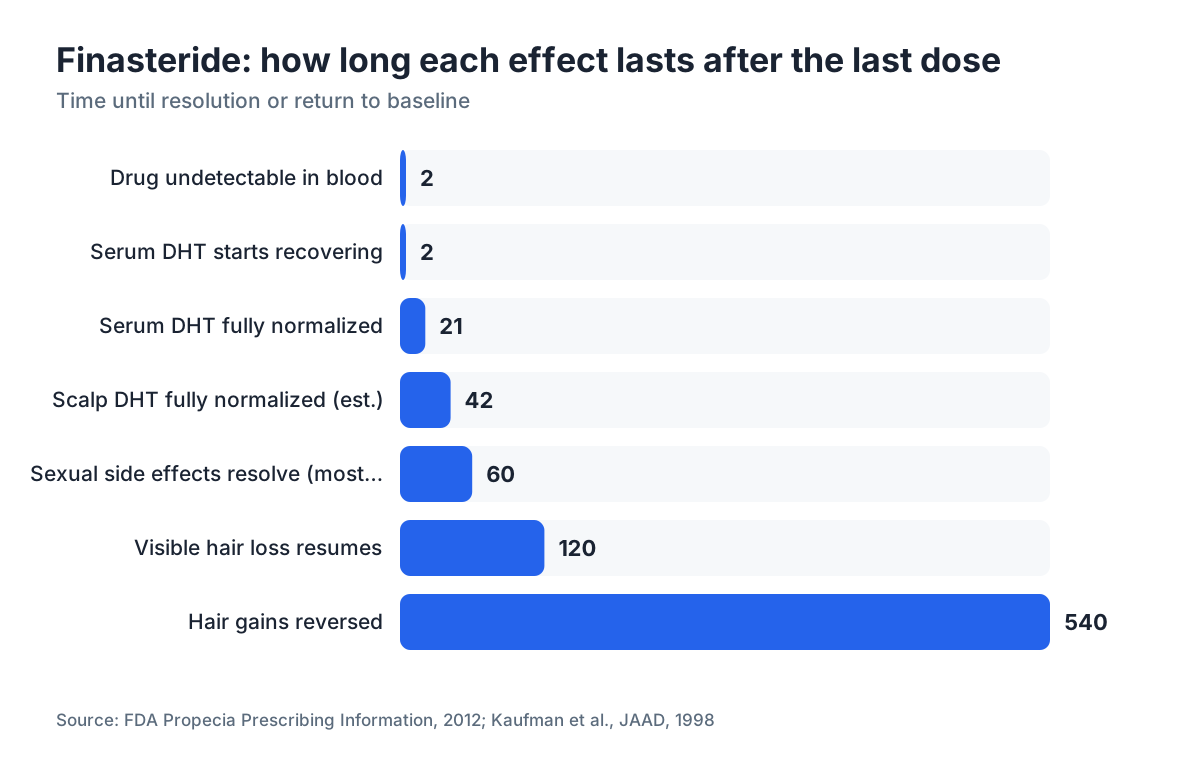
Here's a concrete reference so you can see the differences between plasma clearance, DHT recovery, and hair loss progression side by side.
| Effect | Timeline after last dose |
|---|---|
| Plasma half-life | 6 to 8 hours |
| Drug undetectable in blood | ~2 days (5 half-lives) |
| Serum DHT begins recovering | Within 24 to 48 hours |
| Serum DHT fully normalized | ~2 to 4 weeks |
| Scalp DHT fully normalized | ~4 to 6 weeks (estimated) |
| Sexual side effects resolve (most men) | Weeks to a few months |
| Hair loss resumes visibly | ~3 to 6 months |
| Lost hair gains reversed | ~12 to 24 months |
None of these timelines are carved in stone. Individual variability, age, dose, and duration of use all nudge these numbers. But this table represents the best current clinical picture from the prescribing literature and Phase III trial data [1][3].
If you want to understand where you personally stand in terms of hair loss stage and how much you might have to lose, a tool like the free AI hair analysis at MyHairline can give you a baseline Norwood stage read, which is useful context before making any medication decisions.
Should you taper finasteride or stop cold turkey?
Stop cold turkey. There's no established clinical protocol for tapering finasteride. It's not like a corticosteroid or an antidepressant, where abrupt discontinuation carries physiological risks from receptor upregulation. The half-life is short and the pharmacology is relatively clean.
Some men choose to taper anyway (going from daily to every other day for a few weeks) in hopes of reducing a possible rebound shed. There's no good published evidence this actually reduces shedding. The biologically plausible argument is that it smooths the DHT recovery curve, but DHT is going to recover whether you taper or not.
If you're stopping finasteride before fertility treatments or because of side effects, stopping abruptly is the standard approach in clinical practice. If you're stopping because you're switching to another treatment or having surgery, the same applies.
The one scenario where timing matters somewhat: if you're stopping because of a scheduled blood test (PSA, hormone panel), remember that finasteride suppresses serum PSA by roughly 50 percent and affects DHT and free testosterone readings. Two to four weeks off the drug is typically enough to get a more representative hormone panel, but your physician may want a longer washout period for PSA interpretation.
What causes the receding hairline finasteride was supposed to stop, and is there anything else to do?
Finasteride targets the hormonal driver of androgenetic alopecia: DHT acting on genetically sensitive follicles at the hairline and crown. Once you stop the drug, that driver returns. No treatment currently available permanently turns off DHT sensitivity without ongoing medication or surgical intervention.
The main alternatives people consider after stopping finasteride:
Minoxidil (topical or oral) works through a completely different mechanism, vasodilatory and hair-cycle-related, and does not affect DHT. It can slow progression but won't replicate finasteride's hormonal mechanism. You can read about the minoxidil side effects profile before switching.
Hair transplant surgery is the one permanent intervention, but it uses existing donor follicles from the back of the scalp, which are DHT-resistant. A hair transplant doesn't stop the progression of loss in non-transplanted areas, so most surgeons still recommend ongoing medical therapy alongside surgery.
Understanding the full picture of what causes hair loss and your specific receding hairline pattern helps you make a clearer decision about whether to restart finasteride, switch, or combine approaches.
If you want a data-driven read of your current situation before deciding anything, MyHairline's free AI scan gives you a Norwood stage assessment you can bring to a dermatologist or hair specialist.
Sources
- Journal of Investigative Dermatology, Kaufman et al. 1998, finasteride single-dose DHT kinetics
- Journal of the American Academy of Dermatology, Kaufman et al. 1998, 5-year finasteride trial
- SAMHSA, Mandatory Guidelines for Federal Workplace Drug Testing Programs
- World Anti-Doping Agency, 2024 Prohibited List
- Urology, Overstreet et al. 1999, finasteride effects on sperm and semen in healthy men
- FDA, Drug Safety and Availability, Propecia label change 2012 (persistence of sexual adverse effects)
- NIH National Library of Medicine, MedlinePlus, finasteride
- European Journal of Drug Metabolism and Pharmacokinetics, review of finasteride pharmacokinetics