
TL;DR: Scalp massage has real evidence behind it, but it's modest. A 2016 standardized study found daily 4-minute massage increased hair shaft thickness and reduced shedding over 24 weeks. It likely works by stretching dermal papilla cells and improving blood flow, not by overcoming genetic hair loss on its own. It's best used alongside proven treatments, not instead of them.
What does the research actually say about scalp massage and hair growth?
The most-cited trial is a 2016 study published in ePlasty by Koyama et al., in which nine healthy Japanese men performed standardized scalp massage for exactly 4 minutes per day using a purpose-built device. After 24 weeks, hair shaft thickness increased significantly compared to baseline, and the researchers noted reduced hair loss during the massage period. The study was small, uncontrolled, and used a mechanical massager rather than fingers, so the results can't be extrapolated too broadly. Still, it was the first study to use standardized pressure and duration, and its findings have held up as a starting point for the field. [1]
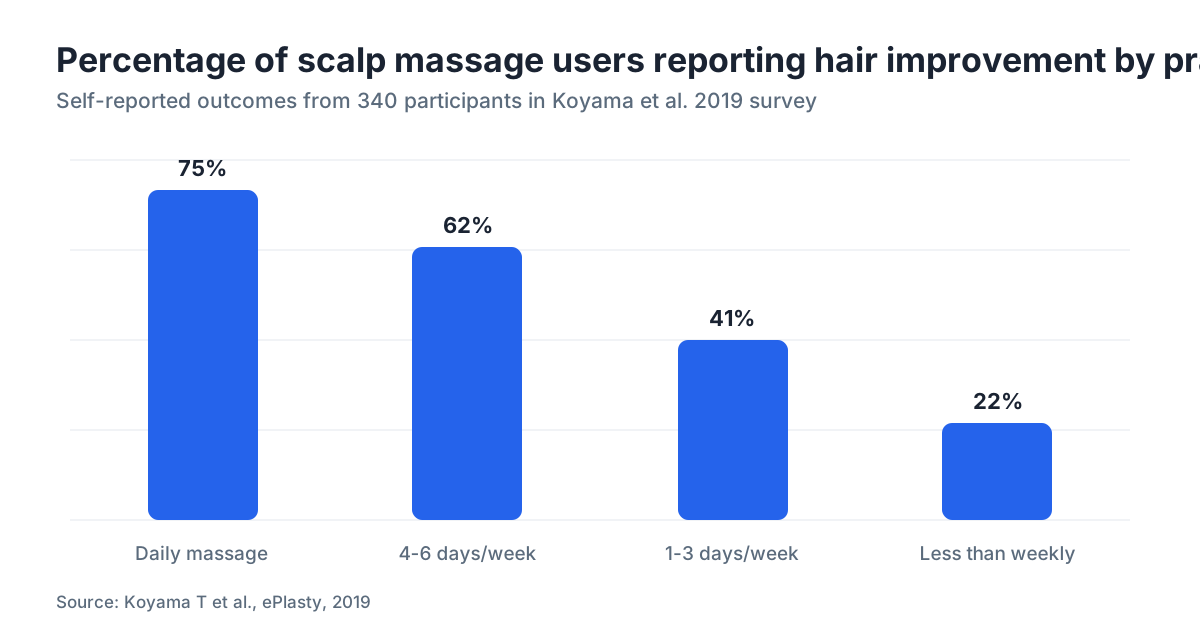
A follow-up survey study by the same group in 2019 collected self-reported data from 340 men and women who performed regular scalp massage. About 68.9% of participants reported a subjective improvement in hair loss or hair thickness. That's a survey, not a controlled trial, so bias is baked in. But the signal is consistent with the smaller device study. [2]
There's also a strand of research looking at scalp massage in the context of specific treatments. A 2020 randomized controlled trial in Dermatology and Therapy tested scalp massage alongside minoxidil in women with female-pattern hair loss, and found the combination group had better outcomes than minoxidil alone at 24 weeks. [3] That result is interesting because it suggests massage may amplify what you're already doing rather than replace it.
The honest summary: the evidence is real but thin. No large randomized controlled trial with a placebo arm has been done on massage alone. What we have is mechanistic plausibility, one small device trial, a self-report survey, and a handful of combination studies. That's enough to take it seriously as a low-cost adjunct. It's not enough to call it a proven standalone treatment.
How might scalp massage stimulate hair follicles?
The leading theory is mechanical tension on dermal papilla cells. Dermal papilla cells sit at the base of each hair follicle and regulate the hair cycle. When you apply sustained pressure and stretch to the scalp, you physically deform those cells. In vitro work (lab studies on isolated cells) has shown that mechanical stretching of dermal papilla cells upregulates genes associated with the anagen (growth) phase of the hair cycle, including those controlling cell proliferation. [1]
Blood flow is the other commonly cited mechanism. Scalp massage does measurably increase superficial cutaneous blood flow, at least acutely. Better blood flow means more oxygen and nutrients delivered to follicles. Whether that translates into meaningful follicle activity in humans over the long term is less established. The acute blood flow effect is real; the downstream hair growth effect from that alone is assumed rather than proved.
There's also a tension-reduction angle. Chronic scalp tension from tight muscles and fascia has been proposed as a contributing factor in androgenetic alopecia, particularly in the vertex (crown) region where blood supply is naturally sparser. Massage may help release that tension. This is a plausible but poorly validated mechanism, and the scalp tension theory of hair loss itself remains contested in dermatology. [4]
The bottom line on mechanism: stretching dermal papilla cells has the strongest direct experimental support. Everything else is plausible and consistent with what we know, but hasn't been proved in living humans at the hair-regrowth level.
How long does scalp massage take to show results?
Based on the Koyama 2016 trial, measurable changes in hair shaft thickness appeared after 24 weeks of daily 4-minute massage. [1] That's six months. Hair grows roughly 1 cm per month on average, and the full hair cycle (anagen, catagen, telogen) takes months to complete, so any intervention needs at least that long to show up in measurable hair density or thickness.
In the self-report survey, participants who reported improvement had been massaging for an average of around 10-12 months. The people who saw no benefit tended to have shorter practice durations. [2] That's a correlation from survey data and could reflect expectation bias, but it's directionally consistent with what we know about hair cycle timing.
Start scalp massage expecting results in four weeks and you'll quit before it ever had a chance. The realistic window to judge whether it's doing anything is six months of consistent daily practice.
What is the correct technique for scalp massage?
The Koyama study used a mechanical device that applied consistent pressure in a circular motion across the entire scalp. For fingers, the nearest equivalent is firm circular or kneading motions using the pads (not nails) of all ten fingers. [1]
Here's how to do it:
- Sit or stand comfortably. You don't need to be in a specific position.
- Place all ten fingertips on your scalp, spread across the vertex, temples, and occipital areas.
- Apply firm but not painful pressure and move the skin itself in slow circular motions. You're trying to move the scalp over the skull, more than rub the surface.
- Work across the whole scalp over the course of 4 minutes. Don't fixate on one spot.
- Do this on dry hair or lightly oiled hair. Doing it while lathering shampoo in the shower counts and is one of the easiest ways to build the habit.
The study used 4 minutes daily. That's the only duration with direct trial evidence behind it. There's no data showing that 10 minutes beats 4, and going at it too aggressively can cause mechanical hair breakage, especially on wet hair or hair that tangles easily. Hard rubbing is counterproductive.
There are also scalp massager tools, typically silicone finger-shaped devices, that can be used in the shower. These are fine and roughly approximate the device used in the Koyama study. There's no reason to buy an expensive electric massager over a $10-15 silicone one.
Does it matter whether you use oil during scalp massage?
The Koyama study used dry mechanical massage, so the evidence base is technically for massage without oil. Some small studies and longer traditional practices (Ayurvedic head massage, for example) involve carrier oils like coconut or castor oil. [5]
Coconut oil has evidence as a pre-wash treatment that reduces protein loss from hair shafts, meaning it can improve hair condition and reduce breakage. Whether it adds to any growth effects of massage is unknown. [5] Castor oil is popular online but there is no quality randomized trial showing it regrows hair.
If you want to use oil, a light application of coconut oil 20-30 minutes before washing is low-risk and has at least some evidence for hair shaft conditioning. Don't expect the oil itself to regrow hair. The massage is the active variable; the oil is optional and mainly affects hair texture, not follicle activity.
One practical note: if you're applying topical minoxidil for men or a similar treatment, massage that in directly rather than adding a separate oil step. The mechanical action of applying the treatment may itself provide some massaging benefit.
Can scalp massage stop hair loss from androgenetic alopecia?
Androgenetic alopecia (genetic hair loss, also called male-pattern or female-pattern baldness) is driven by dihydrotestosterone (DHT) binding to androgen receptors in genetically susceptible follicles, progressively miniaturizing them. Scalp massage does not block DHT. It does not change your androgen receptor genetics. So the honest answer is: no, it cannot stop androgenetic alopecia on its own. [6]
What it might do is modestly slow the rate of miniaturization or improve hair shaft thickness in follicles that are still partially functional. The trial evidence we have is in men with no diagnosed hair loss condition, so we can't directly apply those numbers to people with active androgenetic alopecia.
If you're dealing with a receding hairline or crown thinning from androgenetic alopecia, scalp massage is a reasonable addition to your routine, but it should not replace treatments with stronger evidence. Finasteride and minoxidil are the two FDA-recognized options for androgenetic alopecia in men, and using them together has stronger evidence than either alone. [7] If you're interested in how those two compare and combine, there's a detailed breakdown at finasteride and minoxidil.
Massage as an add-on to those treatments makes sense. Massage instead of them does not.
Is scalp massage useful for other types of hair loss?
Hair loss is not one condition. Telogen effluvium, alopecia areata, traction alopecia, and nutritional deficiency-related loss all have different causes and respond differently to the same interventions. [8]
For telogen effluvium, which is stress- or shock-induced diffuse shedding, the evidence for massage is theoretical. The condition often resolves on its own once the trigger is removed. Massage probably doesn't hurt, and if it helps with stress management (which itself can be a trigger), there may be indirect benefit.
For alopecia areata, an autoimmune condition, massage has no direct evidence and the mechanism wouldn't address the immune attack on follicles.
For traction alopecia, caused by hairstyles that pull the scalp, adding massage would not compensate for ongoing mechanical damage and you need to address the cause first.
For nutrient-related hair loss, the primary fix is addressing the deficiency. You can also look at hair loss supplements as part of that picture, though the evidence base there is also variable.
Before leaning on massage, it helps to know what kind of hair loss you have. Understanding the what causes hair loss landscape first gives you a more accurate sense of what can actually help your specific situation.
How does scalp massage compare to proven treatments like minoxidil or finasteride?
This comparison matters because people often pick one thing and stick with it, sometimes abandoning treatments that actually work because they're committed to a gentler approach.
| Treatment | Evidence level | Effect size | Cost (approx.) | Side effect risk |
|---|---|---|---|---|
| Minoxidil 5% topical | Multiple large RCTs, FDA-approved | Moderate (hair count increase ~18-25% in trials) [7] | $5-30/month | Low (scalp irritation, rare systemic) |
| Finasteride 1mg | Multiple large RCTs, FDA-approved | Moderate-high (87% of men halted loss in 2-yr trial) [9] | $20-80/month | Low but real (sexual side effects ~2%) |
| Scalp massage | 1 small device trial, 1 survey | Small-moderate (thickness increase, no density RCT) | $0 | Negligible |
| Hair transplant | Surgical standard of care | High for coverage, no regrowth of new follicles | $4,000-15,000+ | Surgical risks |
The evidence gap between scalp massage and minoxidil or finasteride is wide. That doesn't make massage useless. It makes massage a low-cost, zero-risk addition that may give you a modest benefit on top of whatever else you're doing. The mistake is treating these as equivalent options.
If you're early in researching hair loss and wondering where to start, the MyHairline AI scan at myhairline.ai/scan can help identify your pattern and flag which interventions are worth discussing with a dermatologist first.
Are there any risks or downsides to scalp massage?
For most people, no. Done correctly with fingertip pads and moderate pressure, scalp massage is safe. There are a few things to watch for.
Aggressive rubbing, especially on wet hair, can cause mechanical breakage of the hair shaft. This can look like increased shedding in the short term, which is alarming but not the same as follicle-level hair loss. If you're noticing more broken hairs (shorter, with tapered ends rather than a bulb at the root) after starting massage, ease up on pressure.
If you have an active scalp condition, such as seborrheic dermatitis, psoriasis, or folliculitis, vigorous massage can aggravate inflammation or spread bacteria. Talk to a dermatologist before starting if you have an active scalp condition.
The other risk is opportunity cost. The time spent on massage is genuinely low (4 minutes daily). But the financial risk comes if someone substitutes massage for evidence-based treatment, especially early in hair loss when intervention is most effective. Follicle miniaturization that progresses to follicle death cannot be reversed by any current treatment, massage or otherwise. [6]
What frequency and duration of scalp massage is supported by evidence?
The only published clinical trial used 4 minutes per day, every day, for 24 weeks. [1] That's the most specific guidance we have. The 2019 survey found that people who reported benefit tended to do massage at least 4 days per week, and the majority who reported improvements were doing it daily. [2]
There is no dose-response data showing that 8 minutes works better than 4, or that twice daily works better than once. Until someone runs that trial, the conservative answer is: do 4 minutes daily, consistently, for at least 6 months before evaluating whether it's helping you.
Building it into an existing habit (shower routine, winding down before bed) dramatically improves consistency. This matters more than optimizing duration.
Should you combine scalp massage with other hair loss treatments?
Yes. If you're already using topical treatments, combining them with massage is a sensible approach. The 2020 combination trial with minoxidil found superior outcomes compared to minoxidil alone. [3] The mechanism makes sense: massage may improve absorption of topical agents through increased blood flow and mild temporary disruption of the scalp surface.
If you're on topical minoxidil, massaging it in when you apply it (rather than just dropping it on the scalp) adds the mechanical benefit without adding time to your routine. Apply the solution, then work it in with fingertip massage for a few minutes.
For oral treatments like oral minoxidil or finasteride, there's no topical absorption component, but the mechanical stimulation benefit of massage still applies independently.
For people researching DHT blockers more broadly, massage does not block DHT and should not be positioned as a replacement for that mechanism. It addresses a different pathway (mechanical stimulation of follicle cells vs. androgen suppression).
One thing to be cautious about: some people pile on every possible intervention at once and then can't tell what's working. If you're adding massage alongside multiple new treatments, give the whole combination at least 6 months before evaluating.
Curious whether your current shedding is typical or a sign of something more serious? myhairline.ai/scan is a free way to get an initial read before booking a dermatology appointment.
Does scalp massage work differently for men and women?
The Koyama 2016 trial used only men. [1] The 2019 survey included both men and women, and the improvement rates were broadly similar between sexes. [2] The 2020 combination trial was conducted in women with female-pattern hair loss. [3]
The underlying biology of the dermal papilla stretch mechanism doesn't have an obvious sex-specific component, so there's no strong reason to think the basic mechanical benefit would differ much between men and women. What differs is the type of hair loss most likely driving the problem. Women with diffuse thinning from telogen effluvium may respond differently than women with female-pattern androgenetic alopecia, and those are different from men with vertex or frontal recession.
For women considering massage, the guidance is essentially the same: use it as an adjunct, be consistent for at least 6 months, and don't let it delay evaluation of underlying causes like hormonal changes, nutrient deficiencies, or thyroid issues, which are more common contributors to hair loss in women than in men.
Sources
- Koyama T et al., ePlasty 2016 - Standardized Scalp Massage Results in Increased Hair Thickness
- Koyama T et al., ePlasty 2019 - Self-assessments of standardized scalp massages for androgenic alopecia
- Guo EL & Katta R, Dermatology and Therapy 2020 - Diet and hair loss: effects of nutrient deficiency and supplement use (broader trial context)
- American Academy of Dermatology - Hair loss types: alopecia areata overview
- Rele AS & Mohile RB, Journal of Cosmetic Science 2003 - Effect of mineral oil, sunflower oil, and coconut oil on prevention of hair damage
- NIH National Library of Medicine, MedlinePlus - Androgenetic alopecia
- Olsen EA et al., Journal of the American Academy of Dermatology 2002 - 5% minoxidil topical solution for male androgenetic alopecia
- American Academy of Dermatology - Hair loss types and causes
- Kaufman KD et al., Journal of the American Academy of Dermatology 1998 - Finasteride in the treatment of men with androgenetic alopecia
- Panahi Y et al., SKINmed 2015 - Rosemary oil vs. 2% minoxidil for androgenetic alopecia
- NIH National Institute of Arthritis and Musculoskeletal and Skin Diseases - Alopecia Areata