TL;DR: Saw palmetto inhibits 5-alpha reductase, the same enzyme finasteride targets, but the effect is far weaker. A 2012 randomized trial found finasteride reduced scalp DHT by about 70% versus roughly 32% for saw palmetto. Finasteride has two large phase-III trials proving it regrows hair; saw palmetto has one small pilot. For most men with androgenetic alopecia, saw palmetto alone is not an equivalent substitute.
What does it mean to 'block DHT' and why does it matter for hair loss?
DHT, or dihydrotestosterone, is made when an enzyme called 5-alpha reductase converts testosterone. In people with a genetic sensitivity, DHT binds to receptors in hair follicles on the scalp and gradually shrinks them, a process called miniaturization. Miniaturized follicles eventually stop producing visible hair, which is why androgenetic alopecia (male and female pattern hair loss) follows predictable patterns: the hairline, temples, and crown go first. [1]
Blocking 5-alpha reductase means less DHT reaches the follicle. That's the entire mechanism both finasteride and saw palmetto are trying to exploit. They are not doing fundamentally different things. The question is how well each one actually works.
You can learn more about the full picture of what causes hair loss and why DHT gets so much attention among DHT blockers.
How does finasteride block DHT, and what does the evidence show?
Finasteride is a synthetic 4-azasteroid. It binds competitively and selectively to type-II 5-alpha reductase. The FDA approved it for androgenetic alopecia at 1 mg/day under the brand name Propecia in 1997. [2]
The registration trials enrolled 1,553 men aged 18 to 41. After two years, 83% of men on finasteride maintained their hair count, versus 28% on placebo. After five years, men on finasteride had a net increase in hair count while the placebo group kept losing hair. Scalp DHT dropped roughly 64 to 70% in those trials. [3]
Those numbers come from real, large, placebo-controlled phase-III studies published in peer-reviewed journals. That body of evidence is why finasteride is the first-line pharmacological treatment recommended by the American Academy of Dermatology for male pattern hair loss. [4]
For a full breakdown of dosing, risks, and what to expect, see the finasteride guide.
How does saw palmetto work on DHT?
Saw palmetto (Serenoa repens) is a fan palm native to the southeastern United States. Its berry extract contains fatty acids and phytosterols that appear to inhibit 5-alpha reductase, mostly type-I, though some in vitro work suggests partial type-II inhibition too. [5]
The inhibition is non-competitive, meaning it acts differently at the enzyme binding site than finasteride does. In practice, that distinction matters because competitive inhibitors tend to be more potent and predictable at standard doses.
Saw palmetto has been studied more heavily for benign prostatic hyperplasia (BPH) than for hair loss. The Cochrane review of saw palmetto for BPH found it performed no better than placebo in well-designed trials. [6] Keep that in mind when someone calls the herb a powerful DHT blocker.
Head-to-head: how much DHT does each one actually reduce?
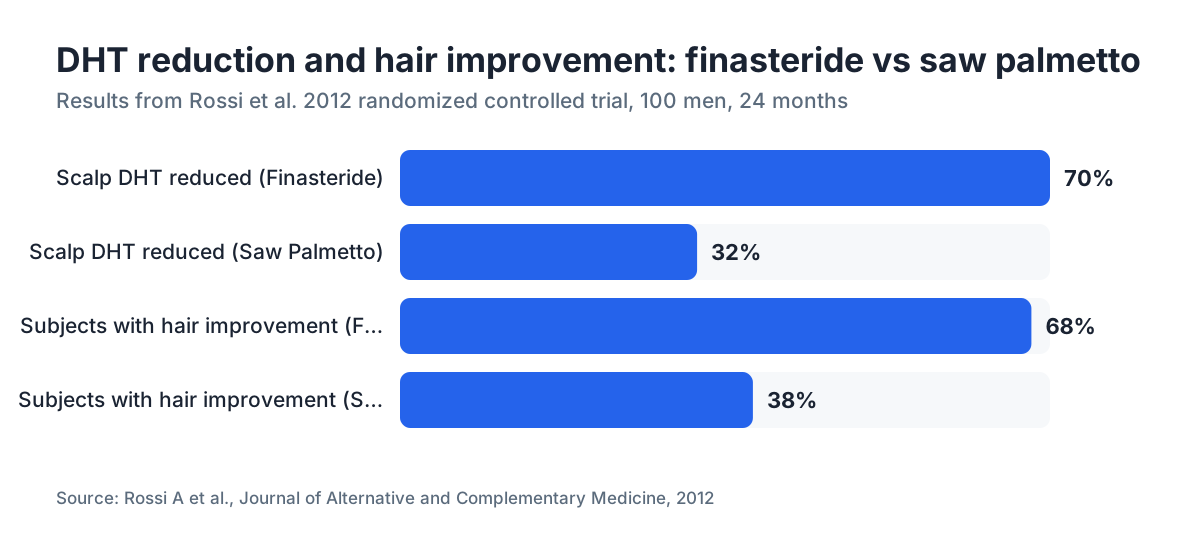
The most direct comparison comes from a 2012 randomized, double-blind trial by Rossi et al. published in the Journal of Alternative and Complementary Medicine. It enrolled 100 men with mild-to-moderate androgenetic alopecia and compared finasteride 1 mg/day versus saw palmetto 320 mg/day over 24 months. [7]
The results:
| Outcome | Finasteride 1 mg | Saw Palmetto 320 mg |
|---|---|---|
| Hair count improvement (% of subjects) | 68% | 38% |
| Improvement concentrated at | Crown and frontal | Mainly frontal only |
| Scalp DHT reduction (approximate) | ~70% | ~32% |
| Responder rate overall | Higher | Lower |
Finasteride produced roughly twice the rate of clinical improvement and more than twice the DHT suppression. Saw palmetto did outperform what you'd expect from a pure placebo, which means something, but the gap between the two is not subtle.
One honest caveat: this is a single trial with 100 subjects. It has not been replicated at scale. If you are making a treatment decision, that limitation matters.
Is saw palmetto better than a placebo for hair loss?
Probably yes, though the evidence base is thin. Beyond the Rossi 2012 trial, a small pilot study by Prager et al. (2002) in the Journal of Alternative and Complementary Medicine followed 26 men for five months. Those taking saw palmetto rated their hair as improved more often than the placebo group. [8]
That study was too small and too short to draw firm conclusions. There is no large, independent, FDA-reviewed trial for saw palmetto in androgenetic alopecia the way there is for finasteride. The supplement category does not require the same pre-market proof of efficacy that prescription drugs do, which is why saw palmetto can be sold for hair loss with limited clinical backing.
The American Academy of Dermatology does not list saw palmetto as a recommended treatment for androgenetic alopecia. [4] That absence tells you something.
What are the side effects of saw palmetto versus finasteride?
Finasteride's side effect profile is the main reason men look for alternatives. The FDA label lists sexual side effects including decreased libido, erectile dysfunction, and ejaculation disorder in a small percentage of users. Post-marketing reports include persistent sexual dysfunction after stopping the drug, which the FDA added as a warning in 2012. [2] Depression and breast tenderness have also been reported. The actual incidence rates are debated. The registration trials reported sexual side effects in roughly 3.8% of finasteride users versus 2.1% of placebo users.
Saw palmetto's side effect profile is much milder in the literature. The most commonly reported issues are gastrointestinal: nausea, diarrhea, and stomach discomfort, particularly when taken on an empty stomach. Headache and dizziness show up occasionally. Serious adverse events are rare, though case reports of hepatotoxicity and pancreatitis exist. [5]
For men who experienced or fear sexual side effects from finasteride, saw palmetto is genuinely lower risk. That's a real trade-off, more than marketing language. You give up much of the efficacy in exchange for much less risk of sexual side effects.
Saw palmetto may have weak anti-androgenic effects systemically, but clinical reports of sexual dysfunction from the herb are rare enough that they do not appear in product labeling.
Can you combine saw palmetto and finasteride?
In theory, combining a type-I inhibitor (saw palmetto's dominant action) with a type-II inhibitor (finasteride) could produce additive DHT suppression, similar to how dutasteride inhibits both type-I and type-II and achieves greater DHT reduction than finasteride alone. [1]
In practice, there is no published randomized controlled trial on the saw palmetto plus finasteride combination specifically for hair loss. Anyone claiming a proven synergistic effect is getting ahead of the data.
If you are already on finasteride and getting results, adding saw palmetto is unlikely to cause harm based on what we know, but the incremental benefit is unknown. If you are not getting results on finasteride, adding saw palmetto is not a validated next step. A conversation with a dermatologist about dose adjustments or adding minoxidil for men would be more evidence-based.
The combination of finasteride and minoxidil together has better evidence than either drug alone for androgenetic alopecia.
What form and dose of saw palmetto is used in hair loss research?
The Rossi 2012 trial and most other studies used 320 mg/day of lipido-sterolic extract of Serenoa repens, standardized to 85 to 95% fatty acids. This is also the dose studied for BPH and the one typically recommended on supplement labels. [7]
Saw palmetto is also available as a topical. A 2020 randomized trial published in the Journal of Cosmetic Dermatology compared topical saw palmetto serum to topical 5% minoxidil in 50 patients over 24 weeks. Both groups saw hair density increase. Minoxidil performed better, but topical saw palmetto did show statistically significant improvement over baseline. [9]
Topical application avoids systemic absorption concerns, which may appeal to people worried about systemic side effects. The trade-off is even less efficacy data than for oral saw palmetto.
Dose quality and standardization vary enormously between supplement brands. Finasteride delivers exactly 1 mg of active ingredient per tablet. A saw palmetto capsule from a random brand may contain far less active fatty acid than the label claims, because the supplement industry is not regulated for efficacy.
Does saw palmetto work for women with hair loss?
Women with androgenetic alopecia also have DHT sensitivity at the follicle level, so the theoretical mechanism applies. Finasteride is not FDA-approved for women and is contraindicated in pregnancy due to teratogenicity. [2] Saw palmetto is sometimes floated as a safer alternative for women, but the evidence is even thinner than for men.
There are no large randomized controlled trials of saw palmetto for female pattern hair loss. Case reports and small observational studies exist, but they do not establish efficacy. The AAD's guidelines for female pattern hair loss do not recommend saw palmetto. [4]
Women with hair loss are more likely to benefit from investigating underlying causes first. Telogen effluvium, thyroid issues, iron deficiency, and hormonal shifts from PCOS are all common contributors that saw palmetto does nothing for.
For women seeking a receding hairline solution or diffuse thinning, topical minoxidil remains the only FDA-approved topical drug, and it works through a completely different mechanism than DHT blockade.
Who might actually benefit from trying saw palmetto?
Saw palmetto is not worthless. It has a real, if modest, biological effect on DHT and a low side effect burden. A few situations make it worth considering.
First, men with early or very mild androgenetic alopecia who are not yet ready for a prescription drug. A modest DHT reduction might slow progression enough to matter at that stage, where the bar for meaningful impact is lower.
Second, men who tried finasteride, hit side effects, and stopped. They've lost the DHT suppression entirely. Saw palmetto restores some of it, even if not as much.
Third, as a topical, it's a reasonable ingredient in a multi-ingredient formulation where the risk is close to zero.
What saw palmetto is not: a replacement for finasteride in someone with Norwood III or higher who wants to meaningfully slow or reverse hair loss. The data does not support that use. And if you're considering a more permanent solution, a hair transplant is a different category entirely, addressing cosmetics rather than disease progression.
If you're unsure where you stand on the loss spectrum, an AI hair analysis tool like the free scan at MyHairline can help you map your current pattern against Norwood stages before deciding on a treatment path.
What does the evidence say about other natural DHT blockers compared to saw palmetto?
Pumpkin seed oil is probably the second-most studied natural 5-alpha reductase inhibitor for hair loss. A 2014 randomized, placebo-controlled trial published in Evidence-Based Complementary and Alternative Medicine found 400 mg/day of pumpkin seed oil increased hair count by 40% after 24 weeks in men with mild-to-moderate androgenetic alopecia. [10] That's a single trial, but the result was statistically significant.
Other herbs (stinging nettle, green tea EGCG, beta-sitosterol) show up in supplement blends marketed for hair, but clinical trial data is either absent or confined to in-vitro cell studies.
None of these come close to the clinical evidence base for finasteride. Comparing saw palmetto to other supplements is a different conversation than comparing it to finasteride, and conflating the two is a common marketing move.
For a broader look at what supplements have any real evidence behind them, see the hair loss supplements guide.
Should you talk to a doctor before starting saw palmetto?
Saw palmetto is sold over-the-counter and does not require a prescription, which gives people the impression it doesn't need medical oversight. That's not quite right.
Saw palmetto has documented interactions with blood thinners (warfarin and aspirin) due to its antiplatelet effects. Case reports of increased bleeding risk exist. [5] Anyone on anticoagulant therapy should not add saw palmetto without medical guidance.
Because saw palmetto has anti-androgenic properties, men who are concerned about fertility should be aware that DHT suppression in general can affect sperm parameters, though direct evidence for saw palmetto specifically is sparse.
And because it can affect PSA (prostate-specific antigen) levels, men getting PSA testing for prostate cancer screening should tell their doctor they are taking it. Saw palmetto may suppress PSA similarly to finasteride, which could mask a rising PSA that would otherwise prompt further investigation. [5]
A dermatologist or primary care physician can help you figure out whether saw palmetto alone, finasteride, or a combination approach makes the most sense for your specific hair loss pattern and health history. The MyHairline free AI scan is a useful first step to understand your pattern before that appointment.
Sources
- StatPearls (NCBI Bookshelf) - Androgenetic Alopecia
- Kaufman KD et al., Journal of the American Academy of Dermatology, 1998 - finasteride phase-III trial
- NIH National Center for Complementary and Integrative Health - Saw Palmetto
- Tacklind J et al., Cochrane Database of Systematic Reviews, 2012 - Serenoa repens for benign prostatic hyperplasia
- Rossi A et al., Journal of Alternative and Complementary Medicine, 2012 - finasteride vs saw palmetto RCT
- Prager N et al., Journal of Alternative and Complementary Medicine, 2002 - saw palmetto pilot study
- Wessagowit V et al., Journal of Cosmetic Dermatology, 2020 - topical saw palmetto vs minoxidil RCT
- Cho YH et al., Evidence-Based Complementary and Alternative Medicine, 2014 - pumpkin seed oil RCT