

TL;DR: Nicotine tightens the tiny blood vessels feeding your hair follicles, raises DHT, and creates oxidative stress that damages follicle DNA. Studies find smokers are roughly twice as likely to develop moderate to severe androgenetic alopecia, and the effect climbs with dose. Quitting won't regrow lost hair, but staying on nicotine almost certainly speeds up the loss.
What does nicotine actually do to your hair follicles?
Nicotine is a vasoconstrictor. It tightens blood vessels, including the tiny capillaries in the dermal papilla that feed oxygen and nutrients to each follicle. Keep those vessels squeezed for years and the follicles get starved. They don't die overnight. They shrink over time, pushing out thinner and thinner hairs until they produce nothing. That's the same miniaturization you see in androgenetic alopecia. [1]
Blood flow is only part of it. Nicotine also raises circulating dihydrotestosterone (DHT), the androgen most directly responsible for pattern hair loss. A 2020 study in Skin Pharmacology and Physiology reported higher 5-alpha reductase activity in smokers than non-smokers. That enzyme converts testosterone into DHT. [2]
Then there's oxidative stress. Cigarette smoke, the usual delivery vehicle for nicotine, throws off free radicals that damage follicle cell DNA and cut nitric oxide availability. Nitric oxide is what lets follicle vessels widen, so losing it stacks on top of the vasoconstriction problem. [3]
Patches and vapes deliver the exact same molecule. Smoking piles on extra oxidative damage from combustion, but the nicotine itself works against your follicles no matter how it gets in.
What does the research show about smoking and hair loss?
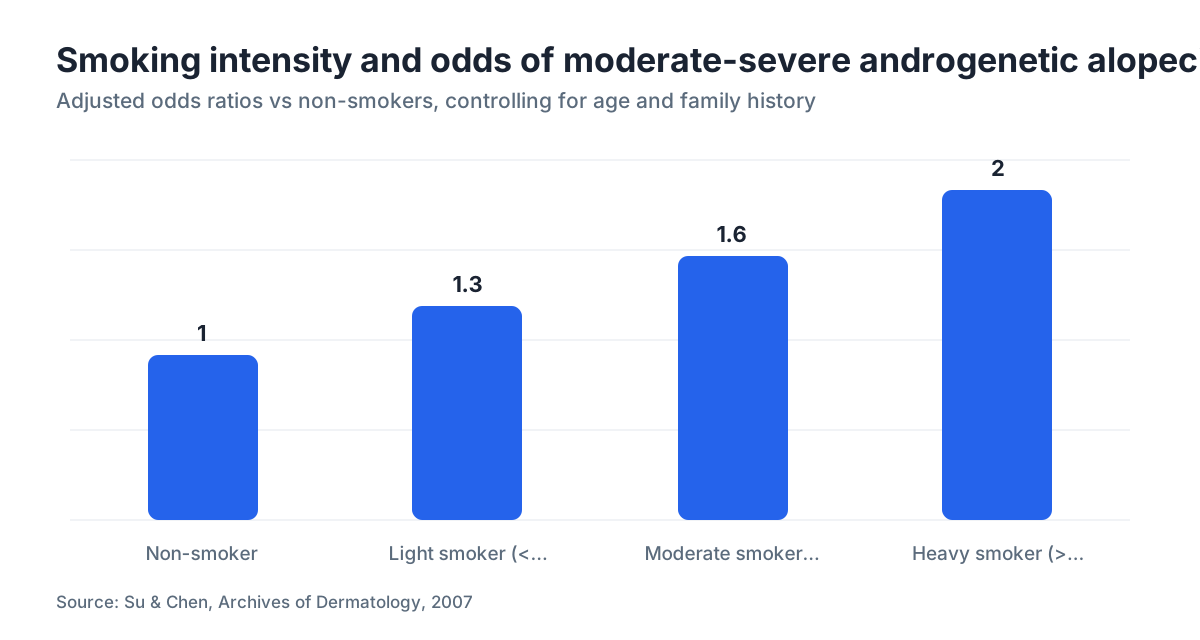
The best study on this followed 740 Taiwanese men and ran in the Archives of Dermatology in 2007. Researchers controlled for age, BMI, and family history, and found smokers were significantly more likely to have moderate to severe androgenetic alopecia than non-smokers. For heavy smokers (more than 20 cigarettes a day), the odds ratio for severe loss came out near 2.0. That's roughly double the risk after adjusting for genetics. [4]
A 2020 systematic review in the Journal of Cosmetic Dermatology pooled seven studies covering more than 1,000 people and called smoking an independent risk factor for androgenetic alopecia, separate from genetic predisposition. [5] "Independent" is the word that matters. The link holds even after you account for family history. You can carry zero genetic predisposition and still speed up loss by smoking.
Nobody has randomized trial data here, because you can't ethically assign people to smoke for decades. So the evidence is observational. The strongest hint that it's causal comes from that dose gradient in the Taiwanese data: heavier smokers scored consistently worse than light smokers. A clean dose-response signal is harder to explain away as coincidence.
For the full picture of what drives hair loss, see what causes hair loss.
| Smoking level | Adjusted odds ratio for moderate-severe AGA | Source |
|---|---|---|
| Non-smoker | 1.0 (reference) | Su et al., Arch Dermatol 2007 [4] |
| Light smoker (<10 cigs/day) | 1.3 | Su et al. [4] |
| Moderate smoker (10-20 cigs/day) | 1.6 | Su et al. [4] |
| Heavy smoker (>20 cigs/day) | ~2.0 | Su et al. [4] |
Does nicotine from vaping or patches also cause hair loss?
Probably yes, though the data on vaping and patches specifically is thin. It's the same molecule doing the same work. Nicotine patches produce measurable skin vasoconstriction and have been shown to cut dermal blood flow enough to slow wound healing. [6] That's the same mechanism that starves follicles.
Vaping drops the combustion byproducts, so some of the oxidative stress from cigarette smoke goes away. But the nicotine still constricts vessels and still nudges DHT metabolism. If smoking shows a dose-dependent effect, it's fair to expect any steady nicotine exposure to carry some proportional risk.
The honest answer is nobody has a well-powered study comparing hair loss rates across vapers, patch users, and non-users. Anyone telling you vaping is safe for your hair is guessing past the data. Anyone insisting it's exactly as bad as smoking is guessing too. The mechanistic case for harm from nicotine in any form is solid. The size of the effect from non-combustion sources isn't pinned down yet.
How much does quitting nicotine actually help your hair?
Here's the honest part. Quitting slows or stops the nicotine-specific damage, but it doesn't undo miniaturization that already happened. Follicles that permanently shrank from DHT sensitivity aren't coming back on their own. The smoking-driven acceleration stops. Regrowth just from quitting does not follow.
What quitting buys you is one less accelerant. If you're genetically set up for androgenetic alopecia, nicotine is fuel on a fire that was already lit. Cut the fuel and the fire doesn't go out, but it stops spreading as fast.
For most people, quitting is the floor, not the ceiling. If you care enough about hair loss to read this far, you probably want to pair quitting with a treatment that actually has evidence behind it. Minoxidil for men improves blood flow to follicles, which pushes directly against the vasoconstriction mechanism. Finasteride lowers DHT, which pushes against the elevated androgen problem. Running them together (finasteride and minoxidil) is the most studied combination in pattern hair loss, and it hits both pathways nicotine makes worse.
Can anemia cause hair loss?
Yes, and it happens more than people realize. Iron-deficiency anemia is one of the most common reversible causes of hair loss in women, and it slips past a lot of doctors because ferritin isn't always checked in a standard hair loss workup. [7]
The link is simple. Hair follicles are among the most metabolically busy structures in the body. They need iron to make hemoglobin, divide cells, and build keratin. When iron stores fall, the body sends oxygen to organs it can't live without and effectively demotes the follicle, shoving hairs into telogen (the resting phase). The result is telogen effluvium, a diffuse shed you usually notice as more hair in the drain or a general drop in volume.
A 2013 review in the Journal of the American Academy of Dermatology looked across multiple studies and concluded that iron deficiency, especially in premenopausal women, is tied to telogen effluvium and possibly to faster androgenetic alopecia progression. [8] The picture in men is murkier, but iron-depleted men can still shed diffusely.
The upside: iron-related hair loss is usually reversible once stores are rebuilt, though it takes months (typically 6 to 12) to see real regrowth after ferritin normalizes. Serum ferritin below 30 ng/mL is the threshold often cited for rising hair loss risk, and some dermatologists want to see ferritin above 70 ng/mL for hair to cycle well. [7]
Other deficiencies (B12, folate) can feed hair loss through the same route, impaired cell division in the follicle matrix. If you're shedding diffusely, a CBC with ferritin, B12, and folate is the sensible first round of bloodwork to ask for.
If you're trying to map several possible causes at once, a free AI analysis at MyHairline (/scan) can help you read your visible pattern before your dermatology appointment.
How do nicotine-related hair loss and anemia-related hair loss differ?
Worth separating, because the fixes have nothing in common.
Nicotine-related hair loss usually looks like sped-up androgenetic alopecia: a receding hairline, thinning at the crown, loss that tracks a Norwood pattern in men. See receding hairline for what that progression looks like. It's patterned, not diffuse, and it reflects follicle miniaturization driven by DHT and starved blood supply.
Anemia-related hair loss, specifically iron-deficiency telogen effluvium, is usually diffuse. You lose density everywhere instead of in a shape. The part widens across the whole scalp. The shed is noticeable and often starts two to four months after the iron ran low, because there's a lag between the trigger and the telogen shed.
You can have both at once, which muddies the diagnosis. Someone who smokes and has low ferritin is dealing with miniaturization and diffuse shedding at the same time. Get bloodwork and let a dermatologist read the pattern before you blame one cause.
| Feature | Nicotine-related AGA | Iron deficiency telogen effluvium |
|---|---|---|
| Pattern | Patterned (Norwood/Ludwig) | Diffuse, all-over thinning |
| Main mechanism | DHT elevation, vasoconstriction | Iron depletion, follicle pushed to telogen |
| Reversible by fixing cause? | Partially (slows progression) | Usually yes, over 6-12 months |
| Key test | Clinical pattern assessment | Serum ferritin, CBC |
| Most common in | Men, post-menopausal women | Premenopausal women, vegans |
Does nicotine affect DHT levels directly?
This is the part that surprises people. Most hair loss talk stops at genetics and DHT, but nicotine appears to turn up the enzyme (5-alpha reductase type 2) that makes DHT in the scalp. [2] So if you're already genetically sensitive to DHT, steady nicotine use adds more of the exact molecule driving your loss.
That's also why DHT blockers matter more, not less, if nicotine is one of your contributors. You've been running elevated DHT for however long you've used nicotine, so pulling it down pharmacologically with finasteride carries extra weight.
The interaction between nicotine-raised DHT and a genetic tendency toward androgenetic alopecia is multiplicative, more than additive. Your genes set the baseline sensitivity. Nicotine cranks up the DHT signal hitting those already-touchy follicles. The two problems feed each other.
What about nicotine and the hair growth cycle specifically?
Healthy hair moves through anagen (growth, usually 2 to 6 years), catagen (transition, a few weeks), and telogen (rest and shedding, about 3 months). You want long anagen and short telogen. Nicotine shortens anagen.
A 2003 in vitro study on human hair follicle organ cultures in the Journal of Investigative Dermatology found nicotine directly slowed hair shaft elongation and kicked follicles into catagen early. [9] This was cell-level work, not a clinical trial, so it can't tell you the exact size of the effect in a living person. But the mechanism it points to, nicotine acting straight on follicle cells to push them out of growth, lines up with the epidemiology.
The practical read: even before nicotine kills a follicle outright, it's probably shrinking the fraction of your follicles growing at any moment. Fewer growing follicles means thinner-looking hair well before permanent miniaturization arrives.
What treatments make sense if nicotine has been a factor in your hair loss?
Step one is stopping nicotine. That's not optional if you want any treatment working at full strength. Minoxidil raises blood flow to follicles, and nicotine spends all day fighting that same mechanism. You can take minoxidil and keep smoking and still see some benefit, but you're working against yourself.
Past quitting, the evidence-based options are the same ones used for androgenetic alopecia in general. Minoxidil (topical or oral minoxidil) improves follicle perfusion and can stretch out anagen. Finasteride lowers DHT. For severe or long-standing loss, a hair transplant can rebuild density where follicles are gone for good.
For telogen effluvium from anemia or iron deficiency, the fix is the deficiency itself, with iron or B12 correction under medical supervision. Supplements with iron, biotin, or other micronutrients can help in a true deficiency, though most hair loss supplements are oversold for people whose nutrition is already fine.
If you've smoked and you have a family history of hair loss, see a dermatologist sooner rather than later. Androgenetic alopecia is far easier to slow than to reverse, and the window closes as follicles miniaturize for good.
There's no version of this where continuing nicotine works with keeping your hair. That's not a moral lecture. It's just what the mechanism shows.
Are some people more vulnerable to nicotine-related hair loss than others?
Yes. Genetics is the clearest modifier. If first-degree relatives have significant androgenetic alopecia, your follicles are already more sensitive to DHT. Nicotine raises DHT and chokes blood flow to follicles that are already teetering. The effect compounds.
Age matters too. Younger people may have more follicular reserve, but years of nicotine eventually show up. The Taiwanese study found the smoking-hair loss link was strongest in men over 40, which likely reflects accumulated damage rather than sudden sensitivity. [4]
Hormonal status counts for women. Premenopausal women get some estrogen-driven protection for their follicles. After menopause, that protection fades, and any DHT bump from nicotine hits harder.
Then there's the iron angle. Some smokers eat poorly, which can add iron deficiency on top of the nicotine effects. Low ferritin plus active nicotine use means two separate drivers of hair loss running at once. Sorting out which does more damage needs a proper workup.
If you want to read your current pattern before deciding what to do, MyHairline's free AI scan (/scan) gives you a starting point based on your visible hairline and density.
Sources
- American Academy of Dermatology, Hair loss overview
- Skin Pharmacology and Physiology, 2020, on 5-alpha reductase activity and smoking
- Journal of Investigative Dermatology, Trüeb RM, 2003, Oxidative stress and hair loss
- Archives of Dermatology, Su LH & Chen TH, 2007, Association between androgenetic alopecia and smoking
- Journal of Cosmetic Dermatology, 2020, systematic review on smoking and androgenetic alopecia
- Nicotine & Tobacco Research, Oxford Academic, skin vasoconstriction from nicotine patches
- Journal of the American Academy of Dermatology, Trost LB et al., 2006, The diagnosis and treatment of iron deficiency and its potential relationship to hair loss
- Journal of the American Academy of Dermatology, 2013 review on iron deficiency and hair loss
- Journal of Investigative Dermatology, Philpott et al., 2003, nicotine effects on human hair follicle organ cultures
- National Institute on Drug Abuse (NIH), Tobacco, Nicotine, and E-Cigarettes
- Centers for Disease Control and Prevention, Smoking and Tobacco Use
- MedlinePlus, U.S. National Library of Medicine, Iron deficiency anemia