TL;DR: Minoxidil works through hair follicles, not skin pigmentation, so your skin tone is not a meaningful predictor of whether it works for you. What actually predicts response is how long you've been losing hair, how much follicle activity remains, and whether you convert minoxidil to its active form efficiently. The research on race and ethnicity shows mixed, modest differences that mostly trace back to hair loss pattern, not skin color.
Why people wonder if skin color affects minoxidil results
It's a fair question, and it comes up a lot. You've probably noticed that nearly every clinical trial photo showing minoxidil results uses a white male subject with androgenetic alopecia. That visual gap, combined with the fact that hair loss can look and behave differently across ethnicities, leads people to assume the drug itself might work differently depending on skin tone.
The short answer: it doesn't, not in any direct way. Minoxidil doesn't interact with melanin. It isn't absorbed or metabolized differently based on skin pigmentation. The drug's mechanism runs deeper than the skin surface, inside the hair follicle itself, where pigmentation is essentially irrelevant.
That said, there are real differences in how hair loss presents across ethnic groups, and those differences do influence how well any treatment works. So the longer, more honest answer requires separating skin color from ethnicity from hair loss pattern, because conflating them is where the confusion starts.
How does minoxidil actually work in the follicle?
Minoxidil was originally a blood pressure medication [1]. The hair regrowth effect was noticed as a side effect in the 1980s and eventually led to the topical formulation approved by the FDA in 1988 for men and 1991 for women [1].
The drug is a prodrug, meaning it doesn't do much in its original form. Once it reaches the scalp, an enzyme called sulfotransferase converts it to minoxidil sulfate, which is the active molecule. That sulfated form opens potassium channels in the smooth muscle cells around hair follicles, increasing blood flow and nutrient delivery to the follicle. It also appears to prolong the anagen (growth) phase and shorten the telogen (resting) phase, pushing more follicles into active growth [2].
None of that process depends on how much melanin is in your skin. The sulfotransferase enzyme doesn't care about pigmentation. The potassium channels don't care. This is why dermatologists across skin types prescribe the same formulation at the same doses without adjusting for skin tone.
What does vary by person is the amount of sulfotransferase enzyme activity in their scalp. Some people have high activity, convert minoxidil efficiently, and are strong responders. Others have low activity and see little benefit regardless of their skin color [2]. This enzyme variation is one of the biggest unsolved problems in predicting individual response to the drug.
What does the clinical research show about skin tone or ethnicity and minoxidil response?
Here's where honesty requires some nuance. The major registration trials for minoxidil, the ones that got it FDA-approved, enrolled predominantly white men [1]. That's a real limitation of the historical evidence base.
More recent research has tried to fill the gap. A 2020 review in the Journal of the American Academy of Dermatology examined hair loss and treatment responses across ethnic groups, noting that "the pathophysiology of androgenetic alopecia appears similar across ethnicities, though presentation and prevalence differ" [3]. The same review observed that Black patients are more likely to present with traction alopecia and central centrifugal cicatricial alopecia (CCCA) rather than classic androgenetic alopecia, which means comparing treatment outcomes across ethnic groups is often comparing different diagnoses, not the same diagnosis in different skin types.
For androgenetic alopecia specifically, the limited comparative data shows no consistent evidence that minoxidil performs better or worse based on skin tone when the hair loss type and stage are held constant [3][4]. A study of Asian populations found response rates broadly comparable to those in Western trials, though the authors noted that differences in hair density and follicle geometry may affect how studies measure "hair count" outcomes [4].
The most honest summary: the research is underpowered to make strong claims here. The differences that do appear in published literature mostly trace back to hair loss type, stage, and duration, not skin color.
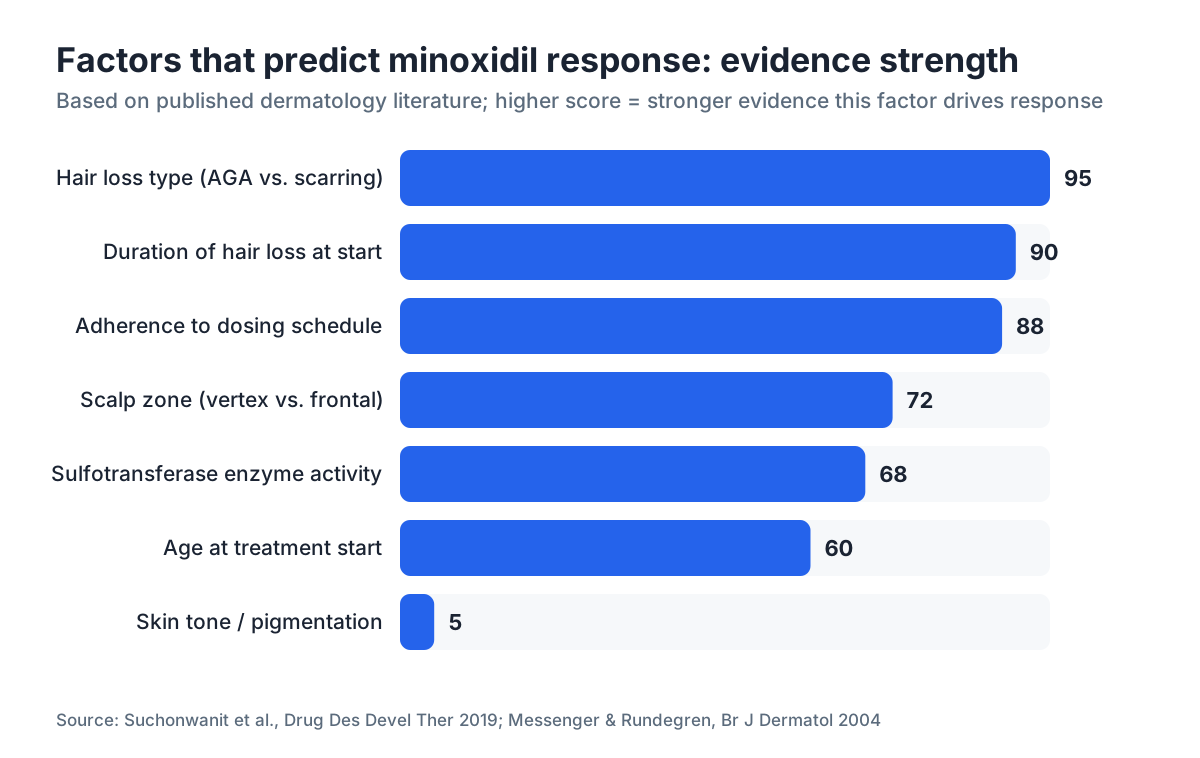
See the comparison table below for a breakdown of key factors that do predict response.
Do different ethnicities experience hair loss differently, and does that change the math?
Yes, and this is the piece that actually matters clinically.
Androgenetic alopecia (male and female pattern hair loss) affects different ethnic groups at different rates. Population studies suggest it affects roughly 50% of white men over 50, compared to lower rates in some Asian and Black populations, though good longitudinal data across all groups is limited [3]. What's less studied is whether that lower incidence reflects genuine biological protection or underdiagnosis driven by differences in healthcare access and research representation.
Black women in particular carry a disproportionate burden of traction alopecia and CCCA, both of which are mechanically or inflammatorily driven forms of hair loss that respond poorly to minoxidil because the follicles are often scarred [3]. This part matters: if you apply minoxidil to scarred follicles, you're not going to see regrowth. That's not a failure of minoxidil in darker skin types. That's a failure to match the right treatment to the right diagnosis.
East Asian hair tends to have a larger follicle cross-section and is often straighter and coarser, which affects how thinning appears visually but doesn't change the biology of minoxidil's action [4].
For people of South Asian descent, data is particularly sparse. Androgenetic alopecia rates appear high in some South Asian populations but large controlled treatment trials are lacking.
The takeaway is that the right question isn't "does my skin tone affect whether minoxidil works" but rather "do I have the type and stage of hair loss that minoxidil is proven to treat." A correct diagnosis matters more than any demographic factor.
If you're uncertain about your hair loss pattern, what causes hair loss has a solid breakdown of the main diagnoses.
Does scalp skin thickness or structure differ across skin types in ways that affect absorption?
Some researchers have noted structural differences in skin across ethnic groups, including differences in stratum corneum thickness, lipid content, and transepidermal water loss [5]. A study in the Journal of the American Academy of Dermatology measured stratum corneum layers and found some variation, but concluded that these differences were not clinically significant for drug penetration in most dermatological treatments [5].
For topical minoxidil specifically, no study has shown that these structural skin differences translate into meaningfully different scalp absorption rates. The formulation, whether 2% or 5% solution or 5% foam, is designed to penetrate into hair follicles, and follicular penetration is driven more by the vehicle (the liquid or foam carrying the drug) than by baseline skin structure [1][2].
Skin sensitivity and tolerability can vary. Some studies note that irritant contact dermatitis from topical minoxidil's propylene glycol vehicle appears at similar rates across skin types, though darker skin tones may show post-inflammatory hyperpigmentation as a secondary reaction to irritation [6]. The foam formulation avoids propylene glycol and may be better tolerated if you experience irritation from the solution.
If scalp irritation or minoxidil side effects are a concern, the foam tends to cause less contact dermatitis than the solution regardless of skin tone.
What actually predicts how well minoxidil will work for you?
The dermatology literature points to the same short list of predictors, and skin tone isn't on it.
First, duration of hair loss. Minoxidil works best on follicles that are miniaturizing but still alive. The longer hair loss has been progressing without treatment, the more likely follicles have fully atrophied. Starting early matters. A lot.
Second, area of loss. The FDA approved 2% solution specifically for the vertex (crown) in both men and women, and later approved the 5% formulation primarily studied at the vertex and anterior mid-scalp. Frontal hairline recession has historically shown weaker response [1]. This isn't a skin-tone issue; it appears to reflect differences in follicle density and androgen sensitivity across scalp zones.
Third, sulfotransferase activity. As mentioned above, your enzyme expression determines how much active minoxidil sulfate you actually produce. Testing for scalp sulfotransferase activity has been proposed as a way to predict response, but it's not yet routine clinical practice [2].
Fourth, underlying cause of hair loss. Minoxidil is FDA-approved for androgenetic alopecia. Using it on traction alopecia, CCCA, or scarring alopecias is off-label and often ineffective once scarring has set in.
Fifth, adherence. Minoxidil requires twice-daily application (for solution) or once-daily (for foam, per many protocols) and continuous use. Stopping leads to loss of any gained hair within months. This is non-negotiable.
For men dealing with pattern hair loss, minoxidil for men goes deeper on dosing and realistic expectations.
Is there evidence that Black patients respond differently to minoxidil?
This is probably the most common version of the skin-tone question, and the honest answer is: we don't have enough well-controlled data to say definitively.
The existing evidence for Black patients with androgenetic alopecia suggests similar mechanisms and similar response ranges to those seen in white patients when diagnosis and staging are matched. However, because Black patients are more likely to be diagnosed with traction alopecia or CCCA than classic androgenetic alopecia, population-level treatment outcomes can look different for statistical, not biological, reasons [3].
For CCCA specifically, some dermatologists do use minoxidil as part of a multi-drug approach to preserve remaining follicles and stimulate whatever growth is still possible, but expectations are lower than for androgenetic alopecia and the evidence base is mostly case series and expert consensus rather than controlled trials [3][6].
Traction alopecia, if caught early before fibrosis sets in, may respond to minoxidil alongside the essential step of removing the traction source. Late-stage traction alopecia with significant scarring typically does not respond.
The American Academy of Dermatology's guidelines acknowledge the underrepresentation of Black and other non-white patients in hair loss trials and call for more inclusive research [3].
What about Asian and Hispanic patients, is there any specific data?
For East and Southeast Asian patients, a handful of trials have been conducted. A study of Korean men with androgenetic alopecia showed that 5% topical minoxidil produced statistically significant increases in hair count and thickness at 16 weeks compared to placebo, with a response profile described by the authors as consistent with results from Western trials [4]. The researchers noted that East Asian hair's larger follicular caliber may make percentage changes in count look smaller even when the biological response is comparable.
For South Asian patients, rigorous controlled trial data is sparse. The published case series and small cohort studies suggest similar clinical behavior to androgenetic alopecia in other populations, but this is an area where more research is genuinely needed.
For Hispanic patients, essentially no ethnic-specific minoxidil trial data exists in the major literature I'm aware of. Clinicians treating this population generally extrapolate from the broader evidence base.
The absence of data isn't evidence that minoxidil works poorly in these groups. It reflects historic underinvestment in research diversity.
Does oral minoxidil change this picture at all?
Oral minoxidil, typically used off-label at low doses of 0.625 to 5 mg daily, bypasses the scalp absorption question entirely by delivering minoxidil systemically [7]. This has led some dermatologists to suggest it might be a more equitable option for patients where topical penetration is a theoretical concern, though again, no controlled evidence shows topical absorption varies meaningfully by skin type.
The clinical evidence for oral minoxidil at low doses in hair loss has grown fast since roughly 2019. A 2020 study in the Journal of the American Academy of Dermatology followed 1,404 patients on low-dose oral minoxidil for various hair loss types and found it effective across diverse patient demographics, though the study wasn't designed to isolate outcomes by ethnicity or skin tone [7].
Side effects are the bigger concern with oral dosing. Unwanted facial hair growth (hypertrichosis) is common, fluid retention is possible, and there are cardiovascular considerations at higher doses. These side effects don't appear to be more or less common by skin tone, but hypertrichosis can be more cosmetically concerning depending on hair color and baseline facial hair patterns.
If oral minoxidil interests you, that decision belongs in a conversation with a dermatologist, not a DIY choice.
Should treatment approach differ by ethnicity even if the drug itself doesn't?
Yes, and this is where nuance actually turns into practical advice.
The diagnosis step matters more when you account for ethnic variation in hair loss types. A Black woman with diffuse thinning should have CCCA ruled out before starting minoxidil, because CCCA requires anti-inflammatory treatment (sometimes topical steroids, doxycycline, or hydroxychloroquine) alongside or instead of minoxidil [3][6]. Starting minoxidil alone on undiagnosed CCCA may delay the right treatment.
A man of any background with a receding frontal hairline should understand that minoxidil's evidence is strongest at the crown and that finasteride or the combination of finasteride and minoxidil has better evidence for frontal recession in androgenetic alopecia. Finasteride also may have variable response related to androgen receptor genetics, not skin tone.
For traction alopecia at any stage, the mechanical cause must be addressed before any drug will produce meaningful results.
Scalp biopsy is underused across all ethnic groups. If your diagnosis is uncertain, a biopsy is often the fastest path to the right treatment plan.
If you want an objective starting read on your hair loss pattern before seeing a dermatologist, a tool like the free AI hair analysis at MyHairline can at least orient you on pattern and severity so you walk into the appointment better prepared.
For context on the full range of options if minoxidil isn't enough, hair transplant information is worth reviewing.
What does the FDA label actually say about skin type?
Nothing. The FDA-approved labeling for topical minoxidil (the original Rogaine-type products) makes no reference to skin tone, ethnicity, or race as factors affecting efficacy or safety [1]. The approved indication is androgenetic alopecia in adults, with the standard warnings about cardiovascular conditions and scalp irritation applying across all patients.
The FDA label does specify the approved use zones (vertex scalp) and notes that results are not guaranteed, that individual response varies, and that hair loss returns after stopping treatment [1]. These qualifications apply regardless of demographic.
The agency's guidance on minoxidil hasn't been updated to add ethnicity-specific dosing or efficacy data because no such data has been submitted or reviewed in the form needed to support a label change.
Summary table: what predicts minoxidil response versus what doesn't
Here's a direct comparison of factors by evidence level:
| Factor | Evidence that it predicts response | Direction |
|---|---|---|
| Duration of hair loss | Strong | Earlier = better response |
| Hair loss type (AGA vs. scarring) | Strong | AGA responds; scarring alopecias often don't |
| Scalp zone (vertex vs. frontal) | Moderate | Vertex has stronger evidence |
| Sulfotransferase enzyme activity | Moderate | Higher activity = better response |
| Skin tone / pigmentation | None found | Not a meaningful factor |
| Ethnicity (as proxy for diagnosis type) | Moderate, indirect | Matters because of diagnosis mix, not biology |
| Age at start of treatment | Moderate | Younger with active follicles = better |
| Adherence and dosing consistency | Strong | Non-adherence causes treatment failure |
For people wondering whether their skin tone is the reason minoxidil hasn't worked for them, the table above is the honest answer. Skin tone isn't in the evidence as a predictor. The other factors are.
If you're a woman dealing with diffuse thinning, telogen effluvium is worth understanding because it can mimic androgenetic alopecia and responds differently to treatment.
Sources
- FDA, Minoxidil Topical Solution Prescribing Information (original NDA basis / OTC label)
- Messenger AG, Rundegren J. Minoxidil: mechanisms of action on hair growth. British Journal of Dermatology. 2004;150(2):186-194.
- American Academy of Dermatology, Hair Loss in Women of Color guidelines and review
- Kang H, et al. Efficacy and safety of a new 5% minoxidil formulation in male androgenetic alopecia: a randomized, double-blind, placebo-controlled study. Ann Dermatol. 2007;19(2):43-50.
- Berardesca E, Maibach H. Racial differences in skin pathophysiology. J Am Acad Dermatol. 1996;34(4):667-672.
- Lawson CN, et al. Updates in the understanding and treatments of skin and hair disorders in women of color. Int J Womens Dermatol. 2017;3(1 Suppl):S21-S37.
- Randolph M, Tosti A. Oral minoxidil treatment for hair loss: A review of efficacy and safety. J Am Acad Dermatol. 2021;84(3):737-746.
- Blume-Peytavi U, et al. S1 guideline for diagnostic evaluation in androgenetic alopecia in men, women and adolescents. Br J Dermatol. 2011;164(1):5-15.
- Suchonwanit P, Thammarucha S, Leerunyakul K. Minoxidil and its use in hair disorders: a review. Drug Des Devel Ther. 2019;13:2777-2786.
- Olsen EA, et al. A randomized clinical trial of 5% topical minoxidil versus 2% topical minoxidil and placebo in the treatment of androgenetic alopecia in men. J Am Acad Dermatol. 2002;47(3):377-385.