TL;DR: Minoxidil does not cause pharmacological tolerance the way people fear. Studies following users for 5 years show it keeps working for most people. What looks like minoxidil wearing off is almost always underlying hair loss continuing to advance, a shedding phase, or inconsistent use. Stopping is the one guaranteed way to lose what you gained.
What does 'minoxidil stops working' actually mean?
Minoxidil rarely stops working. Your hair loss just keeps moving. People describe the same experience in a few different ways: good regrowth in year one, then thinning again somewhere in year two, three, or four. The conclusion most of them reach is that their body built up a tolerance. That conclusion is almost always wrong.
Minoxidil is a potassium channel opener. It widens blood vessels and extends the anagen (growth) phase of the hair follicle. There is no known receptor downregulation or enzyme induction that would make the drug progressively weaker with repeated exposure. True pharmacological tolerance, where the body neutralizes a drug's mechanism over time, has not been demonstrated for minoxidil in any peer-reviewed trial.[9]
Here is what actually happens. Hair loss is a moving target. Androgenetic alopecia, the type behind the vast majority of minoxidil use, is a progressive condition driven by dihydrotestosterone (DHT). Minoxidil does not block DHT at all. It buys time, often years of it, but it cannot stop follicle miniaturization. If your hair loss is advancing faster than minoxidil can compensate, the net result looks exactly like the drug quit. It did not. The disease outpaced the treatment.
Understanding that distinction matters before you spend money on anything else. See what causes hair loss for the full picture on DHT and follicle miniaturization.
What does the long-term evidence actually show?
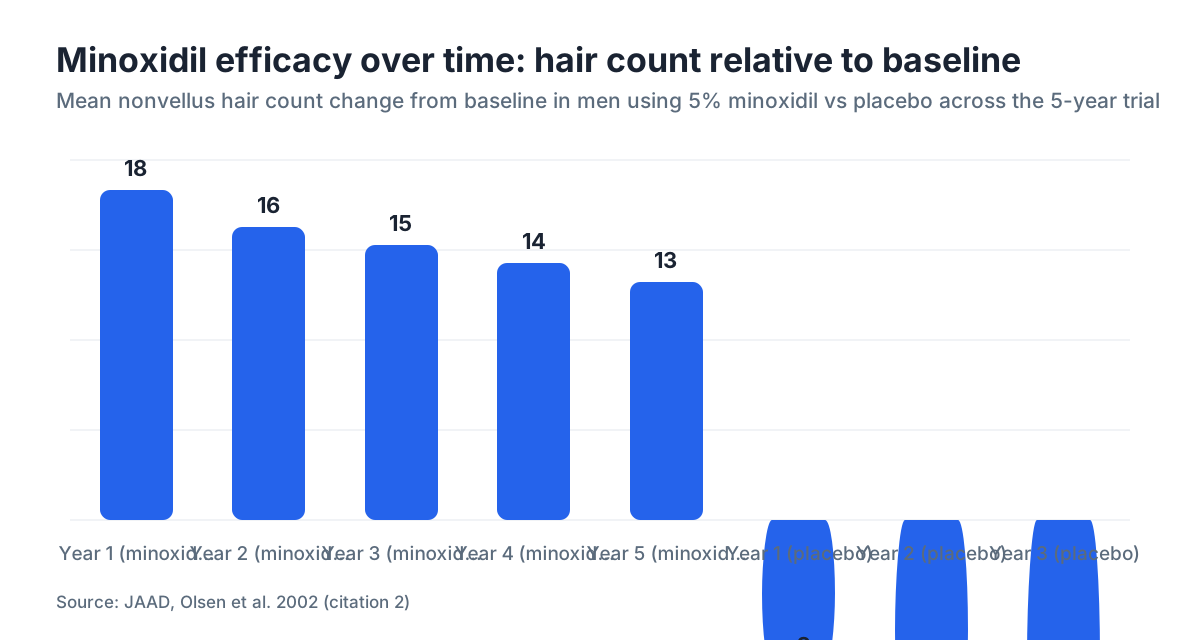
The best long-term data says minoxidil keeps working for years, not months. The most-cited study on topical minoxidil is a 5-year multicenter trial published in the Journal of the American Academy of Dermatology. Researchers followed men using 5% topical minoxidil and found the hair count gains from the first year were largely held at the 5-year mark, with no sign of the drug losing efficacy over time.[2] The reported finding was that minoxidil 5% solution promoted hair growth and maintained that growth across the full observation window.
A separate look at the original FDA approval trials for 2% minoxidil, which ran across multiple years, showed the same pattern: peak response in the first 12 months, a plateau of gains rather than a reversal, and no evidence of tachyphylaxis (the medical term for rapid tolerance).[1]
Where the data thins out: most controlled trials stop at five years because keeping people enrolled is expensive and hard. So the honest answer for year 7 or year 10 is that we have less rigorous data, and nobody should pretend otherwise. Reports from online communities suggest some people notice a gradual drop in efficacy after many years, but separating that from normal disease progression is nearly impossible without a controlled comparison group, which those communities do not have.
Why does minoxidil seem to work better in year one than year five?
Year one is genuinely the best year, and the reason is simple. When you start minoxidil, you rescue follicles that were miniaturized or dormant. Those follicles were underperforming, so bringing them back reads as a big, visible improvement. That gain is real and measurable.
By year five, you have already cashed in that initial recovery. The follicles that could be rescued have been rescued. Any new loss from advancing androgenetic alopecia shows up as a net decline even though minoxidil is doing exactly what it always did. The drug is working. The disease is working too.
This is why dermatologists keep saying to start minoxidil early. The less miniaturization has already happened, the more there is to recover, and the more dramatic the first-year response. Starting at a Norwood 2 gives you a very different trajectory than starting at a Norwood 5. For how this fits into overall treatment strategy for men, see minoxidil for men.
Could it be a shedding phase making it look like minoxidil stopped working?
Yes, and this catches a lot of people off guard. Minoxidil can trigger a telogen effluvium, where existing resting hairs get pushed out to make room for a new growth cycle. That shed usually happens in the first 2 to 8 weeks of use. Some people get a second shed later, especially if they stop and restart the medication after a gap.[3]
Say you took a break from minoxidil for a few weeks or months, then resumed. What looks like tolerance is often a restart shed. The follicles you had maintained are cycling out. This shed is temporary, usually clearing within 3 to 6 months, but it is alarming if you do not see it coming. See telogen effluvium for how this shedding works and how long it lasts.
Consistent daily use, with no gaps, is one of the biggest variables in how well minoxidil holds up over time. Missing doses regularly is a common reason results plateau or seem to reverse.
Are there any real reasons minoxidil's effect might diminish over time?
A few real mechanisms are worth being honest about.
Minoxidil's active form in the scalp is minoxidil sulfate, created when an enzyme called sulfotransferase (SULT1A1) converts the drug after you apply it. Some people have naturally lower SULT1A1 activity in their scalp, so they convert less minoxidil into its active form. These are the people sometimes called non-responders or poor converters.[4] Whether that enzyme activity shifts over years of use is not well studied. There is no strong published evidence that it does, but it is a theoretical pathway worth knowing about.
Follicle exhaustion is real, but it is not minoxidil tolerance. A follicle miniaturized enough by years of DHT exposure eventually hits a point where no topical treatment can revive it. Once the follicle structure itself is gone, minoxidil has nothing to work with. This is why some dermatologists pair minoxidil with a DHT blocker like finasteride early, instead of waiting until significant miniaturization has already set in.
Formulation and technique matter more than most people expect. Switch products, change how much you apply, or start washing your hair more often right after application, and the effective dose reaching your scalp can drop. Check that before you conclude you have developed tolerance.
Does oral minoxidil have the same tolerance issue?
Oral minoxidil skips the scalp enzyme conversion step entirely. It absorbs systemically and circulates in blood plasma, which is why the effective doses run much lower (0.625 mg to 2.5 mg daily for hair loss, versus the 10 mg or more it was originally approved for as a blood pressure drug). Because it does not depend on local SULT1A1 activity, it can work better for people who respond poorly to the topical.[5]
There is no published evidence that oral minoxidil causes tolerance either. The cardiovascular literature on minoxidil going back to the 1970s shows no pharmacological tolerance to its blood-vessel-widening effect. Hair-specific long-term data on oral use is thinner, since low-dose oral for hair loss is a newer off-label practice, but the mechanistic case for tolerance still is not there.
For whether switching to the pill makes sense for you, see oral minoxidil.
What happens to your hair if you stop minoxidil after years of use?
You lose the hair you gained, typically within 3 to 6 months of stopping. The answer is consistent across multiple studies.[1][2]
Minoxidil does not cure anything. It is maintenance. The follicles it supports stay supported only as long as you use it. Stop, and they return to the state your androgenetic alopecia would have put them in had you never started. Sometimes the rapid loss of previously maintained hair looks worse than if you had never used minoxidil, though you are not actually worse off once you count the years of hair you preserved.
The long-term commitment is something to understand clearly before you start. It is not a reason to avoid minoxidil. It is a reason to have a plan. If you already suspect you will not want to apply a topical for decades, oral minoxidil or a combination with finasteride may be a more sustainable route.
Should you combine minoxidil with finasteride if results are slipping?
If you have been on minoxidil alone for several years, used it consistently, and your hair loss is visibly advancing anyway, the most evidence-backed move is adding a DHT blocker, not assuming minoxidil has failed.
Finasteride reduces scalp and serum DHT by roughly 60 to 70 percent at 1 mg daily.[6] That hits the cause of androgenetic alopecia, which minoxidil never touches. Several trials show the combination of finasteride and topical minoxidil beats either drug alone for both hair count and patient-reported satisfaction.[7] See finasteride and minoxidil for the full breakdown of the combined approach.
The American Academy of Dermatology guidelines list both minoxidil and finasteride as first-line options for androgenetic alopecia in men, and note their mechanisms complement each other.[8] If you have been using only one, adding the other is a more rational move than switching or stopping.
To see where your hair loss currently stands before changing anything, MyHairline's free AI hair scan (/scan) gives you a Norwood stage estimate and a starting point for the conversation with your dermatologist.
How do you tell if you are actually a minoxidil non-responder?
Genuine non-response is rarer than people assume, and you usually can only confirm it in hindsight, after 12 full months of consistent daily use. The AAD recommends giving any hair loss treatment at least 12 months before calling it a failure.[8] Most people who write off minoxidil at 3 or 4 months have not reached the full response window.
Signs that point to true non-response rather than tolerance or a slow start: no shedding at all in the first 6 to 8 weeks (shedding actually signals the follicles are reacting to the drug), no visible change in hair density or caliber after 12 months of consistent daily use, and no objective change on photos taken under the same lighting.
If you meet those criteria, SULT1A1 enzyme testing is commercially available, though it is not standard practice yet and dermatologists debate how much the result actually tells you. Switching to oral minoxidil is the more common practical answer to suspected poor conversion. If oral minoxidil also fails after 12 months, you are in a much smaller group, and a consultation with a board-certified dermatologist or hair restoration surgeon is the right next step.
What is the most common mistake people make that looks like tolerance?
Inconsistent use. Full stop.
Minoxidil needs twice-daily application (or once daily for some formulations, per the label) every single day. Miss several applications a week over months, and the effective maintenance dose drops hard. Hair loss does not take days off. When people look back honestly at years two and three, many admit they were applying it far less reliably than in year one, when it was still new and exciting.
A second common mistake is expecting minoxidil to keep producing new gains forever. It does not work that way. Peak visible improvement usually lands in months 9 to 18. After that, maintenance is the realistic goal, not continued growth. Comparing your current hair to the peak of year one and calling it a failure misreads how the drug behaves long-term.
Want to see how your hair has actually changed? A side-by-side of reference photos under standardized lighting beats memory every time. Minoxidil side effects covers other variables that affect how your scalp and hair respond.
When should you consider a hair transplant instead?
Minoxidil and finasteride are maintenance treatments. They preserve what you have and, in good responders, partly recover what you lost. They cannot restore areas where follicles have been completely gone for years. That is where a hair transplant becomes the relevant conversation.
Most hair restoration surgeons want you to stabilize your loss with medication for at least 12 months before a transplant. Transplant into an actively progressing pattern and you may lose native hair around the grafts and need more surgery later. Minoxidil and finasteride are usually continued after a transplant to protect the remaining native hair.
If minoxidil and finasteride together are genuinely not holding the line after 18 to 24 months of consistent use, and your loss is at a Norwood 4 or higher, book a consultation with a board-certified hair restoration surgeon. You are not giving up on the medication. You are adding a tool it was never able to provide.
Sources
- FDA, Minoxidil Topical Solution 2% and 5% label (DailyMed)
- Journal of the American Academy of Dermatology, Olsen et al. 2002, 5-year minoxidil 5% trial
- American Academy of Dermatology, Hair Loss: Diagnosis and Treatment
- Journal of Investigative Dermatology, Buhl et al. 1990, sulfotransferase activity and minoxidil response
- JAAD, Randolph and Tosti 2021, oral minoxidil for hair disorders review
- New England Journal of Medicine, Kaufman et al. 1998, finasteride 1 mg for male androgenetic alopecia
- Journal of Dermatological Treatment, Hu et al. 2015, combination finasteride and minoxidil meta-analysis
- American Academy of Dermatology, Clinical Guidelines for Androgenetic Alopecia
- Clinical, Cosmetic and Investigational Dermatology, Suchonwanit et al. 2019, minoxidil mechanisms review
- Journal of the American Academy of Dermatology, Price et al. 1999, 5% vs 2% minoxidil head-to-head trial