TL;DR: Minoxidil forces resting hair follicles into an active growth phase, which first pushes out old telogen hairs before new ones come in. This shedding typically starts within 2 to 6 weeks of beginning treatment, peaks around weeks 6 to 8, and resolves on its own within 3 to 4 months. It's a sign the drug is working, not a reason to stop.
What is minoxidil shedding and is it actually real?
Yes, it's real, and it catches almost everyone off guard. You start using minoxidil hoping to keep your hair, and within a few weeks more hair than usual is coming out in the shower or on your pillow. It feels like the treatment is making things worse.
It isn't.
Minoxidil shedding, sometimes called a "dread shed," is a documented side effect tied to how the drug actually works. The FDA-approved labeling for minoxidil 2% and 5% topical solutions notes increased hair shedding as an expected early experience for some users [1]. It's not an allergic reaction. It's not the drug failing. It's the drug doing exactly what it's supposed to do, just with an unpleasant middle chapter.
The phenomenon is closely related to telogen effluvium, the broader category of diffuse shedding triggered by a shock or shift in the hair growth cycle. In both cases, follicles that were quietly resting get pushed into action before you see the benefit.
Why does minoxidil cause shedding in the first place?
Hair follicles don't all do the same thing at the same time. They cycle through three main phases: anagen (active growth, lasting 2 to 7 years), catagen (a brief 2 to 3 week transition), and telogen (a resting phase lasting roughly 3 months, after which the old hair falls out naturally to make room for the new one) [2].
At any given moment, about 85 to 90% of scalp hairs are in anagen and 10 to 15% are in telogen [2]. Those telogen hairs are sitting there, still attached, waiting to shed on their own schedule.
Minoxidil is a potassium channel opener. Applied to the scalp, it widens blood vessels and increases blood flow to hair follicles. More important for understanding the shed: it shortens the telogen phase and pushes follicles prematurely into a new anagen cycle [3]. That sounds great, but there's a catch. When a follicle starts a fresh anagen phase, it produces a new hair shaft that physically pushes the old telogen hair out from below. All those resting hairs that were on their own leisurely 3-month timetable suddenly get evicted at once.
So the shedding you see isn't minoxidil destroying healthy hair. It's minoxidil accelerating the turnover of hairs that were already going to fall out, just compressed into a shorter window. The new hairs growing in underneath are the whole point.
How long does minoxidil shedding last?
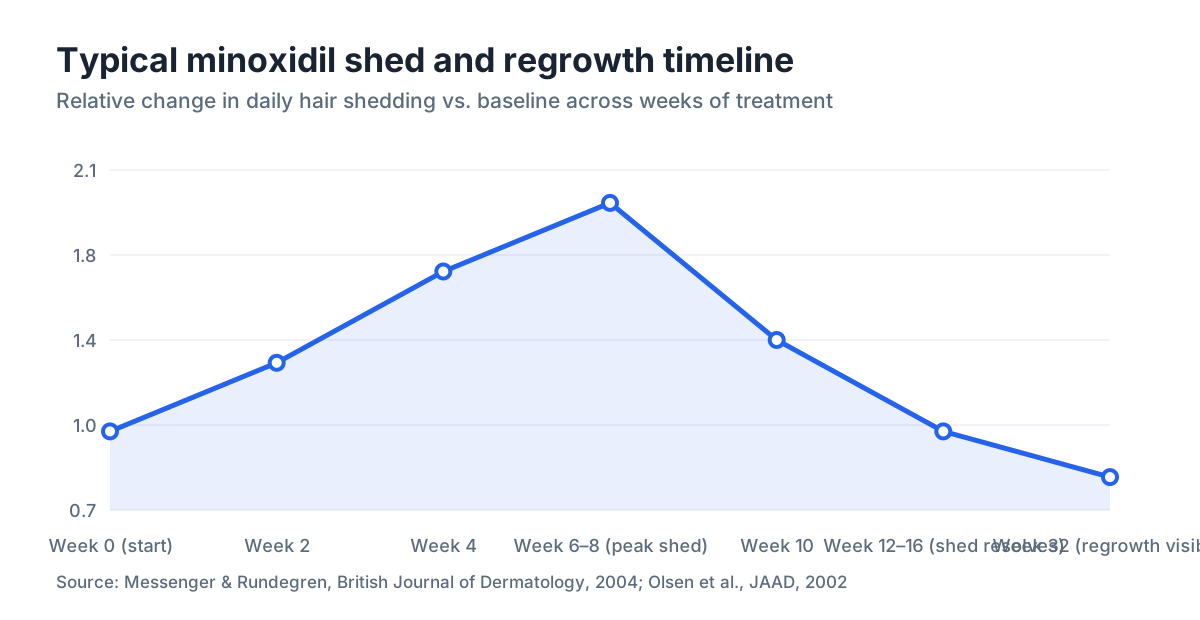
For most people, shedding starts somewhere between week 2 and week 6 after beginning minoxidil. It usually peaks around weeks 6 to 8 and then tapers off. By the 3-month mark, the vast majority of users are through it [3].
New visible regrowth typically takes longer to see. Most clinical trial data measuring minoxidil efficacy looks at 16 weeks (4 months) as the minimum window before meaningful regrowth is assessable, and the 1987 multicenter trial that supported FDA approval found statistically significant hair count increases at 32 weeks [4].
The honest timeline, then, looks something like this: shed for a month or two, see roughly nothing for another month, then slowly start noticing improvement. That full arc from starting the drug to visible payoff is often 4 to 6 months. If you quit during the shedding phase, which many people do, you never reach the benefit.
A small number of users report shedding that lasts longer than 4 months. In those cases it's worth talking to a dermatologist to rule out other causes, such as a concurrent nutritional deficiency or an underlying thyroid condition, rather than assuming minoxidil is to blame for everything.
How much shedding is normal versus too much?
The average person loses 50 to 100 hairs per day under normal circumstances [2]. During a minoxidil shed, that number goes up, but exact counts are hard to find in the literature because most clinical trials report hair count in a target area rather than measuring total daily loss.
A general clinical rule of thumb is that losing more than 150 to 200 hairs per day for more than a few weeks, or losing large clumps in patches rather than diffuse strands, warrants a dermatology visit [2]. Patchy loss is not consistent with a typical minoxidil shed, which is diffuse across the scalp.
If you're also experiencing scalp redness, significant scaling, or burning that started with minoxidil, that suggests a contact reaction to propylene glycol (a common carrier in some formulations) rather than a growth-cycle shed, and you'd want to look at propylene-glycol-free foam versions instead. The minoxidil side effects article covers that distinction in more detail.
Don't try to count every hair that comes out. It's not useful and it increases anxiety, which can itself contribute to stress-related shedding on top of the drug-induced kind.
Does everyone who uses minoxidil experience shedding?
No. Not everyone sheds noticeably. The clinical consensus is that somewhere between 20 to 30% of users experience a shedding phase that they actually notice, though the true number could be higher because mild shedding is easy to overlook [3].
People who tend to notice it more are those who start with relatively dense hair in the treated area (more telogen hairs available to shed) and those who are particularly attentive to hair loss to begin with. If you're already at a more advanced Norwood stage with significant thinning, there are simply fewer hairs in any phase to shed, so the effect can be less visible.
The absence of shedding doesn't mean the treatment isn't working. Some users skip it entirely and still see regrowth. Try not to read too much into whether or not you personally shed.
What happens if you stop minoxidil during the shed?
This is the most common mistake people make, and it's worth being direct about it. If you stop minoxidil during the shedding phase, you will likely lose the new hairs that were just beginning to grow in. They need ongoing minoxidil to maintain the anagen phase. Once the drug is withdrawn, those follicles revert back toward their baseline, and any hair grown with minoxidil's help starts to fall out within 3 to 6 months of stopping [1].
Minoxidil is a maintenance drug, not a cure. It works only as long as you use it. Stopping during the shed means you went through the worst part with none of the payoff.
There's also the question of what's driving your hair loss in the first place. If it's androgenetic alopecia (male or female pattern baldness), the underlying DHT blocker mechanism that drives miniaturization is still operating. Minoxidil doesn't block DHT; it just counters some of its effects by keeping follicles in growth mode. Combining minoxidil with a DHT blocker like finasteride is the approach most dermatologists now recommend for men with pattern loss, and there's reasonable evidence the combination outperforms either drug alone [5].
Does oral minoxidil cause the same kind of shedding?
Yes, and often more of it. Oral minoxidil at low doses (typically 0.625 to 2.5 mg/day for women, 2.5 to 5 mg/day for men) has the same mechanism: it pushes follicles from telogen into anagen, so the same initial shed can occur.
A 2021 retrospective review published in the Journal of the American Academy of Dermatology found that about 24% of patients on low-dose oral minoxidil reported initial shedding, and most of those cases resolved within 3 months [6]. The authors noted that the shedding rate was similar to or somewhat higher than what's reported for topical minoxidil, which makes sense given that systemic delivery reaches more follicles at once.
The benefit of oral minoxidil is adherence and scalp tolerability for people who react to topical formulations. The tradeoff is systemic side effects like fluid retention and increased body hair (hypertrichosis), which are more common with the oral route.
Is minoxidil shedding the same as telogen effluvium?
They're closely related but not identical in cause. Telogen effluvium is a broad category of diffuse shedding that happens when a large proportion of follicles shift into telogen simultaneously, usually after a systemic stressor (surgery, illness, major weight loss, childbirth, severe nutritional deficiency) [7].
Minoxidil-induced shedding is mechanistically the reverse: instead of pushing hairs into telogen, minoxidil pushes them out of telogen prematurely. The result looks the same from the outside (more hair coming out), but the biology runs in the opposite direction. One is follicles going to sleep; the other is follicles waking up.
The practical implication: classic telogen effluvium typically resolves when the original stressor is removed, and the shed comes 2 to 4 months after that stressor [7]. Minoxidil shedding is self-limiting as long as you keep using the drug, because follicles stabilize into their new synchronized cycle. If you have a reason to suspect a separate telogen effluvium happening at the same time (recent illness, drastic diet, postpartum), it's worth investigating with a dermatologist, because the two can stack.
Can you do anything to reduce or speed through the shedding phase?
Honestly, not much. The shed is a byproduct of the mechanism. You can't stop follicles from cycling without also stopping the drug from working.
A few things that have evidence behind them at least for overall hair health:
Getting adequate protein and iron is worth checking. Both are required for the anagen phase, and deficiencies slow new hair growth without slowing shedding, which effectively prolongs the window where loss outpaces regrowth. The American Academy of Dermatology recommends ruling out iron-deficiency anemia in people with unexplained hair shedding [2].
For men with androgenetic alopecia, starting finasteride and minoxidil together rather than sequentially may help because finasteride stabilizes the follicle environment while minoxidil is doing its cycle-resetting work. There's no strong trial data showing this specifically reduces the shed, but it reduces the background DHT-driven loss happening at the same time.
Some users ask about hair loss supplements. Biotin, saw palmetto, and similar options have much weaker evidence than either minoxidil or finasteride, and none are proven to shorten a minoxidil shed. They're not going to hurt, but I wouldn't spend significant money on them for this specific purpose.
The best practical strategy is simply knowing the shedding is coming before it starts. Having that expectation is enough to keep most people from quitting too early. If you're just starting minoxidil and haven't shed yet, bookmark this page.
How do you know when the shedding phase is over?
The shed tapers rather than stops abruptly. Most people notice it just quietly fades, usually by the 10 to 16 week mark. The daily hair count in the shower goes back to something close to baseline.
The next thing to watch for is new growth. Miniaturized hairs that minoxidil is reviving will often appear first as fine, lighter-colored vellus-type hairs before they thicken over successive cycles. You might notice these most easily along the hairline or at the temples depending on where you're applying the product.
If you want a more objective measure, take a photo of a specific area of your scalp in the same lighting and position every 4 weeks from day one. It's the only honest way to track change over a timeline this long. Hair change is too slow for day-to-day perception to be reliable.
If you're concerned about a receding hairline specifically and wondering whether minoxidil is actually doing anything, the hairline tends to be one of the slower areas to respond. The vertex (crown) typically responds better and faster in clinical trials [4]. Realistic expectations: noticeable hairline improvement, if it comes, is usually a 6 to 12 month project.
Myhairline's free AI scan (/scan) can give you a baseline photograph analysis of your hair density and hairline position so you have an objective reference point before and after starting treatment.
What do dermatologists actually recommend during the shedding phase?
The consistent message from dermatology guidelines is: don't stop. The American Academy of Dermatology's patient guidance for androgenetic alopecia recommends giving minoxidil at least 6 months before evaluating whether it's working, explicitly because of the shedding phase and the delayed timeline of visible regrowth [2].
Clinically, if a patient calls a dermatologist during the shed, the standard response is reassurance and confirmation of the mechanism, not a dosage change or a switch to another drug. Dose-reducing minoxidil during the shed to try to reduce hair loss is not recommended; the shed is tied to the mechanism, not the dose per se, and lower doses may still cause shedding while delivering less of the regrowth benefit.
The only reason a dermatologist would intervene during the shedding phase is if the pattern is clearly not consistent with what's expected: patchy loss, scalp symptoms, or shedding that continues well past 4 months without any sign of slowing.
If you haven't been formally evaluated for androgenetic alopecia or have other risk factors for hair loss (family history, recent bloodwork showing thyroid issues, what causes hair loss concerns beyond genetics), a proper diagnosis before starting any treatment is always worth it.
Will minoxidil shedding happen again if you restart after stopping?
Very likely yes. If you stop minoxidil and then restart after a break of several weeks or more, your follicles go through the cycle reset again. The same mechanism applies: follicles that drifted back toward telogen during your break get pushed into anagen, and the old hairs shed.
This is one of the stronger arguments for not taking "breaks" from minoxidil once you've decided it's working. The stop-restart cycle puts you through repeated shedding phases without any additional benefit over continuous use.
The same principle applies when switching formulations, say from topical to oral minoxidil, though the evidence here is anecdotal. If the follicle environment changes enough to trigger a new cycle, you may see another round of shedding even if you were never fully off a minoxidil product.
Sources
- FDA, Rogaine (minoxidil 5%) prescribing information / drug label
- American Academy of Dermatology, Hair Loss: Who Gets and Causes
- Messenger AG, Rundegren J. Minoxidil: mechanisms of action on hair growth. British Journal of Dermatology. 2004;150(2):186-194.
- Olsen EA et al. A randomized clinical trial of 5% topical minoxidil versus 2% topical minoxidil and placebo in the treatment of androgenetic alopecia in men. Journal of the American Academy of Dermatology. 2002;47(3):377-385.
- Hu R et al. Combined treatment with oral finasteride and topical minoxidil in male androgenetic alopecia: a randomized and comparative study. British Journal of Dermatology. 2015;172(6):1554-1557.
- Randolph M, Tosti A. Oral minoxidil treatment for hair loss: A review of efficacy and safety. Journal of the American Academy of Dermatology. 2021;84(3):737-746.
- Malkud S. Telogen Effluvium: A Review. Journal of Clinical and Diagnostic Research. 2015;9(9):WE01-WE03.
- Shapiro J. Hair loss in women. New England Journal of Medicine. 2009;361(21):2045-2054.
- Kaufman KD et al. Finasteride in the treatment of men with androgenetic alopecia. Journal of the American Academy of Dermatology. 1998;39(4):578-589.
- FDA, Minoxidil 2% Topical Solution for Women (original NDA approval summary)