

TL;DR: Treating an underactive or overactive thyroid can reverse thyroid-related hair loss, but it is not instant. Most people wait 3 to 6 months after their thyroid hormone levels normalize before they see real regrowth. Some never get full density back, especially after a long-running thyroid problem or when pattern hair loss is also in play.
How does thyroid disease cause hair loss in the first place?
The thyroid runs your metabolism, and every cell in your body, hair follicles included, depends on thyroid hormone to work. When levels drop too low (hypothyroidism) or climb too high (hyperthyroidism), the normal hair growth cycle falls apart.
Hair grows in three phases: anagen (active growth), catagen (transition), and telogen (rest, then shedding). Thyroid dysfunction shoves an abnormally large share of follicles into telogen all at once. That is the same mechanism behind telogen effluvium. You do not lose the hairs right away. They sit in telogen for two to four months, then shed. So the shedding you notice today often reflects what your thyroid was doing three months back [1].
Hypothyroidism, the more common direction, causes diffuse thinning across the whole scalp and sometimes loss of the outer third of the eyebrows. Hyperthyroidism and autoimmune thyroid conditions like Hashimoto's or Graves' disease can trigger the same diffuse pattern. Hashimoto's specifically carries a higher rate of alopecia areata (patchy loss) because the two share autoimmune pathways [2].
This changes what you should expect from treatment. If the hair loss is pure telogen effluvium driven by thyroid imbalance, correcting the hormone level is the actual fix. If there is an autoimmune component, or pattern baldness (androgenetic alopecia) layered on top, thyroid medication alone will not bring back full density.
What does the evidence say about hair regrowth after thyroid treatment?
Honest answer: the direct trial evidence is thinner than you would hope. Most endocrinology and dermatology literature treats hair regrowth as an expected side benefit of successful thyroid normalization, not the thing being measured, so large randomized trials aimed specifically at hair regrowth after levothyroxine are scarce.
What we do have is consistent observational data and clinical consensus. The American Thyroid Association notes that hypothyroid symptoms, hair loss included, usually start to resolve within a few months of reaching adequate hormone replacement [3]. Dermatology sources generally cite 3 to 6 months as the minimum before visible improvement, with full benefit taking up to 12 months in some people [4].
Work in the Journal of Clinical Endocrinology & Metabolism found that patients whose TSH normalized on levothyroxine still reported symptoms including hair thinning at higher rates than people who had never been hypothyroid, which tells you a normal TSH does not automatically clear every symptom [5]. The target matters too. Some clinicians aim for TSH between 1 and 2 mIU/L for symptom relief rather than just anywhere in the 0.4 to 4.0 mIU/L reference range, though that is not settled practice.
Hyperthyroidism adds a wrinkle. Antithyroid drugs (methimazole, propylthiouracil) and radioactive iodine can themselves drive shedding during treatment, which muddies the timeline. Once a stable euthyroid state holds, the same 3-to-6-month window applies [6].
How long should you actually wait before expecting results?
Two separate clocks are running. The first is how long it takes to get your thyroid levels into a stable, optimal range. The second is how long follicles need to restart their growth cycle after that.
| Phase | Typical duration | What's happening |
|---|---|---|
| Thyroid level normalization | 6 to 12 weeks on levothyroxine | TSH drops toward target; dose may need adjustment |
| Follicle restart | 1 to 3 months after normalization | Follicles re-enter anagen phase |
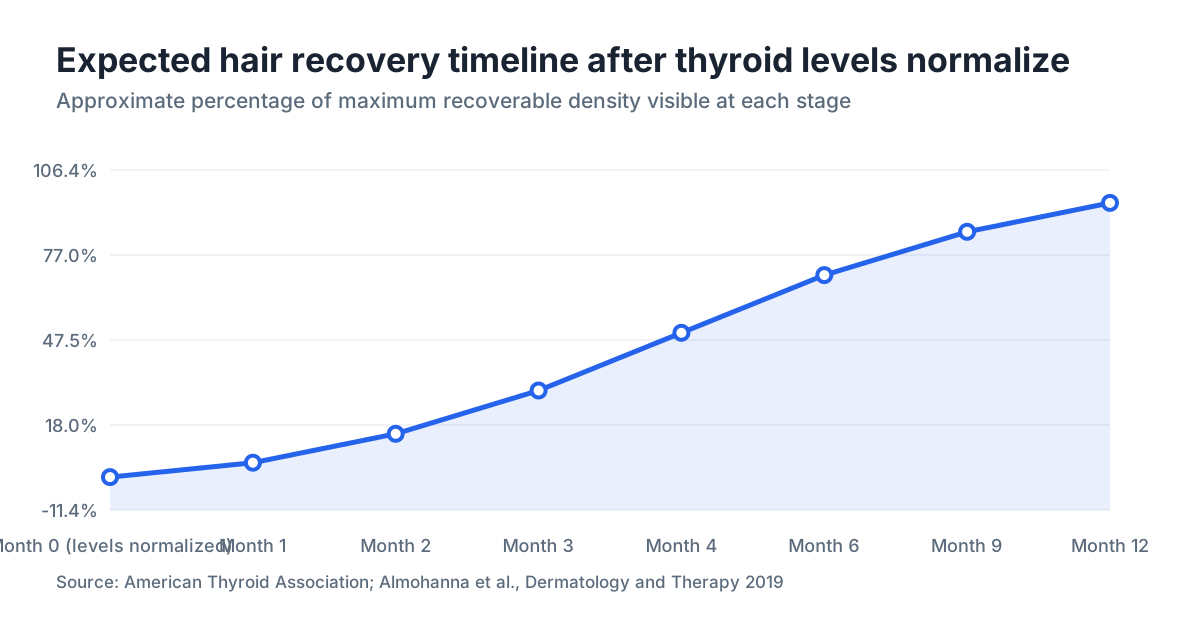
| Visible growth | 3 to 6 months after normalization | New hairs emerge at scalp; density improves gradually |
| Near-maximum recovery | 9 to 12 months | Most patients who will recover have done so by here |
So if your levels took 3 months to stabilize, you are looking at 6 to 9 months from the day you started medication before you can honestly judge how much hair came back [1][3].
Shedding often gets worse in the first 4 to 8 weeks after you start thyroid medication. This is known and temporary. The treatment speeds up the existing cycle and flushes out hairs already sitting in late telogen. It is not the medication failing. It is alarming and expected at the same time.
Past 12 months on a stable, optimal dose with no regrowth? The loss is probably not purely thyroid-driven. That is the point to have a dermatologist look for other causes: androgenetic alopecia, iron deficiency, nutritional gaps, or another autoimmune condition.
Does the type of thyroid medication matter for hair regrowth?
Most people with hypothyroidism get levothyroxine (synthetic T4), the FDA-approved first-line treatment [7]. The body converts T4 into the active form, T3, in peripheral tissues. That works well for the majority.
A subset keep having symptoms, hair thinning included, despite a normal TSH on T4 alone. Some clinicians add liothyronine (T3) or switch to desiccated thyroid extract, which contains both T4 and T3. Evidence that the combination beats T4 alone specifically for hair is limited, and the practice is debated inside endocrinology [5].
For Graves' disease (hyperthyroidism), methimazole is the most commonly used antithyroid drug. Propylthiouracil is held back for specific situations like pregnancy. Neither drug grows hair directly. They bring thyroid hormone down, and the hair responds to the corrected environment.
If you are on thyroid medication and still losing hair, ask your doctor to check more than TSH: free T4 and free T3 too. TSH can read normal while free hormone levels stay suboptimal, particularly in Hashimoto's where the pituitary-thyroid loop is disrupted.
One more thing. Biotin supplements, often pushed for hair loss, can falsely raise or lower thyroid lab values depending on the assay. The FDA put out a safety communication about this in 2017 [8]. If you take high-dose biotin and your doctor cannot square your labs with your symptoms, biotin interference belongs on the list.
Will all the lost hair grow back, or is some loss permanent?
This is the question most people actually want answered. The honest answer is that it depends on a handful of factors you can partly assess.
Telogen effluvium caused purely by thyroid imbalance is largely reversible. The follicles are not destroyed. They are stuck in the wrong phase. Remove the trigger (the hormone imbalance), let the follicle restart, and the hair should regrow. Density back to where it was is the usual outcome in straightforward cases caught and treated early.
Several things lower the odds of full recovery.
Duration matters. A thyroid condition left uncorrected for years causes more lasting follicle stress than one caught within months. Some evidence suggests prolonged hypothyroidism can lead to follicular miniaturization that does not fully reverse [4].
Alopecia areata overlap. If Hashimoto's set off a separate autoimmune attack on the hair follicles themselves (alopecia areata), fixing the thyroid level will not resolve that damage. Alopecia areata needs its own treatment.
Pattern hair loss. Androgenetic alopecia (the genetic, DHT-driven kind, covered in what causes hair loss) can be exposed or sped up by thyroid dysfunction. Treating the thyroid may stop the thyroid-driven loss and leave the pattern loss underneath untouched. That is where minoxidil for men, finasteride, or other pattern-loss treatments come in.
Nutrient status. Iron deficiency rides along with autoimmune thyroid disease often. Ferritin below 30 ng/mL is independently tied to hair shedding, and some dermatologists aim above 70 ng/mL in women with diffuse loss. Correcting iron while normalizing thyroid usually beats fixing either one alone [4].
What other causes of hair loss should you rule out at the same time?
A thyroid diagnosis can create tunnel vision, where every symptom gets pinned on the thyroid. That delays spotting other contributors that need their own treatment.
The usual overlapping causes:
Iron deficiency or low ferritin. Request a complete blood count and a serum ferritin (ferritin matters more than hemoglobin here) alongside your thyroid labs. Ferritin is the better marker of iron stores and has a documented independent link to telogen effluvium [4].
Androgenetic alopecia. This is patterned, not diffuse. In men it follows the Norwood scale (receding temples, thinning crown). In women it thins at the part line. A receding hairline while thyroid levels sit in range points to androgenetic alopecia, which will not budge with thyroid management.
Vitamin D deficiency. Low vitamin D is common in autoimmune conditions including Hashimoto's, and some small studies link it to hair loss, though the causal direction is not settled.
Medications. Beta-blockers (sometimes used in hyperthyroidism), lithium, and certain antidepressants can cause drug-induced telogen effluvium independent of thyroid status.
Stress and illness. A major physical or emotional stressor can trigger telogen effluvium at the same time as thyroid trouble without being caused by it.
A dermatologist can run a dermoscopy or pull test to separate telogen effluvium from the miniaturized follicles that mark androgenetic alopecia. Want a fast first look at your own hairline and density before the appointment? The free AI scan at MyHairline shows where the thinning is concentrated.
When the loss turns out to have both thyroid and androgenetic roots, pairing thyroid treatment with something like finasteride and minoxidil often beats either approach on its own.
How do you know if your thyroid levels are actually optimal, more than 'normal'?
The standard lab reference range for TSH is 0.4 to 4.0 mIU/L. Land anywhere in it and you count as normal. There is a real clinical debate over whether the upper end is optimal for symptom relief, hair included.
Several studies and patient groups argue that lingering symptoms, hair thinning among them, show up more often in hypothyroid patients with TSH above 2.0 mIU/L, even inside the reference range [5]. Some endocrinologists target TSH between 1.0 and 2.0 mIU/L for patients who stay symptomatic at higher numbers. This is not standard everywhere, but it is a fair conversation to have if your hair has not recovered and your TSH sits at, say, 3.5.
Free T4 and free T3 (not total T4 or T3) paint a fuller picture of what your tissues can actually use. Some people convert T4 to T3 poorly because of genetic variants in the deiodinase enzyme (DIO2 in particular), and can run low-normal free T3 despite fine T4 and a normal TSH. That is another reason persistent hair loss on a technically normal TSH deserves the full panel.
Anti-TPO and anti-thyroglobulin antibodies tell you whether Hashimoto's is active and driving ongoing inflammation. High antibodies alongside hair loss, even with an acceptable TSH, point to the autoimmune process as a contributor separate from the hormone level.
So ask for TSH, free T4, free T3, and thyroid antibodies. Then have a specific conversation about whether your numbers are optimal for you, more than inside the range.
Are there hair loss treatments that work alongside thyroid medication?
Yes, and for many people they are necessary rather than optional, especially when full recovery is not happening on thyroid medication alone.
Minoxidil (topical or oral) is the best-studied non-prescription option for diffuse hair loss in men and women. It shortens telogen and stretches anagen, doing at the follicle what correcting thyroid hormone does at the systemic level. The two are not redundant. They work through different mechanisms and stack. See how application and side effects differ in minoxidil side effects, or look at oral minoxidil if topical compliance is a problem.
Finasteride lowers DHT and handles the androgenetic component that thyroid treatment cannot touch. It is approved for men. Evidence in women is more limited, and it is contraindicated in women who are or may become pregnant [9]. The DHT blocker article covers how this class works.
Iron supplementation, when ferritin is genuinely low, has some evidence for cutting telogen effluvium shedding [4]. Do not supplement iron without a blood test. Iron overload carries its own risks.
For broader nutritional support, a few nutrients have reasonable evidence: zinc (deficiency links to shedding), vitamin D, and B12 (often low in Hashimoto's because parietal cell antibodies reduce intrinsic factor). Hair loss supplements breaks down what helps and what does not.
If the loss is severe, has run for years, or left visible bald patches even after thyroid and other medical optimization, a hair transplant consultation becomes reasonable. But a transplant should come last, after the medical causes are fully handled and stable for at least a year.
When should you see a doctor instead of waiting it out?
Shedding that started within months of a thyroid diagnosis, is diffuse (not patterned), and comes with classic thyroid symptoms (fatigue, weight change, temperature sensitivity) is reasonable to monitor with your prescribing physician while levels stabilize.
See a dermatologist specifically, rather than just waiting, when any of these show up:
Heavy shedding for more than 6 months with no sign of slowing. Thyroid-driven telogen effluvium does not usually last this long once levels are corrected.
Patterned thinning (temples, crown, or part line) rather than diffuse loss. Pattern loss needs pattern-specific treatment.
Round or oval bald patches. That points to alopecia areata, which needs immunomodulating treatment more than hormone tuning.
Stable, optimal thyroid levels for 12 months and still no recovery. At that point the cause is likely not reversible through thyroid management alone.
Rapid loss. Consistently shedding more than roughly 150 hairs a day (well above the normal 50 to 100) for weeks warrants investigation no matter what your TSH reads.
Want a fast way to map where the thinning has happened and track it over time? The free AI hair scan at MyHairline can document your baseline before the dermatology appointment and give the clinician objective reference points.
What are realistic expectations for someone just starting thyroid medication?
Here is a straight timeline based on how the biology works, not best-case marketing.
Months 1 to 2: Shedding may briefly worsen as the cycle restarts. Energy and other thyroid symptoms usually improve before hair does. Your doctor checks TSH at 6 to 8 weeks and may adjust the dose.
Months 2 to 4: Shedding should slow as levels stabilize. You may spot baby hairs (short, fine regrowth) at the hairline. Good sign.
Months 4 to 6: Density starts visibly improving for most patients whose loss was mainly thyroid-driven. Not the finish line, but a real checkpoint for direction.
Months 6 to 12: Most recoverable density comes back in this window. No continued improvement here? This is when to revisit the diagnosis and add targeted hair treatments.
Beyond 12 months: Whatever thinning remains is probably not thyroid-driven. Time to look hard at androgenetic alopecia, nutrient deficiencies, or other causes.
Patience is the hardest part, genuinely. The hair cycle does not speed up because you want it to. But for people with straightforward thyroid-driven telogen effluvium caught and treated early, the outlook is good.
Sources
- American Academy of Dermatology (AAD), Hair Loss Resource Center
- National Institute of Diabetes and Digestive and Kidney Diseases (NIDDK), Hashimoto's Disease
- American Thyroid Association, Hypothyroidism
- Dermatology and Therapy, 'The Role of Vitamins and Minerals in Hair Loss: A Review' (Almohanna et al., 2019)
- Journal of Clinical Endocrinology & Metabolism (Peterson et al., 2016), 'Is a Normal TSH Synonymous With Euthyroidism in Levothyroxine Monotherapy?'
- American Thyroid Association, Hyperthyroidism
- U.S. Food and Drug Administration, Drugs@FDA Database (Levothyroxine label)
- U.S. Food and Drug Administration, Safety Communication: Biotin Interference with Lab Tests (2017)
- U.S. Food and Drug Administration, Drugs@FDA Database (Finasteride label)
- National Institutes of Health, MedlinePlus: Thyroid Diseases
- NIDDK, Graves' Disease