
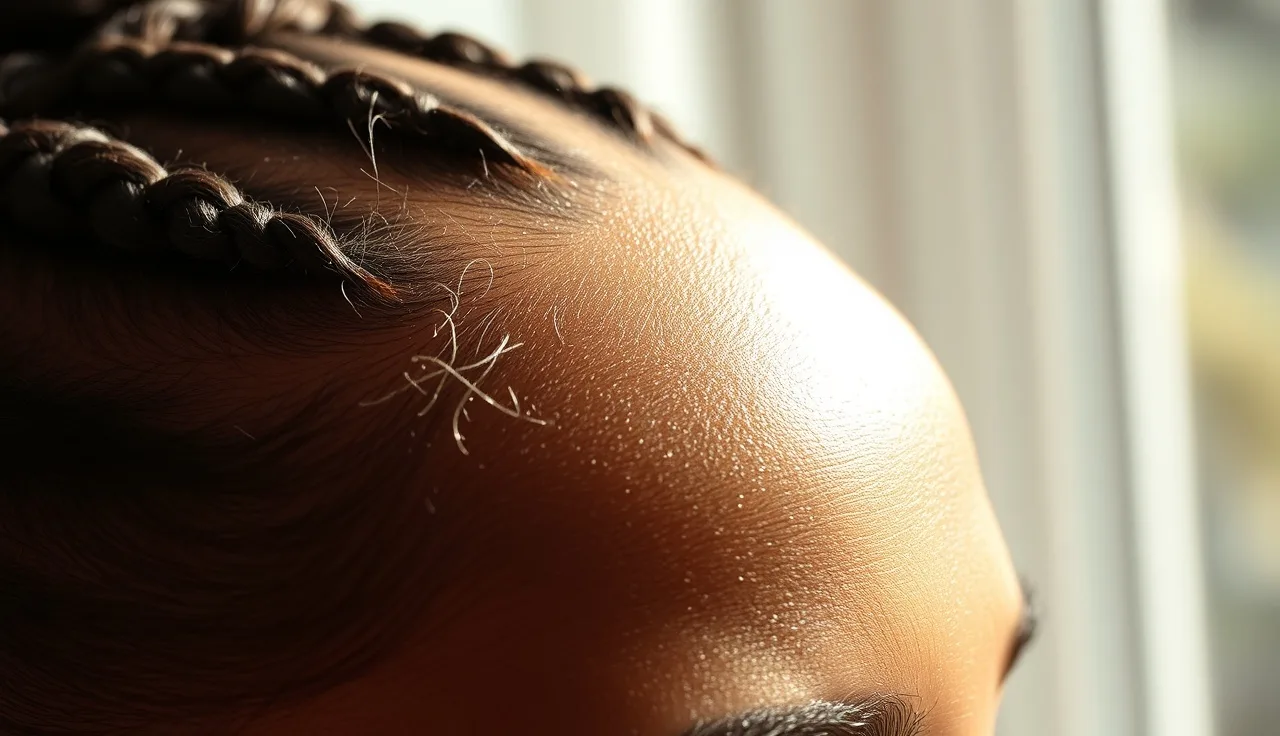
TL;DR: Tight hairstyles cause traction alopecia, a mechanical hair loss distinct from genetic baldness. But if you already carry the genes for androgenetic alopecia, repeated tension on already-vulnerable follicles may accelerate thinning. The damage is reversible early on; sustained tension over years can permanently destroy follicles. Changing styles early is the most effective intervention.
What is traction alopecia and how is it different from genetic hair loss?
Traction alopecia is hair loss caused by sustained mechanical pulling on the follicle. The tension physically stresses the follicle root, triggers inflammation, and over time can scar the follicle permanently. It shows up along the hairline, temples, and edges where the pull is greatest. Think cornrows pulled tight to the scalp, box braids maintained for months at a time, or a ponytail worn so tightly every day that a headache comes with it.
Genetic hair loss, properly called androgenetic alopecia (AGA), works differently. The follicle is miniaturized by dihydrotestosterone (DHT), a hormone that binds to androgen receptors in the hair bulb and gradually shrinks it over repeated growth cycles [1]. The pattern is predictable: temples and crown for men, diffuse thinning at the central part for women. It is driven by genetics and hormones, not mechanics.
These are two distinct conditions with different causes. You can have one without the other, or you can have both running at the same time. That overlap is exactly where things get complicated.
Can tight hairstyles actually make genetic hair loss worse?
This is the core question, and the honest answer is: probably yes, but the evidence is still building.
The clearest data comes from a 2019 study in JAMA Dermatology that followed more than 5,000 women and found that chemical relaxers combined with tight braiding roughly doubled the risk of central centrifugal cicatricial alopecia (CCCA), a scarring alopecia most common in Black women that has a likely genetic component [2]. That is not androgenetic alopecia, but it shows that styling practices and genetic susceptibility interact in measurable ways.
For AGA specifically, the mechanism is more theoretical but biologically coherent. DHT-sensitive follicles are already in a weakened state, cycling through shorter and shorter growth phases. Adding physical tension to an already-stressed follicle may accelerate the inflammatory cascade that accompanies AGA. A 2021 review in the Journal of the American Academy of Dermatology noted that chronic follicular inflammation is now recognized as a co-driver of miniaturization in AGA, more than a bystander [3]. Tension-induced inflammation could feed that process.
Put simply: tight styles probably do not cause AGA in someone who does not carry the genes. But if you do carry the genes, tight styles may move up the timeline. Nobody has a randomized controlled trial proving this directly, because you cannot ethically keep someone in painful braids for ten years. The best available evidence is mechanistic reasoning plus observational data from populations where both AGA and traction alopecia are common.
Which hairstyles put the most tension on follicles?
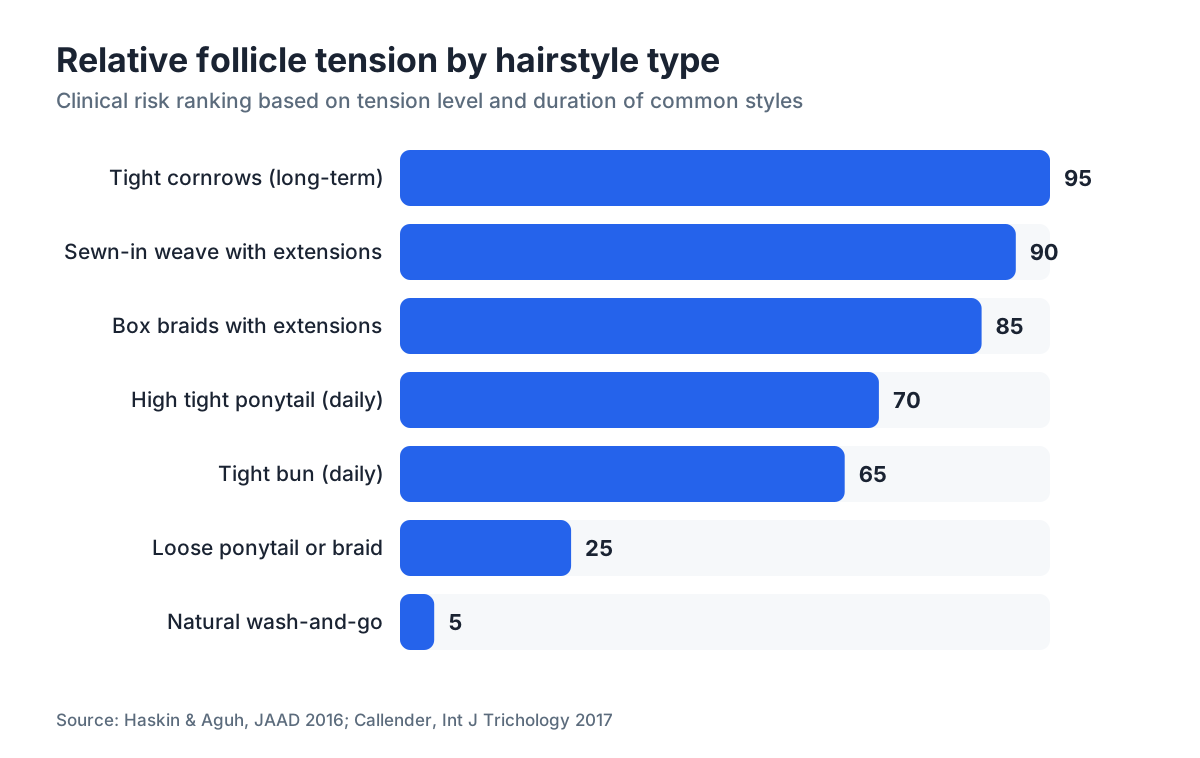
Tension is more than about how tight a style looks. It depends on the angle of pull, the weight on the shaft, how long the style is left in, and how often it is redone in the same pattern.
| Hairstyle | Tension level | Risk notes |
|---|---|---|
| Tight cornrows | High | Greatest at temples and hairline; redoing on same tracks increases risk |
| Box braids with extensions | High | Extension weight adds constant downward force |
| Weaves (sewn-in) | High | Tight wefts can create sustained scalp pressure for weeks |
| High tight ponytail (daily) | Moderate-high | Tension concentrated at elastic anchor point |
| Tight buns (ballerina style) | Moderate-high | Temples and nape most affected |
| Loose ponytail or braid | Low | Minimal follicle stress if hair tie is not cutting into shaft |
| Natural wash-and-go styles | Very low | No sustained directional pull |
Extensions and weaves deserve special mention. The added weight of synthetic or human hair extensions can place a gram-level load on each follicle for weeks at a stretch. A 2017 analysis in the International Journal of Trichology found that hair extension weight ranged from 50 to 150 grams per section, with sewn-in wefts transmitting the most force directly to the scalp [4].
How long you wear a style matters as much as how tight it is. A tight braid worn once for a special occasion is a very different mechanical event than tight braids worn continuously for eight weeks without letting the scalp rest.
Where on the scalp does traction alopecia typically appear?
Traction alopecia follows the tension. For people who wear tight ponytails or sleek buns, the first sign is usually a receding line just above the forehead and at the temples, sometimes mimicking the look of an early-stage receding hairline.
For cornrow wearers, the loss tends to track along the parting lines. For weave wearers, it clusters at the nape and the sides where the weft anchors are sewn.
Early traction alopecia shows fringe hairs: short, broken, or upright hairs at the hairline that look out of place. Dermatologists call this the "fringe sign" and it is a useful early warning. Scalp tenderness, follicular papules (small bumps), or scaling along the part lines are also early flags [5].
If you already have AGA thinning at the temples and you are also wearing tight styles that pull at the temples, those two processes are attacking the same follicles from different directions. The result can look like AGA progressing faster than your family history would predict.
Is traction alopecia reversible, or does it cause permanent damage?
Early traction alopecia is reversible. Stop the tension, and many people see regrowth within months. This is the single most important thing to know: the window for recovery closes gradually, and once the follicle scars, the damage is permanent.
The American Academy of Dermatology (AAD) states that with early diagnosis and removal of the offending tension, most patients regrow hair, but prolonged traction leads to permanent follicular fibrosis [5]. Nobody can give you a precise timeline because it varies with the degree of tension, individual follicle sensitivity, and how quickly the pattern changes. The general clinical consensus is that symptoms lasting more than a few months need evaluation, and symptoms lasting years with active scarring seen on biopsy are unlikely to fully reverse.
Scar tissue replaces the follicle bulb and the surrounding connective tissue. Hair cannot grow from scar. That is why dermatologists who see patients with years of severe traction alopecia sometimes recommend hair transplant surgery to areas that can no longer regrow on their own, assuming the donor area is healthy.
For AGA, the timeline question is different. AGA miniaturization is also largely irreversible without treatment, though medications like finasteride and minoxidil for men can slow or partially reverse it.
Who is most at risk when tight styles meet genetic hair loss?
Risk is not evenly distributed. Black women in particular face a convergence of factors: higher rates of certain styling practices (cornrows, braids, weaves), genetic predisposition to CCCA, and sometimes underdiagnosed AGA on top of that. A 2016 survey published in the Journal of the American Academy of Dermatology found that traction alopecia affected approximately one-third of Black women, making it among the most common hair loss diagnoses in that population [6].
Men are not exempt. Male athletes who wear tight headbands for prolonged training, Sikh men who keep hair tightly wrapped under turbans without breaks, and anyone with early AGA who wears a high, tight fade with daily-slicked edges can all experience the compounding effect.
People with fine hair are at higher mechanical risk because fine strands have lower tensile strength and break more easily under the same load. People with AGA-pattern thinning at the temples are at higher clinical risk because their follicles are already compromised.
Age matters too. Adolescents and young adults who start tight styling before any genetic loss becomes apparent may not notice the interaction until the AGA pattern emerges in their mid-twenties or thirties, at which point the compounding damage can look more advanced than their genetic timeline alone would explain.
How do dermatologists diagnose the difference between the two conditions?
A dermatologist evaluating hair loss looks at the pattern, the scalp surface, the hair pull test, and sometimes a biopsy.
Pattern is the first clue. AGA has characteristic distributions described by the Norwood scale in men and the Ludwig scale in women. Traction alopecia follows the lines of tension rather than hormonal patterns.
Dermoscopy (a handheld magnifying tool used directly on the scalp) lets the clinician look at follicle openings, the presence of perifollicular scaling or redness (active inflammation), and whether follicles are absent (scarring) or just miniaturized (AGA). Early traction alopecia shows preserved follicle openings and perifollicular erythema. Advanced traction alopecia shows absent follicles.
A scalp biopsy is the definitive test when the clinical picture is unclear. Pathology can distinguish between fibrosis from traction, the lymphocytic inflammation typical of AGA, and the mixed picture when both are present [3].
Blood tests are ordered mainly to rule out other causes: thyroid disease, iron deficiency, and autoimmune conditions that can drive telogen effluvium alongside or on top of the primary diagnosis.
If you are trying to understand what you are dealing with before seeing a dermatologist, the free AI hair analysis at MyHairline can help you identify your loss pattern from photos, which is a reasonable first step toward knowing which questions to bring to a clinical appointment.
What does the science say about inflammation connecting the two?
Inflammation is the link that makes the overlap mechanically plausible. For a while, AGA was described as a purely hormonal, non-inflammatory condition. That view has shifted.
A widely cited 2021 review in JAAD confirmed that perifollicular inflammation, specifically a lymphocytic infiltrate around the bulge region of the follicle, is present in AGA specimens and may contribute to miniaturization, more than result from it [3]. The follicle bulge is where stem cells live. Chronic low-grade inflammation around it impairs stem cell function and shortens the anagen (growth) phase.
Traction also triggers inflammation. The mechanical stress of sustained pulling activates mast cells, releases pro-inflammatory cytokines, and creates localized reactive oxygen species around the follicle root. If those processes are happening in the same follicle at the same time, the inflammatory load is additive.
This does not mean every person with AGA who wears a ponytail is accelerating their hair loss noticeably. The magnitude of effect depends on how much tension, how long, and how sensitive that person's follicles are to inflammation. But the biology supports the concern, and for someone already worried about what causes hair loss, adding mechanical inflammation on top of DHT sensitivity is worth taking seriously.
What should you actually do if you suspect tight styles are speeding up your hair loss?
The first step is simple and costs nothing: change the style. Loosen the tension, vary the parting lines so you are not pulling on the same follicles repetitively, and give the scalp a rest between styles.
Specifically:
Avoid leaving tight braids or weaves in for more than six to eight weeks without a break. Let the hair rest for at least an equal amount of time before reinstalling.
Swap elastics for soft fabric ties, and wear ponytails in different positions on different days so the tension point moves.
If your scalp is sore after styling, that soreness is a real signal. It means the tension exceeds what the follicle handles comfortably. A style that hurts is a style that is injuring tissue.
For the genetic component running in the background, there are real medical options. Finasteride and minoxidil used together are the most evidence-backed combination for AGA. Finasteride reduces DHT by roughly 60 to 70 percent at the scalp [7], and minoxidil extends the anagen phase and improves follicle blood flow. Neither reverses scarring from traction, which is why catching the problem early matters.
For women, finasteride use requires careful consideration around pregnancy risk. The AAD's clinical guidelines for female AGA recommend topical minoxidil as first-line, with oral options discussed with a physician [1].
A DHT blocker approach addresses the hormonal driver but does nothing to address ongoing mechanical damage. Both need to be managed if both are present.
Are there protective styling practices that reduce risk without sacrificing the style?
Yes. The core principle is distributing tension and changing its direction frequently.
Low-manipulation styles, worn looser and without extensions, have the lowest risk. Protective styles done correctly (braids loose enough that there is no scalp blanching or pain at the hairline) do protect the ends of the hair but only protect the follicle if the root tension is genuinely low.
Using a satin or silk pillowcase reduces nighttime friction. Avoiding chemical relaxers concurrent with tight styles removes one inflammatory stressor from the equation. The 2019 JAMA Dermatology study found that relaxers plus tight braiding carried higher risk than either factor alone [2], which suggests the insults compound.
Scalp massage is low-risk and has some supporting evidence. A small 2016 study published in Eplasty found that standardized scalp massage of four minutes daily for 24 weeks increased hair thickness compared to baseline, possibly by stretching dermal papilla cells [8]. The effect size was modest, but scalp massage also costs nothing and does not add tension.
For anyone using hair loss supplements, those address nutritional gaps that can worsen shedding. They do not directly address follicle mechanics or DHT. Think of them as addressing a separate contributing variable, not a substitute for either changing styling habits or treating the genetic component directly.
When should you see a dermatologist about this?
See a board-certified dermatologist sooner rather than later if: you notice hairline recession at the temples or edges that correlates with tight styling, if you see broken hairs or a fringe of short upright hairs along the hairline, if your scalp is chronically tender or shows small bumps along the parts, or if a family history of AGA means you know you carry the genetic risk.
The reason timing matters is scarring. Early traction alopecia responds to conservative treatment. Advanced traction alopecia with fibrosis requires either accepting the loss or considering surgical repair. Getting a dermoscopy evaluation when you first notice a problem is far easier than trying to restore a follicle that has been replaced by collagen.
A dermatologist can also run the bloodwork to rule out thyroid disease and iron deficiency, both of which make AGA and traction alopecia worse and are eminently treatable. Low serum ferritin (below 30 ng/mL is the threshold most trichologists use in clinical practice) worsens hair cycling even when iron-deficiency anemia is not present [9].
If you want a preliminary read on your loss pattern before booking an appointment, the free AI scan at MyHairline lets you upload photos and get a pattern analysis. It is not a diagnosis, but it can help you describe what you are seeing when you sit down with a clinician.
Sources
- American Academy of Dermatology, Hair Loss: Diagnosis and Treatment
- Aguh C et al., JAMA Dermatology, 2019: Hair relaxers and braiding combined increase CCCA risk
- Tosti A et al., Journal of the American Academy of Dermatology, 2021: Perifollicular inflammation in androgenetic alopecia
- Callender VD, International Journal of Trichology, 2017: Hair extensions and traction
- American Academy of Dermatology, Traction Alopecia: Overview
- Khumalo NP et al., Journal of the American Academy of Dermatology, 2016: Prevalence of traction alopecia in Black women
- FDA, Propecia (finasteride) 1mg prescribing information
- Koyama T et al., Eplasty, 2016: Standardized scalp massage results in increased hair thickness
- Rushton DH, Journal of Clinical and Experimental Dermatology Research, 2002: Nutritional factors and hair loss
- Haskin A, Aguh C, Journal of the American Academy of Dermatology, 2016: All hairstyles are not created equal