

TL;DR: Wearing a hat does not cause hair loss. No clinical study links normal hat use to androgenetic alopecia or any other hair loss condition. The one real hat-related risk is traction alopecia from headwear worn extremely tight for years. If you're losing hair, genetics, DHT, and hormones are the far more likely cause.
What does the science actually say about hats and hair loss?
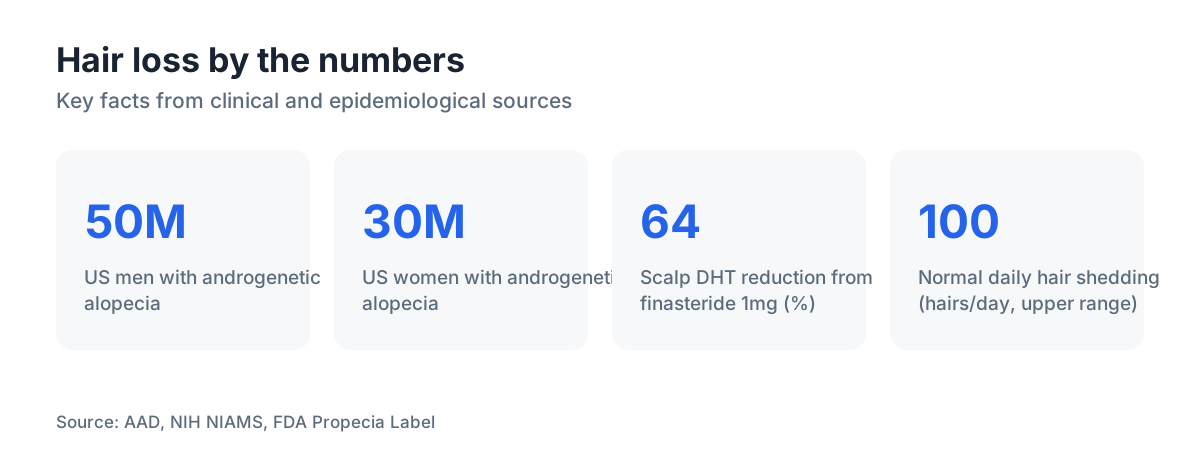
The short answer: hats don't cause hair loss. There is no peer-reviewed clinical trial, no cohort study, and no dermatology society statement linking ordinary hat use to androgenetic alopecia, the most common form of hair loss, which affects an estimated 50 million men and 30 million women in the United States [1].
The claim has circulated for decades. The logic usually goes one of two ways. Hats cut off circulation to the scalp and starve follicles. Or hats trap heat and sweat that somehow damages roots. Neither mechanism holds up.
Hair follicles get their blood supply from vessels that run deep in the dermis, not from the scalp surface. A hat sitting on top of your head cannot compress those vessels meaningfully. And sweat, while occasionally annoying, does not damage follicles. Scalp skin handles moisture all day long. The American Academy of Dermatology does not list hat-wearing among the risk factors for hair loss anywhere in its patient guidance [2].
There is exactly one hat-adjacent mechanism that can damage follicles: persistent, forceful tension on the hair shaft and root over a long stretch of time. That condition has its own name. We cover it fully below.
Where did the hat myth come from?
Part of it is bad pattern recognition. A lot of men who go bald also wear hats, often because they're self-conscious about a receding hairline. People see bald men in hats and flip the causation around.
The other part comes from a kernel of real biology. If you wear a hat so tight it leaves a red pressure mark on your scalp for hours, you probably are restricting blood flow at the very surface of the skin. But the hair follicle bulb sits about 4 millimeters below the surface. Surface pressure from a cotton baseball cap does not reach it.
Military examples get cited here. Soldiers wear tight helmets for long periods. Reviews of hair loss in service members have not turned up a clear association between helmet use and pattern hair loss; the far stronger predictor is family history and age [2]. The people who lose hair under helmets are, overwhelmingly, the same people who would have lost it anyway.
Baldness in fathers and grandfathers is the real predictor, not how many hours anyone spent in a hat.
Can a hat cause traction alopecia?
Yes, but only under specific conditions most people never come close to.
Traction alopecia is hair loss caused by chronic mechanical tension on the follicle. It is well-documented in the dermatology literature, especially in women who wear tight braids, weaves, cornrows, and extensions for years [4]. The American Academy of Dermatology calls it a real and preventable condition [2].
For a hat to cause traction alopecia, it would need to be:
- Extremely tight at the band, pulling follicles under sustained tension
- Worn for many consecutive hours daily
- Continued for months to years
- Combined with hairstyles (like a tight ponytail pulled through a cap) that stack extra tension on the same follicles
A normally fitted baseball cap, beanie, or fedora worn day to day does not create that scenario. The follicle damage in traction alopecia comes from the hair shaft being yanked toward its root repeatedly, not from simple compression.
Early traction alopecia is reversible if you stop the behavior. Chronic, long-standing cases can scar the follicle permanently. If you're a cyclist or athlete who wears a very tight helmet or headband four or more hours daily and you're noticing thinning right where the band sits, raise it with a dermatologist. That's a narrow, unusual situation, not the everyday hat-wearing people worry about.
What actually causes hair loss in men and women?
The causes that matter are genetic, hormonal, and sometimes triggered by systemic stress or medical conditions. Hats are not on the list.
Androgenetic alopecia (pattern hair loss) is the dominant cause in both sexes. In men it produces the receding temples and crown thinning most people picture as going bald. In women it usually shows up as diffuse thinning along the part line. The driver is dihydrotestosterone (DHT), a testosterone metabolite that binds to receptors in genetically susceptible follicles and slowly shrinks them [5]. Your hat has no part in that process.
Other documented causes include:
- Telogen effluvium: a shedding phase triggered by surgery, fever, crash dieting, childbirth, or severe emotional stress, typically producing diffuse shedding 2-3 months after the trigger
- Alopecia areata: an autoimmune condition in which the immune system attacks follicles [9]
- Thyroid disorders, iron deficiency anemia, and other medical causes
- Certain medications (chemotherapy is the obvious one, but anticoagulants and some blood pressure drugs can contribute)
- Scalp conditions like seborrheic dermatitis or psoriasis, which can disrupt follicle function if severe and left untreated
If you want to know what's actually behind your thinning, a full breakdown of causes is worth reading before you spend money on anything.
Does wearing a hat affect DHT or hormones?
No. DHT levels come down to your genetics, your total testosterone production, and how efficiently your body converts testosterone to DHT through the 5-alpha reductase enzyme [5]. A hat on your head has no pathway to touch any of those variables.
The only treatments that actually cut DHT at the follicle are DHT blockers like finasteride, which inhibit the 5-alpha reductase enzyme. Finasteride reduced scalp DHT by roughly 64% in the trials that led to FDA approval [6]. That kind of hormonal shift takes a prescription drug, not the removal of headwear.
Worried DHT is driving your thinning? There are real options. Finasteride is the most studied oral DHT blocker for men. Minoxidil for men works through a different route entirely (vasodilation and follicle stimulation) and often gets paired with finasteride for stronger results. Neither has anything to do with what's sitting on top of your head.
Does hat-wearing affect minoxidil or other topical treatments?
This is a practical question that comes up a lot and gets almost no attention.
If you apply topical minoxidil (the active ingredient in Rogaine and its generics) and immediately jam a tight hat on, you could rub off some product before it absorbs, or trap it against the scalp so absorption goes uneven. The FDA labeling for topical minoxidil says to let the product dry fully before styling your hair or going to bed [7]. The same logic covers hats.
Here's the routine: apply minoxidil, wait 30 to 60 minutes for it to dry, then wear whatever hat you want. You do not need to go hatless all day. There's no evidence that hat use, once the minoxidil has absorbed, reduces its effectiveness. For more on how topical minoxidil works and which side effects matter, see our minoxidil side effects guide.
Same principle for any scalp-applied treatment: let it absorb first, then cover up.
Does sweat under a hat damage your scalp or follicles?
Sweat does not damage hair follicles. The scalp produces sweat through eccrine glands, and the skin there is built to deal with it.
An unwashed scalp with chronic sweat buildup can develop seborrheic dermatitis or folliculitis more easily, though, especially in people already prone to those conditions. Folliculitis (inflamed or infected follicles) can, if severe and recurring, eventually feed into scarring that thins hair density. But that's a hygiene issue, not a hat issue. The fix is washing your hair and your hat regularly.
If you sweat heavily under a hat every day and never wash it, the bacterial and fungal load in the fabric transfers to your scalp. Good reason to launder your caps. Not a reason to give them up out of hair loss fear.
Scalp health matters for keeping the hair you have, and a clean, non-inflamed scalp is worth caring for. Hats worn on a clean scalp and washed regularly are no real threat to follicle health.
Are there any real warning signs hat-wearers should watch for?
A few patterns are worth noticing, even though they're uncommon.
Thinning at the hat band line, meaning the exact spot where a very tight band or elastic presses against the forehead or temples, can flag early traction alopecia if the hat is genuinely too tight and worn for long stretches. You see this most with very tight athletic headbands, swim caps worn for hours in competitive training, or construction hard hats with internal suspension systems that press unevenly on the hairline [11].
If you notice thinning that follows the exact perimeter of a headwear band and doesn't match your family's pattern hair loss, bring it to a board-certified dermatologist. They can usually tell traction alopecia from androgenetic alopecia on examination, and sometimes with a scalp biopsy.
Diffuse thinning across the whole scalp, receding temples, or a widening part are not symptoms of hat use. Those are the footprints of genetics, DHT, or a systemic cause like telogen effluvium. Taking off your hat won't reverse them.
Want a quick read on where your hairline stands right now? MyHairline's free AI scan at myhairline.ai/scan gives you a starting assessment before you decide whether to see a specialist.
What if I've been wearing a hat because I'm embarrassed about hair loss?
You're in good company. Plenty of men and women cover thinning hair with hats, scarves, or other headwear, and there is nothing medically wrong with that choice. Hats don't speed up hair loss. Wearing one while you sort out your treatment options is completely fine.
What matters is not letting embarrassment turn into a reason to avoid real information. Pattern hair loss is progressive, and the treatments that exist work better the earlier you start. Finasteride and minoxidil together carry the strongest evidence base for androgenetic alopecia. If hair loss has already progressed a lot, a hair transplant is another real option, though it's expensive and works best once hair loss has stabilized.
If you've been telling yourself "I should probably deal with this" for a while and haven't, the free AI scan at myhairline.ai/scan is a low-pressure place to start. It's not a medical diagnosis, but it can help you understand what stage you're at and what questions to bring to a dermatologist.
How do you tell the difference between normal shedding and real hair loss?
The average person sheds between 50 and 100 hairs per day as part of the normal hair growth cycle [8]. Finding hairs in your hat, on your pillow, or in the shower does not automatically mean you have a hair loss condition.
The distinction that matters is whether the hairs you shed get replaced by new hairs of the same diameter. In androgenetic alopecia, each new hair grows back slightly thinner than the one before it (miniaturization). Over time the follicle produces a hair so fine it's basically invisible, then stops producing one at all.
If you're shedding heavily but the hairs coming out have a full telogen bulb (a small white or dark club at the root), and you've recently had surgery, a fever, a very stressful stretch, or a baby, that's almost certainly telogen effluvium. It resolves on its own in most cases over 3 to 6 months.
What's not normal: shedding more than roughly 150 hairs per day for more than three months, visible thinning patches, a hairline that has crept backward compared to photos from a few years ago, or a widening part. Those warrant a conversation with a dermatologist.
And no, taking off your hat for a few weeks won't change any of these patterns.
Summary: hat myth vs real risk, side by side
Here's a straight comparison of what's myth and what has real evidence behind it:
| Claim | Verdict | Evidence level |
|---|---|---|
| Hats reduce blood flow to follicles | Myth | No clinical evidence; follicle blood supply is too deep |
| Hats trap DHT on the scalp | Myth | DHT acts systemically via blood, not surface contact |
| Hats cause androgenetic alopecia | Myth | No peer-reviewed study supports this |
| Sweat under hats destroys follicles | Myth | Sweat doesn't damage follicles; poor hygiene can cause folliculitis |
| Very tight hats worn chronically cause traction alopecia | Real, rare risk | Well-documented in dermatology literature [4] |
| Hairstyles combined with tight headwear increase traction risk | Real | Tight ponytail through a cap stacks tension on the same follicles |
| Hats can interfere with topical minoxidil if worn immediately after application | Real, minor | FDA labeling recommends drying time before contact [7] |
The practical upshot: wear your hat. If you're losing hair, the cause sits somewhere in your genetics, hormones, or medical history, not your wardrobe.
Sources
- American Academy of Dermatology, Hair Loss Statistics
- American Academy of Dermatology, Hair Loss Patient Guidance
- Journal of the American Academy of Dermatology, Traction Alopecia Clinical Review
- NIH National Library of Medicine, Androgenetic Alopecia StatPearls
- U.S. Food and Drug Administration, Propecia (finasteride) Prescribing Information
- U.S. Food and Drug Administration, Topical Minoxidil Drug Facts Labeling
- American Academy of Dermatology, Normal Hair Shedding Guidance
- NIH National Institute of Arthritis and Musculoskeletal and Skin Diseases, Alopecia Areata
- DermNet, Traction Alopecia Overview