TL;DR: Dutasteride blocks roughly 90% of scalp DHT; finasteride blocks about 70%. Studies show dutasteride regrows more hair on average, but it carries a longer side-effect tail because it stays in your body for weeks after you stop. Finasteride is FDA-approved for male pattern hair loss; dutasteride is not, though dermatologists prescribe it off-label. Neither is a cure.
What are dutasteride and finasteride, and how do they work?
Both drugs are 5-alpha reductase inhibitors. They block the enzyme that converts testosterone into dihydrotestosterone (DHT), the hormone that shrinks genetically susceptible hair follicles over time. That miniaturization is the root mechanism behind androgenetic alopecia [1].
The difference is which isoforms of the enzyme they hit. Finasteride blocks only type II 5-alpha reductase [2]. Dutasteride blocks both type I and type II [3]. That dual action is why dutasteride suppresses more DHT overall.
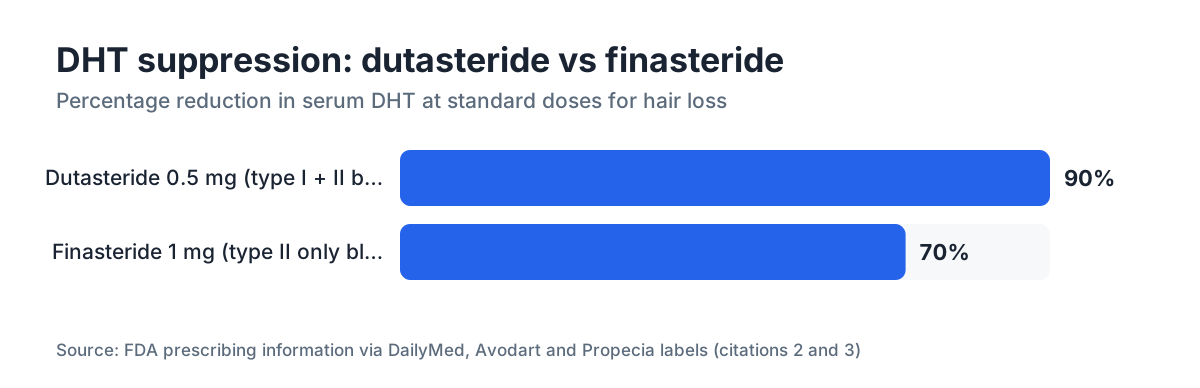
At standard doses, finasteride (1 mg/day) reduces serum DHT by roughly 70% [2]. Dutasteride (0.5 mg/day) reduces serum DHT by about 90% [3]. That extra 20 percentage points is not trivial when your follicles are sensitive to even low DHT levels.
Both are once-daily pills. Neither is a topical spray or shampoo, though compounding pharmacies do make topical versions of each. More on that later.
Is dutasteride or finasteride FDA-approved for hair loss?
Finasteride 1 mg (sold as Propecia, now mostly generic) received FDA approval for male androgenetic alopecia in 1997 [2]. That approval covers men only. The FDA has not approved it for women, and the drug carries a pregnancy warning because it can cause genital birth defects in male fetuses.
Dutasteride 0.5 mg (brand name Avodart) is FDA-approved only for benign prostatic hyperplasia (BPH), not for hair loss [3]. South Korea approved dutasteride 0.5 mg for androgenetic alopecia in 2009, and a few other countries followed. The FDA has never granted that indication in the United States.
That distinction matters for two reasons. Insurance rarely covers off-label prescriptions, so you will almost certainly pay cash for dutasteride if you use it for hair. And the data package that usually comes with an FDA hair-loss approval, including long-term safety studies in hair loss patients specifically, does not exist for dutasteride the way it does for finasteride.
Dermatologists prescribe dutasteride off-label for hair loss routinely, and off-label prescribing is legal and common. Just know you are working with a thinner evidence base and no FDA label written for your indication [4].
Which drug actually regrows more hair? What does the research show?
The best head-to-head data come from a 24-week randomized controlled trial published in the Journal of the American Academy of Dermatology (JAAD) in 2006. Researchers compared dutasteride 0.5 mg, dutasteride 2.5 mg, finasteride 5 mg, and placebo in men with androgenetic alopecia. The study's stated conclusion: "dutasteride 2.5 mg produced the greatest improvements in hair growth from baseline" [5].
A 2019 meta-analysis in JAMA Dermatology pooled data from multiple trials and found that dutasteride 0.5 mg produced statistically greater increases in total hair count compared with finasteride 1 mg over 24 weeks [6]. The gap was meaningful: roughly 12 to 15 more hairs per cm² in favor of dutasteride, depending on the study.
Long-term head-to-head data (beyond two years) are limited. Most of what we know about finasteride's staying power comes from a 5-year trial showing continued benefit with no major efficacy drop-off [2]. Dutasteride's long-term hair data lean on extrapolation from the BPH literature and smaller open-label studies.
Dutasteride likely outperforms finasteride on hair count, especially in the short term. If maximizing regrowth is your only variable, dutasteride looks better on paper. But that is not the only variable.
How do the side effects of dutasteride vs finasteride compare?
Both drugs share the same category of sexual side effects: decreased libido, erectile dysfunction, and reduced ejaculate volume. In finasteride's Phase III trials, these occurred in roughly 3.8% of men versus 2.1% on placebo [2]. Dutasteride's BPH trial data show similar rates, in the 4 to 6% range depending on the outcome measured [3].
The key difference is duration. Finasteride has a half-life of 6 to 8 hours; it clears your system in a few days after you stop [2]. Dutasteride has a half-life of roughly 5 weeks [3]. If you develop side effects and stop taking it, dutasteride keeps suppressing DHT for months. That is not a hypothetical: it is the main reason many dermatologists start patients on finasteride rather than dutasteride.
Post-finasteride syndrome (PFS) is a contested but real patient experience where sexual and cognitive side effects persist after stopping the drug. The FDA updated the finasteride label in 2012 to note that some side effects may continue after discontinuation [2]. Whether dutasteride carries a similar persistent-effect risk is unknown, largely because the PFS research on dutasteride does not exist at scale.
For women, neither drug is straightforward. Finasteride is sometimes prescribed off-label to post-menopausal women for hair loss; dutasteride is used the same way in some practices. Both demand strict contraception in women of childbearing age because of teratogenicity risk. AAD guidance notes that finasteride is not approved for use in premenopausal women [4].
At the population level, the side-effect profile is genuinely close to a toss-up. But dutasteride's long half-life makes its side effects harder to reverse quickly, and that alone tips a lot of first-line decisions toward finasteride.
Dutasteride vs finasteride: quick comparison
The table below sums up the key differences. All figures come from FDA labeling and peer-reviewed trials cited in this article.
| Finasteride 1 mg | Dutasteride 0.5 mg | |
|---|---|---|
| FDA-approved for hair loss | Yes (men only, 1997) | No (off-label in US) |
| 5AR isoforms blocked | Type II only | Type I and II |
| DHT suppression | ~70% | ~90% |
| Half-life | 6-8 hours | ~5 weeks |
| Typical monthly cost (generic) | $10-$30 | $30-$80 |
| Hair count advantage at 24 weeks | Reference | +12-15 hairs/cm² vs finasteride |
| Approved for BPH | Yes (5 mg, Proscar) | Yes (0.5 mg, Avodart) |
| Teratogenic risk | Yes | Yes |
Cost ranges are approximate cash-pay generic prices in the United States as of mid-2025. Actual prices vary by pharmacy; GoodRx and similar tools can narrow the range for your location.
What is topical dutasteride, and is it better than oral?
Topical formulations of both finasteride and dutasteride exist, compounded by specialty pharmacies. The appeal is obvious. Apply it to the scalp, reduce systemic DHT suppression, and in theory get fewer sexual side effects.
The data for topical dutasteride are thin but promising. A randomized trial published in the British Journal of Dermatology in 2021 found that topical dutasteride 0.1% solution applied once weekly improved hair density and reduced scalp DHT without significantly suppressing serum DHT at that dose [7]. Genuinely interesting, though the study was small and short.
Topical finasteride has more clinical backing. A randomized trial found that 0.25% topical finasteride reduced scalp DHT comparably to oral finasteride while suppressing systemic DHT less [8]. That study was also limited in size, but the mechanism holds up.
No topical version of either drug is FDA-approved for hair loss in the United States. If you go this route you are relying on compounded products, which have variable quality control and no FDA review of the specific formulation [9].
For most people starting treatment, an oral generic is simpler, cheaper, and better studied. Topical versions make more sense for people who hit systemic side effects on the pill and want to stay in the drug class.
Who should use dutasteride instead of finasteride?
The honest answer: people who have already run finasteride for at least 12 months, seen partial response, and want to push harder. Switching to dutasteride in that scenario is a reasonable clinical move that many dermatologists make.
Dutasteride may also fit if you have a strong family history of aggressive androgenetic alopecia and your dermatologist wants to hit DHT hard from the start. Some research suggests men at Norwood stage III or higher may benefit more from deeper DHT suppression [6].
Who should probably start with finasteride: anyone new to 5-AR inhibitors, anyone who values being able to stop the drug quickly if side effects show up, and anyone on a tighter budget. The FDA approval for hair loss counts for something too, since it comes with a well-defined label and decades of post-market safety data.
For women, especially post-menopausal women with diffuse thinning, the math is different. Some dermatologists prefer dutasteride here because of the stronger DHT suppression, but the evidence base for either drug in women is weaker than in men [11]. Talk through the AAD guidelines with your doctor before deciding [4].
If you want a clearer read on your hair loss pattern before committing to either drug, the free AI hair analysis at MyHairline can help you document baseline density and track change over time. That matters, because both drugs need at least 6 to 12 months before you can judge them fairly.
How long does it take to see results with each drug?
Neither drug works fast. With finasteride 1 mg, the 5-year trial showed measurable hair count improvement at 6 months, continued gains through year 2, and maintenance after that [2]. Most patients and most dermatologists set a 12-month minimum before calling the drug a success or a failure.
Dutasteride appears to work a bit faster in head-to-head studies. The JAAD trial showed meaningful differences in hair weight and count at 12 weeks with higher doses [5]. At the standard 0.5 mg dose, most people start noticing something around 4 to 6 months.
Initial shedding is possible with both drugs. This is sometimes called a telogen effluvium response, where miniaturized hairs accelerate through their cycle before the follicle stabilizes. It is alarming but not a sign the drug is failing. It usually resolves within 3 months.
Here is the part people ignore. If you switch from finasteride to dutasteride hoping for faster results, you may see incremental improvement, but you are not shortcutting the timeline. Hair follicles grow slowly no matter how much DHT you suppress.
Can you take dutasteride and minoxidil together?
Yes, and it is one of the most common combination regimens in hair loss treatment. Minoxidil works through a completely different mechanism: it extends the anagen (growth) phase of the hair cycle and increases follicular blood flow, independent of DHT [10]. Pairing a 5-AR inhibitor with minoxidil hits two separate biological pathways at once.
A 2021 review in the Journal of the American Academy of Dermatology reported that oral minoxidil combined with 5-AR inhibitor therapy produced greater hair count increases than either drug alone in men with androgenetic alopecia [10]. The work centered on finasteride, but the principle extends to dutasteride.
The combination of finasteride and minoxidil is the most studied pairing. Swapping dutasteride in for finasteride is reasonable but rests on less direct trial evidence.
If you are already on both a 5-AR inhibitor and minoxidil and still losing ground, that is a more serious signal worth taking to a dermatologist. At that point a hair transplant consultation may be worth adding, not as a replacement for medication but as a complement to it.
What about cost and access? Is dutasteride worth the extra money?
Generic finasteride 1 mg is one of the cheapest long-term medications in hair loss. At many pharmacies, a 30-day supply runs $10 to $30 cash-pay with discount cards. Generic dutasteride 0.5 mg typically runs $30 to $80 per month cash-pay, with prices swinging by pharmacy and region.
Because dutasteride is not FDA-approved for hair loss, most insurance plans will not cover it for that use. Finasteride for hair loss is also frequently excluded from coverage, but the lower price keeps it manageable out of pocket.
These are lifetime commitments. Both drugs must be taken indefinitely; stopping either one generally reverses the gains within 6 to 12 months. At $40 extra per month for dutasteride, that is roughly $480 more per year, and you may be at this for a decade or more. Whether that delta earns its keep depends entirely on how you respond to finasteride first.
I would not start with dutasteride unless there is a clear clinical reason. Try finasteride for a year. If the response is partial and you tolerate it well, then the upgrade conversation with your doctor makes sense. Paying more for a drug that may not outperform the cheaper one in your specific biology is not obviously rational.
For the wider picture on DHT blockers and where these two drugs sit among them, it helps to know what other options exist and what the evidence actually says about each.
Are there any alternatives if you cannot tolerate either drug?
Some people cannot tolerate 5-AR inhibitors, either because of side effects or because they are women of childbearing age where the teratogenicity risk is a dealbreaker. A few alternatives worth knowing:
Minoxidil (topical or oral) is the most studied alternative and works without touching androgens at all. Oral minoxidil at low doses (0.625 to 2.5 mg in women, 2.5 to 5 mg in men) has a growing evidence base and is increasingly used off-label.
Spironolactone is an anti-androgen used in women for hair loss. It has a long track record in dermatology, though it is not FDA-approved specifically for alopecia.
Ketoconazole shampoo has mild anti-androgenic effects at the scalp and is sometimes added as an adjunct rather than a primary treatment.
Hair loss supplements like saw palmetto have theoretical anti-DHT activity but no randomized trial data that comes close to finasteride or dutasteride in quality.
For a receding hairline that has already progressed a lot, the reality is blunt. Medications can slow the process and sometimes partially reverse it, but surgical restoration is the only option that reliably fills in areas of significant loss. A consultation to pin down your stage (using the Norwood scale for a receding hairline) before committing to years of medication is time well spent.
If you want an objective baseline before your first dermatology appointment, MyHairline's free AI scan can document your current hair density in a shareable format. That is useful evidence to bring to any clinical conversation.
Sources
- National Library of Medicine, StatPearls: Androgenetic Alopecia
- DailyMed (NIH): Finasteride 1 mg (Propecia) prescribing information
- DailyMed (NIH): Dutasteride 0.5 mg (Avodart) prescribing information
- American Academy of Dermatology: hair loss diagnosis and treatment information
- Olsen EA et al., Journal of the American Academy of Dermatology, 2006
- Shanshanwal SJ et al., JAMA Dermatology, 2019 meta-analysis of 5-AR inhibitors for androgenetic alopecia
- Caserini M et al., British Journal of Dermatology, 2021: topical dutasteride trial
- Hajheydari Z et al., topical finasteride vs oral, randomized trial, 2009
- FDA: Compounding and the FDA questions and answers
- Randolph M and Tosti A, Journal of the American Academy of Dermatology, 2021: oral minoxidil for hair loss review
- van Zuuren EJ et al., Cochrane Database of Systematic Reviews: Interventions for female pattern hair loss
- Kaufman KD et al., finasteride 5-year long-term efficacy study, JAAD 2002