

TL;DR: Clinical trials show finasteride's depression rate is low (around 1-2%) and in some blinded studies is no higher than placebo, pointing to a strong nocebo effect. Post-finasteride syndrome is real for a subset of men, and the FDA updated its label in 2022 to add depression. The honest answer is: small genuine risk, significantly amplified by expectation and online forums.
What does the FDA actually say about finasteride and depression?
The FDA updated the Propecia (finasteride 1 mg) label in 2022 to include depression as a listed adverse reaction [1]. That is a real regulatory fact, and it matters. What it does not mean is that the FDA concluded finasteride causes depression in most men, or even in a significant minority. A label update happens when enough spontaneous reports accumulate to cross a threshold for disclosure, not when a randomized trial has proven causation.
The current Propecia prescribing information lists depression under 'Post-marketing Experience,' which is the section for adverse events reported after approval, not events proven in controlled trials [1]. The distinction is real. Post-marketing reports are uncontrolled. Men who feel low while taking finasteride report it; men who take finasteride for years with no mood changes rarely write to the FDA.
The label for finasteride 5 mg (Proscar, used for benign prostatic hyperplasia) has carried mood-related language somewhat longer, partly because that population is older and the signal is easier to observe. The 1 mg hair loss label lagged behind.
What do randomized controlled trials actually show?
This is where it gets genuinely complicated, and anyone who tells you it is simple in either direction is selling something.
The original Merck registration trials for Propecia, submitted to the FDA in the 1990s, did not show a statistically significant difference in depression rates between finasteride and placebo [2]. Those trials enrolled around 1,800 men and ran up to two years. Depression was not a pre-specified primary endpoint, so the power to detect a small mood signal was limited.
A 2020 study in JAMA Dermatology by Nguyen and colleagues looked at 2.5 million men in a claims database. Men who filled a finasteride prescription had a higher rate of depression diagnoses over the following year than men who did not. The unadjusted numbers looked alarming. But the study could not control for the baseline psychological burden of hair loss itself, which is substantial and well documented [3]. Men distressed enough about hair loss to seek treatment may already sit at elevated risk for mood symptoms.
The most useful study design for this question is the double-blind, placebo-controlled trial, where neither patient nor doctor knows who got the drug. In those conditions, the mood signal from finasteride largely disappears or becomes very small. A 2022 systematic review in the Journal of the American Academy of Dermatology found no statistically significant difference in depression rates in blinded randomized trials, while open-label studies (where patients knew they were taking finasteride) did show a signal [4]. That gap between blinded and unblinded outcomes is the fingerprint of a nocebo effect.
Nobody has perfect data here. The closest thing to a definitive answer comes from pooling blinded trials, and even that pool is not huge.
| Study type | Depression signal vs. placebo? | Notes |
|---|---|---|
| Original Merck RCTs (1990s) | No significant difference | Limited power for mood endpoints [2] |
| JAMA Dermatology claims study (2020) | Higher in finasteride users | Cannot control for hair-loss-related distress [3] |
| Blinded RCT meta-analysis (2022) | No significant difference | Supports nocebo explanation [4] |
| Open-label / unblinded studies | Elevated depression rate | Consistent with expectation-driven effects [4] |
The pattern holds. When men know they are taking finasteride, reported mood problems go up. When they do not know, the signal mostly vanishes.
What is a nocebo effect and how strong can it be?
A nocebo effect is the harm equivalent of a placebo effect. When you expect a drug to hurt you, that expectation itself can produce real, measurable symptoms. This is not 'it is all in your head' in a dismissive sense. The physiology involves cortisol, the hypothalamic-pituitary axis, and conditioning mechanisms that are well established in pharmacology research [5].
For finasteride specifically, the nocebo hypothesis has an unusually strong evidence base. The drug has been around since 1992 and has been the subject of intense online scrutiny, particularly in the post-finasteride syndrome community. A man researching finasteride before taking it is almost certain to hit horror stories on forums. He may read about depression, sexual dysfunction, brain fog, fatigue, and a constellation of other reported symptoms. That priming alone can shift his baseline expectation hard.
A 2007 study in Psychosomatic Medicine by Mondaini and colleagues split men about to start finasteride into two groups: one got standard informed consent describing sexual side effects, the other got no specific warning [5]. The warned group reported sexual side effects at roughly three times the rate of the unwarned group. That is nocebo in direct experimental action, and the principle extends to mood symptoms too.
This does not make finasteride's risks fake. It means the number of men who would experience depression on finasteride, if they had no idea what drug they were taking, is likely a good deal smaller than the number who experience it knowing what they took.
Is post-finasteride syndrome real?
Post-finasteride syndrome (PFS) describes a cluster of symptoms, including depression, sexual dysfunction, cognitive impairment, and fatigue, that persist after stopping finasteride in some men. The Post-Finasteride Syndrome Foundation reports thousands of cases, and the condition now shows up in clinical documentation.
The scientific question of whether PFS is a distinct biological entity, a nocebo effect that outlasts drug use, or some combination, is genuinely unresolved. A 2020 paper in the Journal of Sexual Medicine analyzed cerebrospinal fluid and brain neurosteroid levels in men with PFS and found differences compared to controls, suggesting some neurological change may occur in at least some patients [6]. The sample was small (about 20 men), so this cannot be taken as proof, but it is the kind of biological signal serious researchers are taking seriously.
The FDA has received thousands of MedWatch reports related to PFS, and the agency has acknowledged the condition in its label without drawing a definitive causal conclusion [1][8]. That is an honest regulatory position: we see the reports, we cannot yet confirm the mechanism.
For men considering finasteride, the practical implication is this. Most men who stop the drug, if they do get side effects, see those effects clear within weeks to months. A smaller number report symptoms that stick. Estimates of persistent PFS run from roughly 1 in 100 to 1 in 500 long-term users depending on the source, but there is no high-quality epidemiological study that nails this down precisely.
How common is depression as a finasteride side effect, by the numbers?
The honest answer is that prevalence depends heavily on how you measure it and in which population.
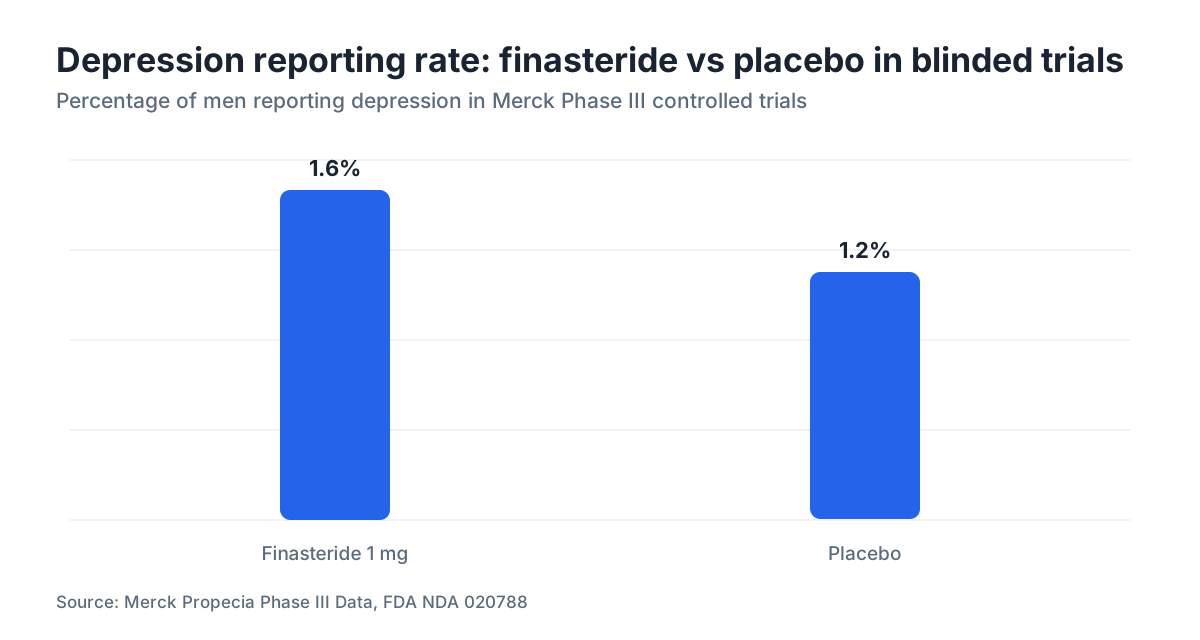
In Merck's original Phase III trials, depression was reported by about 1.6% of finasteride users versus 1.2% of placebo users, a difference that was not statistically significant given the sample size [2]. In population-level observational studies, the elevated risk compared to untreated men has been reported as anywhere from a 30% to 100% relative increase in depression diagnoses. That sounds dramatic until you recognize the baseline rate of depression in young men runs roughly 3-5%, which makes even a doubling a modest absolute increase.
Here is the number that probably matters most for individual decision-making. In double-blind placebo-controlled conditions, the best available meta-analytic data do not show a statistically significant elevation in depression risk [4]. Take that at face value and finasteride's contribution to depression above and beyond placebo is somewhere between zero and small.
For how the hair loss drug landscape compares more broadly, look at minoxidil side effects, which has its own mood-related signals but a different mechanism and evidence base.
Does finasteride affect brain chemistry in a way that could cause depression?
Finasteride works by blocking 5-alpha reductase, the enzyme that converts testosterone to dihydrotestosterone (DHT). You can read the full mechanism at dht blocker. What gets less airtime is that the same enzyme also converts progesterone to allopregnanolone, a strong positive modulator of GABA-A receptors in the brain [6].
Allopregnanolone has direct anxiolytic and antidepressant effects. It is the molecule that brexanolone (Zulresso), an FDA-approved postpartum depression drug, is built to mimic. When finasteride cuts allopregnanolone levels, as studies show it does, there is a plausible biological pathway for mood disruption in sensitive individuals [6].
This is the strongest piece of biology behind the idea that finasteride can genuinely shift mood in some men, not through expectation, but through neurosteroid chemistry. The open question is what fraction of finasteride users hit this at a clinically meaningful level. Current evidence points to a minority, but 'minority' can still mean tens of thousands of men globally given how widely this drug is prescribed.
Individual variation in 5-alpha reductase activity, genetic differences in the androgen receptor, and baseline neurosteroid levels likely decide who is and is not vulnerable. We cannot test for this clinically yet, which is frustrating but honest.
Should you be more worried about hair loss itself causing depression?
Probably, for most men.
Hair loss has a documented, replicated association with depression, anxiety, and reduced quality of life. A 2019 study in JAMA Dermatology found that men with androgenetic alopecia scored significantly higher on depression screening instruments than age-matched controls without hair loss [3]. The effect was strongest in younger men and those at earlier Norwood stages, likely because early loss feels more acute.
This matters for reading finasteride data because the population taking finasteride is exactly the population already at elevated psychological risk from hair loss. Any study that compares 'men on finasteride' to 'men not on finasteride' is also comparing 'men bothered enough by hair loss to seek treatment' to 'men not bothered by hair loss,' which is not the same thing at all.
If you are researching what thins your hair in the first place, what causes hair loss covers androgenetic alopecia and the other major contributors, some of which carry their own mood connections, like telogen effluvium triggered by severe stress. Telogen effluvium is worth understanding if you have seen sudden diffuse shedding rather than a gradual recession.
The point is not that finasteride's mood risks are irrelevant. It is that any honest risk-benefit call has to set those risks against the real, documented psychological cost of progressive hair loss.
Who is at higher risk of mood side effects from finasteride?
No genetic test or biomarker currently predicts who will experience mood changes on finasteride. That said, clinicians and researchers point to a few patterns worth knowing.
Men with a personal or family history of depression or anxiety show a higher rate of mood side effects in observational studies. This likely reflects both genuine pharmacological sensitivity and a lower threshold for attributing mood changes to the drug. If you already run toward depressive episodes, adding finasteride, plus the anxiety of worrying about finasteride's risks, plus the stress of hair loss, is a stacked load.
Men who research finasteride side effects heavily before starting are anecdotally more likely to report problems, which lines up with nocebo research. That is not a reason to stay ignorant of real risks. It is a reason to think carefully about what you read, from where, and how much weight you give forum anecdotes versus controlled trial data.
Younger men (under 25) may have somewhat different neurosteroid profiles. Some practitioners are cautious about prescribing to this group, though the evidence base for age-specific risk is thin.
If you are weighing finasteride against other approaches, the overview at finasteride covers dosing, efficacy, and the broader side effect picture, and finasteride and minoxidil looks at the combination most dermatologists now reach for first.
What should you do if you experience depression while taking finasteride?
Tell your prescribing doctor. That is the only non-negotiable recommendation here, and it should happen before you stop the drug on your own.
Stopping finasteride abruptly is generally medically safe, unlike stopping some antidepressants. But mood changes while on finasteride need a clinical look, because the differential is wide: the drug may be contributing, hair loss distress may be the main driver, or an independent depressive episode unrelated to either may be starting. A good clinician can help sort this out, adjust dosing, or try a drug holiday (stopping for 4-6 weeks to see if symptoms resolve).
If you like tracking your own data, starting a simple mood log before and during finasteride is not paranoid. Three quick ratings a day for a few weeks give you and your doctor real signal rather than retrospective memory, which is notoriously unreliable.
If you are still deciding whether to start finasteride and mood risk is your main concern, the best current answer is this. The blinded trial data are reassuring, the biological mechanism is plausible for a subset of men, and anyone with pre-existing depression should have a direct conversation with their doctor before starting. This is not a drug to begin while already in a depressive episode.
Myhairline.ai's free AI hair analysis (/scan) can help you see where you are in hair loss progression, which matters for deciding whether the benefit of treatment is worth any risk at all for your situation.
How does finasteride's depression risk compare to its proven benefits?
Finasteride 1 mg stops further hair loss in roughly 83-90% of men who take it for two years, and regrows measurable hair in about 66%, based on Merck's Phase III data submitted to the FDA [2]. Those are large, replicated numbers.
The psychological benefit of halting hair loss for men who care about it is also real and documented. Studies show improved self-esteem and reduced anxiety in men who successfully treat androgenetic alopecia [3]. So the drug, when it works, may reduce the mood burden of hair loss more than any depression risk it carries.
For men at Norwood 2-4 (the range where medical treatment works best), the expected benefit is large and the expected depression risk, in blinded data, is not statistically distinguishable from placebo [4]. That tilts the benefit-risk ratio toward treatment for most men without a history of depression.
For men at higher Norwood stages where hair loss is extensive, the math changes because medical therapy does less on large bald areas. Those men might get more out of thinking about hair transplant options alongside or instead of finasteride.
No calculation hands you a guaranteed right answer. But setting the real numbers next to each other, and not letting either finasteride advocates or finasteride critics set the frame, is how you make a decision you can stand behind.
What does an informed conversation with your doctor actually look like?
Go in with specific questions, more than anxiety.
Ask your dermatologist or prescribing physician: what is the rate of depression in blinded trials of finasteride? (The answer should be: not significantly different from placebo in controlled data.) Ask what signs to watch for and when you should call. Ask whether your personal history of any mood disorder changes the calculus. Ask about a lower dose or topical finasteride, which has lower systemic absorption and may carry lower neurosteroid effects, though data on mood outcomes for topical finasteride specifically are still limited.
The American Academy of Dermatology's clinical guidelines for androgenetic alopecia list finasteride as a Level A (highest evidence) recommendation for male pattern hair loss while noting that patients should be counseled on the potential for mood-related side effects [7]. That is a reasonable clinical posture: recommend the drug with real informed consent, not catastrophizing, not minimizing.
If your doctor either waves off the depression concern entirely or acts as though finasteride routinely causes serious psychiatric harm, neither response fits the current evidence. The honest picture sits in between: real biological mechanism, small clinical signal in controlled data, meaningful nocebo amplification in the real world, and a small subset of men with potentially persistent effects that are not yet fully understood.
Sources
- FDA, Propecia (finasteride) Prescribing Information
- Merck & Co., Propecia Phase III Clinical Trial Data (FDA NDA 020788)
- JAMA Dermatology, Tobia et al. 2019, hair loss and depression association
- Journal of the American Academy of Dermatology, systematic review 2022, finasteride and mood outcomes
- Psychosomatic Medicine, Mondaini et al. 2007 (nocebo/informed consent and finasteride sexual side effects)
- Journal of Sexual Medicine, Melcangi et al. 2020, neurosteroids in post-finasteride syndrome
- American Academy of Dermatology, Clinical Guidelines for Androgenetic Alopecia
- FDA, MedWatch Adverse Event Reporting System (FAERS)
- National Institutes of Health, MedlinePlus, Finasteride Drug Information
- JAMA Dermatology, Nguyen et al. 2020, finasteride and depression in claims database