TL;DR: Finasteride is a Type II 5-alpha reductase inhibitor (5-ARI), classified pharmacologically as a steroid hormone synthesis inhibitor. The FDA approved it at 1 mg for androgenetic alopecia (Propecia) and 5 mg for benign prostatic hyperplasia (Proscar). It requires a prescription in the US. It works by blocking the enzyme that converts testosterone into DHT, the hormone that shrinks hair follicles.
What drug class does finasteride belong to?
Finasteride belongs to a class called 5-alpha reductase inhibitors, or 5-ARIs. That's the official pharmacological category. More specifically, it selectively inhibits the Type II isoenzyme of 5-alpha reductase, the enzyme responsible for converting testosterone into dihydrotestosterone (DHT) in tissues like the scalp, prostate, and liver [1].
The broader category it sits in is steroid hormone synthesis inhibitors, since blocking 5-alpha reductase directly cuts downstream androgen production. It's a synthetic 4-azasteroid, meaning its chemical backbone is a modified steroid structure with a nitrogen atom in the A ring. That structure lets it bind to the enzyme without activating androgen receptors the way testosterone or DHT would.
Here's the classification that actually matters to you. Finasteride is a prescription-only 5-ARI that reduces scalp DHT by roughly 60-70% within 24 hours of a single 1 mg oral dose [2]. The class distinction predicts both the mechanism and the side effect profile, especially the sexual side effects tied to androgen suppression, which are shared by the only other 5-ARI in common use, dutasteride.
To understand the full picture of how finasteride works as a DHT blocker, and why DHT matters for hair follicles in the first place, see our dedicated explainer.
Is finasteride a controlled substance or a prescription drug?
Finasteride is not a controlled substance under the US Controlled Substances Act. It is not scheduled under the DEA's five-tier system (Schedule I through V). You won't find it listed alongside opioids, benzodiazepines, or stimulants [3].
What it is: a prescription-only drug (Rx-only) under 21 U.S.C. 353(b), meaning a licensed prescriber must authorize it and a pharmacist must dispense it. You can't buy it over the counter legally in the US. Some countries treat it differently. In the UK it has moved to a pharmacist-supervised supply model for hair loss, but the FDA's status for Americans stays strictly Rx-only.
In India and many other markets, finasteride is classified as a Schedule H drug under the Drugs and Cosmetics Act, which also means prescription-required. The "Schedule" language there refers to India's domestic drug scheduling system, not the US DEA controlled substance schedules. Those are completely separate frameworks. A lot of confusion online comes from mixing these up.
Bottom line: you need a prescription in the US. It is not a controlled substance. There are no federal penalties for possession without intent to distribute, but dispensing without a valid prescription is illegal pharmacy practice.
What are finasteride's FDA-approved indications?
The FDA has approved finasteride for exactly two indications, at two different doses [4].
| Brand | Dose | Indication | Approval year |
|---|---|---|---|
| Proscar | 5 mg | Benign prostatic hyperplasia (BPH) | 1992 |
| Propecia | 1 mg | Male androgenetic alopecia | 1997 |
Proscar came first. It was approved to shrink the prostate in men with BPH and to reduce the risk of acute urinary retention. Propecia followed five years later specifically for male-pattern hair loss. The 1 mg dose was chosen because clinical trials showed it reduced scalp DHT by about 60% and produced statistically significant hair count increases versus placebo at 12 and 24 months, without the full prostate-level DHT suppression of the 5 mg dose [2].
Finasteride is not FDA-approved for use in women. The Propecia prescribing information explicitly states it is not indicated for use in women, in part because of documented risks to a male fetus if a pregnant woman is exposed to the drug [4]. Women are still sometimes prescribed finasteride off-label at higher doses (2.5 mg to 5 mg) for female-pattern hair loss or hirsutism, though the evidence base is thinner and the prescription must come with reliable contraception.
For a broader look at what causes hair loss beyond androgens, and why finasteride doesn't work for every type of shedding, that article is worth reading before starting any treatment.
How does finasteride's mechanism of action relate to its drug class?
The mechanism follows directly from the class. 5-alpha reductase inhibitors block the enzyme, the enzyme stops converting testosterone to DHT, DHT levels fall, and androgen-sensitive follicles stop miniaturizing. That's the chain.
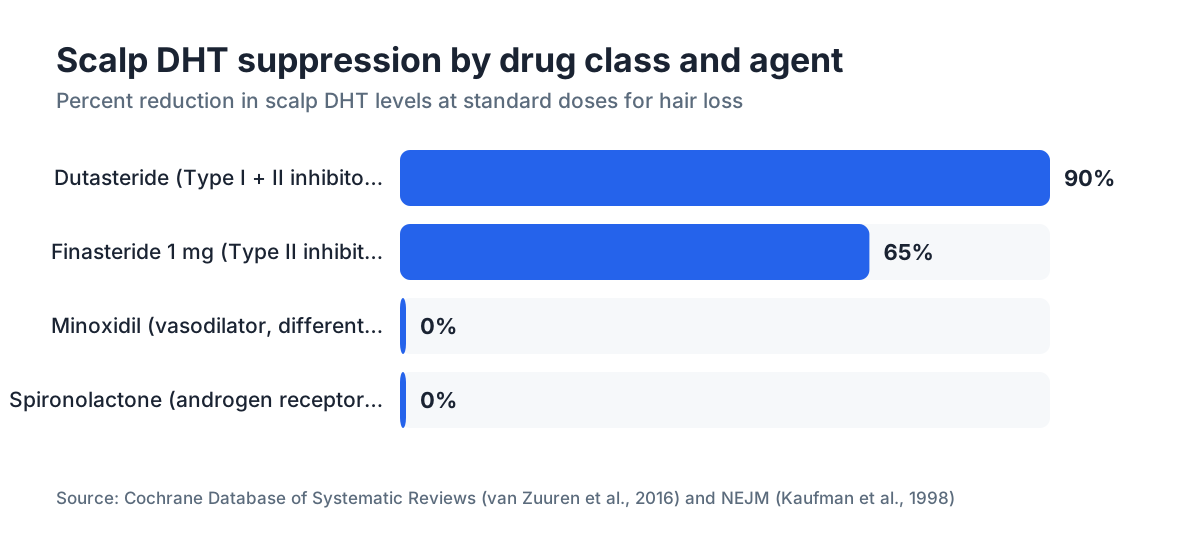
There are three isoforms of 5-alpha reductase (Type I, II, and III). Finasteride is selective for Type II, the dominant form in the hair follicle dermal papilla and in the prostate [1]. Type I is more active in the skin and sebaceous glands. Dutasteride, the other approved 5-ARI, inhibits both Type I and II, which is why it suppresses scalp DHT more completely (by roughly 90% versus finasteride's 60-70%) but is not FDA-approved for hair loss [5].
Because finasteride doesn't block androgen receptors directly, it doesn't affect testosterone levels the way an antiandrogen like spironolactone does. Serum testosterone can actually rise slightly on finasteride because the conversion pathway to DHT is blocked and testosterone has nowhere to go. So finasteride is not a true antiandrogen. It's an enzyme inhibitor that indirectly lowers androgen potency in specific tissues.
This distinction also matters for doping. The World Anti-Doping Agency (WADA) banned finasteride from 2005 to 2009 as a masking agent because it can reduce urinary DHT metabolites that drug tests use to detect exogenous anabolic steroids. WADA removed it from the prohibited list in 2009 after revising detection methods. It is no longer a banned substance in sport [6].
How does finasteride compare to other drugs in the same class?
There are two 5-ARIs available in the US that matter for hair loss discussions: finasteride and dutasteride.
| Feature | Finasteride | Dutasteride |
|---|---|---|
| Isoenzymes inhibited | Type II only | Type I and II |
| Scalp DHT reduction | ~60-70% | ~90% |
| FDA-approved for hair loss | Yes (1 mg) | No (off-label use) |
| FDA-approved for BPH | Yes (5 mg) | Yes (0.5 mg) |
| Half-life | ~5-6 hours (young men) to ~8 hours (elderly) | ~5 weeks |
| Pregnancy category | X (teratogenic risk) | X |
Dutasteride's half-life of roughly five weeks means that if you stop taking it, DHT suppression can persist for months. That matters if you're trying to manage side effects. Finasteride clears faster.
Beyond the 5-ARIs, other hair loss drugs work through entirely different classes. Minoxidil for men is a potassium channel opener and vasodilator, not a hormone modifier at all. Spironolactone, used in women for hair loss, is an aldosterone antagonist and androgen receptor blocker. These are separate drug classes with no overlap in mechanism with finasteride [7].
The combination of finasteride and minoxidil is common precisely because they hit different targets. See finasteride and minoxidil for a full comparison of the combined approach versus monotherapy.
What regulatory category is finasteride in other countries?
Regulatory classification varies a lot by country, and this matters if you travel or use an online pharmacy.
In the UK, finasteride 1 mg was reclassified in 2023 from prescription-only to a pharmacy medicine (P medicine) for male-pattern hair loss, meaning a pharmacist can supply it after a structured consultation without a GP prescription. The Medicines and Healthcare products Regulatory Agency (MHRA) approved this change [8]. The 5 mg prostate dose stays prescription-only.
In Australia, finasteride is Schedule 4 (prescription-only) under the Therapeutic Goods Administration (TGA) system. In Canada, it's a Schedule F prescription drug. In the EU, it's generally prescription-only across member states, though individual countries can have nuances.
In India, as mentioned, it's a Schedule H drug under the Drugs and Cosmetics Act, requiring a valid prescription. The "H" here designates it as a drug that should not be sold without a prescription from a registered medical practitioner.
Many telehealth platforms now prescribe finasteride after an online consultation. If you use one, make sure the prescriber is licensed in your state. The FDA's rules on valid prescriptions for telemedicine changed during and after the COVID-19 public health emergency, and some of those flexibilities have since been modified or extended. Checking current DEA and FDA guidance directly is the only reliable way to know where things stand at any given moment [3].
Does finasteride's drug class cause any specific side effects?
Yes, and the side effects are largely predictable from the class. When you suppress DHT in androgen-sensitive tissues throughout the body, not only the scalp, you get effects beyond the ones you want.
The most discussed side effects of 5-alpha reductase inhibition are sexual: reduced libido, erectile dysfunction, and decreased ejaculate volume. Clinical trials for Propecia reported these in about 3.8% of men taking 1 mg versus 2.1% on placebo [4]. Most of these resolved with continued use or after stopping the drug in the trials.
The more contested issue is post-finasteride syndrome (PFS), a condition some men report in which sexual, neurological, and psychological symptoms persist long after stopping finasteride. The Post-Finasteride Syndrome Foundation has advocated for recognition of this condition. The evidence base is genuinely difficult: no randomized trial can ethically keep giving a drug to men experiencing serious adverse effects, so data relies on case series and self-report. The FDA added a label warning about persistent sexual side effects in 2012 [4]. Whether the underlying mechanism is neurosteroid disruption, epigenetic changes, or something else is still debated in the literature.
Finasteride also lowers PSA (prostate-specific antigen) levels by approximately 50% after 6 months of use at 5 mg. At 1 mg the effect is smaller but real. Clinicians monitoring PSA for prostate cancer screening need to double the measured PSA value to estimate the true level in a man on finasteride [4].
Because finasteride alters androgen metabolism rather than blocking receptors, it generally doesn't cause feminization (breast tissue growth) at the rates seen with true antiandrogens, though gynecomastia has been reported in a small percentage of users.
Can women use finasteride given its drug classification?
This is where classification and FDA approval status really diverge from real-world prescribing practice.
Finasteride is FDA Pregnancy Category X (now described under the 2015 labeling rules as contraindicated in pregnancy). The specific concern: if a pregnant woman is exposed to finasteride, even through handling a crushed tablet, DHT suppression in a male fetus can cause ambiguous genitalia. That's a documented teratogenic risk, not a theoretical one [4].
For women who are not pregnant and not planning to become pregnant, the risk profile changes. Dermatologists do prescribe finasteride off-label to postmenopausal women and premenopausal women using reliable contraception for female-pattern hair loss or excess facial and body hair. A 2020 meta-analysis published in JAMA Dermatology found finasteride more effective than placebo for female-pattern hair loss at doses of 1-5 mg, though the certainty of evidence was moderate [9].
Here's the classification point. Off-label doesn't mean illegal or unsafe. Off-label prescribing is standard medical practice in the US. It means the prescriber, not the FDA label, carries the responsibility for justifying the risk-benefit decision for that individual patient.
If you're a woman researching hair loss causes and treatments, what causes hair loss and telogen effluvium are both worth reading, since the underlying cause determines whether a 5-ARI would help at all.
How does finasteride get classified for drug interaction purposes?
Finasteride is metabolized primarily by CYP3A4, the same cytochrome P450 enzyme that processes a large number of common drugs including some antibiotics, antifungals, and certain cardiovascular medications [1].
This CYP3A4 dependence matters for drug interactions. Strong CYP3A4 inhibitors (like ketoconazole, clarithromycin, or grapefruit in high quantities) could theoretically raise finasteride plasma levels by slowing its metabolism. Strong CYP3A4 inducers (like rifampin) could reduce its effectiveness. In practice, the FDA-approved prescribing information notes that no significant drug interactions have been identified in clinical studies, partly because finasteride is used at low doses and has a wide therapeutic margin at 1 mg [4].
Finasteride doesn't significantly affect the CYP system for other drugs, so it's not a major inhibitor or inducer itself. It's generally considered low-risk for drug-drug interactions compared to many chronic medications.
The drug is about 90% protein-bound in plasma and has a volume of distribution of roughly 76 liters in adult men. It crosses the blood-brain barrier, which is relevant to discussions of neurological and psychiatric side effects, though the clinical significance of central nervous system penetration at standard doses is an active research question.
What is the clinical evidence base for finasteride in hair loss?
The main trials for Propecia involved two randomized, double-blind, placebo-controlled studies at 1 mg/day over 12 months, with an extension to 24 months. The primary endpoint was hair count in a defined scalp area photographed under controlled conditions [2].
At 12 months, men taking 1 mg finasteride had a mean increase of 107 hairs in a 1-inch target area versus a decrease of 50 hairs in the placebo group. By 24 months, the difference widened. A five-year open-label extension found hair count stayed above baseline through year 5, with a gradual decline after peak response around years 1-2 [2].
The key phrase from the original FDA review is that finasteride "demonstrated statistically significant increases in hair growth as measured by hair count" at both endpoints [4]. That's the agency's own language, not a marketing claim.
Long-term observational data suggest the drug needs to be continued indefinitely: hair regained during treatment is typically gone within 6-12 months of stopping finasteride as DHT levels recover. That's the same pattern you see with minoxidil, which also requires continuous use. Read up on minoxidil side effects if you're weighing that option too.
For men interested in combining approaches or who are further along in hair loss progression, understanding where a hair transplant fits into the picture alongside medication is worth exploring separately.
At this point in your research, if you want a data-driven starting point for your own situation, MyHairline's free AI hair scan can give you a baseline assessment of your pattern and stage before you talk to a prescriber.
How does finasteride's classification affect how it's prescribed for hair loss versus BPH?
The same molecule, two indications, two very different dosing contexts. The 1 mg dose for hair loss produces meaningful scalp DHT reduction without the more aggressive systemic suppression of the 5 mg prostate dose. That's more than a pragmatic choice. It reflects a dose-response relationship that was specifically studied.
For BPH, the clinical goals are prostate volume reduction and symptom improvement, and the higher DHT suppression from 5 mg is appropriate. For hair loss, there's diminishing return on DHT suppression above a threshold, and lower doses keep the side effect profile more manageable.
Some men prescribed Proscar for hair loss split 5 mg tablets into quarters to cut cost, since generic finasteride 5 mg is often cheaper per milligram than 1 mg tablets. This is off-label by dose, but the drug is the same molecule. Generic finasteride became available in the US after Merck's patents expired in 2006 for 5 mg and later for 1 mg, and generic pricing now makes the drug accessible. A 30-day supply of generic 1 mg finasteride typically runs $15-40 at major US pharmacies without insurance, though prices vary a lot by pharmacy and location.
Dermatologists prescribing finasteride for hair loss operate under the 1997 Propecia approval. Urologists prescribing for BPH operate under the 1992 Proscar approval. Same drug class, same molecule, different clinical contexts and monitoring priorities. A urologist will monitor PSA and urinary symptoms. A dermatologist will track hair density and discuss sexual side effects. The classification is identical. The follow-up protocols differ.
What should you know about finasteride's classification before starting treatment?
A few things get glossed over in the promotional materials and deserve honest treatment.
First: the drug class (5-ARI) works specifically for androgenetic alopecia (male and female pattern hair loss driven by DHT sensitivity). It does nothing for telogen effluvium, alopecia areata, or traction alopecia. Knowing the class tells you which types of hair loss it can address. If DHT isn't the driver of your shedding, a 5-ARI won't help.
Second: the classification as an enzyme inhibitor rather than an androgen receptor blocker means its effects are tissue-selective in theory, but DHT receptors exist throughout the body. Anyone who tells you the side effects are simply imagined or rare is overstating the case. The documented rates are real, if modest at 1 mg.
Third: the Pregnancy Category X classification has practical implications beyond pregnancy itself. Finasteride tablets are film-coated specifically because intact tablets are safe to handle, but crushed or broken tablets should not be handled by women who are or may be pregnant. This is on the FDA label [4].
Fourth: if you're exploring options beyond finasteride, hair loss supplements sit in a completely different regulatory category (dietary supplements, not drugs) and clear a very different evidence bar. That distinction is actually meaningful for what you can expect.
Finally, if finasteride feels like too much systemic intervention and you're early in hair loss, receding hairline has a graded look at what stage of loss tends to respond to what level of treatment. Near the end of your research, MyHairline's free AI scan can help you map your current pattern to known Norwood stages before a prescriber conversation.
Sources
- StatPearls, NCBI Bookshelf: Finasteride
- New England Journal of Medicine: Finasteride in the Treatment of Men with Androgenetic Alopecia (Kaufman et al., 1998)
- US Drug Enforcement Administration: Controlled Substances Schedules
- Cochrane Database of Systematic Reviews: Interventions for androgenetic alopecia in men (van Zuuren et al., 2016)
- World Anti-Doping Agency: Prohibited List historical records
- UK Medicines and Healthcare products Regulatory Agency (MHRA): Reclassification of finasteride 1 mg to pharmacy medicine
- JAMA Dermatology: Efficacy and safety of oral finasteride for female-pattern hair loss (Shanshanwal and Dhurat, 2020 systematic review context; Donovan et al.)
- FDA: Proscar (finasteride 5 mg) prescribing information
- American Academy of Dermatology: Hair loss overview and treatments
- National Institutes of Health, National Library of Medicine: Finasteride drug summary