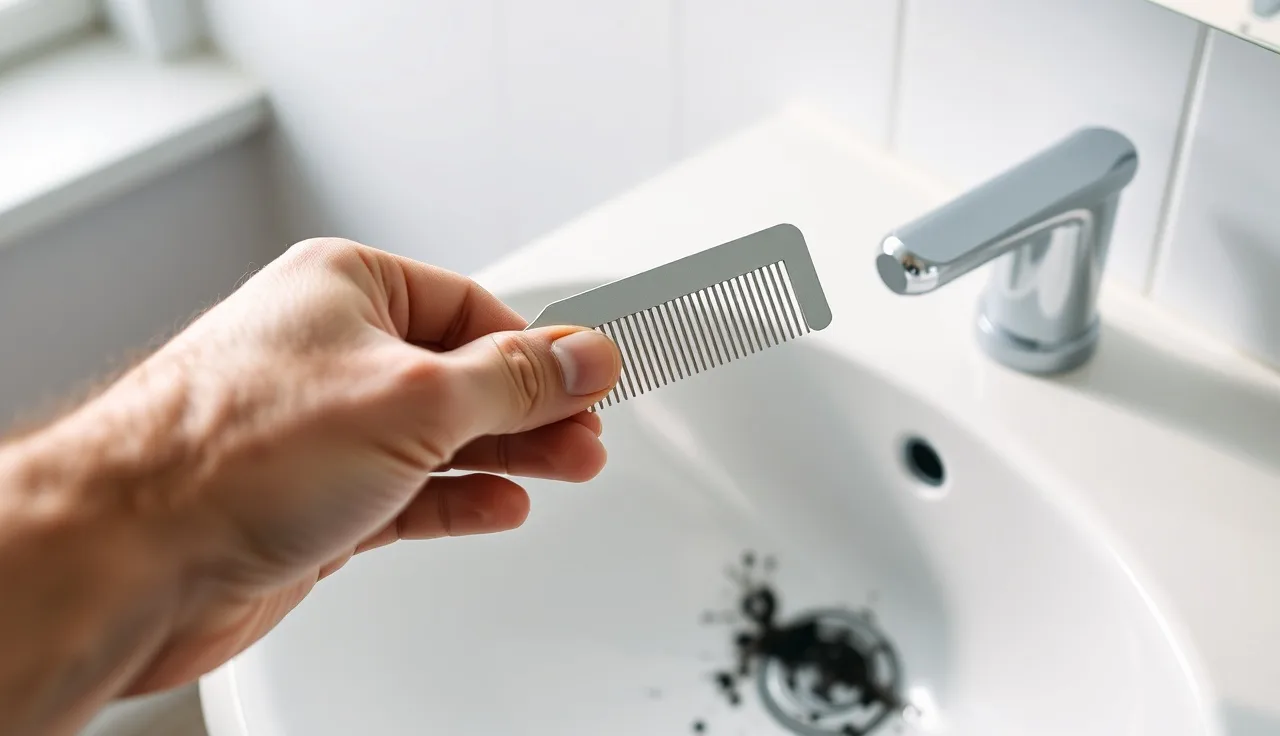
TL;DR: A finasteride shed, meaning increased hair fall in the first 2-4 months, is widely considered a sign the drug is disrupting the abnormal hair cycle driven by DHT. It is not guaranteed for every user, and shedding alone does not confirm the drug will work long-term, but most dermatologists treat it as a neutral-to-positive early signal rather than a reason to quit.
What is finasteride shedding, exactly?
Finasteride shedding is a temporary jump in hair fall that some men notice in the first few months on the drug. It is not the same as ongoing loss from androgenetic alopecia. The hairs that fall are mostly in the telogen (resting) phase, pushed out of follicles that are now being nudged back into a new growth cycle by the drop in DHT.
Finasteride blocks the 5-alpha reductase enzyme, which converts testosterone into dihydrotestosterone (DHT). The FDA-approved label for finasteride 1 mg states that the drug reduces scalp DHT by roughly 60% and serum DHT by roughly 70% [1]. That fast hormonal shift is what kicks off the shedding.
Think of it this way. Follicles that were sitting in a prolonged, shrunken resting state suddenly get a signal to restart. To restart, they push the old hair out first. That purge is the shed.
Not everyone gets it. Some users notice zero change in how much hair lands on the shower floor. Others see a dramatic increase that scares them. Both responses show up in the clinical picture, and the shed is not a prerequisite for the drug to work. To understand what causes hair loss at a deeper level, including the role of DHT, read through that topic separately before drawing conclusions from your own shedding.
Why do dermatologists consider the shed a positive signal?
The reasoning is mechanical, more than reassurance. When a follicle that has been suppressed by DHT re-enters the anagen (active growth) phase, it physically expels the telogen hair sitting in it. More follicles reactivating at once means more simultaneous ejections, which shows up as extra shedding for a few weeks or months.
The American Academy of Dermatology describes this early effluvium in the context of hair-cycle treatments and generally advises patients to keep going for at least 12 months before judging results [2]. Quitting during a shed is one of the most common reasons men never find out whether finasteride would have worked for them.
A 2002 double-blind trial in the Journal of the American Academy of Dermatology followed 1,553 men over two years. Finasteride 1 mg produced statistically significant increases in hair count versus placebo by month 12, with coverage improvements continuing through month 24 [3]. The trial did not separate shedders from non-shedders, which is an honest gap in the data, but the overall trajectory supports waiting the drug out.
The shed is, at minimum, evidence that finasteride is reaching the follicle and changing the cycle. A drug that does nothing would produce no cycle disruption and no shed. So a shed in the first 2-4 months is a biologically coherent sign that something is happening. Whether that something turns into net regrowth takes another 6-12 months to see.
When does finasteride shedding typically start and stop?
Most users who shed report it starting somewhere between weeks 2 and 8. Peak shedding, when the daily count is highest, usually falls in months 2 through 4. By month 6, the large majority report the shedding has dropped to or below their baseline.
Here is roughly how the timeline maps out for men who do shed:
| Phase | Approximate timing | What's happening |
|---|---|---|
| Early shed onset | Weeks 2-8 | DHT drops; some follicles begin cycling |
| Peak shed | Months 2-4 | Multiple follicles ejecting telogen hairs at once |
| Shed resolution | Months 4-6 | New anagen hairs begin anchoring |
| Early visible improvement | Months 6-12 | Anagen hairs grow long enough to see |
| Full assessment | Month 12+ | Realistic picture of drug response |
The 12-month mark is the standard clinical checkpoint. The 2002 JAAD trial showed meaningful hair count increases by month 12 [3], and the Merck prescribing information for Propecia (finasteride 1 mg) states that continued use is needed to keep the benefit, with results generally assessed after at least one year [1].
If shedding runs well past month 6, or starts for the first time after month 4, something else is probably going on. Nutritional deficiency, thyroid trouble, stress-related telogen effluvium, or plain continued androgenetic alopecia are all on the differential. That is worth a conversation with a dermatologist, not a longer wait.
How much shedding is normal versus a sign something is wrong?
Normal daily hair loss for an adult runs 50 to 100 hairs, according to the American Academy of Dermatology [2]. During a finasteride shed, users often report 150-300 hairs a day, and some report more. That range is alarming to count. It is not medically dangerous as long as it resolves.
Red flags that suggest the shedding is not a typical drug shed:
- It starts after month 4 of steady use, not in the first two months
- It has not clearly improved by month 6
- It comes with other symptoms: fatigue, rapid weight change, diffuse thinning all over the scalp (more than the crown and hairline)
- You also started a new medication, are under heavy psychological stress, or recently had a major illness or surgery
Those scenarios point toward something other than a finasteride shed. A dermatologist can do a pull test and basic bloodwork (TSH, ferritin, CBC) to rule out the common culprits.
One more thing to know: the shed from starting minoxidil for men runs on essentially the same biological mechanism and creates the same anxiety. Many men stack both drugs and cannot tell which one is doing it. The minoxidil side effects article covers that separately if you are running both.
Does shedding on finasteride actually predict regrowth?
Honestly, nobody has good controlled data isolating whether shedders do better than non-shedders. The finasteride trials enrolled large groups and measured overall outcomes. They did not publish sub-analyses splitting shedders from non-shedders in a way that answers this cleanly.
What the dermatology community generally says: shedding fits the expected mechanism, so it is a soft positive signal, but it is not a reliable predictor of how much regrowth you will get. A man who sheds heavily in month 3 might end up with excellent regrowth. A man who never sheds might get equally good results.
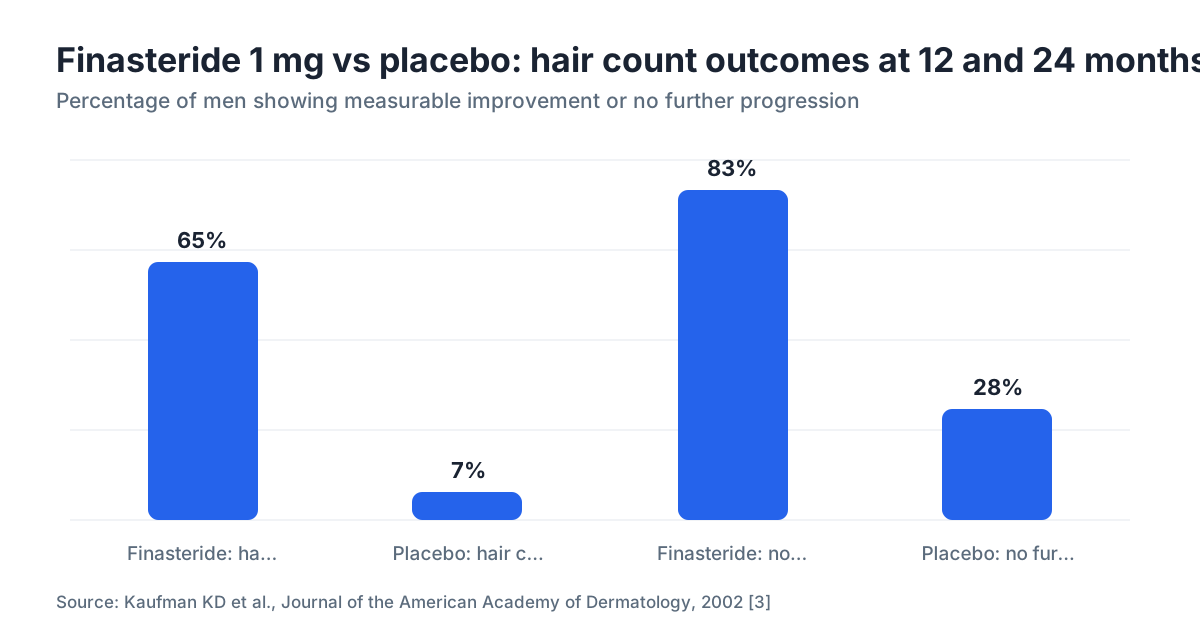
The 2002 JAAD trial reported that 65% of men on finasteride 1 mg showed measurable hair count increases at 12 months, versus 7% on placebo [3]. That 65% covers men who responded, shed or not. No shed does not mean no response.
Here is the honest framing. If you are shedding on finasteride in the first 2-4 months, you have no reason to panic and some reason to be cautiously optimistic. If you are not shedding, you also have no reason to panic. The drug's effect is not visible in the shower drain. It is visible in the mirror after 12 months.
What is finasteride actually doing to DHT, and why does that cause hair to fall out?
Finasteride inhibits type II 5-alpha reductase, the enzyme most active in hair follicles and the prostate. The FDA-approved prescribing information for Propecia states that finasteride 1 mg reduces serum DHT by about 70% and scalp DHT by about 60% [1].
DHT binds to androgen receptors in genetically susceptible follicles, shortens the anagen (growth) phase, and drives those follicles to miniaturize over years. Finasteride's job is to stop that process by pulling DHT out of the picture.
When DHT drops sharply, follicles stuck in a shortened, shrinking cycle get the chance to reset. The reset means moving from telogen back into anagen. But the hair already sitting in that follicle in telogen has to go before the new anagen hair can grow in. That is the shed.
If you want the broader hormonal picture, the DHT blocker article goes deeper on how various agents compare. Finasteride is a type II inhibitor. Dutasteride blocks both type I and type II and produces a steeper DHT reduction, though it is not FDA-approved for hair loss [4].
The practical takeaway: the shed is a downstream effect of the drug doing its job at the follicle. It is mechanistically sensible, not a malfunction.
Should you stop taking finasteride if shedding seems severe?
Almost always, no, not in the first 4-6 months, assuming the shedding is the only thing worrying you. Stopping during the shed is the single biggest mistake men make with finasteride. The shed resolves. Then the regrowth gets a chance to show itself. Quit at month 3 and you will never know.
The exception is if you have sexual side effects, mood changes, or other systemic symptoms that are actually hurting your quality of life. The prescribing information for finasteride lists decreased libido, ejaculatory disorders, and erectile dysfunction as adverse events, each in roughly 1-2% of men in clinical trials [1]. If those are present, that is a conversation with your prescribing physician, not something to push through alone.
For hair shedding by itself, the guidance from dermatology is clear: ride it out. If you are unsure whether your shedding fits the expected pattern, the free AI hair analysis at MyHairline can give you a baseline on your pattern and density, so you have something to compare against at the 12-month mark.
Some men handle the anxiety better by taking progress photos every 4 weeks under the same lighting. The shed phase looks dramatic day to day but is much harder to see in month-over-month photos. That perspective helps.
Can combining finasteride with minoxidil make the shed worse?
Yes, it can. Both drugs cause early shedding on their own through overlapping but distinct mechanisms. Minoxidil is a potassium channel opener that forces follicles into anagen, ejecting existing telogen hairs on the way. Finasteride removes DHT and lets follicles reset. Run them at the same time and you get two shed triggers at once.
The finasteride and minoxidil combination is the most evidence-backed medical approach to androgenetic alopecia short of surgery. A 2021 study in JAMA Dermatology found the combination produced significantly greater hair count increases than either drug alone in men with male pattern hair loss [5]. The combined shed is temporary. The combined benefit appears additive.
If you start both together and the shed is unbearable, some dermatologists suggest staggering: start finasteride first, wait 3-4 months for the shed to settle, then add minoxidil. That way you deal with one shed trigger at a time. No formal trial proves this is the best sequence, but it is a sensible clinical approach.
Oral minoxidil at low doses (0.25-1.25 mg daily) is an alternative to topical that some find easier to stick with. The oral minoxidil article covers what the evidence says about that form. The shed mechanism is the same regardless of route.
How do you know if finasteride is working after the shed ends?
The earliest realistic signal is a drop in shedding itself, usually by months 5-6. After that, you are watching for one of three things: your loss rate returning to zero (stabilization), new terminal hairs appearing at previously thinning spots (regrowth), or a clear lift in overall density.
Stabilization is the most common outcome and is genuinely worth having, even if it does not feel dramatic. Halting years of progressive loss counts for a lot. The 2002 JAAD trial found that after 2 years, finasteride 1 mg produced a 14% increase in hair count from baseline in men with vertex hair loss, versus an 8% decrease in the placebo group [3]. That is a roughly 22-point swing, which photos capture better than mirrors.
Assess at month 12 using good photos in natural light at the same angle each time. Monthly mirror checks are not reliable because the change is slow. If you see no stabilization and no improvement at month 12 of steady daily use, finasteride may not be the right tool for your follicle sensitivity or your Norwood stage. A dermatologist can help evaluate a dose question, a drug switch (dutasteride), or surgical options like a hair transplant.
For men with a heavily receding hairline, finasteride is better at holding the crown than recovering a receding hairline. Managing expectations on that point matters.
Are there other reasons your hair might be shedding more that have nothing to do with finasteride?
Yes, several. Telogen effluvium from stress, illness, nutritional deficiency, or hormonal change can line up perfectly with the timing of starting finasteride, which makes attribution genuinely hard.
Iron deficiency is common and underdiagnosed in men with hair loss. A 2006 review in the Journal of the American Academy of Dermatology found that low ferritin is associated with diffuse hair shedding, independent of anemia [6]. Ferritin below 40 ng/mL is a rough threshold many dermatologists use clinically, though the evidence for a specific cutoff is not settled.
Thyroid disorders, both hypo and hyperthyroidism, produce diffuse shedding. A simple TSH test rules this in or out fast.
Recent high stress (job loss, bereavement, a serious illness) pushes hair into telogen en masse about 2-3 months after the trigger. If you started finasteride around the same time as a major stressor, the shed you blame on the drug could be stress-related, drug-related, or both.
Supplements and their effects on hair are covered in the hair loss supplements article if you want to see what the evidence says about nutritional support. Creatine users sometimes worry about this separately. The does creatine cause hair loss article addresses that specific concern with the available data.
The point: do not assume all shedding on finasteride is the finasteride shed. If the timing is off, the pattern is diffuse, or other symptoms are present, get a basic workup.
What do real clinical trials say about finasteride shedding outcomes?
The major trials on finasteride 1 mg (Propecia) for androgenetic alopecia enrolled men aged 18-41 with mild to moderate vertex and frontal scalp hair loss. The main studies published between 1998 and 2002 consistently showed:
- Finasteride 1 mg produced statistically significant increases in hair count versus placebo at 12 months [3]
- At 24 months, 83% of men on finasteride showed no further progression of hair loss, versus 28% on placebo [3]
- The drug worked better for vertex thinning than for the frontal scalp
A 5-year open-label extension study showed continued benefit, with hair counts at year 5 still above baseline, which suggests the drug's effect does not simply plateau and reverse [7].
None of these trials published shedding sub-analyses in a way that lets us say definitively that shedders had outcome X and non-shedders had outcome Y. That is an honest limit. The mechanistic argument for the shed being a good sign is well-reasoned, but it is not confirmed by a randomized trial. What is confirmed: the drug works for a meaningful share of men, it takes 12 months to assess, and stopping reverses the benefit within 12 months [1].
Stop finasteride and you will likely lose the benefit within a year. That fact matters as much as anything about the shed.
Sources
- FDA, Propecia (finasteride 1 mg) Prescribing Information, DailyMed
- American Academy of Dermatology, Hair Loss Resource Center
- Kaufman KD et al., Journal of the American Academy of Dermatology, 2002; 47(3):377-385
- FDA, Avodart (dutasteride 0.5 mg) Prescribing Information, DailyMed
- Hu R et al., JAMA Dermatology, 2021; combination finasteride and minoxidil vs monotherapy
- Trost LB et al., Journal of the American Academy of Dermatology, 2006; 54(5):824-844
- Finasteride Male Pattern Hair Loss Study Group, 5-year data summarized via PubMed, National Library of Medicine
- MedlinePlus, National Library of Medicine, Hair Loss
- MedlinePlus, National Library of Medicine, Finasteride Drug Entry
- American Hair Loss Association, Finasteride Treatment Overview