TL;DR: Generic finasteride (1 mg) costs roughly $10, $30 per month at most US pharmacies when you pay cash. Brand-name Propecia can run $70, $100 or more for the same 30-day supply. Telehealth subscriptions sit in between, typically $20, $50/month. Insurance rarely covers it for hair loss. GoodRx and similar discount cards can cut the cash price significantly.
What does finasteride cost per month at a US pharmacy?
Generic finasteride 1 mg, the dose approved for male pattern hair loss, costs roughly $10, $30 for a 30-tablet supply when you pay cash at major US pharmacy chains [1]. Buy in 90-tablet quantities and the per-pill price drops further, sometimes to $0.20, $0.35 a tablet. That puts a full year's supply under $130 if you shop around.
Brand-name Propecia, now made by Organon (it used to be a Merck product), lists at $70, $100 or more for 30 tablets at most retail pharmacies in 2024 to 2025 [2]. Same molecule. Same dose. The patent expired in 2006, so there is no clinical reason to choose the brand unless your prescriber has a specific rationale.
Prices swing by zip code, pharmacy, and whether you use a discount card. The same generic 30-tablet supply that costs $28 at one chain might cost $14 at another. Check GoodRx or RxSaver before you pay the sticker price. The cards are free and accepted almost everywhere.
One number worth anchoring to: GoodRx lists finasteride 1 mg as available for under $20 for a 30-count supply at major chains like Walmart, Costco, and Kroger with a free discount coupon [1]. Costco and warehouse pharmacies land at the low end consistently.
Brand-name Propecia vs. generic finasteride: is the price difference worth it?
No. The FDA requires that a generic drug match the brand-name reference product on active ingredient, strength, dosage form, and route of administration [3]. Finasteride is finasteride. The inactive excipients differ slightly between manufacturers, but no peer-reviewed trial has shown a clinical difference in efficacy or side-effect rates between brand and generic for hair loss.
Propecia at $70, $100/month versus generic at $10, $30/month adds up to roughly $600, $840 per year in extra spending for no proven benefit. If you were prescribed Propecia by name, ask your pharmacist whether a generic substitution is allowed in your state. It almost certainly is.
There is one narrow exception. A small number of patients report that a specific generic formulation feels different or seems to cause more side effects. Nobody has good data on this. The evidence is anecdotal, and the FDA's bioequivalence standard exists to prevent clinically meaningful differences [3]. If you genuinely feel a difference, talk to your prescriber before you default to paying brand-name prices.
See our full breakdown of how finasteride works and what the evidence says about its effectiveness.
How do telehealth subscription prices compare to pharmacy prices?
Telehealth platforms (Hims, Keeps, Roman, Ro, and others) typically charge $20, $50 per month for a finasteride subscription that bundles the prescription visit, ongoing provider access, and medication delivery. Some price the consultation separately (often $0, $25 one-time) and then charge $15, $35/month for the medication itself.
A few platforms sell compounded finasteride or finasteride-plus-minoxidil combination products. Those compounded formulations are not FDA-approved finished drug products; they come from compounding pharmacies operating under Section 503A or 503B of the Federal Food, Drug, and Cosmetic Act [4]. That does not make them dangerous, but it does mean the manufacturing standards differ from those for approved generics.
The convenience premium is real. You skip the in-person dermatologist visit and get medication mailed to you. That matters if your schedule is tight or you have no nearby prescriber. But if you already hold a prescription, a GoodRx coupon at Walmart or Costco will usually beat the telehealth subscription on medication cost alone.
For the finasteride and minoxidil combination some platforms now sell, expect $40, $70/month for the bundle. Whether it is worth it depends on your Norwood stage and how you respond to monotherapy first.
Does insurance cover finasteride for hair loss?
Usually not. Most commercial insurance plans treat finasteride 1 mg (Propecia and its generic, for hair loss) as a cosmetic treatment and exclude it from coverage [5]. Finasteride 5 mg (Proscar) for benign prostatic hyperplasia is a different story: it is commonly covered under standard drug benefits because BPH is a medical diagnosis.
Some patients and prescribers work around this by getting finasteride 5 mg covered for BPH and using a pill splitter to approximate four 1 mg doses. The 5 mg tablets are often scored, and the cost per milligram runs lower than the 1 mg tablets. This is done off-label. Discuss it with your prescriber. Do not self-administer it based on something you read online.
Medicare Part D coverage for finasteride 1 mg for hair loss is similarly limited; cosmetic-use exclusions apply [5]. Medicaid coverage varies by state.
HSA and FSA accounts can generally be used for prescription medications, including finasteride prescribed for androgenetic alopecia, because it is a prescription drug treating a recognized medical condition [6]. If you have an HSA or FSA, use it. That gives you an effective discount equal to your marginal tax rate, often 22 to 32% for most working adults.
What are the cheapest ways to get finasteride legally?
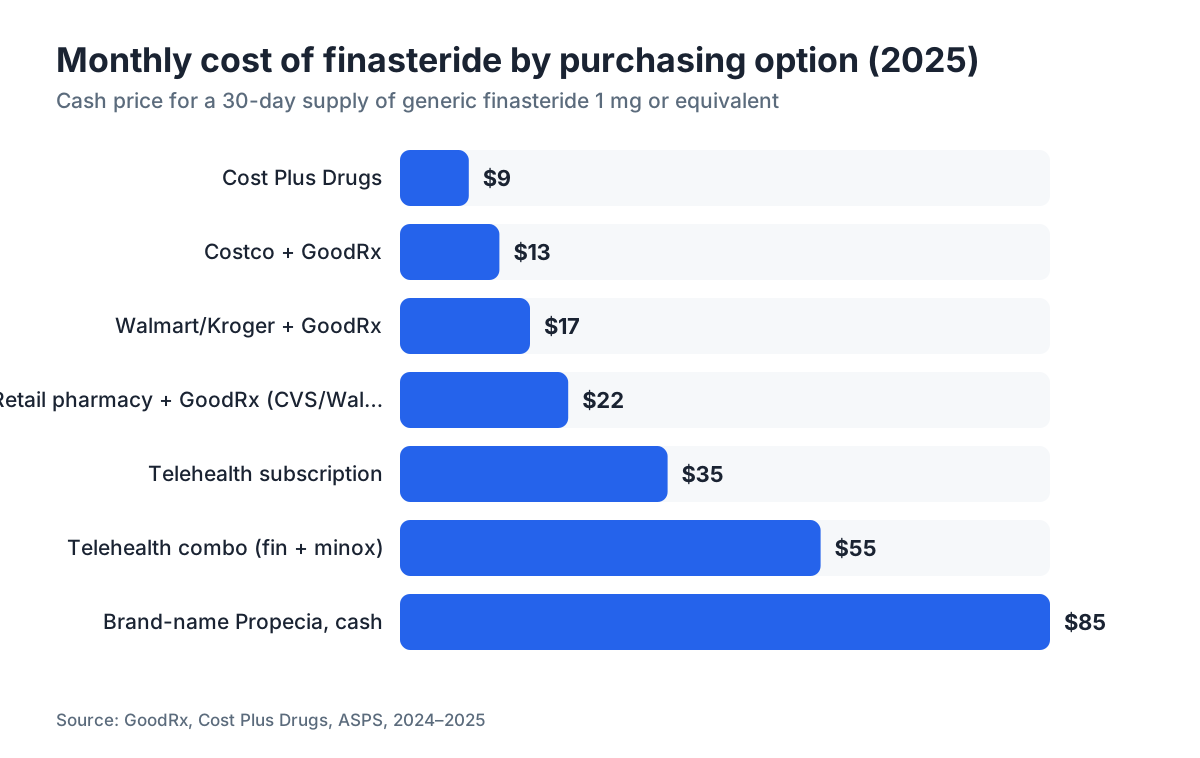
Here is a frank ranking by cost, lowest to highest, for a 30-day supply of 1 mg finasteride in 2025:
| Option | Typical monthly cost | Notes |
|---|---|---|
| Costco/Sam's Club with GoodRx | $8, $14 | Lowest consistent cash price |
| Walmart/Kroger pharmacy + GoodRx | $10, $20 | Widely available |
| Mark Cuban's Cost Plus Drugs | $5, $12 | Requires shipping; no storefront pickup |
| Standard retail pharmacy + GoodRx | $14, $28 | CVS, Walgreens, Rite Aid |
| Telehealth subscription | $20, $50 | Includes consult; convenient |
| Telehealth combo (fin + minox) | $40, $70 | Bundled; compounded versions vary |
| Brand-name Propecia, cash pay | $70, $100+ | No clinical advantage over generic |
Cost Plus Drugs (costplusdrugs.com), founded in 2022, publishes its finasteride 1 mg price openly and uses a cost-plus-15% markup model [7]. For a 90-day supply it is among the cheapest options available, though you need a valid prescription sent there.
Three things actually move the needle: buying 90-day supplies instead of 30-day supplies (the per-pill cost drops), using a discount card, and choosing warehouse pharmacies over chain drugstores. None of them require a special program or enrollment.
Before you spend anything, confirm you actually have androgenetic alopecia. Understanding what causes hair loss is genuinely useful when you are deciding whether a long-term medication expense makes sense.
How much does finasteride cost per year, and is the long-term spend worth it?
At $15/month (a realistic cash-pay generic price with a discount card), finasteride costs $180 per year. At $30/month it is $360 per year. Over five years that is $900, $1,800 in medication costs.
Compare that to a single hair transplant, which costs $4,000, $15,000 depending on graft count and clinic, and does not stop ongoing hair loss without concurrent medical treatment [8]. On cost alone, five years of finasteride at even $30/month ($1,800 total) is dramatically cheaper than trying to surgically replace hair you could have kept.
The 2-year Finasteride Study Group trial, published in the Journal of the American Academy of Dermatology, found that 83% of men taking 1 mg finasteride daily maintained or increased their hair count versus 28% in the placebo group [9]. Efficacy needs continued use. Stop the drug and the loss usually resumes within 6 to 12 months.
So the financial case is clear enough: if finasteride works for you (which you will not know until you have tried it for at least 12 months), it is one of the most cost-efficient interventions in hair loss medicine. If it does not work, or you cannot tolerate it, stopping is straightforward and the only sunk cost is the monthly spend.
For people who want to understand the DHT blocker mechanism before deciding whether to spend the money, that is a reasonable step before committing.
Does finasteride cost more for women?
Finasteride is not FDA-approved for women. Some dermatologists use it off-label in post-menopausal women with androgenetic alopecia, typically at 1 mg or 2.5 mg daily [10]. Because it is off-label, insurance is even less likely to cover it, and the prescriber pool is smaller, which means the consultation visit may cost more.
The tablet price itself is identical no matter who is prescribed it. A 1 mg generic tablet costs the same whether it is dispensed to a 55-year-old woman or a 30-year-old man. The added cost for women comes from needing a specialist comfortable with off-label use, and potentially more frequent monitoring.
Finasteride is absolutely contraindicated in pregnancy and in women who may become pregnant, because of the risk of fetal genital abnormalities, specifically hypospadias in male fetuses [3]. This is not a nuance. It is a hard contraindication on the FDA label. Women of childbearing potential who are not on reliable contraception are not candidates.
If you have female pattern hair loss and are not even sure finasteride is the right question, learn the difference between androgenetic alopecia and telogen effluvium first. It will help you decide which treatments are worth researching.
How does the cost of finasteride compare to minoxidil?
Topical minoxidil 5% (generic Rogaine) costs roughly $15, $30 for a two-month over-the-counter supply as foam or solution, which works out to $8, $15/month [11]. No prescription needed, so the prescriber visit cost disappears entirely.
Oral minoxidil, which does require a prescription and is used off-label for hair loss, runs $15, $40/month at cash-pay prices depending on dose. See the oral minoxidil guide for the full breakdown.
Finasteride and topical minoxidil can be used together. The AAD notes that combination therapy has shown additive benefit in some trials compared to either alone [10]. Use both and you are looking at roughly $25, $45/month total for the pair at generic cash prices. Still well under the cost of a hair transplant consultation fee.
For men, minoxidil works on the growth side (it prolongs the anagen phase) while finasteride works on the hormonal cause (it reduces DHT). Different mechanisms, which is why they stack. For more on how minoxidil for men works and what it actually costs, that guide covers the OTC and prescription versions in detail.
What are the hidden costs of taking finasteride?
The prescription visit is a real cost that gets left out of drug price comparisons. An in-person dermatology appointment runs $150, $300 out of pocket if you have a high-deductible plan or no coverage for specialist visits. A telehealth hair loss consultation runs $0, $75 on most platforms. Some now offer a free first visit if you subscribe to their medication plan.
Blood work is not routinely required before starting finasteride for hair loss in otherwise healthy men, but some prescribers order a PSA (prostate-specific antigen) baseline, especially in men over 40. A PSA test costs $25, $75 cash pay, or may be covered under preventive care. Here is the part people miss: finasteride lowers PSA by roughly 50%, so your urologist or internist needs to know you are on it if they use PSA for prostate cancer screening [3].
Side effects are a cost too, even if they never show up on a receipt. Sexual side effects (reduced libido, erectile dysfunction, ejaculation changes) occurred in roughly 2 to 4% of men in clinical trials, though some post-market data suggests the real-world rate may be higher [9]. Most side effects resolve when you stop the drug. Post-finasteride syndrome, a reported condition of persistent side effects after discontinuation, is contested in the literature, and the FDA has not reached definitive conclusions about its prevalence [12]. That is not a reason to avoid finasteride. It is a reason to have an honest conversation with your prescriber before starting.
If you are not sure hair loss is even the right problem to be spending money on, a free AI-powered photo analysis like the one at MyHairline can help you assess your pattern before you pay for a single consultation.
Can you get finasteride cheaper outside the US?
Yes, a lot cheaper. In the UK, generic finasteride 1 mg costs roughly £10, £20 for a 28-day supply through NHS-affiliated pharmacies or private online prescribers. In Canada, prices sit well below US levels. In India, the finasteride brand Finpecia costs the equivalent of $2, $5 per month.
Importing prescription drugs into the US for personal use sits in a legal gray zone. The FDA prohibits personal importation of unapproved drugs, but historically has enforced that against commercial importers rather than individuals bringing a small personal supply [4]. That is not the same as saying it is legal. If you travel often to countries where finasteride is available OTC or cheaply, the practical reality differs from the legal technicality.
Online pharmacies that ship internationally are a mixed bag. Legitimate Canadian pharmacies are regulated by Health Canada and stock the same generics. Gray-market or unverified foreign pharmacies are a different risk entirely. The FDA's BeSafeRx program has guidance on verifying whether an online pharmacy is legitimate [4].
For most US residents, GoodRx plus a warehouse pharmacy brings the cost low enough that the legal and logistical hassle of importation is not worth it.
Will finasteride prices go up or down in the next few years?
Generic drug prices in the US stay competitive once multiple manufacturers enter a market, and finasteride has had generic competition since 2006. Dozens of generic companies make the molecule. That structural dynamic keeps prices low and stable.
Cost Plus Drugs and similar transparent-pricing models have added more downward pressure on generic prices at the retail level. There is no patent cliff coming that would reset pricing.
The telehealth space is still consolidating. As platforms compete harder and more traditional healthcare providers offer hair loss telemedicine, subscription prices for bundled consult-plus-medication services may drift lower. The $25, $35/month range for a telehealth finasteride subscription feels like where the market is settling.
One scenario could raise costs: supply chain disruption. Most active pharmaceutical ingredients for US generics are made in India and China, and a significant disruption there would hit availability and price. That is a background risk for most generic drugs, not something specific to finasteride.
For men thinking about receding hairlines and whether to start now or wait, the cost argument favors starting early. You are preserving hair you still have rather than chasing hair already lost, and the annual cost at current generic prices is low enough that waiting for a better deal is unlikely to pay off.
Sources
- GoodRx, Finasteride price overview
- Drugs.com, Propecia prices and coupons
- DailyMed (US National Library of Medicine), Finasteride prescribing information
- FDA, BeSafeRx: Your Source for Online Pharmacy Information
- Medicare.gov, How Part D drug coverage works
- IRS, Publication 502: Medical and Dental Expenses
- Mark Cuban Cost Plus Drugs, finasteride pricing
- American Society of Plastic Surgeons, Hair Transplant procedure guide
- Kaufman KD et al., Finasteride in the treatment of men with androgenetic alopecia, Journal of the American Academy of Dermatology, 1998
- American Academy of Dermatology, Hair loss diagnosis and treatment
- MedlinePlus (US National Library of Medicine), Minoxidil topical
- FDA, Drug Safety and Availability