
TL;DR: Finasteride is pronounced fih-NAS-teh-ride, with the stress on the second syllable. The word breaks into four syllables: fi-nas-ter-ide. It's generic for Propecia and Proscar, and it works by blocking the enzyme that converts testosterone into DHT. Mispronouncing it at the pharmacy or with your doctor changes nothing about how it works, but knowing it helps you sound confident asking the right questions.
How do you actually pronounce finasteride?
The correct pronunciation is fih-NAS-teh-ride. Say it slowly: fih (like the start of "finish") then NAS (rhymes with "lass") then teh (a soft, unstressed syllable) then ride (exactly like the word "ride"). Put the emphasis squarely on the second syllable, NAS, and the rest falls into place.
Four syllables total. fi-NAS-ter-ide. Some pharmacists clip it to three syllables in casual speech and say fi-NAS-tride, which is close enough that nobody will misunderstand you. The formal clinical pronunciation used in FDA labeling and drug references is the four-syllable version [1].
Common mispronunciations include fih-NAS-tuh-reed (flipping the final syllable to "reed" instead of "ride"), fin-ASS-tuh-ride (misplacing the stress), and fin-AH-stuh-ride (softening the "a" in the wrong syllable). None of these will get you the wrong pill at the pharmacy, but they will mark you as someone who learned the word by reading rather than saying it out loud. That's fine. Most people who research their own medications are in exactly that situation.
What does the name finasteride actually mean?
Drug names are rarely random, and finasteride is no exception. The name is built from its mechanism, chopped into standard naming pieces.
The core root is "steride," pointing to the steroid backbone of the molecule. Finasteride is a synthetic 4-azasteroid, meaning its chemical structure is built on a modified steroid ring system where a nitrogen atom replaces one carbon [2]. The prefix "fin-" comes from the specific enzyme it targets: 5-alpha reductase. The compound was originally developed by Merck and approved by the FDA in 1992 at 5 mg for benign prostatic hyperplasia (sold as Proscar), then again in 1997 at 1 mg for androgenetic alopecia (sold as Propecia) [1].
Knowing the etymology actually helps you understand what you're taking. A steroid-based molecule that blocks a reductase enzyme. That's the whole story of why it works, condensed into one word. If you want to understand the mechanism more deeply, the finasteride overview covers the clinical evidence from the ground up.
The generic name finasteride follows the International Nonproprietary Name (INN) system, which assigns names based on pharmacological class. The "-steride" suffix is the INN stem for 5-alpha reductase inhibitors, so other drugs in the same class, like dutasteride, share that ending [3].
How does finasteride compare to dutasteride in pronunciation and use?
Dutasteride: doo-TAS-teh-ride. Same four-syllable structure, same stress pattern, same "-steride" suffix. The only difference in pronunciation is the first syllable: "doo" instead of "fih."
In terms of what the drugs actually do, the difference is bigger. Finasteride blocks only the type II isoform of 5-alpha reductase, while dutasteride blocks both type I and type II [4]. That makes dutasteride a stronger DHT suppressor, and some research suggests it beats finasteride for hair retention, though it is not FDA-approved for hair loss in the United States as of this writing. Finasteride at 1 mg is the only oral 5-alpha reductase inhibitor with that specific FDA approval [1].
If your doctor mentions dutasteride for hair loss, they're using it off-label. That's legal and not uncommon, but it's worth knowing the distinction. Both drugs work through the same general pathway, which you can read about in more detail in the DHT blocker article.
| Drug | Pronunciation | FDA-approved for hair loss | DHT reduction (scalp) |
|---|---|---|---|
| Finasteride 1 mg | fih-NAS-teh-ride | Yes (1997) | ~60-70% [4] |
| Dutasteride | doo-TAS-teh-ride | No (off-label use) | ~90% [4] |
| Minoxidil (topical) | mih-NOX-ih-dil | Yes (1988) | None directly |
What is the phonetic breakdown for non-native English speakers?
If English isn't your first language, or you're just more comfortable with phonetic guides, here's finasteride mapped out precisely.
fi: short "i" sound, like the "i" in "fit" or "fill." Not "fee" and not "fye."
NAS: rhymes with "mass" or "class." The "a" is a flat, front-of-mouth vowel. This is the loud syllable.
ter: unstressed, like the "ter" in "water" in American English. In British English this might come out as "tuh." Either works.
ide: exactly "ide" as in "ride," "side," or "hide." A long "i" vowel followed by a "d" sound.
Put together in International Phonetic Alphabet (IPA) notation, the standard American English pronunciation is /fɪˈnæs.tə.raɪd/ [5]. British English speakers often say /fɪˈnæs.tər.aɪd/ with a more clearly pronounced final "r." The stress mark (ˈ) sits before "næs," confirming that second-syllable stress.
If you're filling a prescription in a country where the drug has a different brand name or spelling, the INN generic name finasteride is consistent worldwide. The pronunciation varies slightly by language, but the written word is the same.
What are the brand names for finasteride and how are they pronounced?
Propecia: pro-PEE-sha. The 1 mg brand tablet approved specifically for male pattern hair loss [1]. Stress on "PEE." Some people say pro-PEE-see-ah with four syllables; either version is understood.
Proscar: PROS-kar. Two syllables, stress on the first. The 5 mg tablet originally developed for enlarged prostate. Some hair loss patients are prescribed Proscar and cut the tablets into quarters to approximate a 1 mg dose at lower cost, though this is an off-label practice and tablet-cutting is not FDA-recommended because the coating and dose uniformity may be affected.
Generic finasteride: just say "fih-NAS-teh-ride." Most pharmacies dispense generic, and the price difference is large. Brand-name Propecia has historically run $70 to $100 per month out of pocket, while generic finasteride typically runs $10 to $30 per month depending on the pharmacy and whether you use a discount card [6].
The fact that three different names refer to the same molecule at different doses creates real confusion. If you hear your doctor say Propecia, Proscar, or finasteride, they're talking about the same drug. The dose is what changes.
Why does getting the name right matter when talking to your doctor or pharmacist?
In practice, no pharmacist will dispense the wrong drug because you mispronounced finasteride. The prescription is written. But saying it correctly, or at least close to correctly, signals that you understand what you're asking for, which tends to produce better conversations.
More practically, knowing the name well enough to say it confidently means you can ask informed follow-up questions. What dose? Generic or brand? Are there interactions with anything else I'm taking? Finasteride does have interactions worth knowing: concurrent use with alpha-blockers used for blood pressure or prostate symptoms can increase dizziness risk [1]. If you're also researching minoxidil for men as a combination approach, being able to name both drugs clearly when talking to a provider matters.
There's also a second reason. Finasteride is a category X drug in pregnancy, meaning it is contraindicated for pregnant women, and even crushed tablets or broken capsules should not be handled by women who are pregnant or may become pregnant [1]. If you share a household with a pregnant partner, pronouncing and identifying the drug correctly is a safety issue, more than a nicety.
How does finasteride work, and does pronunciation affect how you take it?
No, pronunciation has zero effect on pharmacology. But since you're here, a quick explanation is worth having.
Finasteride inhibits 5-alpha reductase type II, the enzyme responsible for converting testosterone into dihydrotestosterone (DHT) in the scalp and prostate. DHT binds to androgen receptors in genetically susceptible hair follicles and causes them to miniaturize over time, which is the underlying biology of male pattern baldness, also called androgenetic alopecia [2]. By reducing scalp DHT levels by roughly 60 to 70%, finasteride slows that miniaturization process and, in many men, partially reverses it [4].
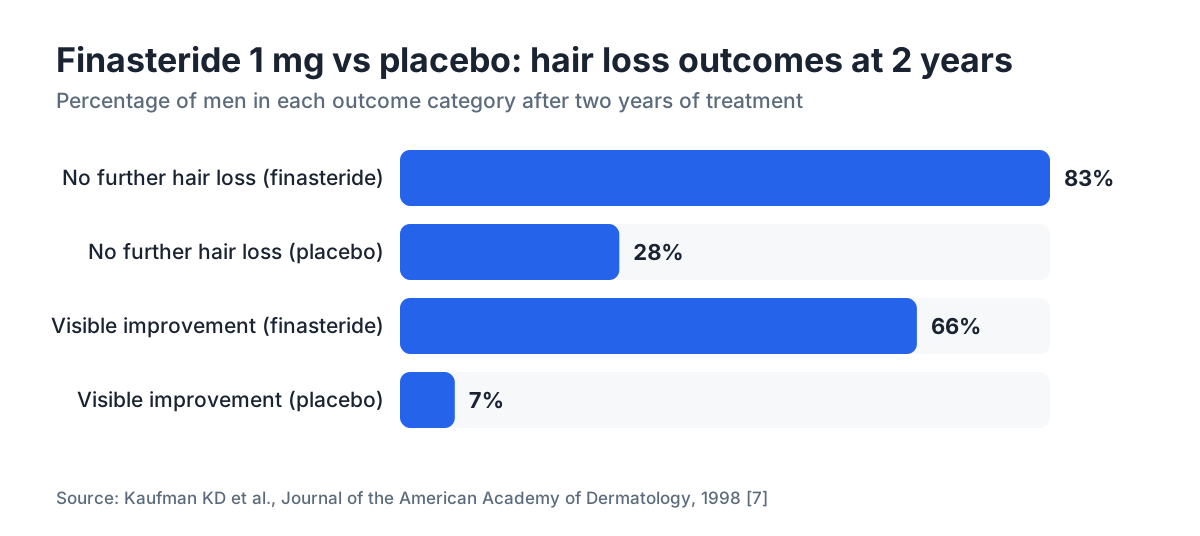
The FDA-approved 1 mg dose is taken once daily, orally, with or without food [1]. It takes time. Most clinical data shows meaningful hair count improvement at 12 months. The two-year trial published in the Journal of the American Academy of Dermatology found that 83% of men taking 1 mg finasteride had no further hair loss versus 28% of placebo recipients [7].
If you're trying to understand whether finasteride is right for your specific hair loss pattern, the what causes hair loss article is a good starting point, and the finasteride and minoxidil comparison covers why many doctors now recommend both together rather than either alone.
Using MyHairline's free AI scan (/scan) can also help you identify your current Norwood stage before your first appointment, so you walk in with useful information instead of starting from scratch.
What are the side effects people worry about when they look up finasteride?
Sexual side effects are the main concern and they're real, though less common than the internet suggests. The FDA-approved prescribing information reports sexual adverse effects, including decreased libido, erectile dysfunction, and ejaculation disorder, in roughly 3.8% of men taking 1 mg finasteride in clinical trials versus 2.1% in placebo groups [1]. That's a real but modest difference.
The more contested issue is post-finasteride syndrome, a cluster of persistent sexual, neurological, and psychological symptoms reported by some men after stopping the drug. The FDA added a label update in 2012 noting that some of these effects may persist after discontinuation [1]. The medical community does not agree on the mechanism or the prevalence, and strong epidemiological data is still thin. Honest answer: nobody has great data on how often it persists, and the closest large studies suggest persistent effects are uncommon but not impossible.
For women, finasteride is not FDA-approved for hair loss, though some clinicians prescribe it off-label for postmenopausal women with androgenetic alopecia. The evidence base is smaller and the teratogenicity concern (category X) makes it inappropriate for any woman who could become pregnant [1].
Breast tenderness, skin rash, and testicular pain are listed as less common side effects in the prescribing information. Liver enzyme elevations have been reported rarely.
If you're weighing finasteride against topical options, reading about minoxidil side effects gives you a useful comparison for a different risk profile.
Is finasteride effective enough to be worth trying?
For men with androgenetic alopecia at Norwood stages II through V, the evidence is genuinely good. The main two-year trial found that 83% of men on 1 mg finasteride maintained or improved hair count, and about 66% showed visible improvement [7]. Those numbers hold up in the real world better than most drugs in this category.
The catch is duration. Finasteride works while you take it. Stop the drug and DHT levels recover within weeks, and hair loss resumes roughly where it would have been without treatment within six to twelve months. It's a maintenance drug, not a course of treatment.
For men with a receding hairline at an early Norwood stage, starting earlier generally produces better outcomes because there are more miniaturized (but still surviving) follicles to rescue. Starting at Norwood VI or VII is less productive because the follicles in the bald area are typically gone, and no DHT blocker will regrow hair from a completely scarred follicle.
A hair transplant is sometimes the right call for advanced loss, and finasteride is often prescribed alongside it to protect existing hair from continuing to shed. The two approaches address different problems: surgery replaces lost follicles, medication protects the ones still working.
If you're also curious about supplements marketed for hair loss, the evidence base there is much weaker. The hair loss supplements article covers what the data actually shows.
Where did finasteride come from and when was it approved?
Merck developed finasteride as a way to treat benign prostatic hyperplasia (BPH) by blocking the DHT production that drives prostate growth. The FDA approved it at 5 mg (Proscar) for BPH in June 1992 [1].
The hair loss connection came from an observation that men with genetic 5-alpha reductase deficiency had neither prostate enlargement nor male pattern baldness, even though they had normal testosterone levels. This suggested DHT, not testosterone, drove both conditions. Merck ran clinical trials at the lower 1 mg dose specifically for androgenetic alopecia, and the FDA approved Propecia in December 1997 [1].
The drug has been off patent for years, which is why generic versions are widely available and cheap. The active compound, the mechanism, and the evidence base are identical between brand and generic. The FDA requires generic manufacturers to demonstrate bioequivalence to the brand [8].
One thing worth knowing: finasteride was tested almost exclusively in men in the original trials. The drug was labeled for men, and women were excluded from most trials due to teratogenicity concerns. Off-label use in postmenopausal women exists and has some supporting evidence, but it's a different evidentiary situation than for men.
Can women take finasteride, and how should they say it when asking a doctor?
Women who are postmenopausal and experiencing androgenetic alopecia sometimes receive finasteride off-label. The pronunciation is the same: fih-NAS-teh-ride. The drug is not gender-specific in its name.
The clinical picture is different though. Women's hair loss patterns often differ from the Norwood scale used for men, typically presenting as diffuse thinning at the crown (Ludwig scale) rather than a receding frontal hairline. The causes can also differ: telogen effluvium from stress, thyroid dysfunction, iron deficiency, or postpartum hormonal shifts can mimic androgenetic alopecia and don't respond to finasteride.
For premenopausal women, finasteride is generally not an option because of the pregnancy risk [1]. A fetus exposed to finasteride can develop abnormal genital development. The prescribing information is unambiguous on this point. If you're a woman under 50 researching hair loss and considering finasteride, get a full hormonal workup first to rule out treatable causes before considering an off-label drug with real contraindications.
The MyHairline AI scan (/scan) can help you characterize your hair loss pattern and give you clearer language for your first dermatology appointment, though it's not a substitute for that appointment.
For women specifically, the evidence on finasteride is modest and the risk calculus is different. Honest assessment: minoxidil is generally the better first-line option for women because it has FDA approval for female pattern hair loss and a cleaner safety profile for women of childbearing age.
Sources
- FDA, Propecia (finasteride) prescribing information
- National Library of Medicine, MedlinePlus Drug Information: Finasteride
- World Health Organization, INN Recommended List and Stem Book
- Andriole GL et al., Urology 2004; comparative 5-alpha reductase inhibitor pharmacology
- Merriam-Webster Medical Dictionary, finasteride entry
- GoodRx, finasteride price comparison
- Kaufman KD et al., Journal of the American Academy of Dermatology, 1998; two-year finasteride trial
- FDA, Generic Drug Facts
- National Institutes of Health, StatPearls: Finasteride