TL;DR: Finasteride is a prescription pill that blocks DHT, the hormone that shrinks hair follicles in male pattern baldness. Clinical trials show it stops hair loss in roughly 87% of men and regrows measurable hair in about 66%. It takes 3 to 6 months to see results and requires ongoing use. Side effects are real but affect a minority of users.
What is finasteride and what does it actually do?
Finasteride is an oral medication the FDA approved in 1997 under the brand name Propecia for male pattern hair loss (androgenetic alopecia) [1]. It belongs to a class of drugs called 5-alpha-reductase inhibitors, which means it blocks the enzyme that converts testosterone into dihydrotestosterone, better known as DHT.
DHT is the main culprit behind what causes hair loss in men who are genetically susceptible. It binds to receptors in hair follicles and shrinks them over years until they can no longer produce visible hair. For the full mechanism, the dht blocker article covers how DHT fits into the bigger picture.
Finasteride at the 1 mg dose (Propecia) cuts scalp DHT by roughly 60% and serum DHT by around 70% [2]. That's enough to slow or stop follicle miniaturization in most men. It doesn't cure the underlying genetic tendency. Stop taking it and DHT rebounds, follicle shrinkage resumes, and any hair you gained or kept typically sheds again within 9 to 12 months.
A 5 mg version of finasteride (brand name Proscar) came earlier, in 1992, for benign prostatic hyperplasia. The two drugs are chemically identical. Some men and their doctors split Proscar tablets to cut cost, though that's off-label.
How effective is finasteride for hair loss?
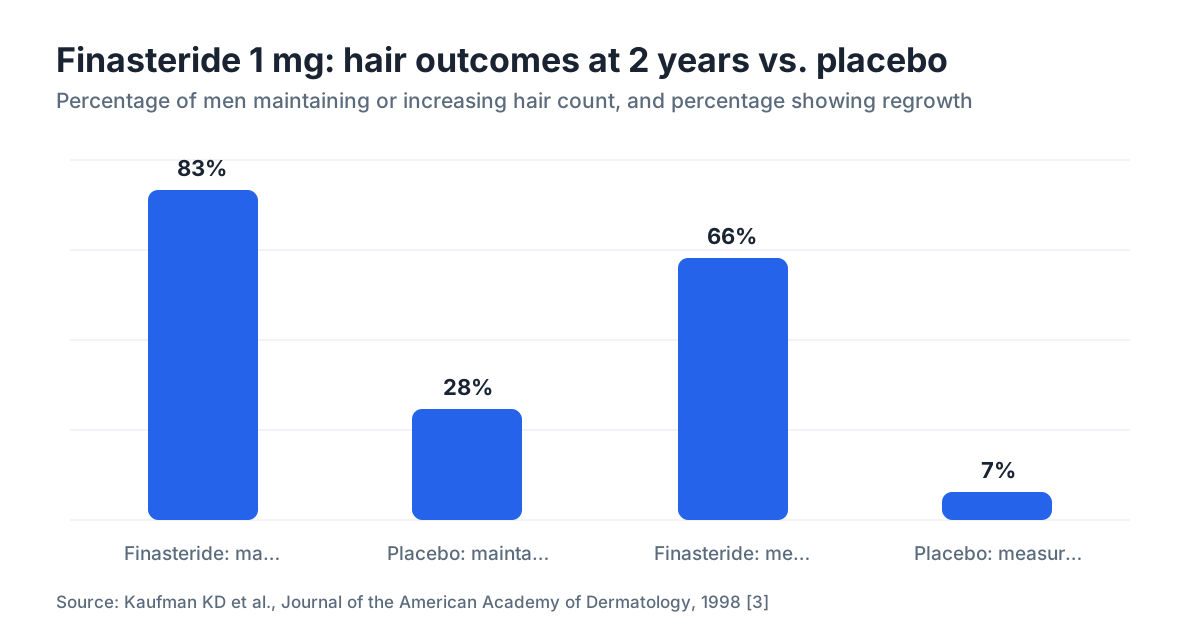
The main two-year trial published in the Journal of the American Academy of Dermatology enrolled 1,553 men aged 18 to 41 with mild to moderate vertex (crown) hair loss. After two years, 83% of men taking 1 mg finasteride daily maintained or increased their hair count, compared with 28% on placebo. Hair count in the finasteride group rose by a mean of 107 hairs in a 1-inch diameter circle on the vertex [3].
A five-year extension of those trials found that 90% of finasteride users held or improved hair count versus baseline, while men on placebo kept losing hair. Five years is the longest controlled dataset available for the 1 mg dose.
The frontal hairline and temples tell a different story. Finasteride works best on the crown and mid-scalp. It can slow recession at the hairline but rarely produces visible regrowth there. If your primary concern is a receding hairline, set expectations up front.
Finasteride also works in women with female pattern hair loss, but it is not FDA-approved for women and is strictly contraindicated in pregnancy because it can cause genital birth defects in a male fetus [1]. In postmenopausal women, small trials have shown benefit, but the evidence base is far thinner than it is for men.
One clean fact worth bookmarking: in the five-year clinical trial data, 66% of men on finasteride showed measurable hair regrowth, more than maintenance [3].
How long does finasteride take to work?
Three months minimum before you see anything meaningful. Hair follicles cycle slowly, and finasteride has to interrupt that cycle enough times to change what you see in the mirror.
Here's the realistic timeline. In the first one to three months, DHT drops fast but follicles already in the dying phase shed on schedule. Some men notice what feels like accelerated shedding during this window. That's usually a sign the drug is working, not a sign it isn't. It's a form of telogen effluvium triggered by follicles resetting their cycles.
By months four to six, shedding stabilizes and some men start to notice thickening. By month twelve, the full picture of how well it's working gets clearer. Peak effect in clinical trials landed at two years [3], so patience is genuinely required.
Seen no change, no stabilization, and continued loss at month twelve? Go back to a dermatologist. A minority of men are poor responders, possibly because their androgen receptor sensitivity differs.
What are the real side effects of finasteride?
This is the question most men sit with longest before deciding, and it deserves an honest answer rather than reassurance.
In the original two-year clinical trials, sexual side effects occurred in 3.8% of finasteride users versus 2.1% of placebo users [1]. Those side effects included decreased libido, erectile dysfunction, and decreased ejaculate volume. Most resolved when the drug was stopped, and many resolved even while men kept taking it.
Post-marketing experience brought a more complicated picture. A syndrome called post-finasteride syndrome (PFS) has been reported, where sexual, neurological, and psychological symptoms persist even after stopping the drug. The FDA updated the label in 2012 to acknowledge reports of persistent sexual side effects after discontinuation [1]. The true prevalence of PFS is not established. Advocacy groups report much higher rates than clinical trial data show; the scientific disagreement is genuine and ongoing.
Other side effects on the FDA label include breast tenderness or enlargement (gynecomastia), rash, and testicular pain (rare). There is also a label warning about a slightly increased risk of high-grade prostate cancer in men taking 5-alpha-reductase inhibitors, which came out of the Prostate Cancer Prevention Trial using the 5 mg dose [4]. The FDA requires this warning on all finasteride products. Its relevance at the 1 mg dose is debated.
Depression and anxiety show up in some users, and the FDA label does list mood changes. Nobody has good population-level data on the exact rate at the 1 mg dose; the closest study found neurosteroid changes in a small sample, but the clinical meaning is unclear.
Some men take finasteride for years with no side effects. Others notice changes within weeks. There is no reliable way to predict which group you'll be in. If you have a history of depression or sexual dysfunction, bring that context to the doctor before starting.
Finasteride vs. minoxidil: which one should you choose?
These two treatments work in completely different ways, and men often combine them rather than pick one.
Minoxidil for men is a topical or oral vasodilator that extends the anagen (growth) phase of the hair cycle. It doesn't touch DHT at all. Finasteride attacks the hormonal root cause. The mechanisms complement each other, which is why the combination is widely used and has some of the strongest real-world evidence behind it.
A 2022 study in the Journal of the American Academy of Dermatology found that men using both finasteride and topical minoxidil had significantly greater hair count increases than those on either drug alone [5]. If you're considering both, the finasteride and minoxidil article goes deep on how to combine them.
Head-to-head trials generally show finasteride produces more hair regrowth than 2% topical minoxidil in men with vertex loss. The comparison with 5% minoxidil foam is closer. Neither drug wins for everyone.
| Treatment | Mechanism | FDA-approved (male AGA) | Regrowth rate (trial data) | Main risk |
|---|---|---|---|---|
| Finasteride 1 mg | DHT blocker (oral) | Yes (1997) | ~66% show regrowth [3] | Sexual side effects (~3.8%) |
| Minoxidil 5% topical | Vasodilator (topical) | Yes (1988) | ~40-48% show regrowth [6] | Scalp irritation, initial shedding |
| Minoxidil oral | Vasodilator (oral) | Off-label | Limited trial data | Fluid retention, body hair |
| Finasteride + minoxidil | Combined | Yes + Yes | Greater than either alone [5] | Combined side effect profiles |
Minoxidil carries its own side effect profile, though it doesn't share the sexual side effects of finasteride. Read minoxidil side effects before deciding.
For most men with early to moderate male pattern baldness and no contraindications, the evidence favors finasteride as the more effective single agent for stopping progression. But how you weigh the side effect risks should drive the call.
Who should not take finasteride?
Women who are pregnant or may become pregnant should not take or handle crushed finasteride tablets. The drug absorbs through the skin and can cause ambiguous genitalia in a developing male fetus [1]. This is an absolute contraindication.
Beyond that, men with a history of hypersensitivity to finasteride or any component of the tablet should avoid it. Men with known or suspected prostate cancer should talk it through with a urologist, given the interaction between 5-alpha-reductase inhibitors and prostate cancer screening and risk [4].
Men trying to conceive should know finasteride has been found in semen at very low concentrations. Most evidence suggests this is clinically insignificant, but raise it with a reproductive specialist if fertility is a concern.
Liver disease may affect finasteride metabolism since it's cleared mostly by the liver, though dose adjustments aren't routinely required for mild impairment.
Men with pre-existing depression, sexual dysfunction, or low testosterone may want to weigh the risks more carefully. None of these are absolute contraindications, but they're worth raising with the prescribing doctor.
How much does finasteride cost and where can you get it?
Brand-name Propecia has largely given way to generic finasteride, which reached the US market after the patent expired in 2006. Generic 1 mg finasteride costs roughly $15 to $40 per month through major pharmacy chains or online telehealth services, depending on the platform and whether insurance covers any of it [7].
Brand-name Propecia, if you can still find it, runs $70 to $100+ per month. Most dermatologists see no clinical reason to prefer the brand over the generic.
The Proscar (5 mg) tablet-splitting route drops costs further, sometimes to $5 to $15 per month, though the FDA has not approved tablet splitting for this purpose and dosing consistency varies.
Finasteride needs a prescription in the United States. Telehealth platforms (Hims, Keeps, Roman, and others) have made getting one online easy. The consultation runs $5 to $25 or comes free. The convenience is real, but these platforms can't examine your scalp, and some dermatologists argue a baseline exam and proper Norwood staging before starting is worth the extra step.
If cost is a barrier to other treatments too, the hair loss supplements article reviews what the evidence says about the over-the-counter alternatives, though none match finasteride's results.
Can finasteride regrow hair at a receding hairline?
Honest answer: probably less than you hope.
Finasteride's strongest data is from crown and vertex thinning. The hairline and temples (the frontal scalp) respond less, and the clinical trials weren't primarily designed to measure frontal regrowth. Anecdotal reports of frontal regrowth exist, and some observational studies suggest improvement, but the controlled data is much weaker than for the crown.
That doesn't make it useless for a receding hairline. Finasteride can slow the rate of recession a lot, which buys time and preserves the follicles that are still viable. Stopping progression at the hairline at age 28 is a different thing from doing nothing until 38.
For men who want to actually restore a hairline rather than just slow its retreat, a hair transplant is the only option with a credible regrowth outcome at the temples. Most surgeons require or strongly recommend that patients stabilize loss on finasteride before transplant, because transplanting into an actively thinning scalp gives an uneven result as surrounding native hairs keep falling.
Does finasteride work for women?
The FDA has not approved finasteride for women, and the data is thin next to the male evidence base.
Small trials and retrospective studies in postmenopausal women with female pattern hair loss have shown modest benefit, typically at doses from 1 mg to 5 mg daily. A 2000 trial found no significant difference between 1 mg finasteride and placebo in postmenopausal women [8], which is part of why the FDA hasn't moved on approval.
Some dermatologists prescribe higher doses (2.5 mg or 5 mg) off-label in postmenopausal women and report more convincing results in their clinical experience. Premenopausal women who use it must use highly reliable contraception.
For women, the risk-benefit math looks different than for men. The sexual side effects that worry men don't map the same way. But uncertainty about long-term neurological effects, limited breast cancer risk data, and the lack of large controlled trials means informed consent needs more caveats.
If you're a woman researching this, the finasteride hub article has a fuller section on off-label female use.
What happens when you stop taking finasteride?
Within weeks of stopping, DHT levels return to baseline. Within months, any hair you gained or maintained on the drug begins to shed, because DHT-sensitive follicles resume their miniaturization path.
By 9 to 12 months after stopping, most men who had responded to finasteride are back to roughly where they would have been without it, and sometimes worse off than if they had never started, because the progression continued under the surface while the drug masked it. That last point is debated. Some clinicians argue the underlying state is the same; others say men feel the rebound more acutely because they experienced thicker hair in between.
This drug is a long-term commitment. Starting at 25 with the intention of stopping at 30 is a reasonable short-term choice for some situations, but go in with eyes open about what stopping means.
If you stop because of side effects, most sexual side effects resolve within a few weeks to months for most men. The minority who report persistent side effects (PFS) are the reason this deserves careful monitoring rather than dismissal.
Is finasteride better than other DHT blockers?
Dutasteride is the main competitor. It blocks both type 1 and type 2 5-alpha-reductase enzymes (finasteride only blocks type 2) and cuts scalp DHT by roughly 90% versus about 60% for finasteride [9]. Clinical trials have shown dutasteride 0.5 mg produces greater hair count increases than finasteride 1 mg in head-to-head comparisons.
Dutasteride (brand name Avodart) is FDA-approved for BPH, not for hair loss in the US. It is approved for androgenetic alopecia in South Korea and Japan. American dermatologists prescribe it off-label.
The tradeoff: dutasteride has a much longer half-life, around 5 weeks versus finasteride's 6 to 8 hours. So if side effects develop, they take longer to clear after stopping. For men who are anxious about sexual side effects, that extended exposure window matters.
Saw palmetto, the popular supplement sold as a natural DHT blocker, has weak human data. One small study showed modest benefit, but no large controlled trial exists [10]. The dht blocker article compares the full range of options honestly.
Midway through your research, if you want a baseline picture of where your hair loss actually stands before committing to a treatment, the free AI scan at MyHairline gives you a Norwood stage estimate and a starting reference point.
What do dermatologists actually recommend?
The American Academy of Dermatology lists finasteride as a first-line treatment for male androgenetic alopecia and recommends it alongside minoxidil for men who are suitable candidates [11]. The recommendation rests on the depth and consistency of the randomized controlled trial data.
Most dermatologists start men on finasteride early in the hair loss process because follicles that are already completely dead cannot be revived by any current medical treatment. Stopping at Norwood II is easier than trying to recover at Norwood V. Early intervention, from a clinical standpoint, is where finasteride has the most to offer.
There's no universal AAD recommendation to combine finasteride with minoxidil as a standard protocol, but many clinicians do recommend the combination for men with more advanced loss or faster progression.
For men who don't respond to finasteride or who aren't candidates, the next step up is either dutasteride off-label or a hair transplant evaluation. Finasteride is often continued post-transplant to protect native hairs that weren't moved.
Sources
- FDA, Drugs@FDA database, Propecia (finasteride) prescribing information
- FDA, Drugs@FDA database, Propecia prescribing information (pharmacodynamics section)
- Kaufman KD et al., Journal of the American Academy of Dermatology, 1998; finasteride 1 mg clinical trial 2-year data
- FDA, Drug Safety and Availability, 5-alpha-reductase inhibitors safety communication on high-grade prostate cancer risk
- Hu R et al., Journal of the American Academy of Dermatology, 2022; combination finasteride and minoxidil trial
- FDA, Drugs@FDA database, Rogaine (minoxidil 5%) prescribing information and efficacy summary
- GoodRx, finasteride 1 mg price estimates
- Price VH et al., Journal of the American Academy of Dermatology, 2000; finasteride in postmenopausal women trial
- Olsen EA et al., Journal of the American Academy of Dermatology, 2006; dutasteride vs finasteride head-to-head trial
- Rossi A et al., Journal of Alternative and Complementary Medicine, 2012; saw palmetto vs finasteride trial
- American Academy of Dermatology, hair loss resource and treatment guidance for androgenetic alopecia