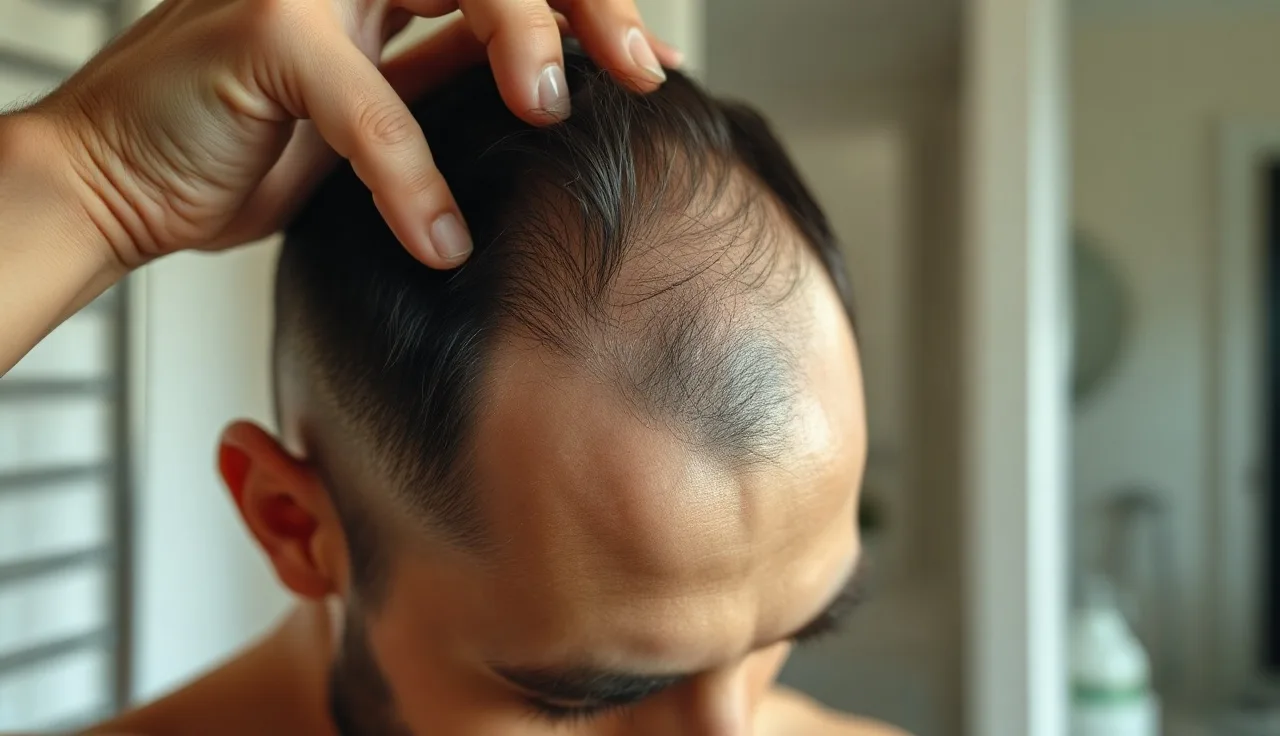
TL;DR: Finasteride shedding is a temporary jump in hair loss that hits some men in the first 1 to 6 months. It happens because dropping DHT resets the hair cycle, pushing more hairs into the telogen (shedding) phase before new growth starts. It usually clears on its own. More often than not, it means the drug is working, not failing.
What is finasteride shedding, exactly?
When you start finasteride, your scalp's relationship with dihydrotestosterone (DHT) changes almost immediately. Finasteride blocks the 5-alpha reductase type II enzyme, dropping serum DHT by roughly 70% within the first two weeks of a 1 mg daily dose [1]. That's a big biochemical shift, and your hair follicles notice it.
For some men, the result is a shedding phase that feels alarming but is actually a normal part of how the drug resets your hair cycle. The clinical term for this kind of temporary, diffuse shedding is telogen effluvium. It isn't specific to finasteride. Anything that shocks the follicle cycle can trigger it.
Here's the mechanism as best as researchers understand it. Finasteride pulls miniaturized, DHT-damaged follicles back toward a normal anagen (growth) phase. To do that, follicles stuck in a long, unhealthy telogen state abruptly restart their cycle. Restarting means shedding the old club hair first, then growing a new, thicker strand behind it. So the shedding is literally the follicle clearing the way for better hair.
Not every man goes through this. Randomized controlled trials suggest it happens in roughly 1 to 2% of participants, though dermatologists who see real-world patients say the true rate looks higher, probably because mild shedding goes unreported in clinical settings [2]. The honest answer is that we don't have a precise population-level number.
How long does finasteride shedding last?
Most men who shed on finasteride notice it starting somewhere between weeks 2 and 8. The peak is typically around weeks 6 to 12. By month 4 to 6, shedding returns to baseline for the majority of people who experience it [2].
A small group reports shedding that continues past six months. If that's you, something else is likely going on. Nutritional deficiencies, thyroid dysfunction, or a separate telogen effluvium from stress or illness can stack on top of finasteride's effects and stretch the timeline. Get a blood panel before you blame the drug.
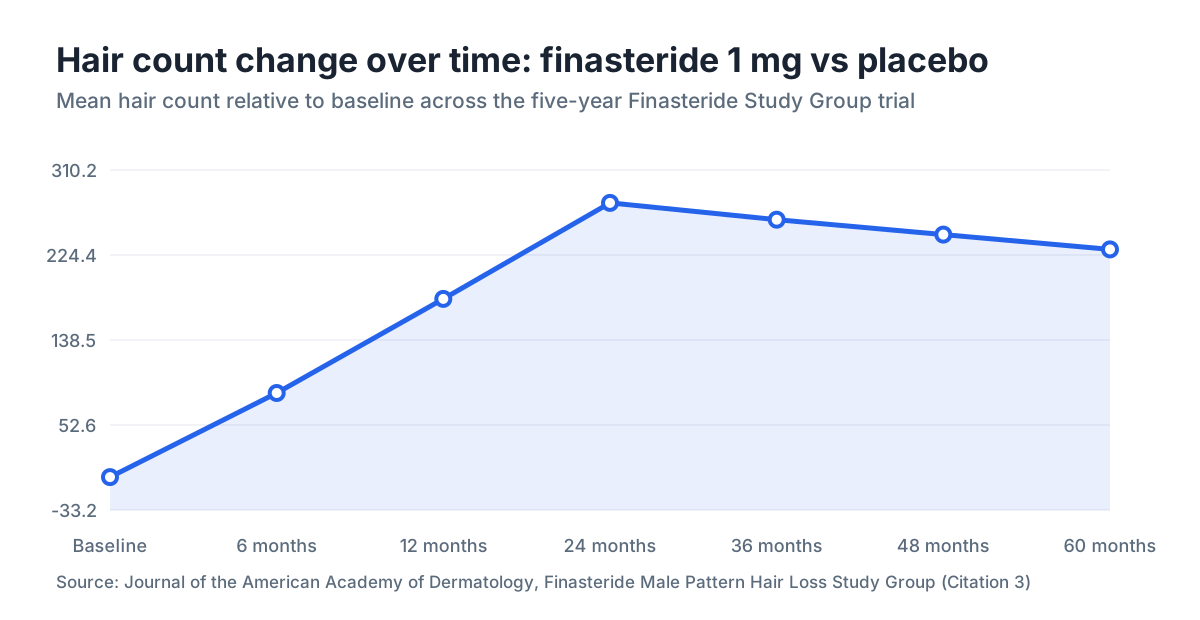
The dermatology literature is clear on one point: shedding that resolves by month 6 and is followed by noticeable regrowth is consistent with the drug working as intended. The five-year trial published in the Journal of the American Academy of Dermatology found that 90% of men on 1 mg finasteride maintained or improved their hair count versus baseline after two years, with similar figures holding at five years [3]. That outcome doesn't happen if early shedding meant the drug was failing.
Patience is genuinely the hardest part. You won't see meaningful regrowth in the mirror until month 6 to 12 at the earliest, and full results take two years. Start finasteride expecting a quick win and you've set yourself up to quit during exactly the window when shedding looks worst.
Is finasteride shedding a sign it's working or not working?
Almost every new user asks this. Shedding early is more consistent with the drug working than with it failing.
The mechanism makes this intuitive. If finasteride were doing nothing, your follicles would stay in their current state, and you'd shed at your normal (pre-treatment) rate. The fact that follicles are cycling faster, dropping the old telogen hairs and attempting a new anagen phase, suggests DHT suppression is actually reaching those follicles.
Shedding still isn't a required sign of success. Plenty of men respond well and never shed more than usual. Absence of shedding does not mean the drug isn't working. Don't treat a shed as a good omen, and don't panic if it happens.
Here's the scenario you actually want to watch for: shedding that starts after month 6, continues indefinitely, and shows no recovery. That pattern points to something other than the typical finasteride telogen effluvium, and it's worth a dermatology appointment to sort out. Understanding what causes hair loss more broadly helps you tell androgenetic alopecia, effluvium, and other causes apart so you're not guessing.
How much shedding is normal vs. too much?
The average person loses 50 to 100 hairs a day as part of normal cycling [4]. During a telogen effluvium, that number can climb to 200 to 300 per day. Anything in that range during the first six months of finasteride sits inside expected territory, though that's cold comfort when you're watching it happen in the shower drain.
Signs that suggest something beyond normal finasteride shedding:
- Shedding that starts several days after a physical illness, surgery, big weight loss, or severe emotional stress (that's classic telogen effluvium from the other trigger, not finasteride)
- Patchy loss rather than diffuse thinning (that pattern points toward alopecia areata, which finasteride doesn't cause and can't treat)
- Shedding with scalp pain, redness, scaling, or visible follicle changes (inflammatory scalp conditions need their own diagnosis)
- Loss continuing past six months with no sign of slowing
If you're losing clumps, watching bald patches form fast, or losing sleep over the anxiety, see a dermatologist. The American Academy of Dermatology recommends a board-certified dermatologist as the first stop for any hair loss that persists or causes distress [4]. Online photos and forum opinions are not a substitute.
Does combining finasteride with minoxidil make shedding worse?
It's a fair concern, because minoxidil for men also causes a shedding phase by similar logic: it speeds up follicle cycling. In theory, starting both drugs at once could mean two overlapping shedding phases.
In practice, the combination doesn't seem to produce a dramatically worse shedding experience for most men. A 2021 study in the Journal of the American Academy of Dermatology comparing oral minoxidil plus finasteride to finasteride alone found combination users had better hair count outcomes without a significantly higher adverse event rate [5]. That study didn't quantify shedding by amount, which is an honest gap in the data.
Many dermatologists suggest staggering the two drugs by 4 to 6 weeks if you're worried: start finasteride first, let the initial shedding settle, then add minoxidil. No randomized trial shows this cuts shedding specifically, but it makes mechanistic sense and gives you a cleaner picture of which drug is causing what.
If you stack them and shed heavily, resist the urge to quit both at once. Stopping finasteride causes its own shedding event as DHT rebounds, typically within 3 to 6 months of stopping [1]. Quitting mid-shed just delays the same cycle reset you're trying to get through.
What does the research actually say about finasteride shedding rates?
Less than you'd hope.
The original finasteride trials (the Merck Phase III studies summarized in the FDA-approved prescribing information) tracked hair count and patient assessments, but shedding was never a primary endpoint. The prescribing information notes that increased hair loss (telogen effluvium) has been reported in post-marketing experience, and gives no incidence rate because it was never systematically measured in trials [1].
The best data comes from smaller observational studies and dermatology case series. A 2019 case series in Dermatology and Therapy described the shedding pattern in 14 patients starting finasteride, finding onset between weeks 2 and 8 and resolution by week 24 in all cases followed to completion [2]. The sample size is too small to build firm statistics on, but the timeline matches what most clinicians see.
A 2019 systematic review in JAMA Dermatology covering 22 trials and over 4,000 patients on finasteride 1 mg found the drug significantly improved hair count versus placebo, with adverse events mostly tied to sexual function, not shedding [6]. That again suggests shedding either wasn't captured or was too mild and short-lived to surface in aggregate safety data.
The practical takeaway: shedding is real, it's recognized, and it's been studied less rigorously than other finasteride effects. If you're tracking your own hair loss carefully, the what causes hair loss framework helps you keep a baseline count and catch genuine changes.
Should you stop finasteride if you're shedding?
For most men, no. Stopping finasteride during an active shed resets the whole process. DHT rebounds within about two weeks of stopping a 1 mg daily dose [1], follicles re-miniaturize on the same timeline they were on before treatment, and you'll often see a second shedding event as the cycle resets.
The men most tempted to quit are the ones three to four months in, still shedding, and not seeing regrowth yet. That's the worst possible moment to stop. You're often just weeks away from the shed resolving and the regrowth starting.
Stopping does make sense if:
- You're having confirmed sexual side effects that hurt your quality of life (finasteride's sexual side effects are documented and real, reported in roughly 3.8% of men in trials [10])
- A dermatologist has examined you and found a different cause for the shedding that finasteride is making worse
- Your mental health is taking serious damage from the anxiety, and that damage outweighs the potential hair benefit
Those are legitimate medical reasons. "The shedding looks scary" on its own is not, as long as you're inside the expected timeline and pattern.
If the shedding is genuinely wrecking you psychologically, ask a dermatologist about a short-term bridge like topical minoxidil, which can reduce the visual severity without changing the underlying finasteride mechanism. This isn't standard protocol. It's a practical conversation worth having with whoever manages your treatment.
Does finasteride shedding happen with topical finasteride too?
Topical finasteride was developed partly to lower systemic exposure and, with it, sexual side effects. But it still suppresses scalp DHT, which means the same follicle-cycling mechanism applies.
A 2020 randomized trial in JAMA Dermatology found that topical finasteride 0.25% once daily produced meaningful reductions in scalp DHT and hair count improvements comparable to oral finasteride 1 mg, with lower serum DHT suppression (around 30% versus the 70% seen orally) [7]. Lower systemic DHT suppression might theoretically mean a smaller shed, but the trial didn't measure shedding as an outcome.
Anecdotally, clinicians who prescribe both forms say shedding complaints seem similar between topical and oral routes, though the topical shedding literature is thin. If you chose topical finasteride precisely to dodge shedding, you may be disappointed to find it still occurs. The mechanism driving shedding is local and scalp-based, not systemic, which is why cutting systemic exposure doesn't necessarily kill it.
Understanding DHT blockers more broadly helps clarify why any DHT-reducing treatment, topical or oral, can trigger this cycle reset.
How can you tell if your shedding is finasteride-related or something else?
This matters a lot, because treating the wrong thing wastes months.
Finasteride-related shedding has a recognizable pattern: diffuse loss across the scalp (especially the top and crown, where DHT damage concentrates), onset within the first two to eight weeks, and resolution by month four to six. The hair that sheds is usually a mix of short hairs that were already miniaturized and some normal-length hairs caught mid-cycle.
Distinguishing features of other causes:
| Cause | Typical onset | Pattern | Duration |
|---|---|---|---|
| Finasteride telogen effluvium | Weeks 2-8 | Diffuse, top/crown heavy | Resolves by month 4-6 |
| Classic telogen effluvium (stress, illness) | 2-3 months after trigger | Diffuse, all scalp | Usually resolves in 6-9 months |
| Androgenetic alopecia (baseline) | Gradual over years | Frontal recession, crown thinning | Progressive without treatment |
| Alopecia areata | Sudden, any time | Patchy, defined edges | Variable, often cycles |
| Nutritional deficiency | Gradual after months of deficit | Diffuse | Reverses with correction |
A dermatologist can run a hair pull test, dermoscopy, and basic bloodwork (ferritin, TSH, complete blood count) to separate these causes. If you're six months into finasteride and still shedding with no sign of slowing, get the labs done. Ferritin below 30 ng/mL has been linked to increased telogen shedding in women, and there's reasonable clinical logic that the same applies in men, though the evidence base is weaker [8].
If you're already tracking symptoms and want a structured starting point, the free AI hair analysis at MyHairline helps you characterize your loss pattern before your dermatology appointment, though it doesn't replace clinical evaluation.
What can you actually do to manage shedding while on finasteride?
The honest answer: mostly, you wait. The shedding is driven by a biological process no supplement or topical is proven to stop.
A few things are reasonable and supported by evidence at varying levels:
Address fixable deficiencies. Low ferritin, low vitamin D, or thyroid dysfunction can independently worsen telogen shedding. Getting a panel and correcting deficiencies is low-risk and sensible [8].
Avoid additional triggers. Severe caloric restriction, crash diets, and major physical stress in the first six months amplify telogen effluvium. Not the time for a hard cut.
Consider adding topical minoxidil. This won't stop the shedding phase, but it may speed the anagen recovery that follows, shortening the overall miserable window. The evidence for finasteride and minoxidil together is stronger than for either drug alone.
Be gentle with your hair. Tight ponytails, aggressive brushing, and high-heat styling put traction stress on already-cycling follicles. Not a major factor, but a free fix with no downside.
Don't pile on hair loss supplements. Most lack strong evidence for androgenetic alopecia or finasteride shedding specifically. Biotin especially: it's everywhere, but no good trial shows it helps shedding in people who aren't biotin-deficient, which most people on a normal diet aren't [9]. Save the money.
The hardest part is mental: accepting you're playing a long game. The men who see the best results on finasteride are usually the ones who stayed on through the ugly months.
What happens to your hair after the shedding phase ends?
Assuming finasteride is working for you, the trajectory after the shed resolves looks roughly like this:
Months 4-6: shedding slows to baseline or below. Hair may still look thinner overall because the new anagen hairs are short.
Months 6-12: new growth becomes visible. Hairs that were miniaturized start coming back thicker. This is when you might first notice your hairline looking less transparent or your crown looking less sparse.
Year 1-2: the main growth window. The two-year Finasteride Study Group data showed a mean increase of 277 hairs per inch squared compared to baseline at two years, versus a continued drop in the placebo group [3].
Year 2 and beyond: maintenance. Finasteride mainly halts further loss. Regrowth is real but modest. The drug is better at stopping the slide than reversing it.
If you reach month 12 with no improvement and shedding has resolved, that's a legitimate signal to reassess. Some men are non-responders. Around 10% of men in the original trials saw no meaningful improvement [3], and that subgroup likely includes people whose loss has gone too far for the remaining follicles to recover. At that stage, the conversation shifts toward a hair transplant as a complement to ongoing medical therapy, not a replacement for it.
Finasteride after a transplant is actually standard of care, because the transplanted hairs are (mostly) resistant to DHT but the native hairs around them are not. Stopping finasteride after a transplant is a common and avoidable mistake.
Does a receding hairline respond differently to finasteride shedding?
Frontal hairline recession responds less well to finasteride than crown and mid-scalp thinning, and this shapes how you read your shedding experience.
The original Phase III trials split results by vertex (crown) and frontal loss and found significantly better outcomes for the vertex [3]. The frontal scalp has different androgen receptor density and follicle characteristics. Finasteride slows frontal recession but regrows frontal hair less reliably than crown hair.
If your shedding sits mostly at the hairline and you're watching recession speed up in the first few months, the picture gets complicated. Some of that may be finasteride shedding that will recover. Some may be continued baseline recession that finasteride can't reverse at the hairline. You need a dermatologist to properly assess your receding hairline before deciding the drug is or isn't helping at the front.
This is also why adding minoxidil matters for frontal loss specifically: minoxidil has a broader mechanism (it's a vasodilator and a potassium channel opener, not purely DHT-dependent) and tends to help frontal and mid-scalp zones that finasteride reaches less well. The combination is recommended for men with both frontal and vertex involvement.
Sources
- FDA-approved prescribing information for finasteride 1 mg (Propecia label)
- Dermatology and Therapy, 2019 case series on finasteride telogen effluvium
- Journal of the American Academy of Dermatology, Finasteride Male Pattern Hair Loss Study Group, five-year trial
- American Academy of Dermatology, hair loss overview
- Journal of the American Academy of Dermatology, 2021 study on oral minoxidil plus finasteride combination
- JAMA Dermatology, 2019 systematic review of finasteride 1 mg trials
- JAMA Dermatology, 2020 randomized trial of topical finasteride 0.25%
- Journal of the American Academy of Dermatology, ferritin and hair loss review
- NIH Office of Dietary Supplements, biotin fact sheet
- FDA, MedWatch post-marketing safety reports for finasteride