
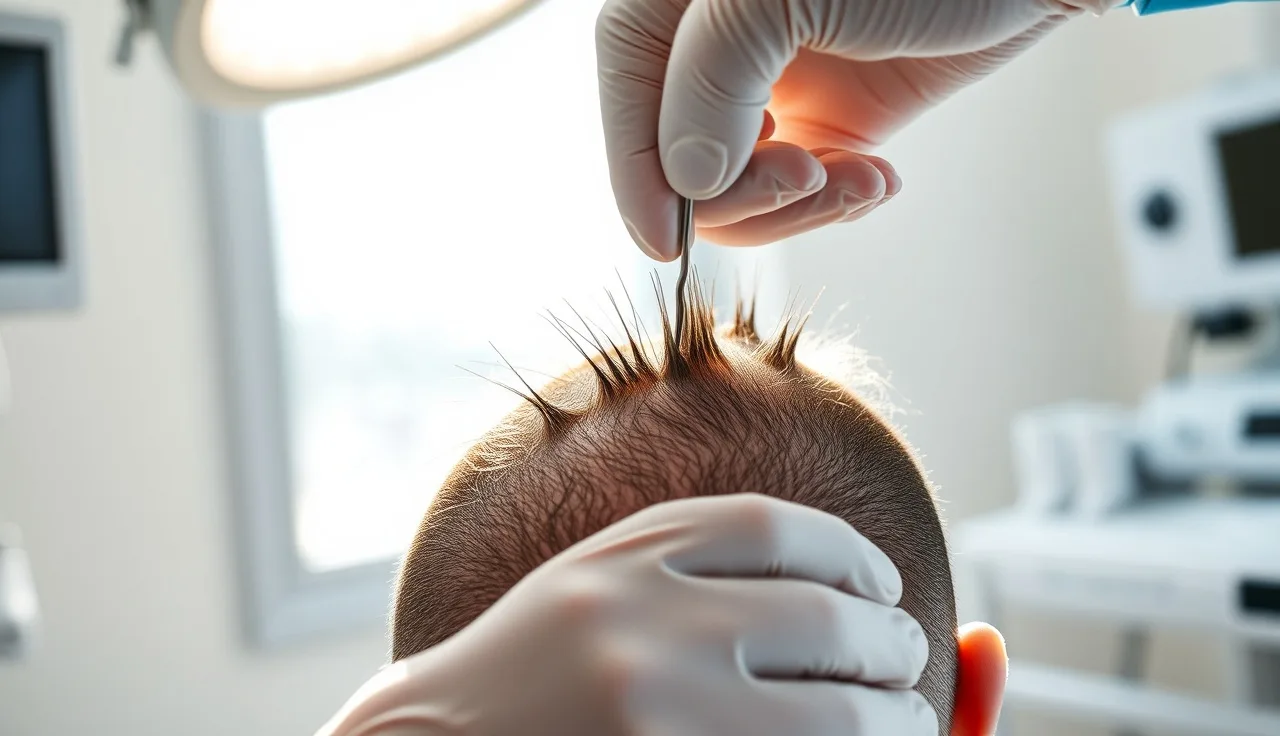
TL;DR: Hair transplantation moves follicles from a permanent donor zone (usually the back of the scalp) to thinning or bald areas. FUE and FUT are the two main techniques. Most patients need 1,500 to 3,500 grafts, pay $4,000 to $15,000 out of pocket, and see final results after 12 to 18 months. The transplanted hair is permanent, but ongoing loss needs medication alongside the surgery.
What is hair transplantation and how does it work?
Hair transplantation moves hair follicles from a donor area, usually the back and sides of the scalp where follicles resist DHT-driven miniaturization, into thinning or bald zones. Those donor follicles keep the genetic programming of the area they came from, so they keep growing in the new spot for the rest of your life. Dermatologist Norman Orentreich named this principle in 1959: donor dominance [10].
The surgery doesn't create new hair. It moves existing hair around. That one fact explains almost every limit of the procedure. Patients with very little donor hair, or with diffuse thinning across the whole scalp, are poor candidates because there's nowhere good to borrow from.
Modern transplants work at the follicular unit level. A follicular unit is a natural bundle of one to four hairs, sebaceous glands, and a bit of surrounding tissue. Moving these intact bundles instead of the large plugs surgeons used in the 1980s is what makes results look natural now [11]. The procedure is done under local anesthesia and takes four to ten hours depending on graft count. Most patients go home the same day.
For a wider look at why hair falls out in the first place, see our guide on what causes hair loss.
What are the different types of hair transplant surgery?
Two harvest techniques dominate today: Follicular Unit Excision (FUE) and Follicular Unit Transplantation (FUT, also called the strip method). A third category, robotic-assisted FUE, is really a variant of FUE run by an automated punch.
FUT (strip): A surgeon cuts a horizontal strip of scalp from the donor area, closes the wound with sutures (leaving a linear scar), and a team of technicians dissects that strip into individual follicular units under microscopes. FUT often yields more grafts per session because less follicle transection happens during dissection, and the linear scar, while permanent, hides easily under surrounding hair.
FUE hair transplantation: A small circular punch (0.7 to 1.0 mm) pulls individual follicular units straight out of the scalp, one at a time. No strip, no linear scar, faster healing. The trade-off: FUE takes longer per graft, has a slightly higher transection rate in less experienced hands, and the donor area gets shaved for most techniques. FUE has become the dominant method worldwide because patients want no linear scar and quicker social recovery.
Robotic FUE (ARTAS system): The FDA cleared the ARTAS system for hair restoration [1]. It uses image guidance to pick and punch follicles on its own. Results run broadly even with manual FUE. The catch is higher cost passed to patients and no ability to harvest from non-scalp areas.
A smaller group of patients pursue body hair transplantation, pulling follicles from the beard or chest. These follicles behave differently from scalp hair, growing in shorter cycles, so they mostly add density rather than serve as the main graft source.
| Technique | Scar type | Typical max grafts/session | Shaving required | Avg. recovery |
|---|---|---|---|---|
| FUT (strip) | Linear | 3,000 to 5,000+ | No | 10 to 14 days |
| FUE (manual) | Scattered dots | 2,000 to 3,500 | Usually yes | 5 to 7 days |
| Robotic FUE | Scattered dots | 1,500 to 2,500 | Yes | 5 to 7 days |
| Body hair FUE | Scattered dots | 500 to 1,500 | Partial | 5 to 7 days |
How much does a hair transplant cost?
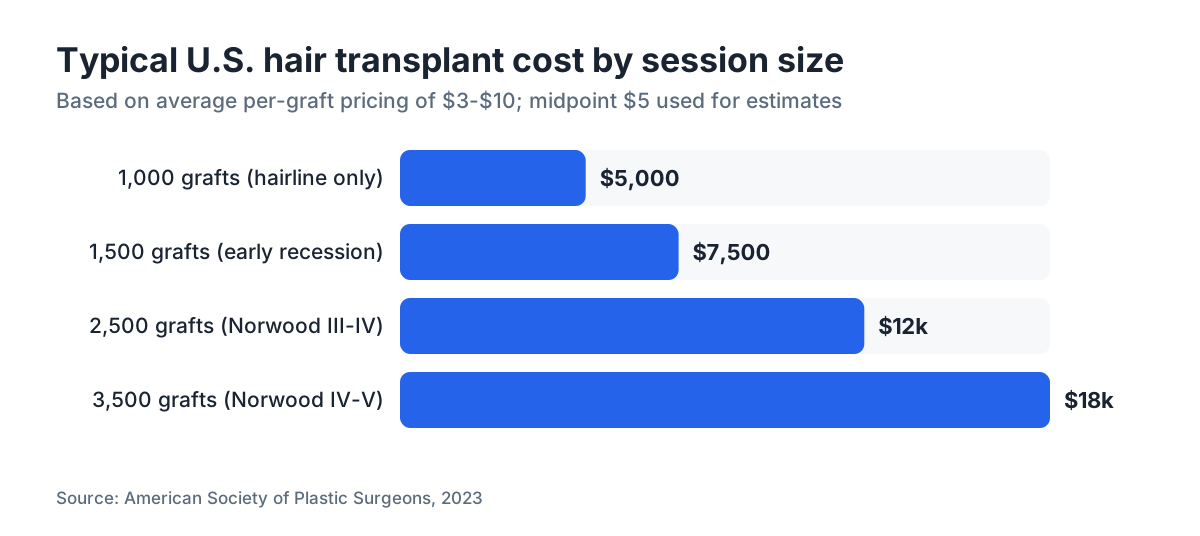
A hair transplant in the U.S. costs $4,000 to $15,000 out of pocket, and clinics almost always quote per graft, from $3 to $10 each [2]. A session of 2,000 grafts at $5 per graft comes to $10,000. Clinic prestige, surgeon experience, location, and graft count drive most of the variance.
FUE hair transplantation runs higher than FUT for the same graft count because it's more labor-intensive. Expect to pay roughly 15 to 25 percent more for FUE at the same clinic.
Insurance never covers hair transplants. The American Society of Plastic Surgeons classifies cosmetic hair restoration as elective, and no major U.S. insurer treats it as medically necessary for androgenetic alopecia [2]. Some clinics offer financing through third-party lenders. Read the interest rate first, because 18 to 28 percent APR is common.
Costs drop sharply outside the U.S. Turkey has become the highest-volume destination for hair tourism, with all-inclusive packages often advertised between $1,500 and $3,500. If you go this route, verify that the operating surgeon (more than a technician) does the whole extraction and implantation, and that the clinic is licensed by the local health authority. The savings can be real. So can the risks if something goes wrong and follow-up care is thousands of miles away.
Graft count is the biggest cost lever. A hairline restoration might need 1,000 to 1,500 grafts. Filling a Norwood 5 pattern could take 3,000 to 4,500 grafts, sometimes split across two sessions.
Who is a good candidate for a hair transplant?
The ideal candidate has stable patterned hair loss (androgenetic alopecia), enough donor density at the back and sides of the scalp, and realistic expectations about what a redistribution surgery can do.
"Adequate donor density" usually means at least 40 to 80 follicular units per square centimeter in the permanent donor zone, though the threshold shifts by surgeon and by how large the recipient area is [3]. Surgeons measure this with a densitometer or trichoscopy before quoting a graft count.
Age matters too. Most experienced surgeons are cautious about operating on patients under 25 because the final pattern of loss is still forming. A transplant that fills a hairline in a 22-year-old can look fine now and stranded, surrounded by bald scalp, in ten years. Patients who go on medical therapy first (finasteride, minoxidil, or both) and take time to stabilize tend to get better surgical results, because the surgeon can plan against a more predictable future.
Who tends to be a poor candidate: people with diffuse unpatterned alopecia, active autoimmune conditions like alopecia areata, unrealistic density expectations (transplanted hair will never match your original scalp's density), or too little donor hair for the area they want covered.
Women can be candidates, especially those with Ludwig-pattern loss or hairline recession. But female candidates need more careful evaluation, because female hair loss is more often diffuse, which shrinks the safe donor zone and makes it less reliable [3].
If you haven't mapped your current loss pattern, our free AI hair analysis at MyHairline gives you a starting point before you book a consultation.
What happens during the procedure, step by step?
The day starts with a pre-operative consultation where the surgeon marks the new hairline and agrees on the design. Hairline design is more art than science. It has to look natural for the patient's age, face shape, and likely future loss. A hairline set too low almost always looks wrong in 20 years.
Local anesthetic goes into both the donor and recipient areas. This is the most uncomfortable part of the day. After 15 to 20 minutes of numbness, the patient feels pressure but not pain.
For FUE: the surgeon (or robotic device) punches around each follicular unit, and the unit comes out with forceps. This goes on for hours. Grafts sit in chilled holding solution to stay viable. Research on graft storage suggests follicles tolerate out-of-body time up to about 6 to 8 hours in proper solution, though shorter is better [4].
For FUT: a strip is excised, sutured, then dissected by the tech team while the surgeon moves to recipient site creation.
Recipient sites (tiny incisions or slits) then go into the bald area at precise angles and densities to copy natural hair direction. This phase decides a lot. Poor angulation is one of the main reasons transplants look fake.
Finally, grafts go into those sites one by one. A graft team of two to four technicians usually handles this phase under the surgeon's supervision. The whole process takes four to eight hours.
You leave with the grafts in place, a bandaged donor area, and instructions for washing and sleeping position.
What is recovery like and when do results appear?
The first 10 days are the most awkward stretch. Small scabs form around each graft in the recipient area. You sleep at a 45-degree angle to cut swelling, keep direct water pressure off the scalp, and skip hard exercise. Most patients return to a desk job within 3 to 5 days, though the scalp looks pretty obvious during this window.
Around day 7 to 14, those scabs fall off. Between weeks 2 and 6, most transplanted hairs shed. This is shock loss, and it's expected. The follicle survives. It's just entering a resting phase after the trauma of moving. Patients who don't know this happens sometimes panic and assume the surgery failed.
New growth shows up around months 3 to 4. By month 6, about 60 percent of the final result is visible [5]. Full density and maturation take 12 to 18 months. The new hairs come in fine at first and thicken over time.
Shock loss in the native hair, meaning temporary shedding of non-transplanted hair near the surgical area, can also happen in the first few months. It's a documented effect of surgical trauma and anesthesia on the surrounding follicles. It usually reverses, but ask your surgeon about it beforehand.
For how stress and surgery-related shedding works, see our article on telogen effluvium.
Do hair transplants actually work? What does the evidence say?
The evidence base for hair transplantation is thinner than most patients realize. There are very few large randomized controlled trials, because surgery doesn't fit a placebo control and outcomes are harder to standardize than a pill trial. What exists is mostly prospective cohort data, retrospective case series, and clinician-reported outcomes.
The data we have is encouraging. A 2019 review in the Journal of the American Academy of Dermatology reported that patient satisfaction in published series consistently topped 80 percent [5]. Graft survival rates of 90 to 95 percent get cited often by experienced surgeons, though those numbers come mostly from clinic-reported data rather than independent audits.
The procedure's biggest limit isn't whether transplanted hair grows. It usually does. The limit is that androgenetic alopecia is a progressive disease. A 35-year-old who gets a transplant today may need another at 45 if he keeps losing hair in untreated zones. That's why most hair restoration specialists recommend medical therapy at the same time, usually finasteride or minoxidil for men, to slow further loss in native hair and protect the result.
Finasteride (1 mg/day) is FDA-approved for male pattern hair loss and has the strongest evidence of any medical co-treatment for transplant patients [6]. Taking it after a transplant doesn't touch the transplanted hair, which is already DHT-resistant by origin, but it protects the remaining native follicles. Patients who refuse any medication and only do surgery often end up chasing their loss with repeat procedures.
For how the two approaches stack together, our finasteride and minoxidil guide covers the combination therapy evidence.
What are the risks and side effects of hair transplant surgery?
Hair transplantation is low-risk in absolute terms, but it isn't zero risk.
Most issues are temporary: swelling of the forehead and around the eyes in the first few days (worse after FUT and large FUE sessions), folliculitis (small pimples around follicles as hairs start growing in), and itching as the scalp heals. These clear on their own or with simple treatment.
The more serious but less common risks: infection, which shows up in roughly 1 percent or fewer of cases in clinic data, poor wound healing in the donor area, and hypertrophic or keloid scarring in predisposed patients [7]. If you have a known tendency toward keloid scarring, tell the surgeon before surgery.
The risk of a cosmetically poor result, meaning hair that grows at the wrong angle, in a pattern that looks fake, or too thin, is real and mostly comes down to surgeon skill and experience. Picking a board-certified surgeon with a large published portfolio who will show you 18-month results (not 6-month ones) is the single best way to lower that risk.
Nerve damage in the donor or recipient area is rare but documented. Most patients get temporary numbness that resolves in months. Permanent altered sensation is uncommon with modern techniques.
Then there's overharvesting the donor area. Extract too many grafts in one session or across several, and the donor zone can look thin or scarred. A good surgeon plans a lifetime graft budget, not a single session's grab.
How do I choose the right surgeon and clinic?
This is where patients spend the least time and should spend the most.
Board certification matters but isn't enough on its own. In the U.S., hair transplantation is done by plastic surgeons, dermatologists, and facial plastic surgeons. The International Society of Hair Restoration Surgery (ISHRS) keeps a member directory and has published guidelines on ethical practice and surgical standards [8]. Membership doesn't guarantee quality, but it means the surgeon engages with the field.
Ask exactly this: who performs the extraction, who creates the recipient sites, and who places the grafts. In high-volume clinics, technicians handle large parts of the procedure while the physician is in another room. Some of those technicians are excellent. Some aren't. Insist on knowing what your surgeon personally does during your case.
Review before-and-after photos with a critical eye. Look for results at 12 to 18 months, not 6. Look for patients whose starting point resembles yours. Ask whether the photos are the surgeon's own patients. Some clinics quietly use stock photos or images from other practices.
Get at least two consultations. Graft count estimates from two qualified surgeons for the same patient should land in the same ballpark. One clinic promising 5,000 grafts when another says 2,500 is a red flag in either direction.
Avoid any clinic that pressures you to book immediately, offers dramatically below-market pricing with vague explanations, or can't show you the actual surgeon's credentials.
If you're not sure your current loss is worth treating surgically yet, mapping your receding hairline stage first gives you and the surgeon more useful data to work from.
Can you combine a hair transplant with medications like finasteride or minoxidil?
Yes, and most experienced surgeons recommend it. A transplant fixes existing bald or thin areas. It does nothing to stop continued loss in native hairs elsewhere on the scalp. Combining surgery with medication is how patients protect the money they spent.
Finasteride (1 mg daily) reduced further loss and maintained existing hair in roughly 80 to 90 percent of men over two years in randomized trials [6]. The FDA approved it for male androgenetic alopecia in 1997. Transplanted follicles don't need finasteride because they're already DHT-resistant by donor origin, but the surrounding native hairs do.
Minoxidil, applied topically twice daily or taken orally at low doses, grows hair through a different mechanism: vasodilation and potassium channel opening at the follicle. Topical minoxidil (2% and 5%) is FDA-approved for androgenetic alopecia in men and women [9]. Some surgeons suggest starting minoxidil a few weeks post-transplant to help the healing recipient area, though the evidence for post-transplant topical minoxidil specifically is limited.
Oral minoxidil at 0.625 to 2.5 mg daily is used off-label more and more, and shows real efficacy in emerging trial data, though the FDA hasn't approved it for hair loss at these doses. For more on that option, see our oral minoxidil guide.
Some patients take DHT blockers beyond finasteride, like dutasteride, which is used off-label for hair loss in the U.S. (it's approved for hair loss in some other countries). Talk through the full picture with your surgeon and, if needed, a dermatologist who specializes in hair loss.
What norwood stages benefit most from a hair transplant?
The Norwood scale runs from I (minimal recession) to VII (extensive baldness leaving only a horseshoe fringe). Where you sit on it shapes what surgery can realistically do.
Norwood II to III: early recession, and often excellent candidates. Donor supply is usually plentiful relative to the area needing coverage. Results here can look like no hair loss ever happened.
Norwood III to IV: the most common range for first-time transplant patients. A skilled surgeon can usually restore a natural hairline and add real mid-scalp density in a single session of 2,000 to 3,000 grafts.
Norwood V: coverage gets harder. The area to fill is large enough that one session may not hit the density patients expect. Two sessions, spaced about 12 months apart, are common.
Norwood VI to VII: very large bald zones and, the deciding factor, limited donor hair relative to the recipient area. Full coverage usually isn't achievable. Surgery can give partial improvement, especially a hairline frame, but donor supply is the binding constraint. Scalp micropigmentation (a non-surgical tattoo technique) is sometimes added to a transplant to fake extra density.
Progressive loss is the other variable. A 28-year-old Norwood IV may be a Norwood VI by 45. Good planning accounts for this by designing hairlines and allocating grafts against the future loss, more than the present state.
Are hair transplants worth it? Honest take on the money and expectations
If you're a good candidate (stable patterned loss, enough donor supply, realistic expectations, and willing to use medication alongside surgery), hair transplantation has a strong track record of lasting, natural-looking results. The transplanted hair is permanent. You cut it, style it, and wash it like any other hair. Nothing to apply or remember daily.
The financial math differs from ongoing medication. Finasteride costs roughly $20 to $50 a month out of pocket and you take it indefinitely. Over 20 years that's $4,800 to $12,000, and if you stop, you likely lose the benefit. An $8,000 transplant is a one-time cost for hair that stays.
The case against doing surgery alone, with no medication, is that you're spending $8,000 to $15,000 on a snapshot in time. If the hair around the transplant keeps falling out and you can't or won't do another procedure, the result looks stranger over the years. The happiest long-term patients are usually the ones who treated the disease (with medication) and fixed the visible deficit (with surgery).
You're also under no obligation to buy the most expensive option available. If you're early in your loss and on finasteride, you may not need surgery for a decade, if ever. A free AI analysis of your current pattern at MyHairline before you book any consultation costs nothing and gives you a baseline to track from.
If you're wondering whether supplements might help or delay the need for surgery, see our guide on hair loss supplements. The honest answer: most supplements have weak evidence, though a few have more data than the rest.
Sources
- U.S. Food and Drug Administration, 510(k) Premarket Notification Database, ARTAS Robotic Hair Restoration System
- American Society of Plastic Surgeons, Hair Transplantation Procedure Statistics and Cost Overview
- International Society of Hair Restoration Surgery (ISHRS), Practice Standards and Patient Guidelines
- Limmer BL, Dermatologic Surgery, 1994 - Micrograft survival and ex vivo storage
- Avram MR et al., Journal of the American Academy of Dermatology, 2019 - Hair transplantation review
- U.S. Food and Drug Administration, Propecia (finasteride 1 mg) Prescribing Information
- American Academy of Dermatology, Hair Loss: Diagnosis and Treatment
- International Society of Hair Restoration Surgery (ISHRS), Member Directory and Ethical Practice Guidelines
- U.S. Food and Drug Administration, Minoxidil Topical Solution Labeling (Rogaine and generics)
- Orentreich N, Annals of the New York Academy of Sciences, 1959 - Autografts in alopecias
- Bernstein RM, Rassman WR, Dermatologic Surgery, 1995 - Follicular transplantation