TL;DR: Hims minoxidil solution is a topical 5% minoxidil product for men with androgenetic alopecia. The active ingredient is FDA-approved and clinically proven to slow hair loss and regrow some hair in a meaningful share of users. Expect 3-6 months before visible results. It won't regrow a full head of hair, but it's one of the most evidence-backed options you can buy without a prescription.
What exactly is Hims minoxidil solution?
Hims is a telehealth company that sells, among other things, a topical 5% minoxidil solution marketed to men with androgenetic alopecia (the technical name for male pattern baldness). The product itself is not unique. 5% minoxidil solution has been sold over the counter in the United States since 1997, when the FDA approved it for men [1]. Hims sources it through licensed pharmacies and sells it under its own branding, mostly through a subscription.
What you're actually buying is a liquid you apply twice a day to a dry scalp. The formula is minoxidil dissolved in a base of alcohol and propylene glycol. That base matters. It's a common reason people get scalp irritation or dryness, and it's why some users switch to minoxidil foam instead.
Hims also sells a foam version, finasteride tablets, and combination products, but this article is about the liquid solution. For the broader picture on how minoxidil works, the minoxidil for men guide covers the pharmacology in more detail.
How does minoxidil actually cause hair to regrow?
Minoxidil started as an oral blood pressure drug in the 1970s. Doctors noticed patients taking it grew more body and scalp hair as a side effect. That observation led to the topical version we have now [2].
The honest answer is that scientists still don't fully understand why it works on hair. The leading explanation: minoxidil is a potassium channel opener that widens blood vessels in the scalp, raising blood flow and oxygen delivery to follicles. It also extends the anagen (growth) phase of the hair cycle and may partly reverse follicle miniaturization, the process by which DHT slowly shrinks follicles in people with androgenetic alopecia [3].
What it does not do is block DHT. Minoxidil has no meaningful hormonal effect. That's why it works differently from finasteride, and why combining the two beats either one alone. For the DHT angle specifically, dht blocker explains how anti-androgens work and who they suit.
Because minoxidil doesn't touch the hormonal driver of male pattern baldness, the results depend on maintenance. Stop using it and you'll likely lose whatever you gained within 3-6 months.
What does the clinical evidence actually say about 5% minoxidil?
The evidence for 5% topical minoxidil in men is among the strongest in hair loss medicine. FDA approval rests on a randomized, double-blind, placebo-controlled trial in which men using 5% solution showed significantly greater regrowth than the placebo group at 48 weeks [1]. A 1992 trial in the Journal of the American Academy of Dermatology found men on the 5% solution had 45% more hair regrowth than those on the 2% solution at 48 weeks [4].
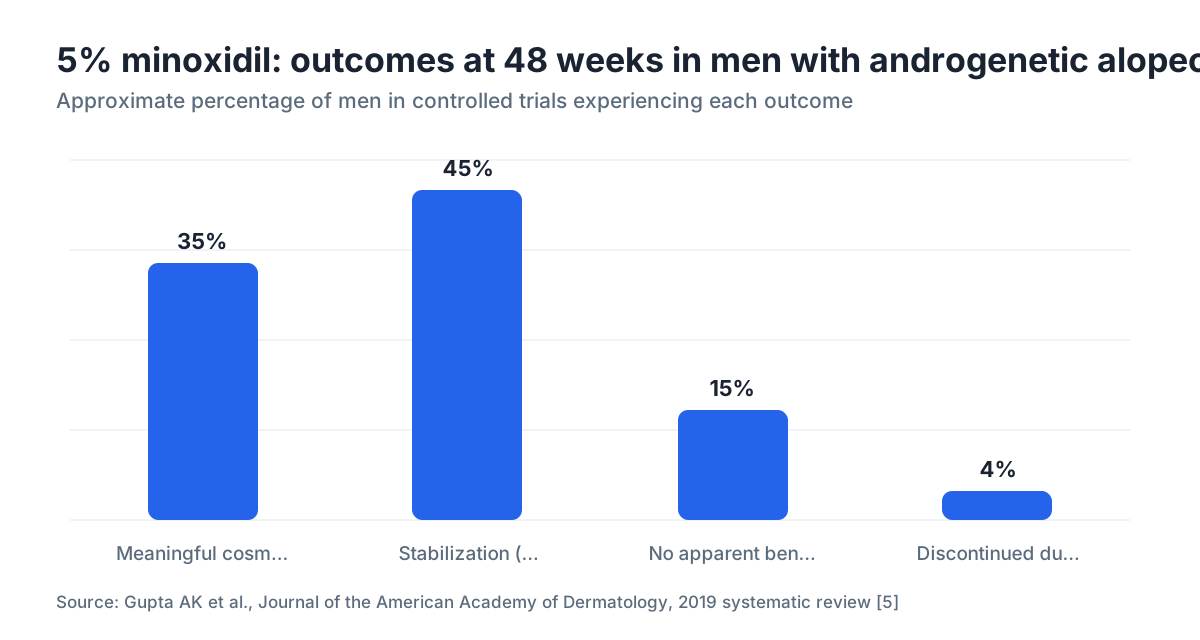
A 2019 systematic review in the same journal pooled multiple controlled trials and concluded that topical minoxidil "is effective in treating androgenetic alopecia and is well tolerated" across both sexes [5]. Response rates vary a lot. Roughly 30-40% of men see meaningful cosmetic regrowth, a larger share see stabilization (loss slowing), and a small percentage get nothing.
Those numbers matter. Minoxidil is not a guaranteed fix. It reliably stops or slows further loss for most men who use it consistently, and it produces real regrowth in a meaningful minority. Set your expectations before you start. That single move saves the most disappointment.
| Outcome | Approximate % of men at 48 weeks |
|---|---|
| Meaningful cosmetic regrowth | 30-40% |
| Stabilization (loss slowed or stopped) | 40-50% |
| No apparent benefit | 10-20% |
| Side effects requiring discontinuation | <5% |
These figures come from clinical trial populations, which mostly include men with moderate (Norwood II-IV) loss. Results at more advanced stages tend to be weaker.
How long does it take to see results from Hims minoxidil?
Three months is the absolute minimum before you draw any conclusions. Six months is the more honest window for learning if you respond at all.
Here's why the timeline runs this way. When you start minoxidil, it pushes some follicles out of a resting phase (telogen) and into the growth phase (anagen). Those hairs shed first, which is why many men see more shedding in months 1-2. This is telogen effluvium, and it's normal, not a sign the product is failing you. If that's new to you, telogen effluvium explains why it happens and when it settles.
New, finer hairs usually show up between weeks 8 and 16. They're easy to miss. Thicker, more visible regrowth, if it's coming, generally lands in the 4-6 month range. The FDA label for 5% minoxidil recommends at least a 4-month trial before you judge it [1].
See no change at all by month six? You're probably not a strong responder. Some men keep improving slowly for up to a year, so it's reasonable to continue if you're seeing any positive signal.
How do you apply the Hims minoxidil solution correctly?
Application technique matters more than people think. Plenty of users soak their hair instead of their scalp, which wastes product and cuts effectiveness.
The standard dose is 1 mL on the affected scalp area twice a day, about 12 hours apart. Hims includes a dropper applicator. Part your hair over the affected area, hold the tip close to the scalp, drop the liquid onto the skin, then spread it gently with your fingertips. Wash your hands right after.
Let it dry all the way before bed or before putting on a hat. The solution takes about 2-4 hours to fully absorb. Applying to wet or damp hair dilutes it and lets it run onto the forehead or neck, which sometimes grows unwanted hair there.
Don't up the dose thinking more is better. 1 mL twice daily is what the clinical trials tested. More doesn't help and it raises the risk of systemic absorption and side effects [1].
Consistency is the whole game. Missing an occasional dose probably doesn't matter. Missing weeks at a time, or stopping and restarting over and over, wrecks your results.
What are the side effects of Hims minoxidil solution?
The most common side effects from the liquid are local: scalp dryness, flaking, irritation, and itching. These come from the propylene glycol base, not the minoxidil itself, which is why some men tolerate the foam better [1][5].
Unwanted facial or body hair is a real possibility. If the solution runs onto your forehead, cheeks, or neck, those areas can grow hair. Careful application, keeping it off non-scalp skin, cuts that risk a lot.
Systemic side effects are less common but worth knowing. Because minoxidil is a vasodilator, some people get fluid retention, a faster resting heart rate, or lightheadedness. These are far more likely with oral minoxidil than with topical use, but they can happen topically, especially if you apply more than the recommended dose. Anyone with cardiovascular disease should check with a doctor before starting [1].
Contact dermatitis (an allergic reaction with redness, swelling, or blistering) is rare but does occur. If you get that kind of reaction, stop.
For a full breakdown of every documented side effect, how often it happens, and how to manage it, the minoxidil side effects article walks through each one with the clinical context.
How much does Hims minoxidil cost, and is it good value?
Hims sells its 5% minoxidil solution as a subscription. Pricing has shifted over time, but as of mid-2025 the liquid runs roughly $20-25 per month, with discounts for longer commitments. They often bundle it with other products at a lower per-item price.
For comparison, generic 5% minoxidil solution at major pharmacy chains (CVS, Walgreens, Costco) usually costs $10-20 for a three-month supply, which works out to about $4-7 per month [6]. The active ingredient and concentration are identical because they all follow the same FDA rules.
What Hims charges a premium for is convenience: doorstep delivery, a telehealth interface if you want a provider to review your case, and the option to add prescription products (finasteride, dutasteride) through one platform without a separate doctor visit. Whether that's worth $15 extra a month is a personal call. If you already see a dermatologist, buying generic minoxidil at a pharmacy is almost certainly the smarter money move. If you don't have easy access to a prescriber and want prescription products alongside your minoxidil, the bundled telehealth model has real value.
Thinking about Hims mainly to add finasteride? finasteride and minoxidil covers what the evidence says about combining them and whether it's worth it for your stage of loss.
Is Hims minoxidil solution different from what you'd buy at a pharmacy?
The short answer is no, not in any way that matters clinically.
Minoxidil 5% solution from Hims has the same active ingredient at the same concentration as the generic versions at CVS, Walgreens, or Amazon. The FDA requires all OTC minoxidil products to meet the same efficacy and safety standards under the monograph for topical minoxidil [1]. The inactive ingredients (the carrier base) can vary a bit between brands, which affects tolerability but not efficacy.
Hims does sell some compounded products through affiliated pharmacies, including minoxidil mixed with other ingredients like tretinoin or azelaic acid. Those aren't the same as standard OTC minoxidil, and they're prescription-only. There's early evidence that tretinoin may boost minoxidil absorption, but that research is preliminary and those compounded formulas aren't FDA-approved as combinations [7].
If a Hims product is labeled as a compounded preparation rather than a standard OTC product, it's going through a different regulatory pathway. That's not automatically bad. It's just worth knowing the difference.
Who is Hims minoxidil solution best suited for?
Topical minoxidil works best for men in the earlier stages of androgenetic alopecia: Norwood I through IV, with active follicles that have shrunk but not died. Once a follicle is gone (a smooth, shiny patch of scalp with no follicular openings), minoxidil can't bring it back. The window is real.
Men who catch their loss early and start before heavy thinning get the best outcomes. Men at Norwood V and above generally see modest results and are often better served by talking to a hair transplant surgeon alongside medical therapy. hair transplant explains when surgery makes more sense than medication alone.
Hims fits well if you want an easy subscription, if you want the option to step up to prescription products through the same platform, or if you don't have a dermatologist. It's a poor fit if money is tight and you're fine picking up generic minoxidil at a pharmacy yourself.
Not sure what stage you're at? Getting a clear read on your hairline is step one. A free AI hair scan at MyHairline can assess your hairline from a photo and help you figure out what you're working with before you spend a dollar on treatment. Knowing your baseline matters, because it's the only way to tell later whether a treatment is actually working.
A note for women reading this: Hims is male-focused. Women can use 2% or 5% minoxidil (the 5% evidence for women is still developing), but the products and dosing differ. This article is about the men's product specifically.
Should you combine Hims minoxidil with finasteride?
If you have androgenetic alopecia and you're not on finasteride, you're probably leaving results on the table. Strong statement, but the evidence backs it.
Minoxidil and finasteride work through different routes. Minoxidil improves blood flow and stretches the growth phase. Finasteride blocks the conversion of testosterone to DHT, hitting the hormonal root of follicle miniaturization. A 2002 randomized trial in Dermatology found men using both drugs had greater hair count improvements than those using either alone [8].
Hims offers finasteride through its platform, which is one of its genuine conveniences since finasteride needs a prescription. finasteride covers the evidence, the risks (including sexual side effects that hit roughly 2-4% of users), and who should and shouldn't take it.
Finasteride isn't right for everyone. Men worried about sexual side effects, men planning to have children soon, or men with prostate conditions may want to talk through alternatives with a physician. Starting minoxidil alone and seeing how you respond first is a completely reasonable plan.
What happens if you stop using Hims minoxidil?
You lose the gains. That's the part nobody loves.
Because minoxidil doesn't address the DHT-driven miniaturization underneath, you're renting the result, not buying it. Stop, and follicles resume their programmed shrinking. Most men who quit minoxidil return to their pre-treatment density within 3-6 months, and some studies note a brief burst of shedding right after stopping [3].
This is a lifetime commitment if you want to keep the result. That's a real factor in the cost math. At even $15-25 per month, you're looking at $180-300 a year, every year, for as long as you want the benefit.
If that sounds unsustainable, think about whether oral minoxidil fits your life better. oral minoxidil has a different dosing routine and cost structure that some people find easier to stick with, though its side effect profile differs.
Are there alternatives to Hims minoxidil that might work better?
Minoxidil is a good start, but it isn't the ceiling.
For men with androgenetic alopecia, the strongest evidence-backed approach is topical minoxidil plus oral finasteride. That combination hits both the mechanical side (follicle stimulation) and the hormonal side (DHT blockade). If you're serious about holding onto your hair, most dermatologists point you toward combination therapy first [8].
For men who can't or won't take finasteride, low-level laser therapy (LLLT) has some clinical evidence, though the effect sizes are generally smaller than minoxidil alone. Supplements like saw palmetto get a lot of attention but rest on weaker, less consistent evidence. hair loss supplements covers what the research actually shows for the popular options.
For advanced loss, or areas where minoxidil has clearly failed, hair transplant surgery (FUE or FUT) is the only option that moves hair to new areas rather than maintaining what's there. Minoxidil after a transplant can help protect the non-transplanted hair around the graft sites.
Worried about other causes of hair loss beyond pattern baldness, like dietary deficiencies, stress, or medication side effects? what causes hair loss is a good starting point before you assume minoxidil is the answer.
A receding hairline specifically often responds well to the minoxidil-finasteride combination applied early, before the hairline has retreated far.
Sources
- FDA, Minoxidil OTC drug information
- National Library of Medicine / NCBI, Minoxidil history and mechanism review
- American Academy of Dermatology, hair loss information
- Olsen EA et al., Journal of the American Academy of Dermatology, 1992
- Gupta AK et al., Journal of the American Academy of Dermatology, 2019 systematic review
- MedlinePlus / National Library of Medicine, Minoxidil topical drug information
- Suchonwanit P et al., Drug Design, Development and Therapy, 2019
- Khandpur S et al., Dermatology, 2002 randomized trial
- American Academy of Dermatology, hair loss information
- MedlinePlus / National Library of Medicine, Minoxidil topical